

The Slang Dictionary (1865): The Victorian Book That Mapped the Language of London's Streets

In 1859, a 27-year-old London bookseller with no formal academic credentials published what would become one of the most influential linguistic documents of the 19th century. He didn't put his name on it. The first edition of A Dictionary of Modern Slang, Cant, and Vulgar Words appeared credited only to "A London Antiquary." The author was John Camden Hotten, and the book that would later become The Slang Dictionary was about to go through five editions in 15 years.
The 1865 edition, the third, is the one most people mean when they reference the book. It's the version bearing that gloriously blunt subtitle: "The Vulgar Words, Street Phrases, and Fast Expressions of High and Low Society." By that point Hotten had given up the anonymity. His name was on the cover. He'd also substantially expanded the contents, to nearly 10,000 words and phrases, which he described as "commonly deemed vulgar, but which are used by the highest and lowest, the best, the wisest, as well as the worst and most ignorant of society."
It was a runaway success. And it was also, by the standards of respectable Victorian scholarship, completely disreputable.
Who Was John Camden Hotten?
Hotten was born in Clerkenwell, London, in 1832, to Cornish parents. His father was a carpenter and undertaker. At 14 he was apprenticed to a London bookseller, John Petheram, which is where his obsession with rare and obscure texts took root. By 1848 he was in the United States, where he spent five or six years absorbing American popular culture and the lively, irreverent tone of American street language.
He came back to London around 1853 and set up his own publishing house at 151 Piccadilly. From there he built a genuinely unusual list: slang dictionaries, histories of signboards, the first British editions of Mark Twain and Artemus Ward, and, in his spare time, a steady stream of erotica published under various pseudonyms. One of his more colourful sidelines was a bawdy comic opera titled Lady Bumtickler's Revels. He wasn't especially discreet about it.
When he died in 1873, aged just 40, his publishing business was bought by his former clerk, Andrew Chatto, who turned it into Chatto & Windus. The firm is still active. Hotten's name is mostly forgotten, but his dictionary isn't.
A Book That Covered Everyone
What made the Slang Dictionary unusual wasn't just that it documented criminal cant, though it did that thoroughly. It was the breadth of the social terrain it covered. The full subtitle of the 1859 first edition made this explicit: the book covered slang "used at the present day in the streets of London, the universities of Oxford and Cambridge, the Houses of Parliament, the dens of St Giles, and the palaces of St James."

In other words: everyone. Hotten's thesis was that slang wasn't the exclusive property of criminals and the poor. It was everywhere, used by every class, simply adapted to fit context. Alongside entries for thieves' cant and beggars' jargon, the dictionary includes public schoolboy slang, pirate slang, stagehand slang, equine stable slang, the slang of softened oaths, and phrases attributed to Dr Johnson. He even documented parliamentary slang. The book treats the Duke's choice of words and the pickpocket's choice of words as equally worthy of study.
Hotten also thought carefully about the origins of slang, tracing it back through centuries of linguistic borrowing. He identified words of Romany origin, terms absorbed from Italian, French, and Dutch, and vocabulary inherited directly from much older criminal argots. He disagreed with contemporaries who thought the tradition of recording such language began with Richard Head's Life of an English Rogue around 1680. Hotten traced it back to Thomas Harman's Caveat for Common Cursitors in 1567, which he reproduced at length in the dictionary itself.
Back Slang and the Costermongers
One of the most fascinating sections of the dictionary is its glossary of back slang, the secret language used by London's costermongers, the street traders who sold fruit, vegetables, and other goods from barrows and market stalls. Back slang was exactly what it sounds like: words spoken in rough reverse, designed to be unintelligible to outsiders, particularly police and customers.
Hotten's 1859 first edition is considered the first printed back slang dictionary, following Henry Mayhew's earlier documentation of it in London Labour and the London Poor in 1851. The system had its own internal logic. A shilling was a "gen" (shilling reversed, more or less). A pound was "dunop." Numbers ran: eno, oat, earth, roaf, evif, exis, nevis, theg, enin, net. Fifteen was "earth-evif." Eighteen was "net-theg." The word "yob," meaning a boy, survives in modern English carrying a very different connotation from the neutral Victorian original. And "tenip," meaning a pint, is still occasionally encountered.

The system had its impurities. Hotten himself noted anomalies where words weren't straightforward reversals, and modern scholars have since pointed out that his accuracy wasn't always reliable. But the attempt to document it at all was significant.
Rhyming Slang Gets Its First Serious Treatment
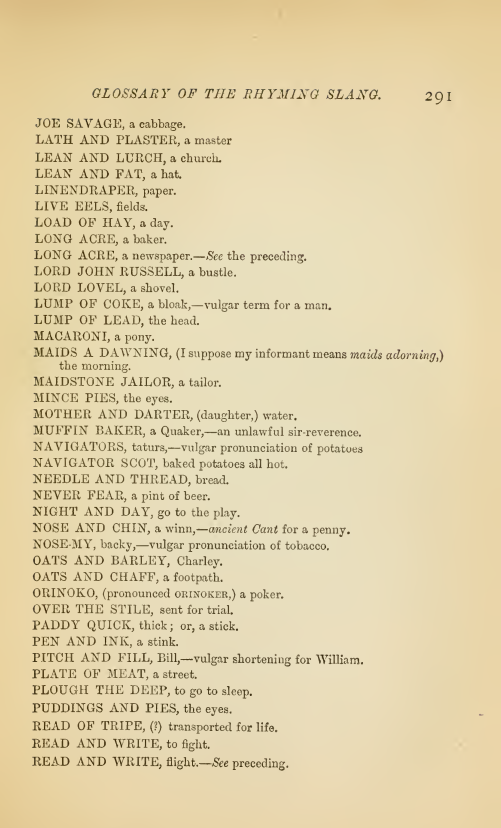
The Slang Dictionary is also one of the earliest serious academic treatments of rhyming slang, the Cockney dialect in which a word is replaced by a rhyming phrase, usually with the rhyming word then dropped. "Table" becomes "Cain and Abel." "Mince pies" are eyes. "Dog and bone" is a phone, though in 1865 that particular entry was still a few decades from being relevant.
Hotten included not just definitions but histories, tracing how these formulations developed and spread. He was genuinely curious about the mechanics of how language moves between social groups, how an expression coined in a Whitechapel market stall could end up in a West End drawing room, and what that journey said about Victorian society.
It's also worth noting the cover illustration of the 1865 edition, showing a character labelled "The Wedge" and another called "The Wooden Spoon." These aren't decorative doodles. Both are slang terms defined inside the book, and putting them on the front cover was a small act of wit that most readers probably missed entirely. The Slang Dictionary had that quality throughout: a dry self-awareness that stopped it from being merely a catalogue.
The Controversy, and the Lasting Legacy
Hotten's scholarly reputation during his lifetime was complicated by his other publishing activities. The erotica didn't help. His use of a loophole in international copyright law to publish cheap British editions of American authors without paying royalties earned him lasting enmity from Mark Twain, who referred to him in correspondence in terms that aren't printable here. The irony of Twain's most colourful insults appearing in letters about the man who compiled The Slang Dictionary presumably wasn't lost on everyone.

Oxford Academic has since noted that the dictionary's etymologies are frequently unreliable. Hotten was working without the tools of modern linguistics, and his enthusiasm sometimes outran his evidence. But as a snapshot of the living language of Victorian London, the book is irreplaceable. Scholars still use it.
The dictionary directly influenced Eric Partridge, whose Dictionary of Slang and Unconventional English became the standard 20th-century reference work in the field. Partridge acknowledged his debt. The book was also continued and republished after Hotten's death, with later editions incorporating his unpublished notes and corrections, running well into the 20th century.
It's free to read online now, thanks to Project Gutenberg. Which Hotten would probably have appreciated, though he'd almost certainly have found a way to charge for it.
If you're interested in how the Victorians communicated in other covert ways, the site's piece on the language of flowers covers a rather more fragrant form of coded messaging from the same era.
Read the dictionary in full here -
You can put a face to the people that may be using this language by taking a look at these fantastic photos of Victorian London
SOURCES
1. Project Gutenberg, The Slang Dictionary: https://www.gutenberg.org/ebooks/42108
2. American Numismatic Society, Hotten's Numismatic Slang: https://numismatics.org/pocketchange/numismatic-slang/
3. Wikipedia, A Dictionary of Modern Slang, Cant, and Vulgar Words: https://en.wikipedia.org/wiki/A_Dictionary_of_Modern_Slang,_Cant,_and_Vulgar_Words
4. The Public Domain Review, A Dictionary of Modern Slang, Cant, and Vulgar Words (1860): https://publicdomainreview.org/collection/dictionary-of-modern-slang/
5. Oxford Academic, Julie Coleman, A History of Cant and Slang Dictionaries Vol. III: https://academic.oup.com/book/4666/chapter/146833231
6. Victorian Web, Earth Yenneps: Victorian Back Slang: https://victorianweb.org/history/slang2.html
7. Lehigh University, A Dictionary of Modern Slang exhibit entry: https://exhibits.lib.lehigh.edu/exhibits/show/dictionaries/slang-dialect/hotten


