

The Man Who Couldn't Stop: Charles Ponzi's Skin, His Wife, His Charisma, and His Broken Final Act
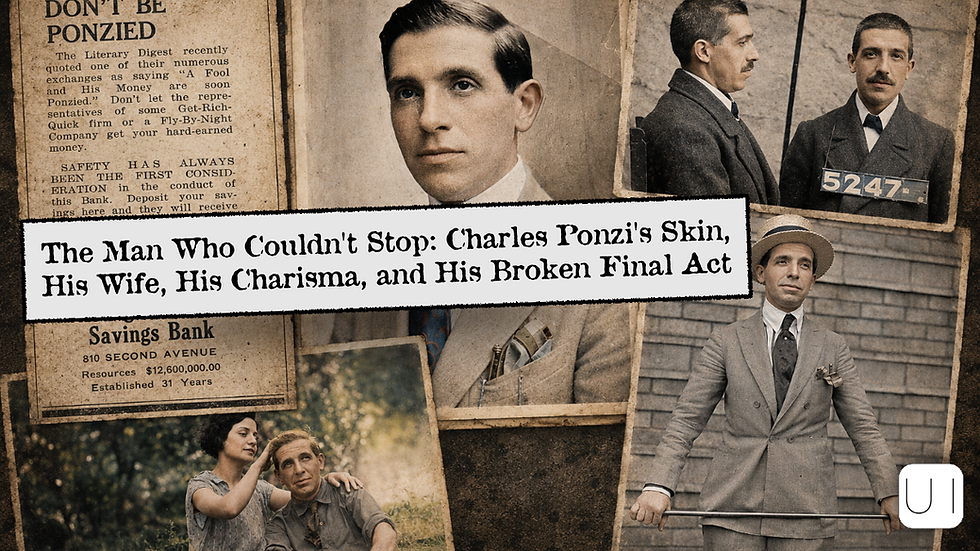
Most people know the name. Fewer know the man. Charles Ponzi spent eight months in 1920 pulling off the most audacious financial fraud America had ever seen, collecting the equivalent of hundreds of millions of dollars in today's money from tens of thousands of ordinary Bostonians who trusted him completely. His scheme collapsed, his name became a noun, and history filed him away as a cautionary tale. But the story that gets forgotten is everything else: the stranger, sadder, more contradictory life that sat either side of those eight manic months. The man who gave away his own skin to save a stranger. The woman who stayed loyal through every prison stretch and only left when she had no choice. The celebrity con man who charmed entire cities into loving him. And the long, grinding final act that ended in a charity ward in Rio de Janeiro with $75 to his name.
The Name He Arrived With
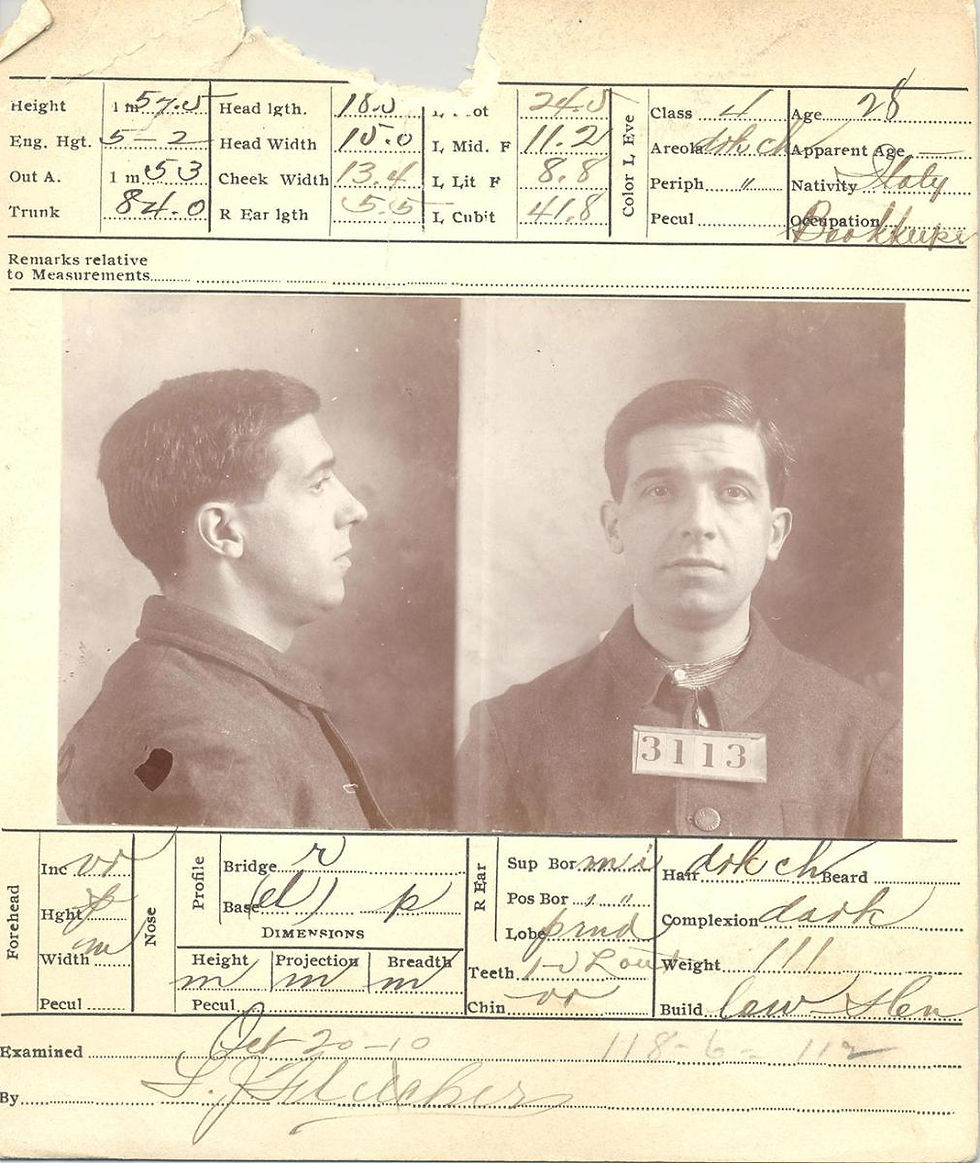
Carlo Pietro Giovanni Guglielmo Tebaldo Ponzi was born in March 1882 in Lugo, a small town in northern Italy. He came from a family that had once had money and social standing, and his mother never let him forget it. She raised him on stories of past glory, and Ponzi absorbed them completely. By the time he was a young man he'd developed the tastes of a millionaire without the income to match. He burned through what his family had, enrolled at the University of Rome, spent more time at lavish parties than lectures, racked up debt, and quietly left without a degree.
He arrived in Boston in 1903 with $2.50 in his pocket, having gambled away the rest of his money on the crossing. He spoke almost no English. He had no contacts, no prospects, and no plan. He washed dishes, waited tables, picked fruit, and moved around constantly. None of it satisfied him. He wasn't cut out for honest labour and he knew it. What he had instead was charm: a gift for conversation, an ability to read what people wanted to hear, and an unshakeable belief that something better was always just around the corner.
The Skin He Gave Away
Before the scheme, before the scandal, before any of the things that made him famous, Charles Ponzi did something that almost nobody ever talks about.
Around 1912 he was working as a nurse at a mining camp in the American South. The camp had no running water and no electricity. Another nurse named Pearl Gosid was badly burned when a gasoline stove she was using to prepare a patient's meal exploded. The injury was severe. Gangrene was setting in. A doctor at the camp told Ponzi that the only thing that might save her was a skin graft, but he couldn't find a single person among the 2,000 residents of that camp willing to donate even one square inch of their own skin to save a woman most of them barely knew.
Ponzi said he'd do it.
That evening, the doctor took 72 square inches of skin from Ponzi's thighs. Pearl needed more. Ponzi went back under the knife and gave another 50 square inches from his back. He spent months in recovery. He developed pleurisy and similar complications. He lost his job at the camp. Pearl Gosid survived.
Nobody rewarded him for it. Nobody much noticed. Ponzi never used it as a selling point or a public relations move later in life. It's just something he did, quietly, for a stranger, at considerable personal cost. The same man who would later steal millions from working people who trusted him was capable of that. His biographers have wrestled with the contradiction ever since.
The Woman Who Knew
Back in Boston in 1917, Ponzi took a job as a clerk and stenographer. He was in his mid-thirties, broke, and perpetually chasing the next scheme. Then he met Rose Maria Gnecco on a streetcar.
Rose was 21, the daughter of Italian-American immigrants who ran a small fruit stall in downtown Boston. She was sharp, steady, and apparently not easily put off. Ponzi proposed quickly. He didn't mention the three years in a Canadian prison for cheque forgery. He didn't mention the two years in Atlanta for smuggling Italian immigrants across the US border. He was, by all accounts, extraordinarily charming in person.

His mother, however, was not charming. She wrote the Gnecco family a letter from Italy before the wedding, spelling out her son's criminal history in detail. Rose read it. She married him anyway.
Rose wanted a quiet life. A small apartment. Modest savings. Ponzi, she later said, had the tastes of a millionaire even when they had nothing. He carried himself like a man already successful. When his scheme was at its height in 1920, he bought a 20-room mansion in Lexington, Massachusetts, a fleet of luxury cars, and a controlling stake in his own bank. Rose stood beside him through all of it.
When it collapsed, she stayed. When the federal charges came, she stayed. When the state charges followed and he was convicted again, she stayed. When he jumped bail, fled to Florida under a false name, sold swampland to unsuspecting buyers under a fake company, got caught, jumped bail again, tried to flee the country on a freighter disguised as a sailor with a shaved head and a fake moustache, and got hauled off the ship in New Orleans, she stayed.
She divorced him in December 1936, more than a decade into his various prison stretches, only because he was being deported and she wanted to remain in America. When a reporter asked why she'd waited so long, she gave one of the more remarkable quotes in the whole Ponzi story: 'When he was down, when he was in trouble, when he was in prison, I stuck to him. When he had millions, when he had a mansion, when he had cars, I stuck with him. And now I feel that I have proved my loyalty through thick and thin, and I intend to secure a quiet divorce.'
Even after the divorce, they wrote to each other regularly. Rose remarried, moved to Florida, and spent the rest of her life trying to avoid being associated with his name. She'd lost money in his scheme, same as everyone else. She'd also lost 20 years.
The Wizard of School Street
The scheme itself is worth understanding properly, because what made it extraordinary wasn't the mechanics. It was the performance.
In January 1920, Ponzi set up a company called the Securities Exchange Company and began telling people he'd found a way to make enormous profits by buying international postal reply coupons cheaply in Europe and redeeming them at face value in America, where they were worth considerably more. The concept was plausible enough as a starting point. Arbitrage of that kind exists. The problem was that the whole thing was mathematically impossible at the scale he claimed. There were only around 27,000 such coupons in circulation worldwide at the time Ponzi was telling investors he needed 160 million of them to cover his commitments. He'd spotted an idea that was technically real and then completely fabricated everything else.
What he actually did was pay early investors with money from later ones. In January 1920, 18 people invested a total of $1,800. By July of that year, new investors were handing over close to a million dollars a day. Two-thirds of the Boston police force put money in. Grocery clerks, labourers, factory workers, and retirees queued around the block on School Street. He promised 50 percent returns in 45 days, or double your money in 90.

He was five foot two, always immaculately dressed, with a straw boater hat, a walking cane, and a boutonniere in his lapel. He had a way of making every single person he spoke to feel like the only person in the room. When the Boston Post ran a straightforward front-page profile of him in July 1920, not even a puff piece, just a news story, the crowds outside his office swelled. People read it and decided they wanted in.
When nervous investors showed up demanding their money back, Ponzi handed out coffee and donuts and cashed them out immediately, which only made the remaining investors more confident. He paid back $2 million in three days to panicked investors and barely flinched. On July 26, 1920, he arrived at his office to find a line of people four abreast stretching from City Hall all the way down the street. He later wrote: 'To them I was the realization of their dreams. The wizard who could turn a pauper into a millionaire overnight.'
When he walked out of the Massachusetts State House after a routine audit, a crowd surged forward. Someone called out that he was 'the greatest Italian of them all.' Ponzi paused, then said: 'No. Columbus and Marconi were greater. Columbus discovered America. Marconi discovered the wireless.' A voice from the crowd shouted back: 'But you discovered money!'
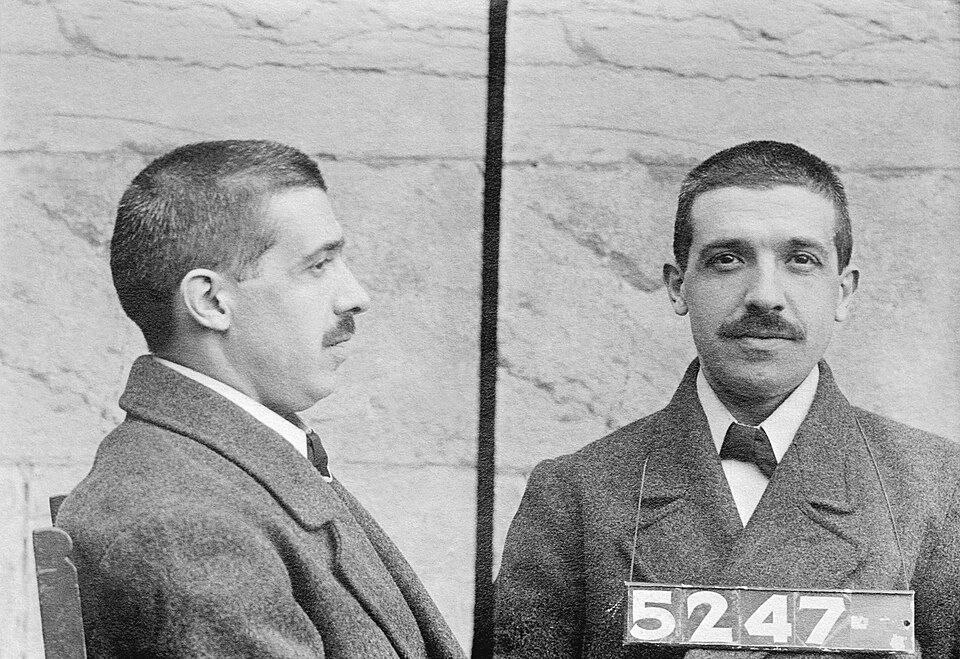
He was arrested on August 12, 1920. The scheme had taken in around $15 million from approximately 40,000 investors. The actual postal coupons involved in his operation were worth a few hundred dollars.
The Part Nobody Tells You
He pleaded guilty to federal mail fraud, served three and a half years, and came out to face state charges in Massachusetts. He fought them, lost, appealed, and used the window of bail to flee to Florida, where he set up a real estate company called the Charpon Land Syndicate under a false name. He bought 100 acres of swampland east of Jacksonville for $16 an acre and began selling lots to buyers, advertising it as prime Florida land. He was arrested again. Convicted again.
He jumped bail again. He shaved his head, grew a moustache, and signed on as a seaman on an Italian freighter bound for Europe. When the ship docked in New Orleans for a final American port call, authorities recognised him. He was brought back to Massachusetts to serve out his sentence.
He reportedly tried appealing to President Calvin Coolidge for early deportation. When that failed, he apparently tried Mussolini. Neither worked. He served his time, came out in 1934 bald and 40 pounds heavier, and was met at the prison gates by immigration officials with a deportation warrant. He'd never taken American citizenship. He left on October 7, 1934.

In Italy, his second cousin Colonel Attilio Biseo of the Italian Air Force, a friend of Mussolini's, landed him a position managing the Brazilian office of a new Italian airline doing business between Rome and Rio de Janeiro. From 1939 to late 1941, Ponzi actually lived reasonably well again.
Then he discovered that senior airline officials were smuggling currency on the side and hadn't included him in the arrangement. His response was characteristically Ponzi. He tipped off the Brazilian government, demanding 25 percent of whatever fines were levied. They paid him nothing. When he then offered to share what he knew with the United States government, they declined to hear from him. When the war turned against Italy and the Brazilian government cut the airline off, the operation folded entirely.
He tried running a small lodging house in Rio. It failed. He gave English and French lessons. He drew Brazilian unemployment benefit. He claimed late in life that he'd nearly pulled off a $2 million con involving the Soviet Union and gold smuggling, but by that point nobody took his word for much. In one of his last interviews he reflected on the investors who'd lost their money back in Boston and said: 'Even if they never got anything for it, it was cheap at that price. Without me, they would never have had the thrill of knowing what it felt like to be millionaires, even for a little while.'
He suffered a stroke in early 1948 and was left partially paralysed and nearly blind. He died in the charity ward of a Rio de Janeiro hospital on January 18, 1949, aged 66. His estate totalled $75, which was used to cover the burial.
The Question That Lingers
What do you do with a man like that? He stole from thousands of working people. He ruined lives. He was arrested repeatedly, convicted repeatedly, and kept going. But he also gave his own skin, without fuss or reward, to save a stranger's life. He inspired what was arguably genuine affection in investors who should have hated him. His wife, who knew exactly who he was before she married him, stood by him for nearly 20 years through circumstances that would have broken most people's loyalty in the first month.
Ponzi understood something about people that most honest men don't. He knew that people don't just want money. They want to believe something wonderful is possible. He sold that feeling. For a few months in 1920 he made Boston feel like the rules could be bent, that ordinary people could win, that the bankers who kept all the real profits for themselves could be outmanoeuvred by a dapper little immigrant with a straw hat and a boutonniere.
He was wrong about almost everything except that part.
His name has now outlasted everything. The scheme he popularised was already centuries old when he ran it. He didn't invent it. Charles Dickens described a version of it in a novel 60 years before Ponzi's scheme. But Ponzi did it bigger and louder and with more charm than anyone before him, and the name stuck. Every few weeks somewhere in the world another one collapses, and journalists reach for the same word.
He'd have loved that.
Sources
1. Smithsonian Magazine – The Leopold and Loeb “Crime of the Century”: https://www.smithsonianmag.com/history/the-crime-of-the-century-a-century-later-180984586/
2. The Orkneyinga Saga (medieval Icelandic source on Sigurd the Mighty)
3. Minnesota Historical Society – Andrew Myrick and the Dakota War of 1862: https://www3.mnhs.org/usdakotawar/stories/history/andrew-myrick
4. Los Angeles Times – Michael Anderson Godwin electrocution, 1989: https://www.latimes.com/archives/la-xpm-1989-03-08-mn-277-story.html
5. Canada Eh X – George Beurling: https://canadaehx.com/2022/07/18/george-beurling/
6. NPR / Smithsonian Magazine – Thomas Midgley Jr.: https://www.npr.org/2013/04/18/177046258/the-man-who-tried-to-clean-up-the-world
7. Britannica – Maximilien Robespierre: https://www.britannica.com/biography/Maximilien-Robespierre
8. Britannica – Marcus Crassus: https://www.britannica.com/biography/Marcus-Licinius-Crassus
9. UtterlyInteresting – The Depraved Life of Pope John XII: https://www.utterlyinteresting.com/post/the-depraved-life-of-pope-john-xii-history-s-most-scandalous-pontiff
10. UtterlyInteresting – Ken McElroy, The Town Bully: https://www.utterlyinteresting.com/post/ken-mcelroy-the-town-bully-murdered-in-front-of-a-crowd-of-witnesses-but-nobody-saw-a-thing
11. UtterlyInteresting – Lavrentiy Beria: https://www.utterlyinteresting.com/post/lavrentiy-beria-stalin-s-right-hand-man-serial-murderer-prolific-rapist-absolute-monster
12. UtterlyInteresting – Irma Grese: https://www.utterlyinteresting.com/post/irma-grese-beauty-power-and-the-machinery-of-cruelty
13. UtterlyInteresting – Oskar Dirlewanger: https://www.utterlyinteresting.com/post/oskar-dirlewanger-the-ss-officer-whose-own-side-found-him-too-brutal
14. Smithsonian Magazine – Charles Ponzi and the Original Ponzi Scheme: https://www.smithsonianmag.com/history/the-original-ponzi-scheme-64006222/


