


The Depraved Life of Pope John XII: History's Most Scandalous Pontiff

He was barely eighteen years old when he took the most sacred seat in Christendom, and he used it to run what contemporaries described as a brothel. Pope John XII not only bent the rules of his office. He set them on fire, toasted the devil with wine over the ashes, and then went back to his mistresses. His nine-year reign in the tenth century remains one of the most jaw-dropping chapters in the entire history of the Catholic Church and a story that most people have never heard told in full.
Born Into a Dynasty Built on Violence and Manipulation
To understand how a teenage degenerate ended up wearing the papal tiara, you have to understand the family that put him there.
John XII was born around 937 in Rome as Octavianus, the only son of Alberic II of Spoleto. His father was no ordinary nobleman. Alberic was the self-proclaimed ruler of Rome, a man who had seized power in one of the most brazen acts of medieval Italian politics. In 932, furious at his mother Marozia for overlooking him in favour of her new husband, King Hugh of Italy, and reportedly seething after Hugh punched him in the face at a party held in the Castel Sant'Angelo, Alberic led a mob to storm the fortress. Hugh escaped through a window but Marozia and Pope John XI were captured and imprisoned. Marozia was never heard from again.

That is the family Octavianus was born into. His grandmother Marozia had been the alleged mistress of Pope Sergius III and was widely considered the most powerful woman in Rome. She had been given the unprecedented titles of senatrix and patricia of Rome by Pope John X. The women of this dynasty didn't just influence the papacy. They owned it.
Alberic remained the master of Rome for twenty years. He successfully defeated numerous attempts by Hugh to return to power and appointed four popes, one of which, Stephen VIII, he had mutilated to death for not following his instructions. This was the environment in which young Octavianus grew up, watching his father install and destroy popes like pieces on a chess board.
In 954, Alberic, barely forty at the time, fell ill and had himself moved to the tomb of St. Peter the Apostle. He gathered the city's influential people and made them swear at the tomb of the Apostle that the next time the papal throne became vacant, his son Octavianus would receive the position. It was not an invitation. It was a deathbed command from a man who had spent two decades demonstrating what happened to those who defied him.
When Pope Agapetus II died in 955, the nobility kept their promise. Upon the death of Pope Agapetus II in 955, Octavianus was elected pope, adopting the name John XII. At just 18 years old, he became one of the youngest popes in history. He was also, crucially, the first pope in recorded history to change his name upon taking office, a tradition that all subsequent popes would follow, though none would make the contrast between the name and the man quite so stark.
The Pornocracy: When Rome Was Run by Harlots
John XII didn't become pope in a vacuum. He was the product of an era so corrupt that Church historians gave it a name that has stuck for over a thousand years.
Due to the almost constant political competition between noble families, the line of popes that entered office during the tenth century has been known collectively by a collection of unflattering terms: "the pornocracy," the "Rule of Harlots," and the "Saeculum Obscurum," a Latin phrase which literally translates as "Dark Age" due to the incomprehensible level of corruption and depravity.
The men installed as pope during this period were little more than political puppets. Some of the most memorable lowlights include Sergius III, who probably fathered an illegitimate child who would eventually become a pope himself, John XI. The papacy had become a family inheritance, passed between the same small group of Roman aristocrats like a piece of property, and the moral qualifications for the role had been entirely abandoned.
John XII was the fullest expression of everything wrong with this system. He hadn't been trained for the priesthood. He hadn't been educated in theology or pastoral care. His upbringing was shaped by aristocratic privilege rather than clerical training. He'd grown up watching his father treat the papacy as a tool of political control, and that's exactly how he used it himself, except he also found time to treat it as a tool for personal gratification on a truly spectacular scale.
What He Actually Did: The Charges Against Him
The historical record on John XII comes primarily from Liutprand of Cremona, the bishop and chronicler who served as Emperor Otto I's secretary. Because Liutprand was an ally of Otto, who had strong political reasons to blacken John's reputation, historians have long debated how much of the detail was propaganda. Even if this immature pontiff, scarcely 18, were not guilty of all the vices attributed to him by Liutprand, there is sufficient unbiased evidence to prove that he was unworthy of his office.
In other words, strip away the most lurid accusations and what remains is still damning.

The Lateran Palace, the papal residence and the spiritual heart of Western Christianity, became something else entirely under John XII.
Contemporary accounts, though potentially exaggerated by his enemies, paint a picture of a pontiff who transformed the sacred Lateran Palace into a den of vice and debauchery, similar to a brothel. He reportedly drank heavily, went hunting when he should have been attending to Church business, and pursued sexual relationships so openly and so widely that they became a matter of public scandal across Rome.
The specific women named in the historical record are striking. The Patrologica Latina lists his activities as including fornication with the widow of Rainier, with Stephana his father's concubine, with the widow Anna, and with his own niece. That last detail is worth pausing on. He's accused not merely of breaking his vow of celibacy in general terms, but of incest within his own family, an accusation so serious that it featured prominently in the formal charges brought against him years later.
Liutprand accused the young pope of gambling and invoking Jupiter and Venus while playing dice, pagan deities invoked in what amounted to a desecration of his role. He reportedly celebrated Mass without taking communion, a profound sacrilege for a man whose entire purpose was to lead the faithful in worship. One witness at his eventual trial claimed to have seen him ordain a deacon in a stable, completely outside the prescribed times and setting for such a ceremony. Another testified that he'd consecrated a ten-year-old boy as Bishop of Todi. That child, at ten, was given one of the highest offices in the Church under John's authority.
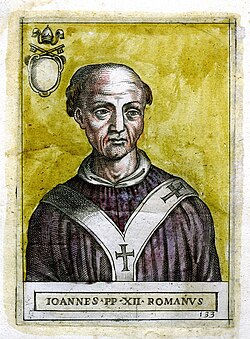
He was also accused of arson, of strapping on a sword and marching around in a helmet and body armour, and of physical violence so specific that the synod named individual victims.
His confessor, a man called Benedict, was blinded on John's orders. Benedict died shortly afterwards. A cardinal subdeacon also named John was castrated and then killed. John was additionally charged with ordering his own godfather to be blinded. These weren't battlefield casualties. They were a pope's personal confessor and two senior Church officials, targeted for what they knew or said.
When John retook Rome in early 964 after Otto's departure, he made his feelings about those who'd testified against him at the synod brutally clear. Cardinal-Deacon John had his right hand struck off. Bishop Otgar of Speyer was publicly flogged. A high palatine official lost both his nose and his ears. These weren't private executions. They were deliberate, visible mutilations of named, senior figures carried out as a public statement to anyone thinking about opposing him.
His reputation became so notorious that female pilgrims reportedly dared not travel to Rome to visit the tombs of the apostles while he was in power. That detail, recorded in Church sources with no obvious reason to exaggerate it, tells you something important: his behaviour wasn't just an internal Vatican scandal. It was disrupting ordinary religious life across the Christian world. The charges against John XII at the 963 synod read like a list of the Seven Deadly Sins, covering sacrilege, violence involving blindings and castrations of his political rivals, incest and adultery, and paganism through invoking Jupiter and Venus while playing dice.
Historian Simon Sebag Montefiore didn't mince his words in his assessment: "Pope John XII was the most depraved bishop ever to head the Church. His conduct was in complete contradiction to the principles of Christian ethics. He was hypocritical, cruel and thoughtless, the embodiment of the papal pornocracy of the first half of the tenth century."
The Unlikely Alliance with Otto I
Despite all of this, John XII managed to pull off one of the most consequential acts in medieval European history.
By 960, the Papal States were under serious pressure from Berengar II, King of Italy, who was aggressively encroaching on territories that the papacy considered its own. John needed military muscle he didn't have. He looked north and reached out to Otto I of East Francia, a man who had been steadily consolidating his power across Germany and who had his own reasons for wanting to establish a formal relationship with Rome.
Upon Otto's arrival in Rome on January 31, 962, he swore an oath to Pope John XII, vowing to defend the pope and the Holy Roman Church. He pledged not to enact any laws within Rome without John's consent and to return any conquered territory of St. Peter to the papacy.
On February 2, 962, John crowned Otto emperor and Otto's wife, Adelaide, empress, in St. Peter's Basilica, beginning the long association of the imperial title with the German kingdom. It was the first coronation of a Holy Roman Emperor in the West in nearly four decades, and it set a precedent that would define European politics for centuries to come. Whatever John's personal failings, he made history that day.
Eleven days after the coronation, John and Otto ratified the Diploma Ottonianum, an agreement that made Otto the protector of the Papal States stretching from Naples to Venice, the first effective protection since the fall of the Carolingian Empire.
But the alliance began to sour almost immediately. Otto left Rome on 14 February 962 to bring Berengar II to heel. Before leaving he suggested that John, "who passed his whole life in vanity and adultery," give up his worldly and sensual lifestyle. John ignored this advice with the contempt of a man who'd never been told no by anyone who mattered.
Playing Both Sides: John's Betrayal of Otto
With Otto away fighting in northern Italy, John began to panic. The emperor was growing too powerful, too close, and too interested in how Rome was being run. Rather than gratitude, John responded with paranoia and treachery.
Fearing Otto's increasing power, John sought alliances against Otto, reaching out to the Magyars and the Byzantine Empire and even negotiating with Berengar's son, Adalbert. This was not a minor diplomatic indiscretion. John had just personally crowned Otto as emperor and sworn loyalty to him. He was now secretly writing to Otto's enemies and attempting to destabilise the empire he'd helped create. When Otto found out that John had allowed Adalbert into Rome, he marched on the city with his army.
John fled. He took the city's treasury with him, hiding in Tivoli while Otto entered Rome unopposed on 2 November 963.
The Trial of a Pope: The Synod of 963
What happened next was genuinely unprecedented in the history of the Western Church.
Otto did something no ruler had ever done. He put a reigning pope on trial. Not secretly or symbolically, but formally, in St Peter's Basilica, in front of cardinals and bishops.
The Synod of Rome was held in St. Peter's Basilica from 6 November until 4 December 963, under the authority of the Holy Roman Emperor, to depose Pope John XII. The events of the synod were recorded by Liutprand of Cremona.

After convening the synod, Otto appointed John, Bishop of Narni and John, the Cardinal-Deacon to act as the pope's accusers, while Liutprand of Cremona, the emperor's secretary, responded to the Romans on behalf of the emperor. John XII was called forth to present himself before the council.
He didn't show up.
Instead, he wrote in his poor grammar, saying, "To all the bishops, we hear that you wish to make another pope. If you do I excommunicate you by almighty God and you have no power to ordain no one or celebrate mass." The grammatical errors in the letter became a source of mockery as well as outrage. The man claiming the authority of the Vicar of Christ couldn't write a coherent Latin sentence.
The synod wasn't moved. With John absent, witnesses came forward one after another. John of Narni declared that he had seen him ordain a deacon in a stable, and out of the appointed times. Another cardinal-priest bore witness that he had seen him celebrate Mass without communicating. Others accused him of murder and perjury, of sacrilege, of incest with members of his own family including his sisters. They accused him of simony, of consecrating a ten-year-old child as Bishop of Todi, of converting the Lateran Palace into a brothel, of hunting, of mutilating men, of arson.
The synod responded by declaring, "We therefore beg your imperial greatness to drive away from the Holy Roman Church this monster, unredeemed from his vices by any virtue, and to put another in his place, who may merit by the example of a good conversation to preside over us."
Otto removed John from office and installed Leo VIII in his place, a layman who had never even been ordained as a priest.
The Comeback and the Final Act
John XII didn't accept his deposition quietly.
When Otto departed, John and his partisans returned to Rome, where in February 964 John conducted a synod that deposed Leo, who then fled to Otto. Back in power by the start of 964, John took brutal revenge on those who'd testified against him, mutilating enemies and reasserting his authority in the city.

He didn't enjoy it for long.
In May 964, Pope John XII's life met a lurid end befitting his notorious reputation. According to one chronicler, the 27-year-old pope suffered a fatal stroke in the midst of an adulterous tryst, collapsing in the bed of a married woman. Another rumour claimed an irate husband burst in and threw the young pope out a window to his death.
In another version he would have a male lover, who murdered him out of jealousy.
He was buried in the Lateran, the palace he'd turned into a symbol of everything the papacy wasn't supposed to be.
Legacy: What John XII Left Behind
In a strange twist, one of John XII's most enduring legacies has nothing to do with vice. In 960, he granted the pallium to Dunstan, the Archbishop of Canterbury, strengthening the ties between the English church and Rome. History remembers Dunstan as one of the great reforming churchmen of the medieval period, a sharp contrast to the man who formalised his authority.
The coronation of Otto I as Holy Roman Emperor in 962, whatever John's personal motivations, set a template for the relationship between papal and imperial power that shaped European history for the next five hundred years.
But John's real legacy is what he represents. He was the logical endpoint of the pornocracy, the moment when the corruption of the papacy by powerful families produced its most extreme result: a man with no spiritual vocation, no theological training, and no moral compass placed at the head of the Western Church simply because his father had made the right people swear an oath at a dead apostle's tomb.
Incredibly, John managed to hold onto power for nine years, despite his sinful behaviour. That, perhaps more than any individual scandal, tells you everything about the state of the tenth-century Church.
The accusations made against him at the Synod of 963 likely mixed genuine crimes with political exaggeration. But the broader picture that emerges from multiple independent sources is consistent: a young man who treated the papacy as a personal playground, who filled the Lateran Palace with his mistresses, who raised his hand against his enemies with no fear of consequence, and who genuinely seemed to believe that his position placed him above every rule that existed.
He was wrong about that in the end. He just ran out of time before anyone could make it stick.
Sources
Liutprand of Cremona, Historia Ottonis (c. 964) — primary eyewitness and partisan account of the Synod of Rome and John XII's conduct. Available via Monumenta Germaniae Historica: Scriptores, vol. 3, pp. 340-346.
The Synod of Rome (963) — Wikipedia: https://en.wikipedia.org/wiki/Synod_of_Rome_(963)
Pope John XII — Wikipedia: https://en.wikipedia.org/wiki/Pope_John_XII
"The Debauched Life and Mysterious Death of Pope John XII" — The Collector (Nov 2025): https://www.thecollector.com/pope-john-xii/
"Pope John XII: The Youngest and Worst Pope in History" — Pulse Nigeria (Dec 2025): https://www.pulse.ng/story/john-xii-youngest-worst-pope-2025042209083581959
"Pope John XII: Exploring His Scandalous Life and Era" — Medieval History (Jan 2026): https://historymedieval.com/pope-john-xii-exploring-his-scandalous-life-and-era/
"The Hellish Reign of Pope John XII" — Atmostfear Entertainment (Oct 2024): https://www.atmostfear-entertainment.com/culture/criminology/hellish-reign-pope-john-xii-vice-violence-veneration/
"John XII: The Playboy Pope" — Medieval Archives (Apr 2026): https://medievalarchives.com/2026/04/02/john-xii-the-playboy-pope-and-the-dark-heart-of-the-10th-century/
"Roman Synod Deposed Pope John XII" — Christianity.com: https://www.christianity.com/church/church-history/timeline/901-1200/roman-synod-deposed-pope-john-xii-11629775.html
"Was John XII the Worst Pope in History?" — The Past World (May 2025): https://www.thepastworld.com/post/pope-john-xii
"Pope John XII" — Josh West, Medium (Oct 2021): https://joshwest63.medium.com/pope-john-xii-the-youngest-and-worst-pope-in-history-b701a9949eaf
"Italy and the Papal Pornocracy 800-1100" — Paul Budde History: https://paulbuddehistory.com/europe/italy-and-the-papal-pornocracy-800-1100/
"Emperor Otto I and Pope John XII" — European Royal History (Aug 2021): https://europeanroyalhistory.wordpress.com/2021/08/20/emperor-otto-i-and-pope-john-xii/
John XII, Pope — Encyclopedia.com: https://www.encyclopedia.com/religion/encyclopedias-almanacs-transcripts-and-maps/john-xii-pope
Leo VIII — Britannica: https://www.britannica.com/biography/Leo-VIII
"The Woman Who Ruled the Papacy" — Medievalists.net (Sep 2023): https://www.medievalists.net/2023/09/woman-who-ruled-papacy/
Simon Sebag Montefiore, Holy Roman Empire — quoted via Pulse Nigeria and multiple secondary sources.


