

Madame LaLaurie: The Sadistic Slave Owner of the New Orleans French Quarter
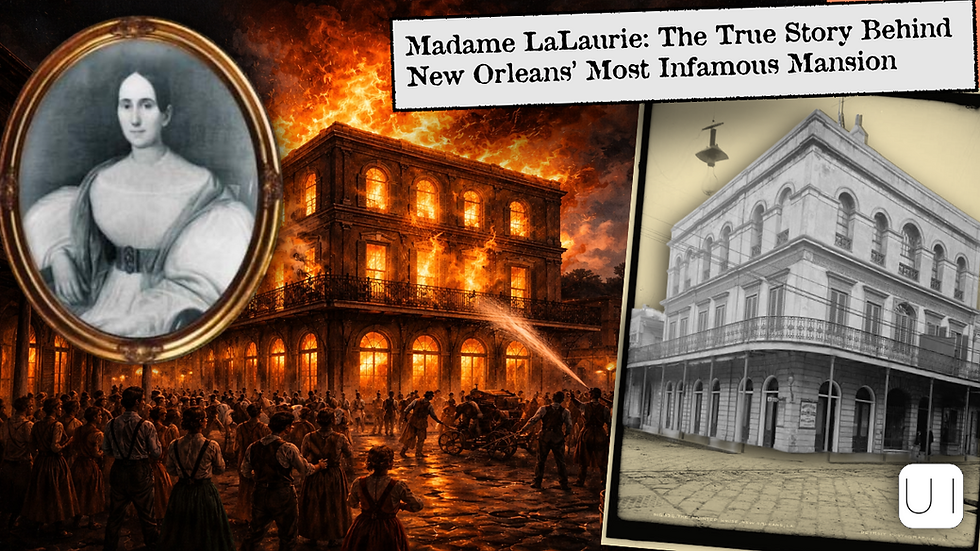
On the morning of 10th April, 1834, smoke began to rise from one of the grandest homes in New Orleans. Within hours, what had long been whispered about in private would be exposed in full public view. Behind the polished façade of 1140 Royal Street, a reality emerged that would permanently stain the reputation of one of the city’s most prominent women, Delphine LaLaurie.
This is not simply a story about one individual. It is also a reflection of the social world in which she lived, a world shaped by wealth, hierarchy, and the brutal institution of slavery.
Early Life and Social Standing
Marie Delphine Macarty was born on 19th March, 1787, in New Orleans, during the period when Louisiana was under Spanish rule. Her family occupied a prominent position within the city’s European Creole society. Her father, Louis Barthélemy de Macarty, descended from Irish immigrants who had settled in the region during the French colonial period. Her extended family held influence across political and administrative circles, including her cousin, Augustin de Macarty.

This environment shaped Delphine’s early life. She grew up in a society where wealth, status, and reputation were carefully maintained, often through strategic marriages. By the age of thirteen, she had already entered her first marriage, to Don Ramón de Lopez y Angulo, a high-ranking Spanish officer. His death a few years later left her a widow with a young child.
Her second marriage, in 1808, to the banker and legislator Jean Blanque, further strengthened her position. With him, she had four children and lived in considerable comfort. When Blanque died in 1816, Delphine was once again widowed, but financially secure.
Her third marriage, in 1825, to physician Leonard Louis Nicolas LaLaurie, brought her the name by which she would become infamous. Despite this marriage, contemporary records suggest that she maintained an unusual degree of independence for a woman of her time. She managed her own finances, oversaw property transactions, and conducted business affairs in her own name.
The Royal Street Mansion
In 1831, Delphine purchased property at 1140 Royal Street in the French Quarter. The following year, a substantial residence was completed on the site.
At the time, the house stood as a visible marker of wealth and refinement. With its elevated structure and commanding presence, it became one of the most recognisable buildings in the area. Inside, it featured elaborate interiors, including marble flooring, carved woodwork, and interconnected drawing rooms designed for entertaining.

Delphine maintained her position in society through regular gatherings and hospitality. Visitors described her as graceful and composed, a woman who appeared entirely at ease within the expectations of elite New Orleans life.
Yet, even during these years, rumours circulated.
Rumours and Early Warnings
Accounts from the early 1830s indicate that some residents of New Orleans had begun to question the conditions within the LaLaurie household. Observers noted that enslaved individuals seen in public appeared unusually thin and distressed compared to others in the city.
Despite these concerns, Delphine maintained a carefully managed public image. One contemporary observer later remarked:
“The lady was so graceful and accomplished, so charming in her manners and so hospitable, that no one ventured openly to question her perfect goodness.”
Official intervention did occur at one point. Following reports of mistreatment, a lawyer visited the property to investigate. No clear evidence of wrongdoing was found at that time.
However, other incidents would soon draw far more serious attention.
The Incident of Lia
One of the most widely repeated accounts from this period concerns a young enslaved girl, often identified as Lia. According to later recollections, the incident began with a minor mistake while brushing Delphine’s hair.
What followed, as described in contemporary narratives, was a pursuit through the house with a whip and onto the roof. What happened on the roof remains uncertain. Some accounts suggest that the girl fell accidentally, others that she jumped, and some that she was pushed.
A witness later described the aftermath:
“She heard the fall, and saw the child taken up, her body bending and limbs hanging as if every bone in her body was broken.”
This event prompted legal action. Delphine was found guilty of illegal cruelty and required to forfeit several enslaved individuals. However, this intervention proved ineffective.
Through intermediaries, she arranged for those individuals to be repurchased and returned to her household.

The Fire of 10th April, 1834
The turning point came on 10th April, 1834.
A fire broke out in the kitchen of the Royal Street mansion. When emergency responders arrived, they discovered an elderly enslaved woman chained to the stove. She later explained that she had set the fire herself, choosing what she believed would be a quicker death over continued life in the household.
She also revealed something more troubling. According to her account, those taken to the upper parts of the house "didn't come back".
As the fire was brought under control, attention turned to the rest of the property. When bystanders attempted to access the slave quarters, they were refused entry. The doors were locked, and Delphine and her husband reportedly declined to provide the key.
Eventually, the doors were forced open.
The Discovery Inside
What was found inside the quarters shocked even those familiar with the realities of slavery in the American South.
A contemporary report in the New Orleans Bee, dated 11th April, 1834, described:
“Seven slaves more or less horribly mutilated were seen suspended by the neck, with their limbs apparently stretched and torn from one extremity to the other.”
Later accounts, including those of the English writer Harriet Martineau, provided further detail. Writing after her visit to New Orleans in 1836, she described individuals who were emaciated, bound in restrictive positions, and subjected to repeated physical abuse.
“They were chained and tied in constrained postures… Their bones were coming through the skin.”
One of those who entered the premises was Judge Jean François Canonge, who later testified to having found in the LaLaurie mansion (among others) a "negress ... wearing an iron collar" and "an old negro woman who had received a very deep wound on her head [who was] too weak to be able to walk". Canonge said that, when he questioned LaLaurie's husband about those enslaved on the property, he was told in an insolent manner that "some people had better stay at home rather than come to others' houses to dictate laws and meddle with other people's business". A version of this story, circulating in 1836 and recounted by Martineau, added that the enslaved people were emaciated, showed signs of being flayed with a whip, were bound in restrictive postures, and wore spiked iron collars which kept their heads in static positions.
When the discovery of the abused and enslaved people became widely known, a mob of local citizens attacked the Royal Street mansion and "demolished and destroyed everything upon which they could lay their hands". A sheriff and his officers were called to disperse the crowd, but, by the time the mob left, the property had sustained major damage, with "scarcely any thing [remaining] but the walls."
The Pittsfield Sun, citing the New Orleans Advertiser and writing several weeks after the evacuation of LaLaurie's quarters of her victims, claimed that two of the enslaved people found in the mansion had died following their rescue. It added, "We understand ... that in digging the yard, bodies have been disinterred, and the condemned well [in the grounds of the mansion] having been uncovered, others, particularly that of a child, were found." These claims were repeated by Martineau in her 1838 book Retrospect of Western Travel, where she placed the number of unearthed bodies at two, including the aforementioned child, Lia.
Official records also indicate that multiple deaths had occurred within the household between 1830 and 1834, though causes were not documented. These deaths included a woman named Bonne (c. 1803 – February 7, 1833), a cook and laundress, and her four children, Juliette (c. 1820 – February 21, 1833, died age 13), Florence (c. 1821 – February 16, 1831, d. age 10), Jules (c. 1827 – May 29, 1833, d. age six) and the youngest, Leontine (c. 1829 – August 26, 1831, d. age two), respectively. Bonne had previously been enslaved by a refugee from Saint Domingue, and was described during her sale as "a chronic runaway"
It is important to note that while some later descriptions became increasingly graphic, not all claims are supported by contemporary evidence. Over time, elements of the story have been expanded through folklore and retelling.
Public Reaction and the Destruction of the House
News of the discovery spread rapidly through New Orleans. Public reaction was immediate and intense.
A large crowd gathered outside the mansion. According to reports, citizens from across social groups participated in the response. The building was attacked and systematically dismantled.
Furniture was destroyed, decorative items smashed, and the interior stripped. By the time authorities restored order, much of the property had been reduced to little more than its structural shell.
In the days that followed, thousands of residents reportedly visited the site where the surviving enslaved individuals had been taken, seeking to understand the extent of what had occurred.
Escape and Exile
Amid the chaos, Delphine LaLaurie managed to escape.
She was transported by carriage to the waterfront and departed New Orleans by boat, first travelling to Mobile, Alabama, and then onward to France.
Despite the severity of the discoveries made at her residence, she was never brought to trial.
Her later life remains partially unclear. Some accounts suggest she lived quietly in Paris. A copper plate discovered in the St Louis Cemetery No 1 indicates a death date of 7th December, though historical records confirm the year as 1849.
The Mansion After LaLaurie
The original structure at 1140 Royal Street did not survive in its original form. After being heavily damaged, it was eventually rebuilt later in the 19th century.
Over the decades, the building has served various purposes, including a school, apartments, and commercial premises. In 2007, it was purchased by Nicolas Cage before later changing ownership again.
Today, it remains one of the most recognised buildings in the French Quarter, partly due to its architecture and partly due to its history.

Folklore and Cultural Legacy
The story of Delphine LaLaurie did not end with her departure from New Orleans. Instead, it evolved.
During the 19th century, accounts of the events were retold in newspapers, books, and personal recollections. Writers such as George Washington Cable incorporated elements of the story into broader narratives about the city.
By the mid 20th century, authors such as Jeanne deLavigne introduced more graphic descriptions, many of which lack direct historical evidence. Later retellings continued to build on these accounts, blending fact with speculation.
In modern culture, the figure of Delphine LaLaurie has appeared in television, literature, and tourism narratives. The house itself is frequently described as one of the most haunted locations in New Orleans, with reports of unexplained sounds and sightings forming part of the city’s broader ghost folklore.
A Story Shaped by Context
Understanding the story of Delphine LaLaurie requires placing it within its historical setting.
New Orleans in the early 19th century was a complex society shaped by French, Spanish, and American influences. Slavery was deeply embedded in its economic and social structures. While cruelty was not uncommon, the events uncovered at the Royal Street mansion were widely regarded as extreme, even by the standards of the time.
The public reaction in 1834 reflects this distinction. The destruction of the house and the widespread outrage indicate that the behaviour attributed to LaLaurie was seen as going beyond accepted norms, however unjust those norms themselves were.
Conclusion
The case of Delphine LaLaurie remains one of the most unsettling episodes in the history of New Orleans. It is a story built from documented events, eyewitness accounts, and later interpretations.
At its core, it highlights the contradictions of a society that could celebrate refinement and civility while simultaneously sustaining a system of profound human suffering.
The house at 1140 Royal Street still stands today, altered but recognisable. Its presence serves as a reminder not only of one individual’s actions, but of the broader conditions that allowed those actions to occur.


