


The 1953 Iranian Coup: How the US and UK Toppled Mossadegh
Updated: Oct 6

Shortly before midnight on 15 August 1953, an Iranian colonel named Nematollah Nassiri climbed into a car in Tehran carrying a piece of paper that was supposed to end a war fought entirely with money, radio broadcasts and rented crowds. The paper was a royal decree, signed by the Shah, dismissing Prime Minister Mohammad Mossadegh. Nassiri never got to deliver it. Mossadegh's people were waiting for him, and by morning he was under arrest rather than the man doing the arresting.

Four days later, the same plan succeeded anyway, in a much rougher form, and Iran's first and only democratically elected prime minister was gone for good. What happened in between is one of the best documented covert operations in Cold War history, not because anyone involved wanted it documented, but because sixty years of leaks, declassifications and a very embarrassed CIA eventually put almost the whole thing on the record. It's a story about oil, but it's also a story about how quickly a foreign government can decide a country's democracy is negotiable, provided the price is right and the excuse is communism.
Quick Answers
Why did the US and UK overthrow Mossadegh in 1953? Officially to stop Iran falling to communism. In practice, Britain wanted to reverse Mossadegh's 1951 nationalisation of the Anglo-Iranian Oil Company, and persuaded the incoming Eisenhower administration to help using Cold War arguments after President Truman had refused.
What was Operation Ajax? The CIA's codename for the coup, run in Iran by officer Kermit Roosevelt. Britain's parallel codename was Operation Boot. Together they bribed officials, editors and clergy, staged street protests, and pushed the Shah to dismiss Mossadegh.
What happened to Mossadegh afterwards? He was tried for treason, sentenced to three years in solitary confinement, and then held under house arrest at his family estate in Ahmadabad until his death in 1967. He was buried under the floor of his own dining room after the Shah refused his request to be buried among the martyrs of a 1952 uprising that had once saved his government.
The Concession That Started It All
The root of all of it went back more than fifty years before the coup itself, to 1901, when a British speculator named William Knox D'Arcy paid the Iranian court for a sixty year concession to hunt for oil across most of the country, then still called Persia. Oil turned up in 1908, the concession became the Anglo-Persian Oil Company, and by the 1940s that company, later renamed the Anglo-Iranian Oil Company and eventually British Petroleum, was running Abadan, the largest oil refinery on Earth, on Iranian soil, with the British government itself holding a majority stake. It was, in every meaningful sense, an arm of the British state operating inside someone else's country.
Iranians got remarkably little back for it. Royalties were a fraction of what Venezuela or Saudi Arabia were negotiating for comparable reserves, AIOC's accounts were never opened to Iranian auditors, and the Iranian workers who kept Abadan running lived in conditions the company's own British staff would never have tolerated. By the time the Second World War had finished dismantling colonial arrangements across the rest of the world, AIOC's grip on Iran's single most valuable resource had become the one issue every faction in Iranian politics, nationalists, clergy and communists alike, could agree was intolerable.

Old Mossy
The man who turned that grievance into policy was already a decidedly unlikely revolutionary. Mohammad Mossadegh was born in 1882 to a finance minister father and a mother descended from the Qajar royal family, and by the time he became prime minister in 1951 he was nearly seventy, frail, prone to fainting spells and open weeping in the middle of speeches, and famous for conducting entire diplomatic meetings from his bed, in his pyjamas, with an ambassador perched awkwardly on a nearby chair. British and American officials who dealt with him took to calling him Mossy, sometimes fondly, sometimes not. Foreign Secretary Anthony Eden once remarked that Old Mossy, with his pyjamas and iron bedstead, was the first genuinely good material to come the cartoonists' way since the war.
It was easy, and convenient, for Western observers to write off the theatrics as evidence of an unstable old man in over his head. What that reading consistently underestimated was how calculated Mossadegh actually was. In March 1951, Iran's parliament voted to nationalise the oil industry outright, and appointed Mossadegh prime minister the following month specifically to see it through. Britain took its case to the International Court of Justice at The Hague, arguing the nationalisation was illegal, and lost. Humiliated, it fell back on economic strangulation instead, organising a worldwide boycott of Iranian oil that gutted government revenue and left the Abadan refinery sitting idle. Mossadegh's response was to accuse Britain, in a phrase that made headlines around the world, of behaving like a cruel and imperialistic country stealing from a needy and naked people. In October 1952, he broke off diplomatic relations with Britain entirely and expelled every remaining British diplomat, and every British intelligence officer working under diplomatic cover, from the country.
Give Us Death or Give Us Mossadegh
Britain's first real attempt to be rid of him came not from London or Washington but from inside Iran itself, and it's a crucial part of the story that tends to get skipped over in favour of jumping straight to 1953. In July 1952, after the Shah refused Mossadegh's demand for direct personal control of the war ministry, Mossadegh resigned in protest, and the Shah, encouraged by British and American officials who'd been quietly courting alternatives for months, replaced him with the veteran conservative politician Ahmad Qavam.

Qavam lasted five days. His government announced, bluntly, that the era of public defiance was over and the time for obedience had arrived, and Tehran answered with three days of the largest street protests Iran had seen in a generation, crowds chanting give us death or give us Mossadegh as soldiers loyal to the Shah opened fire on them. By 21 July, a date still marked in Iran as the 30th of Tir, somewhere between forty and seventy demonstrators were dead, army commanders were pulling their troops back to barracks rather than keep shooting, and Qavam resigned. A shaken Shah reappointed Mossadegh that same evening and handed him the war ministry he'd originally asked for. Mossadegh addressed the crowds from his balcony in tears, telling them he wished he'd died before seeing the nation mourn like this. In his will, years later, he asked to be buried among the ordinary Iranians who'd died defending his government that day.
It's worth sitting with that episode for a moment, because it's the exact template the CIA and MI6 would try to replicate a year later, minus one crucial ingredient: this first attempt to remove Mossadegh by street pressure had been entirely homegrown, and it had failed spectacularly, in his favour. Whoever came after him wasn't going to get to rely on Iranians spontaneously deciding they wanted him gone. That crowd would have to be built from scratch, and paid for.
Truman Says No, Eisenhower Says Yes
With its own intelligence officers thrown out of the country and a homegrown attempt at regime change already having backfired badly, Britain needed American help to try again, and spent much of 1952 trying to get it. Winston Churchill leaned hard on President Harry Truman, reminding him that Britain had backed America in Korea and expected Anglo-American solidarity over Iran in return. Truman wasn't moved. He'd met Mossadegh in Washington in October 1951, the tone had been cordial enough that Iranians briefly hoped America might actually side against Britain, and Truman spent the following year trying to broker a negotiated settlement rather than a coup. In November 1952 his administration formally rejected British proposals for covert action, uneasy about the precedent CIA involvement in toppling an elected government would set for the rest of the world.
That calculation didn't survive the 1952 US presidential election. Dwight Eisenhower's incoming administration was built around two brothers with firm, almost reflexive anti-communist instincts, John Foster Dulles as secretary of state and Allen Dulles running the CIA, and Britain reframed its pitch accordingly. The argument shifted away from unpaid oil royalties and toward the much more persuasive Cold War claim that an unstable, cash-starved Iran sitting on the Soviet Union's southern border might fall to the pro-Soviet Tudeh Party if nothing was done. It worked. By April 1953, Allen Dulles had authorised an initial one million dollars for the CIA's Tehran station, to be used, in the agency's own internal wording, in any way that would bring about the fall of Mossadegh.
Kim Roosevelt Comes to Tehran
The man sent to spend that money was Kermit "Kim" Roosevelt Jr., grandson of Theodore Roosevelt, a soft-spoken Harvard graduate a colleague once described as the last person you'd expect to find up to his neck in dirty tricks. He arrived in Tehran on 19 July 1953 travelling under the alias James Lockwood, to run a plan drafted that spring on Cyprus, where CIA officer Donald Wilber and his British counterpart Norman Darbyshire had spent weeks working out the operational detail together, half diplomacy and half stagecraft.

Much of the groundwork on the ground had already been laid by the Rashidian brothers, wealthy Iranians who'd worked for British intelligence for years and whose job was mobilising bazaar merchants, small businessmen and paid crowds on command. CIA and MI6 money reportedly reached figures well beyond the usual suspects too, including, by some accounts, Ayatollah Kashani, a former Mossadegh ally turned opponent. Agents visited newspaper editors carrying suitcases of cash to buy favourable coverage outright, and one particularly cynical strand of the campaign involved paying people to pose as Tudeh communists and stage threatening, provocative demonstrations, a deliberate effort to frighten religious and middle class Iranians into believing a communist takeover was imminent unless the Shah acted first.
One of the operation's more unlikely recruits was Major General Norman Schwarzkopf, an American officer who'd spent years in the 1940s running the US Gendarme Mission that trained Iran's national police, and whom the Shah genuinely liked and trusted. Roosevelt brought him back to Tehran specifically to talk the nervous, wavering Shah into actually signing the decrees dismissing Mossadegh and installing General Fazlollah Zahedi in his place. The State Department's cover story at the time, that Schwarzkopf was simply in Iran on a personal visit to see old friends, was later shown by the CIA's own internal history to be false. His son, Norman Schwarzkopf Jr., would go on to command the US-led coalition in the 1991 Gulf War, roughly four decades after his father helped engineer regime change in the very same part of the world.
The Coup That Failed, Then Didn't
The plan hinged on the Shah's nerve, which turned out to be its weakest link. Nassiri's arrest on the night of 15 to 16 August exposed the plot instantly. Mossadegh, tipped off in advance, rounded up other plotters overnight, and the Shah, who had needed weeks of persuading just to sign the decrees in the first place, panicked completely and fled the country, first to Baghdad and then on to Rome, apparently convinced the whole scheme was finished.
In Washington and London it looked that way too. On 18 August, CIA headquarters cabled its Tehran station that the operation had failed and should not be continued in any form that could be traced back to the United States. Roosevelt, on the ground with Iranian collaborators already committed and exposed, simply ignored the order and pressed on regardless, a decision that would have ended his career if it had gone the other way and instead became the most celebrated part of his own later account of the operation.
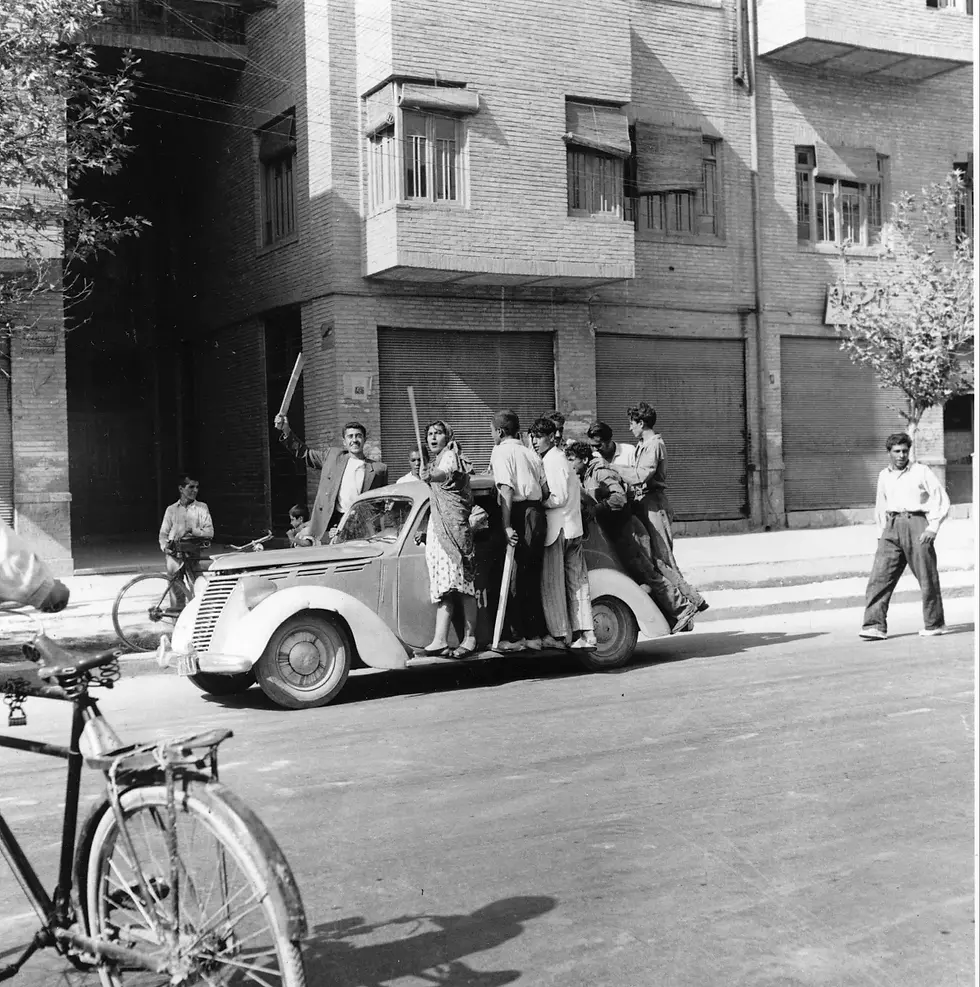
The next day, 19 August, paid crowds and hired strongmen flooded central Tehran instead of dispersing. Among them was Shaban Jafari, a well known wrestler and street enforcer nicknamed "Shaban the Brainless," released from prison that same morning specifically to help lead the pro-Shah mob. The Rashidian brothers' network produced several thousand more, fronted at one point by a female organiser named Malakh Eatezadi, who reportedly tied her chador around her waist and led chants standing on top of a jeep. By afternoon the crowds had seized Tehran Radio and government buildings, and tanks loyal to Zahedi were shelling Mossadegh's residence. Mossadegh went out through his own garden wall in his pyjamas, the same pyjamas the American and British press had spent two years mocking him for, and went into hiding. He surrendered himself the following day. Estimates of the dead from the two days of street fighting run from roughly 200 to 300 people, on top of the dozens already killed in the 1952 uprising that had briefly saved him.
Mossadegh's Long Goodbye
His military trial that November was, by his own account, the last real stage he ever got to perform on, and he played it exactly the way he'd played every crisis before it. Prosecutors initially sought the death penalty, but Iranian law shielded anyone over sixty from execution, and Mossadegh was seventy one. He was convicted on charges including treason and defying the Shah's dismissal order, and met the verdict with open sarcasm, telling the court it had only added to his historical glory and that he was extremely grateful to have been convicted at all.

He served three years in solitary confinement, was released briefly in 1956, and was almost immediately placed under permanent house arrest at his family estate in Ahmadabad, watched over by soldiers for the rest of his life, visited only by close family and only on Fridays.
His wife of over sixty years died in 1965. Mossadegh himself died of throat cancer on 5 March 1967, aged 84. His written wish was to be buried among the martyrs of the 30th of Tir uprising, the same crowd whose sacrifice had once handed him back his government. The Shah refused it, refused a public funeral in Tehran too, and barred any death notice from running in the Iranian press. Mossadegh was buried instead beneath the floor of his own dining room, in the house where he'd spent his final decade unable to leave.
What the Coup Bought
The Shah returned from Rome within days, and over the following twenty five years used the coup's success as licence to govern with steadily less restraint than he'd ever shown before it. A new oil consortium formed in 1954 gave a 40 per cent share of Iranian production to American companies for the first time, alongside a rebranded AIOC, which changed its name to British Petroleum that same year. In 1957, with direct help from a handful of CIA officers, Schwarzkopf reportedly among them, and by some accounts Israel's Mossad, the Shah established SAVAK, the secret police force that would go on to define his regime's reputation for surveillance and torture for the next two decades.
The Long Shadow
For a long time none of this was officially admitted. The CIA's own internal history of the operation, written in 1954 by agency historian Donald Wilber, stayed classified for decades until it was leaked to the New York Times in 2000. That same year, Secretary of State Madeleine Albright became the first senior US official to formally acknowledge America's role, calling the intervention regrettably shortsighted and a setback for Iran's political development, without quite going as far as a full apology. President Obama referenced the coup again in his 2009 Cairo speech on relations with the Muslim world. It wasn't until 2013, on the coup's sixtieth anniversary, that the CIA itself finally released internal documents openly naming its own involvement for the first time.
Inside Iran, none of that acknowledgment was ever really necessary for the coup to matter. It became the founding grievance of the 1979 revolution that overthrew the Shah for good, and a permanent, bitter reference point in Iranian arguments that Western talk of democracy promotion couldn't be trusted an inch. Outside Iran, it became something else entirely: a working template. The same basic playbook, bribery, staged unrest, a friendly general waiting in the wings, was run again in Guatemala the following year, and again two decades later in Chile against Salvador Allende. Iran was the prototype. Everything after it was a variation.
How Much Did the Coup Actually Matter?
Not every historian agrees on how decisive the CIA's role really was, and given everything already established about Mossadegh's genuine popularity, it's worth being straight about where the argument actually sits rather than pretending the record is tidier than it is. The mainstream account, backed by the declassified CIA and MI6 files themselves along with most academic historians of the period, treats the coup as a foreign-engineered operation that succeeded because Anglo-American money, planning and coordinated pressure tipped an otherwise survivable political crisis into Mossadegh's downfall.
A smaller group of revisionist historians, Ray Takeyh chief among them, has argued something closer to the opposite: that by the summer of 1953 Mossadegh's own missteps, including a widely criticised referendum to dissolve parliament that fractured his own coalition, had already isolated him from clergy, military officers and ordinary Iranians well before the coup, and that domestic actors, not the CIA, did the actual work of removing him. Critics of that view, including Iran specialist Mark Gasiorowski, argue it drastically understates how central foreign money and coordination were to organising the crowds, bribing the press and timing the final push, even granting that Iranian hands carried out the physical work on the ground. The declassified paper trail leaves no real doubt that the CIA and MI6 ran and funded a coordinated operation. How much that operation alone determined the outcome, against the backdrop of a genuinely fractured Iranian political scene, is the part historians are still arguing about, and probably always will.
You Might Also Like
For another CIA-backed overthrow of an elected government, read The Chilean Coup of 1973: The Rise of Pinochet and the Shadows of CIA Involvement.
For the CIA's other major Cold War regime change operation of the era, see How the CIA Helped Kill a Dictator, and Failed to Kill Another.


