Robert-François Damiens: The Man Who Stabbed a King and Was Torn Apart for It

On the evening of 5 January 1757, a 42-year-old domestic servant from northern France pushed through the crowd at the Palace of Versailles, drew a small penknife, and stabbed King Louis XV in the side. The wound was barely a centimetre deep. The king lived. The attacker, Robert-François Damiens, made no attempt to run. He stood there and was seized immediately.
What followed was one of the most extreme mismatches between crime and punishment in recorded history. Louis XV recovered within days. Damiens spent the next 83 days in prison being tortured repeatedly, then endured an execution so savage that eyewitnesses fainted, vomited, and turned away in disgust. Giacomo Casanova was in the crowd at the Place de Grève that day and later wrote in his memoirs that he found the spectacle an offence to our common humanity.

Damiens was the last person in France to be executed by drawing and quartering. His case has fascinated historians, philosophers, and the morbidly curious ever since, not least because it marked the dying gasp of a medieval punishment system that was already wildly out of step with the Enlightenment era surrounding it.
Who Was Robert-François Damiens?
Damiens was born on 9 January 1715 in La Thieuloye, a small village near Arras in northern France. His father was a poor gatekeeper. From childhood, he was described by those who knew him as difficult and hot-tempered, which apparently earned him the nickname Robert le Diable, Robert the Devil.
He briefly enlisted in the French army, then cycled through a succession of jobs as a domestic servant, working for various well-off families and Parisian institutions. He was dismissed from several of them for stealing. One of his employers was the Jesuit college in Paris. He also worked in the households of several councillors attached to the Parlement de Paris, the kingdom's highest court.
That last detail matters. The Parlement was deep in a bitter political and religious conflict with Louis XV over the relationship between the crown, the Jesuits, and the Jansenist sect. The councillors Damiens worked for were vocal critics of the king, and he apparently absorbed a great deal of their frustration. He wasn't a political agent or a conspirator. He was an unstable man who had spent years listening to powerful people say the king was ruining France, and he eventually decided to do something about it.
Historians have consistently noted that Damiens was probably mentally unwell. Under interrogation, he described his goal not as killing Louis XV but as punishing him, a warning rather than an assassination. He expected, somehow, to survive this.
The Attack at Versailles
The evening of 5 January 1757 was dark and cold. Louis XV had been visiting the princesses at Trianon and was making his way back through the covered passageway near the Royal Courtyard, accompanied by the Dauphin, senior guards, and members of the court. A coach was waiting for him.
Damiens had spent part of the afternoon lurking around the palace grounds. When the king emerged from the guardroom into the torchlit passage, Damiens pushed through the crowd of courtiers, grabbed the king by the shoulder with one hand, and struck him in the right side with the penknife. He was caught almost immediately, in part because he hadn't removed his hat in the presence of the king, which made him conspicuous.
Louis reached for his side, and his hand came back bloody. The penknife had penetrated between the fourth and fifth ribs, but the thick winter clothing and, according to some accounts, the padding of the king's coat reduced the depth of the wound to just one centimetre. Louis initially thought he'd been punched or elbowed. When he realised he was bleeding, he called for a confessor because he genuinely feared he might be dying.

He wasn't. The court surgeons examined him and confirmed the wound was shallow. Louis XV was back on his feet within days. The blade had barely touched him.
Damiens made no attempt to escape. He was dragged away, and the hysteria began.
The Politics of Panic
Even though the attack was minor and Damiens clearly acted alone, the political fallout was enormous. Accusations flew in every direction. Some at court blamed the Jesuits, pointing to Damiens's time working at their college. Others suspected the Parlement itself, reasoning that its feud with the crown had created the conditions for this kind of fanaticism. Pamphlets circulated across Paris within days.
The Jansenist-Jesuit dispute, which sounds arcane today, was genuinely explosive at the time. French Catholic clergy had been refusing to administer last rites to Jansenists, whom they considered heretics. The Parlement had sided with the Jansenists against the crown's support of the Jesuits. Damiens had absorbed all of this and, in his distorted reasoning, come to blame the king personally for the crisis.
Despite weeks of brutal interrogation, investigators found no conspiracy. Damiens maintained he had acted alone. The government eventually accepted this, but it didn't reduce the fury around the case. If anything, a lone madman was in some ways more disturbing than a plot, because it offered nothing to dismantle.
Voltaire, who had plenty to say about irrational behaviour in powerful institutions, used the case to sharpen his critiques of religious fanaticism and judicial excess. He was not alone in finding the punishment that followed grotesquely disproportionate. You can read more about four of the irrational behaviours Voltaire warned us about in a separate piece on the site.
The Sentence
The trial ran from 12 February to 26 March 1757. Damiens was convicted of regicide, which carried its own legal category: parricide against the person of the king. The fact that he'd failed didn't matter. Under French law, the intent and the act were enough.
The sentence handed down was extraordinary even by the standards of the time. It followed the template used for François Ravaillac, who had successfully assassinated Henri IV in 1610. The prescribed punishment ran as follows.
Damiens was to be taken to the Place de Grève wearing only a shirt and carrying a two-pound wax torch. On the scaffold, flesh would be torn from his breasts, arms, thighs, and calves using red-hot steel pincers. His right hand, the one that held the knife, would be burned with sulphur. Into the open wounds, the executioners were to pour a mixture of molten lead, boiling oil, burning resin, and molten wax. He would then be attached by ropes to four horses and pulled apart. Whatever remained of his body would be thrown onto a fire and his ashes scattered. His family home was to be demolished. His relatives were to be permanently banished from France.
The sentence came from the Parlement of Paris, the same body whose councillors had employed Damiens. There was something almost grimly theatrical about that.
The Execution
On the morning of 28 March 1757, Damiens was taken from his cell. Accounts report that when told the day had arrived, he said only: "La journée sera rude." The day will be hard.
At the Place de Grève, a large scaffold had been built. Estimates of the crowd vary, but it numbered in the tens of thousands. People had come from outside Paris. Spectators paid for elevated positions on rooftops and at windows overlooking the square. It was, by the standards of the day, an event.
The torture began with the brodequins, iron compression devices fitted around the lower legs and tightened with wooden wedges to crush the bones and tissue. Damiens screamed and lost consciousness more than once.
Then came the pincers. Specially made for the occasion, roughly a foot and a half long, the steel pincers were heated until red-hot and used to tear chunks of flesh from his chest, arms, and thighs. After each application, the executioners poured the boiling mixture of lead, oil, pitch, and sulphur directly into the wounds. Accounts from the day describe Damiens raising his head at intervals to look at what was being done to him.
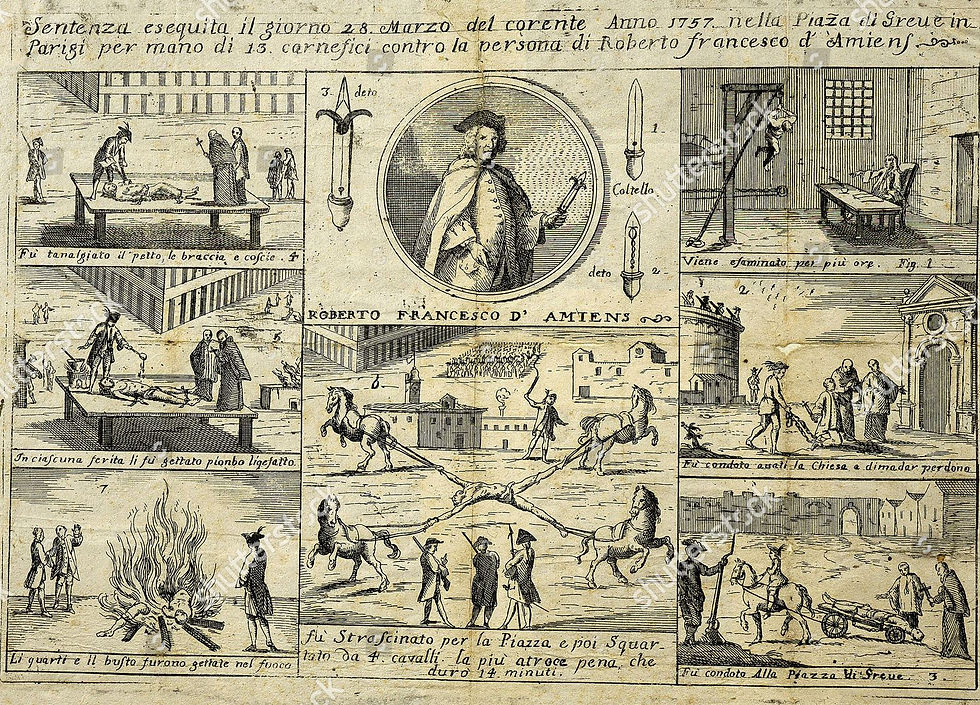
His right hand was burned with sulphur. The sulphur, according to one eyewitness account from an officer of the watch, burned poorly and only scorched the surface of the skin. The executioner had to try several times.
Then came the quartering. Four horses were attached to Damiens by ropes bound to his arms and legs. The horses pulled. And pulled. And nothing happened. Damiens was a physically robust man, and his joints wouldn't give. After repeated attempts, a sixth horse was added. Still the dismemberment didn't proceed as intended. Eventually, the executioners resorted to cutting through the sinews with knives to allow the horses to complete the process. Even then, the horses could only separate the limbs after the muscles had been partially severed.
Throughout all of this, Damiens was still alive. He reportedly cried out "Pardon, my God! Pardon, my Lord!" repeatedly. He did not curse. He did not beg the executioners to stop. He asked them to pray for him.
What remained of his torso was thrown onto the fire. His ashes were scattered. The execution had taken the better part of a day.
The executioner was Charles-Jean-Baptiste Sanson, part of the multi-generational family of state executioners who would later oversee the guillotine during the Revolution. His son Charles-Henri Sanson would execute Louis XVI, the grandson of the very king Damiens had failed to kill. You can read more about the life of Albert Pierrepoint, Britain's most prolific executioner, in a separate piece.
The Legacy
The execution of Damiens is remembered partly because it was the last of its kind in France, and partly because the philosopher Michel Foucault chose it as the opening of his landmark 1975 work Discipline and Punish, using it to illustrate the theatrical cruelty of pre-modern punishment before arguing that power over bodies was gradually replaced by power over minds.
Foucault's point was not simply that the execution was horrible, but that it revealed something about how sovereignty worked in the 18th century. The king's body had been violated, however slightly, and the state's response was to demonstrate its absolute power over the body of the offender in the most explicit way imaginable. The punishment wasn't just about Damiens. It was a performance for everyone watching.
Within a few decades, drawing and quartering had been abandoned across Europe. The guillotine arrived in France in 1792, selling itself on its reliability and, compared to what happened at the Place de Grève in 1757, its relative mercy.
Damiens himself remains a strange, tragic figure. He wasn't a calculating assassin. He wasn't part of any plot. He was an unstable, frustrated man who did something catastrophically stupid with a small knife and paid for it with everything he had. Louis XV, for his part, recovered completely and reigned for another seventeen years.
The wound was one centimetre deep. The punishment took all day.
SOURCES
1. Britannica: Robert-François Damiens — https://www.britannica.com/biography/Robert-Francois-Damiens
2. Château de Versailles: Assassination Attempt on King Louis XV by Damiens, 1757 — https://en.chateauversailles.fr/discover/history/key-dates/assassination-attempt-king-louis-xv-damiens-1757
3. Liberty, Equality, Fraternity (CHNM): The Sentence against Damiens (1757) — https://revolution.chnm.org/d/242
4. Executed Today: 1757: Robert-Francois Damiens, Disciplined and Punished — https://www.executedtoday.com/2008/03/28/1757-robert-francois-damiens-discipline-and-punish/
5. European Royal History: January 5, 1757 — Attempted Assassination of King Louis XV — https://europeanroyalhistory.wordpress.com/2023/01/05/january-5-1757-attempted-assassination-of-king-louis-xv-of-france-and-navarre/
6. Geri Walton: Robert-François Damiens: Attempted Assassin of Louis XV — https://www.geriwalton.com/assassination-attempt-of-king-louis-xv/