

Why Marilyn Monroe's Death Is Still a Mystery: The Investigation That Went Wrong
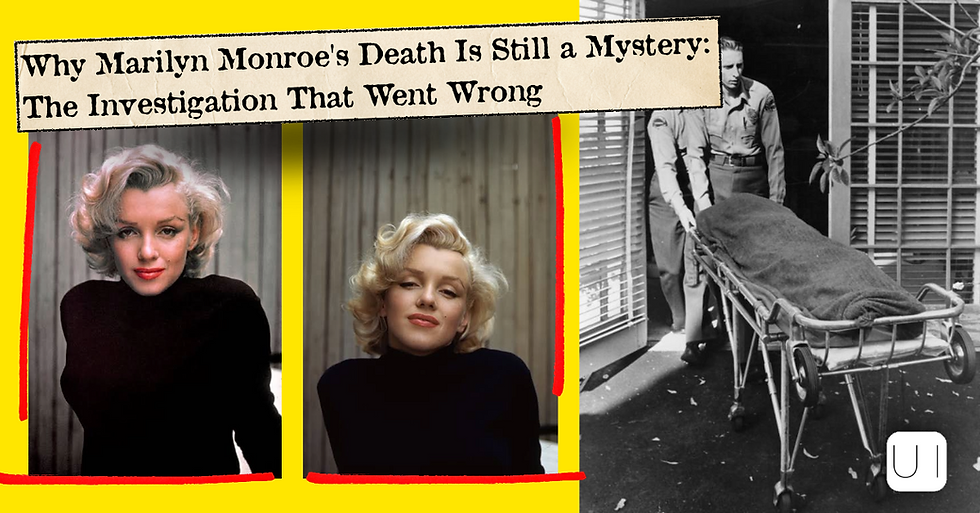
Sixty plus years on, people still argue about how Marilyn Monroe really died. Most of that argument gets framed as a cover-up, the Kennedys, the CIA, a mob hit dressed up as an overdose. But the more interesting and much better documented story isn't a conspiracy at all. It's that the actual investigation into her death was rushed, incomplete, and in at least one crucial respect, physically impossible to finish properly, because the evidence that could have settled things was destroyed before anyone could test it. The mystery isn't the result of what someone hid. It's the result of what nobody bothered to preserve.
A Coroner Fresh Off Probation
When Monroe's body was found on the morning of 5 August 1962, the autopsy went to Thomas Noguchi, a 35 year old deputy medical examiner who was still on probation in the Los Angeles County coroner's office. He wasn't the obvious choice. Chief Coroner Theodore Curphey, his boss, would normally have handled a case of this profile himself. Instead it landed with the newest man on staff, something Noguchi himself later said left him uneasy, since a botched examination on the world's most famous actress would be his to answer for, not Curphey's.

During the autopsy, Noguchi opened Monroe's stomach and small intestine expecting to find residue from the dozens of pills that supposedly killed her. He found none. No capsule fragments, no powder, none of the discoloration barbiturates typically leave behind. That absence should have been a major red flag demanding follow up testing. It got some, but not nearly enough.
The Organs That Vanished Before They Could Be Tested
Noguchi sent samples of Monroe's blood, liver, kidneys, stomach and intestines to the county's head toxicologist, Raymond Abernathy, for analysis. Abernathy's results showed fatal levels of pentobarbital and chloral hydrate in her blood and liver, more than enough to rule the death a barbiturate overdose. Satisfied he had his answer, Abernathy decided there was no need to test the rest of the organs and disposed of them once the coroner's report was filed.
That decision is the single biggest reason nobody can say with total certainty how the drugs entered her body. Without stomach or intestinal tissue to test, there was no way to confirm whether Monroe swallowed the pills or received them another way, such as by injection or enema, both of which were floated by researchers and biographers in the years that followed. When Noguchi went back to the lab weeks later hoping to run further tests, he was told the samples were already gone. He later called it one of the most consequential gaps in a case file he'd ever worked, not proof of murder, just a hole in the evidence nobody could ever go back and fill.
Inventing a New Forensic Method on the Fly
With the physical evidence incomplete, the coroner's office turned to something that had never really been used before: a formal psychiatric reconstruction of Monroe's state of mind in her final days. Curphey brought in three psychiatrists from the Los Angeles Suicide Prevention Center, Robert Litman, Norman Farberow and Norman Tabachnik, and asked them to interview her doctors, friends and associates to determine whether her death fit the profile of a suicide.
The technique they used didn't have a name yet. It would later become known as the psychological autopsy, now a recognised tool in suicide research, but at the time it was being improvised in real time specifically to plug the hole the missing organ samples had left. The team concluded Monroe had suffered from depression and abrupt mood changes, and that her death was consistent with a probable suicide, though notably not a certain one. Curphey's official ruling used exactly that phrase, probable suicide, an unusually hedged conclusion for a death that had already made international headlines.

The Housekeeper Who Couldn't Keep Her Story Straight
If the physical evidence was incomplete, the witness testimony was even messier. Eunice Murray, Monroe's live in housekeeper, was the last person known to have seen her that night and the one who raised the alarm. Her account of what happened shifted almost immediately.
She first told police she'd woken around midnight, seen a light under Monroe's door, and grown concerned. Within hours she'd revised that to say she hadn't woken until roughly 3.30am. Sergeant Jack Clemmons, the first officer on scene, later said Murray struck him as evasive, and noted she was doing laundry at the house in the middle of the night when he arrived, an odd task at that hour by any account.
Murray was never seriously reinterviewed. She left for an extended trip to Europe not long after and the investigation moved on without her. It would take over a decade before she said anything more. She stayed silent about Monroe's personal life for ten years, then published a memoir in 1975, and only years after that, in conversations with the investigative journalist Anthony Summers, did she acknowledge that Monroe had known the Kennedys and that a doctor had been in the house while Monroe was still unconscious but alive, details that never made it into her original statements to police at all.
A Case Closed in Days, Not Weeks
The entire process, autopsy, toxicology, psychiatric interviews and a public ruling, wrapped up in under two weeks. Curphey announced the finding of probable suicide on 17 August, just twelve days after Monroe's body was found. For comparison, the psychological autopsy team's own interviews with her doctors and associates were still being finalised close to that same announcement. It was less a deliberate cover-up than a system that wanted an answer fast, got one that was defensible on paper, and moved on before the physical evidence gaps had a chance to matter to anyone in a position to reopen the case.

A Records Gap That's Much Harder to Verify
There's one more evidence gap worth mentioning, though it sits on far shakier ground than anything above. The journalist Anthony Summers has long claimed that Monroe's phone records from her final days went missing, allegedly seized from the telephone company on the orders of someone senior enough to make them disappear before investigators could review them. The claim traces back mostly to secondhand sourcing, a reporter's anonymous phone company contact, a friend of an LAPD security adviser recalling a private conversation decades later, that kind of thing. No official document has ever surfaced confirming records were seized or by whom, and nothing about it has the paper trail that the organ samples or Murray's shifting statements do. It's worth flagging because it's part of why the case still gets treated as an open question, but it's a rumour with persistent sourcing, not an established fact the way the rest of this story is.
What Actually Made This a Permanent Mystery
None of this proves murder, and Noguchi himself was always careful to say so. What it proves is something more mundane and, in its own way, more damning: a high profile death was handled by an inexperienced examiner working with a toxicologist who destroyed evidence before it could be fully tested, and the resulting gaps were papered over with a brand new psychiatric technique invented specifically because the physical proof wasn't there. That combination, not a Kennedy conspiracy, is why questions about Monroe's death were never actually closed. If you're curious how the chaos around her continued well past the autopsy, the fight over her estate and belongings tells its own version of the same story, of people scrambling to make sense of a life that ended faster than anyone around her was prepared for.
It's a strange footnote to a career that started with ten dollar an hour modelling jobs under a different name entirely. The woman who spent years being reinvented by studios, photographers and the press ended up having even her death reinvented after the fact, not by any single villain, but by an investigation that ran out of evidence and filled the gap with best guesses.
Sources
1. The Mirror US, "Marilyn Monroe's coroner says 'alarm bells went off' over shock autopsy findings"


