


The Murder of Dr John Britton: The Pensacola Shotgun Killings of 1994

Dr John Britton knew someone might try to kill him. He wore a bulletproof vest he'd made himself, kept a .357 Magnum close by and was driven to work by a pair of retired volunteers. None of it mattered on the morning of 29 July 1994, when a former minister called Paul Hill walked up to a pickup truck outside a clinic in Pensacola and opened fire with a shotgun.
Britton and his escort James Barrett were killed. Barrett's wife June was wounded. It was the second time in 17 months that a doctor had been murdered outside an abortion clinic in the same small Florida city, and it turned Pensacola into the most notorious flashpoint of America's abortion conflict.
Quick Answers
• Who was Dr John Britton? A 69-year-old family doctor from Fernandina Beach, Florida, who flew to Pensacola each week to perform abortions at the Ladies Center clinic.
• When was he killed? Early on the morning of Friday 29 July 1994, in the clinic's car park.
• Who killed him? Paul Jennings Hill, a defrocked Presbyterian minister and anti-abortion extremist, using a 12-gauge pump-action shotgun.
• Who else was shot? Retired Air Force Lieutenant Colonel James Barrett, 74, was killed and his wife June, 68, was wounded.
• What happened to Paul Hill? He was sentenced to death in December 1994 and executed by lethal injection at Florida State Prison on 3 September 2003.
Pensacola Before the Shooting
By 1994 Pensacola already had a grim track record. The Ladies Center, the clinic where Britton worked, had been bombed in 1984, once in June and again as part of a string of Christmas Day attacks carried out by a small group of young fundamentalists. The Meteor's history of the city's clinic violence traces the long build-up that made the place a magnet for hardliners.

Then on 10 March 1993, Dr David Gunn was shot dead behind another Pensacola clinic, Pensacola Women's Medical Services. His killer, Michael Griffin, was given life in prison. The Roanoke Times noted at the time that it was the first killing to happen during an abortion protest in the US.
Gunn had also worked shifts at the Ladies Center. Someone had to replace him, and the man who stepped forward was John Britton.
Who Was Dr John Britton?
Britton was born in Boston in 1925. He studied at the University of Virginia and its medical school, served in the US Army and eventually settled as a family doctor in Fernandina Beach, on Florida's Atlantic coast. A local history piece in the Fernandina Observer recalls one mourner describing him as "a perfectly lovely man and a wonderful doctor."
He wasn't a saint and he didn't pretend to be. Time magazine's 1994 profile found that he'd been helping women get abortions on principle since the late 1960s, but by the 1980s he was also doing them for the money, sometimes 32 a day at $50 a time. He'd lost a hospital job in 1978 after clashing with colleagues, and in 1981 he was put on two years' probation for improperly prescribing narcotics. Patients he took on from Gunn sometimes found him brusque. He was a father of five and a man of fairly modest means.
The New York Times famously called him an uncertain martyr. He didn't fit the image either side wanted, and that's partly what makes his story so human.

The Homemade Vest and the Volunteer Bodyguards
After Gunn's murder, Britton started flying across the state to Pensacola every week. He took the threats seriously. Rather than buy body armour, he made his own vest out of scraps from a manufacturer, and he worried it didn't come down far enough. He put it bluntly to a reporter: "If they get me in the liver, that's pretty tough to patch."
What's less well known is that he turned down proper protection. An Associated Press report published days after the killings revealed that Pensacola police had offered him an armed escort to and from the airport earlier that year, after the clinic's director raised concerns about staff being stalked. Britton said no.
Instead he relied on James and June Barrett. Jim Barrett was born in Annapolis, Maryland, in 1919, got his pilot's licence at just 15 and spent a career in the US Air Force before retiring as a lieutenant colonel. Pensapedia's biography of Barrett says the couple moved to Pensacola in June 1992, joined the local Unitarian Universalist Fellowship and threw themselves into community causes. June was a retired nurse. Every week they'd collect the doctor from the airport and drive him to the clinic.
Paul Hill: From Pulpit to Picket Line
Paul Hill had been a minister in two conservative Presbyterian denominations. After Gunn was killed, he did something that shocked even many anti-abortion campaigners: he went on television to defend the murder. Christianity Today reported that he rang talk show host Phil Donahue two days after Gunn's death and was on the programme three days later. The elders of his church told him to stop appearing on TV and stop writing in support of so-called justifiable homicide. He ignored them and was excommunicated.
He set up a group called Defensive Action and wrote a statement arguing that any force you'd be allowed to use to protect a born child should be allowed to protect an unborn one. He even repeated that argument on Donahue, sitting near Gunn's son.
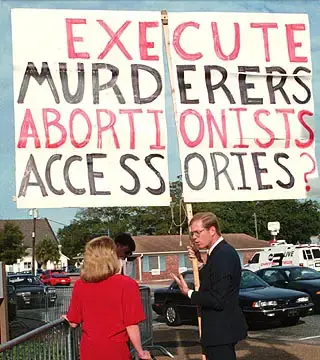
By the summer of 1994 he was a fixture outside the Ladies Center. Encyclopedia.com's account of Florida v. Hill describes him putting on a child's voice and yelling "Mommy, Mommy, don't murder me!" at the building. On 17 June police arrested him under a local noise ordinance. Six weeks later he came back with a newly bought Mossberg shotgun.
The Morning of 29 July 1994
The Barretts met Britton at the airport as usual and drove him to the clinic in Jim's blue pickup. They pulled in shortly before 7.30am. Hill was waiting. Accounts say he stepped aside to let the truck into the driveway, then pulled out the shotgun and walked towards it.
The Florida Legislature's capital case summary sets out what happened next. As Jim Barrett climbed out, Hill shot and killed him and wounded June. Then he turned the gun on Britton. Investigators later said Hill fired several times, reloaded and fired again. Both men were hit in the head. Britton's homemade vest didn't come into it.
Hill didn't run. He put the gun down and walked away, and he was arrested within minutes after witnesses pointed him out. June survived with a wound to her arm.

The Reaction
President Bill Clinton branded the killings domestic terrorism and promised federal help for local police. The Congressional Record index for 1994 shows members of the House and Senate raising the Pensacola shootings repeatedly over the following week, and the FBI opened an inquiry into whether clinic violence was being organised nationally. Writers at On The Issues pointed out that the clinic had begged the FBI to act on Hill weeks before, with no result.
Mainstream anti-abortion groups lined up to condemn Hill. The American Center for Law and Justice, which had been representing him over the June protest arrest, dropped him on the day of the shooting. Hill's supporters, though, weren't shy. At one gathering in Britton's memory, protesters screamed abuse and one man turned up with a giant marksmanship trophy for the gunman.
June Barrett refused to be scared off. She told a local paper, "My husband died for the cause of a woman's right to choose," and kept on escorting. Jim was buried with military honours at Arlington National Cemetery on 8 August 1994. June lived until 2011.

Trial, Death Row and Execution
Hill faced federal charges under the brand-new Freedom of Access to Clinic Entrances Act, signed only that May, as well as state murder charges. He chose to represent himself. He was convicted on all counts and on 6 December 1994 he was sentenced to death. The Clark County Prosecutor's death penalty file on Hill notes the Florida and US supreme courts both upheld his convictions in 1997.
After that he gave up on further appeals. Governor Jeb Bush signed his death warrant in 2003, less than a year after Florida had executed the serial killer Aileen Wuornos. On the eve of his execution Hill told reporters, "I expect a great reward in heaven," the Southeast Missourian reported.
The run-up was tense. Letters with rifle bullets inside were mailed to the judge who sentenced Hill, to state attorney general Charlie Crist and to two prison officials, the Vindicator reported. Extra police and sniffer dogs ringed the prison at Starke.
Hill's last meal was steak, a baked potato, broccoli, salad, orange sherbet and sweet iced tea. Strapped to the gurney, he urged people who saw abortion as lethal force to do whatever it took to stop it, ending with "May God help you to protect the unborn," as CNN's live coverage recorded. He was pronounced dead at 6.08pm on 3 September 2003, while the Deseret News described lightning flashing across a nearly black sky.
Around 60 supporters stood in a cow pasture across the road, some holding signs reading "Dead Doctors Can't Kill," the Taipei Times reported. Hill became the first person in the US executed for killing an abortion provider.
Why the Case Still Matters
The Britton and Barrett murders sit alongside the decade's other homegrown attacks, from the bombings that ended with the capture of the Unabomber to the clinic bombings that followed later in the 1990s. Hill wanted to be remembered as a martyr, and to a tiny fringe he still is.
But the people who paid for his beliefs were a flawed, stubborn country doctor and a retired airman in his seventies who'd volunteered to keep him safe. Two dead, one wounded and a killer who went to his grave insisting he'd do it all again.
Suggested Reading
Want to dig deeper into Pensacola and the wider story? These are worth a look.
Wrath of Angels: The American Abortion War by James Risen and Judy L. Thomas
Two journalists trace the rise of militant anti-abortion activism, with Pensacola and Paul Hill right at the heart of it.
Terrorism on American Soil by Joseph T. McCann
A broad look at homegrown attacks in the US, including the Britton and Barrett killings.
Religious Violence and Abortion: The Gideon Project by Dallas A. Blanchard and Terry J. Prewitt
Written by two Pensacola academics, this digs into the 1984 clinic bombings that set the stage for everything that followed.
As an Amazon Associate, Utterly Interesting earns from qualifying purchases.
You Might Also Like
Sources
1. Avenging the Unborn, Time
2. Paul Hill: Capital Case Summary, Florida Legislature
3. Abortion Clinic Slayings (30 July 1994), Roanoke Times
4. Florida Shootings Stifle Pro-lifers, Christianity Today
5. Abortion Doctor Rejected Police Escort, The Moscow Times (Associated Press)
6. Florida v. Hill: 1994, Encyclopedia.com (Great American Trials)
7. James Barrett, Pensapedia
8. Confronting the Antis in Pensacola, On The Issues
9. John Bayard Britton: The Fernandina Doctor Killed in Pensacola, Fernandina Observer
10. It All Started in Pensacola, The Meteor
11. Congressional Record Index 1994: Britton, John B., GovInfo
12. Paul Jennings Hill #873, Clark County Prosecuting Attorney
13. Anti-abortion extremist slated for execution, Southeast Missourian
14. A murderer, not a martyr, is put to death in Florida, The Vindicator
15. CNN Transcript, 3 September 2003, CNN
16. Killer of abortion doctor is executed, Deseret News
17. Florida executes anti-abortion militant, Taipei Times


