

Britain's Greatest Eccentrics: The Bizarre, the Brilliant, and the Completely Unhinged

They rode bears into dinner parties. They ate the heart of a dead king. They built entire underground cities to avoid speaking to anyone. Britain has produced some of the most gloriously peculiar individuals who ever walked the earth, and the world is a stranger, richer place for it. What follows is a collection of the finest, most jaw-dropping eccentrics in British history, from aristocrats who tunnelled beneath their own estates to MPs who ate rotting food rather than spend a penny on fresh groceries.
William Cavendish-Scott-Bentinck, 5th Duke of Portland (1800-1879): The Man Who Moved Underground
If shyness were an Olympic sport, William Cavendish-Scott-Bentinck would have taken gold every time. The fifth Duke of Portland despised human contact so completely that he took the logical, if wildly expensive, step of simply going underground to avoid it.
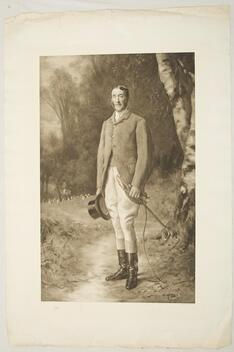
At his estate, Welbeck Abbey in Nottinghamshire, the Duke spent years directing the construction of one of the most extraordinary private building projects in Victorian England. He had 15 miles of tunnels dug beneath the grounds, connecting the various rooms and outbuildings of his estate. One tunnel alone stretched a mile and a quarter, running directly from the coach house to Worksop Railway Station. This meant the Duke could travel to London without ever risking being seen. His carriage would move through the tunnel to the station, where it was loaded directly onto a railway truck, the Duke concealed inside. When he arrived at his London townhouse in Cavendish Square, servants were dismissed so he could slip inside unobserved.
Underground at the Abbey, the Duke created an entire secret world. He built a ballroom large enough to accommodate two thousand guests and a billiard room so vast it could house a dozen full-size billiard tables. A private underground library and a suite of rooms completed the complex. The workmen he employed were under standing orders: if they encountered the Duke, they were to pretend they hadn't seen him and walk on without acknowledgement. He apparently returned the courtesy.
Above ground, the Abbey fell into deliberate neglect. Visitors reported seeing nothing but darkened windows and empty corridors. The Duke lived alone, communicating with the outside world entirely by written note. He died in 1879, leaving behind a subterranean kingdom that no one else had ever really been invited to see.
The 6th Duke, a distant relative who had never met him, inherited everything and found the Abbey in extraordinary condition. Nearly every room had been painted pink, stripped of all furniture, and fitted with a commode in the corner. He documented it in his 1937 memoir Men Women and Things, which only deepened the mythology around his predecessor.
The tunnels themselves had an eventful afterlife. Some of the narrower corridors still have the narrow-gauge rails visible on their floors, used to carry trolleys of warm food from the kitchens to the main house. The estate later had a military presence during the Second World War, and parts of the underground network were pressed into service for storage.
There's one remarkable historical footnote connected to the estate that the Duke narrowly missed. In November 1913, Archduke Franz Ferdinand visited Welbeck as a guest of the 6th Duke for a pheasant shoot. During the day's hunting, one of the loaders stumbled and both barrels of his gun discharged, the shot passing within a few feet of the Archduke. The 6th Duke later reflected in his memoir that he often wondered whether the First World War might have been averted, or at least delayed, had Franz Ferdinand met his end in Nottinghamshire rather than Sarajevo the following June.
As for visiting today, the tunnels themselves are closed to the public for safety and preservation reasons, but there's more to see at Welbeck than you might expect. The South Tunnel Lodge Walk takes visitors past one of the original tunnel entrances, flanked by the Duke's distinctive Victorian lodges, where the underground carriage road once ran south towards Worksop. The Harley Gallery on the estate, which occupies the converted building the Duke originally had constructed as his gas works to light the underground chambers, runs a permanent exhibition called Tunnel Vision. It includes architectural models of his building projects, portraits of Adelaide Kemble (the opera singer widely believed to be his lost love), his death mask, and the famous double-letterbox bedroom door through which he communicated with staff. The Portland Collection at the gallery is also worth the trip in its own right, containing works by Van Dyck and a pearl earring said to have been worn by Charles I at his execution.
John "Mad Jack" Mytton (1796-1834): Shropshire's Finest Disaster
Born at Halston Hall in Shropshire in 1796, John Mytton inherited 132,000 acres of land and an income equivalent to over a million pounds a year in today's money. He proceeded to destroy all of it in roughly fifteen years, and managed to have a genuinely extraordinary time in the process.
Mytton was expelled from both Westminster and Harrow before going up to Cambridge, where he famously sent three pipes of port ahead to his lodgings. A pipe is a large wine cask holding around 534 litres, so three pipes amounted to roughly 2,000 bottles waiting for him on arrival. He never graduated. He then served briefly as a Tory MP for Shrewsbury, having paid £10 per vote to secure election, spending a total of £10,000 (more than £750,000 in todays money). He visited the House of Commons exactly once, stayed for half an hour, and never returned.
His pursuits were rather more vigorous than parliamentary debate. He hunted in all weathers, often stripping down to nothing in the middle of a winter chase. He stalked duck by moonlight on the frozen lake at Halston in his nightshirt. He rode his horse up the grand staircase of the Bedford Hotel in Leamington Spa, jumped from the balcony over the diners below, and out through a window into the street, apparently on a bet. He disguised himself as a highwayman and ambushed dinner guests as they left his home on the Oswestry road, blazing pistols and all. He once tested whether a horse pulling a carriage could jump over a toll gate. It couldn't.
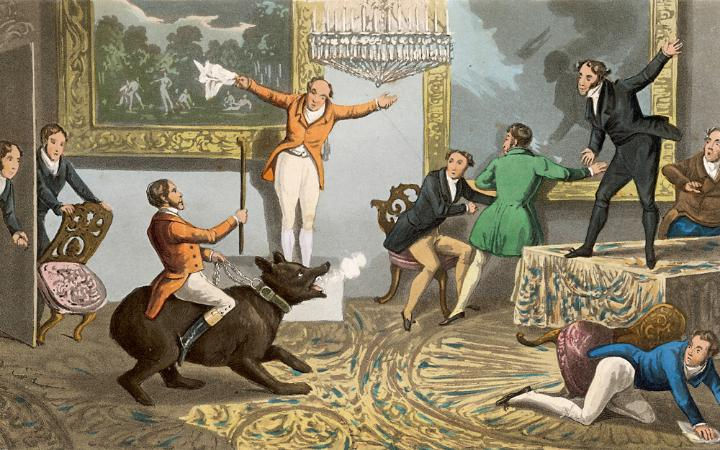
His most famous party trick involved a pet bear. One biographer records that Mytton rode the animal into his drawing room in full hunting costume. The bear, initially cooperative, bit him through the calf when Mytton applied a spur. Mytton thought this was hilarious. A later and stranger piece of evidence came in 2023, when a Time Team investigation sent a camera into the vault at Halston Chapel and found what appeared to be the skin of his beloved bear draped over his coffin.
The incident that most perfectly captures the man occurred in France, where he'd fled to escape his creditors. Plagued by hiccups one evening, Mytton applied what seemed to him the obvious remedy. He set his nightshirt on fire. The hiccups stopped. So, nearly, did he. His companions beat out the flames. As he reeled naked into bed, singed and satisfied, he announced: "The hiccup is gone, by God!" He later lay in the smouldering wreckage of the moment and calmly quoted Sophocles in the original Greek.
He died in the King's Bench debtors' prison in Southwark in 1834, aged 37. Three thousand people attended his funeral.
John Elwes (1714-1789): The Man Who Inspired Scrooge
Long before Charles Dickens invented Ebenezer Scrooge, the real thing was walking the streets of London in clothes he'd salvaged from a hedge. John Elwes inherited a fortune worth tens of millions in today's money and lived as if he had nothing. Dickens later referenced him by name in his letters while writing A Christmas Carol, and again in Our Mutual Friend.

Elwes was born John Meggot in 1714. He changed his name to inherit his uncle's estate. The uncle, Sir Harvey Elwes, was himself a spectacular miser, and young John spent enough time visiting him to learn the trade thoroughly. The two of them would dine together on a single small bird or a piece of mouldy cheese, share one glass of wine between them, and go to bed the moment daylight faded to save candles.
After inheriting everything, Elwes adopted his uncle's habits permanently and then went further. He refused to pay for coaches, walking miles through the rain to save the fare, then sitting in his soaking clothes rather than waste fuel on a fire to dry them. He wore the same ragged outfit until it fell to pieces. On one occasion he found a wig discarded in a hedge and wore it for two weeks. Strangers regularly pressed coins into his hand, taking him for a beggar. He was reportedly delighted by this.
His mansions, full of expensive furniture, rotted around him because he refused to pay for repairs.
He ate putrefied game rather than buy fresh food and once rescued a moor hen a rat had dragged from a river and ate that instead. Curiously, for all his own penny-pinching he was recklessly generous to others. He once unsolicited lent a friend, Lord Abingdon, £7,000 to place a bet at Newmarket. On the day of the race, Elwes rode to the track himself and spent fourteen hours there with nothing to eat except a piece of pancake he'd had in his coat pocket for two months, which he assured a startled companion was as good as new.
Once, he cut both legs badly walking home in the dark. He allowed the apothecary to treat only one, betting his fee that the untreated leg would heal first. Elwes won by a fortnight.
He served as MP for Berkshire for twelve years and never once spoke in the House of Commons. His fellow members joked that he couldn't be accused of being a turncoat since he owned only one coat to begin with.
He died in 1789, leaving an estate worth over £500,000 (roughly £75 million in today's money) to his two illegitimate sons. He'd built much of what is now London's West End, financing properties around Portman Square, Piccadilly, and Marylebone, while sleeping on empty floors in the houses he owned rather than pay a housekeeper.
William Buckland (1784-1856): The Geologist Who Ate Everything
William Buckland was one of the greatest scientists of the nineteenth century. He identified the first known dinosaur fossil, named Megalosaurus, pioneered the study of fossilised droppings, and won the Copley Medal for his analysis of Kirkdale Cave. He was also determined to eat every animal species on earth, and came uncomfortably close to achieving it.
Buckland lectured at Oxford in flowing black robes, rushing at terrified students with a hyena skull and demanding: "What rules the world?" When they failed to answer, he'd roar: "The stomach, sir! The great ones eat the less, and the less the lesser still!" He then demonstrated the point at every possible opportunity.

Dinner at Buckland's house might feature hedgehog, crocodile, panther, porpoise, sea slug, or mouse on toast, which was among his favourites. He served alligator soup to guests, then revealed what it was. He kept a pet hyena named Billy, along with guinea pigs, snakes, ferrets, hawks, owls, a pony, and a large tortoise people were welcome to ride. The home doubled as both laboratory and menagerie.
The worst thing he ever ate, he declared, was the common mole, a distinction later revised when he tried stewed bluebottle fly.
His most extraordinary meal came during a visit to Lord Harcourt, the Archbishop of York, who produced a silver snuffbox containing what was said to be the mummified heart of King Louis XIV of France, stolen during the French Revolution. As it passed around the table, Buckland examined the walnut-sized relic, announced "I have eaten many strange things, but I have never eaten the heart of a king before," and swallowed it.
He also visited an Italian cathedral where a priest claimed the slick floor was wet from the ever-flowing blood of martyred saints. Buckland knelt, licked the stone, and identified it as bat urine. He would know.
He died in 1856 and was buried at Westminster Abbey. Grave diggers found that the plot he'd selected lay directly over a thick seam of Jurassic limestone, requiring explosives to excavate. Friends suspected he'd planned it that way.
Henry Cyril Paget, 5th Marquess of Anglesey (1875-1905): The Dancing Marquess
Henry Cyril Paget inherited an income of £110,000 a year in 1898, the equivalent of roughly £12 million annually today, along with 30,000 acres of estates in Staffordshire, Dorset, Anglesey, and Derbyshire. He spent all of it within seven years, on clothes.
Known to friends as "Toppy," the 5th Marquess was the great-grandson of the celebrated Field Marshal who lost his leg at Waterloo and reportedly said "By God, sir, I've lost my leg" to which Wellington replied "By God, sir, so you have." His descendant was cut from rather different cloth, or rather, was cut from all the finest cloths in Europe, simultaneously.

Paget renamed the family's Welsh seat Plas Newydd as "Anglesey Castle" and converted the family chapel into a 150-seat theatre he called the Gaiety. He hired professional actors away from their London engagements with promises of extravagant pay, had a pathway of flaming torches lit to guide audiences to the first performance, and employed an army of stagehands who required five trucks to move the equipment.
His signature act was the butterfly dance, performed in a voluminous robe of white transparent silk that he waved like wings. He performed free shows for local people from Anglesey and then took his company on tour through Europe, staging works by Oscar Wilde at a time when Wilde had just been prosecuted and jailed.
Fellow eccentric Lord Berners attended one performance, having been told it was a disgrace to the peerage and determined to see for himself. He reported: there was a roll of drums, the curtain rose on the Marquess standing motionless in a white silk tunic covered in diamonds and jewels, and then the curtain came down again.
His marriage to his first cousin was annulled for non-consummation. His private papers were all destroyed after his death by the successor who inherited the title and immediately converted the Gaiety Theatre back into a chapel. Surviving photographs, a diamond tiara worn at his performances, and a pair of purple-striped silk underpants now in the National Museum of Scotland are among the few physical traces that remain.
He died of tuberculosis in Monte Carlo in 1905, aged 29, having reportedly told an interviewer: "In six years I have run through that fortune, just how I could not tell you."
Lord Berners (1883-1950): Pigeons, Pigs, and Surrealist Dinner Parties
Gerald Hugh Tyrwhitt-Wilson, 14th Baron Berners, was a composer, novelist, painter, and aesthete who may have been the last great English eccentric of the traditional type: wealthy, inventive, and completely indifferent to what anyone thought of him.
He kept whippets at Faringdon House in Berkshire that wore pearl necklaces bought from Woolworths, the cheap high-street chain. The joke was that when a guest once came running to tell him "Fido has lost his necklace," Berners replied: "Oh dear, I'll have to get another out of the safe." He drove his Rolls-Royce with a small clavichord keyboard stored under the front seat, playing as he went. He wore a pig's head mask while driving around his estate to frighten the local population, explaining on one occasion that he simply got very bored with his own face. He invited a friend's horse to tea in his drawing room, then painted its portrait there without troubling to move it to a more convenient location.

His most famous contribution to the neighbourhood was dyeing the estate pigeons in vibrant colours using natural dyes. The tradition proved so beloved that Faringdon adopted the pink pigeon as its symbol and it remains so today. He also arranged, as a birthday gift for his companion Robert Heber-Percy, the construction of a 100-foot folly tower in 1935, the last folly built in England. A notice at the entrance read: "Members of the Public committing suicide from this tower do so at their own risk."
His social life was extraordinary. He was friends with the Mitford sisters, Igor Stravinsky, Salvador Dalí, the Sitwell siblings, and what felt like most of London's artistic establishment. When Dalí came to England to open an exhibition of Surrealist art, Berners suggested he arrive in a deep-sea diving suit. Dalí nearly drowned practising in Berners's lake beforehand and then nearly suffocated inside the suit during the exhibition itself. Berners apparently considered both outcomes acceptable.
Nancy Mitford used him as the model for Lord Merlin in The Pursuit of Love. He composed music for two films. He wrote his own epitaph before he died. The doctor who treated him in his final days refused any payment, saying Berners's company had been more than sufficient.
Lord Rokeby (1713-1800): The Human Fish
Matthew Robinson-Morris, 2nd Baron Rokeby, decided at some point in his long life that he was most at home in water. Not metaphorically. He would spend hours in the sea off the beaches of Kent, and his servants frequently had to wade in and drag him out unconscious.

As he aged, he had an enormous tank built at his home, Mount Morris near Hythe, with a glass top. He spent much of his time floating in it. His beard grew so long it hung to his waist and spread across the surface of the water when he floated. He took all his meals in the pool, which his family found deeply awkward. He had drinking fountains installed wherever he could and consumed extraordinary quantities of water daily.
He survived all of this and reached the age of 88, which he took as evidence that he was doing something right.
Francis Henry Egerton, 8th Earl of Bridgewater (1756-1829): Dinner with the Dogs
Francis Egerton, 8th Earl of Bridgewater, had no time for women and very little for men, but found dogs to be superior company to both. He expressed this conviction architecturally, seating his dogs at his dining table every day for formal meals.

The table was laid for twelve. Each dog was led in wearing a clean white napkin tied around its neck. A servant was assigned to each dog individually and served from silver dishes. The dogs were expected to maintain good table manners; those who failed to do so were demoted to eating in the kennel for a period, which the Earl apparently considered a significant sanction.
His other obsession was footwear. He wore a brand-new pair of boots every single day and at night arranged the previous pairs in rows around the walls of his rooms, using them as a calendar to track the days of the month.
He was also a scholar of some distinction, leaving funds for what became known as the Bridgewater Treatises, a series of works commissioned to demonstrate the power, wisdom, and goodness of God through the evidence of creation. Eight of them were published. The dogs got no authorship credit.
William Beckford (1760-1844): The Man Who Built Too Fast
William Beckford inherited £1 million in 1770 at the age of ten, along with several plantations in Jamaica and an income of £100,000 a year. He was one of the wealthiest men in England and spent much of his fortune building things that fell down.

His great project was Fonthill Abbey in Wiltshire, a Gothic fantasy he began in 1794. Impatient by nature, he refused to wait for proper foundations. Instead he kept 500 men working round the clock, plied them with beer in the hope it would speed things up, and pushed the project forward regardless. The abbey rose magnificently, with a spire 300 feet high. A gale hit and the spire snapped in two. Beckford immediately ordered construction of a new tower. Seven years later, the second tower was finished. Shortly after Beckford ate his Christmas dinner in the abbey kitchen, the kitchen collapsed.
He lived at Fonthill with a single servant, a Spanish dwarf, but had the dining table set for twelve every day and full meals prepared for twelve guests who never came.
He also built Lansdown Tower in Bath, which still stands.
Lord Cornbury (1661-1723): The Governor in a Dress
Edward Hyde, Viscount Cornbury and 3rd Earl of Clarendon, was Queen Anne's cousin and was appointed her representative as Governor of New York and New Jersey in 1701. He took the representative function rather literally.

Since he was representing a woman, he reasoned, he ought to dress as one. At the formal opening of the New York Assembly in 1702, he appeared in a blue silk gown and satin shoes, carrying a fan. He maintained this approach throughout his tenure, commissioning the most elaborate and expensive hooped gowns in silk and brocade for official functions. The cost was considerable enough that his wife had to resort to theft to clothe herself.
He was recalled to England in 1708 but continued to dress as a woman and managed to remain in favour with the Queen regardless. He's now among the stranger footnotes in American colonial history.
Baron Lionel de Rothschild (1808-1879): Zebras and a Bear at Dinner
The Rothschild family was famous for wealth and philanthropy, but Baron Lionel de Rothschild also maintained what amounted to a private zoo at his chateau in Buckinghamshire and saw no particular reason to keep it separate from his social life.
He drove a carriage pulled by four zebras, which drew considerable attention along the roads of Buckinghamshire. His tame bear had the run of the house and developed a habit of slapping women guests on the bottom, which the Baron apparently found amusing.

For one important political dinner attended by Lord Salisbury and eleven other guests, the Baron had arranged a table setting with one empty chair beside each diner. Just before the meal was served, twelve immaculately dressed monkeys were led in and seated in the vacant places. No explanation appears to have been offered.
Lord North (dates approximate, 18th century): The Six-Month Bed
Lord North of Burgholt House had a straightforward explanation for spending half the year in bed: no ancestor of his had risen between October and March since the family lost the American Colonies, and he saw no reason to break with tradition.

He returned from his Caribbean honeymoon in October and announced to his new American wife that he was going to bed. He stayed there until March 22nd the following year. A 25-foot dining table was moved into his bedchamber so he could entertain guests properly during his confinement. His wife, by all accounts, found this an unexpected aspect of married life.
Robert "Romeo" Coates (1772-1848): The Worst Actor in England
Robert Coates was a wealthy amateur actor from Antigua who became famous in Bath and London in the early nineteenth century for performances of such spectacular incompetence that audiences came specifically to watch them fail.

He favoured Romeo above all other roles and wore for the part a spangled cloak, a large cocked hat festooned with feathers, and tight blue silk breeches, regardless of what the character was supposed to be wearing. When he felt a scene wasn't going well, he simply started it again from the beginning. When an audience laughed, he waited for them to finish before continuing with great dignity. When he died a particularly effective death as Romeo, he would sometimes bow to the audience and die again, for the applause.
Crowds came in their hundreds, then thousands. In Bath, audiences rioted trying to get tickets to mock him. He remained entirely unbothered by any of it and continued performing well into his career, apparently under the impression that the audiences adored him. He was killed in London in 1848 when he was hit by a carriage outside the opera house, still dressed, witnesses noted, in quite remarkable fashion.
William Archibald Spooner (1844-1930): The Accidental Wordsmith
The Reverend William Archibald Spooner, Warden of New College Oxford, left the English language permanently altered without particularly meaning to. His habit of accidentally transposing the opening sounds of words in a phrase gave the world the spoonerism, a term coined in his honour and still in use today.

Among his documented examples: addressing a student he told, "You have hissed all my mystery lectures and tasted two worms." He reportedly toasted "the queer old Dean" when he meant to honour the dear old Queen. Announcing a hymn, he requested the congregation sing "Kinquering Congs their titles take" rather than "Conquering Kings."
He was, by all accounts, a genuinely gentle and devout man who found his condition mortifying. Oxford undergraduates collected and circulated his slips eagerly, which probably didn't help. He served as Warden for decades and was a distinguished academic outside of his pronunciation difficulties. The condition itself wasn't new, but he made it famous enough to name.
Sources
John Mytton, Wikipedia: https://en.wikipedia.org/wiki/John_Mytton
Mad Jack Mytton, The Field: https://www.thefield.co.uk/features/john-mad-jack-mytton-a-spectacular-eccentric-from-the-regency-era-56552
Mad Jack Mytton, Commonplace Fun Facts: https://commonplacefacts.com/2024/08/22/mad-jack-mytton-the-bare-naked-bear-riding-money-burning-maverick-of-privilege/
Mad Jack Mytton, Number One London: http://numberonelondon.net/2020/09/the-true-story-of-regnecy-eccentric-mad-jack-mytton/
Henry Cyril Paget, 5th Marquess of Anglesey, Wikipedia: https://en.wikipedia.org/wiki/Henry_Paget,_5th_Marquess_of_Anglesey
The 5th Marquess of Anglesey, National Trust: https://www.nationaltrust.org.uk/visit/wales/plas-newydd-house-and-garden/people-and-history-at-plas-newydd
The Dancing Marquess, National Portrait Gallery: https://www.npg.org.uk/collections/search/person/mp67764/henry-cyril-paget-5th-marquess-of-anglesey
5th Marquess of Anglesey, North Wales Live: https://www.dailypost.co.uk/whats-on/5th-marquess-anglesey-life-history-14012663
Lord Berners, Wikipedia: https://en.wikipedia.org/wiki/Lord_Berners
Lord Berners, Classical Music magazine: https://www.classical-music.com/features/composers/lord-berners-2
Faringdon House history: https://www.fdahs.org.uk/buildings/faringdon-house/
William Buckland, Wikipedia: https://en.wikipedia.org/wiki/William_Buckland
William Buckland ate every animal, Atlas Obscura: https://www.atlasobscura.com/articles/the-father-and-son-who-ate-every-animal-possible
William Buckland, McGill University: https://www.mcgill.ca/oss/article/history/unusual-diet-18th-century-geologist-william-buckland
John Elwes, Wikipedia: https://en.wikipedia.org/wiki/John_Elwes_(politician)
John Elwes, Amusing Planet: https://www.amusingplanet.com/2025/10/john-elwes-miser-who-inspired-dickens.html
John Elwes, The Vintage News: https://www.thevintagenews.com/2017/12/18/ebenezer-scrooge/
John Elwes, Grunge: https://www.grunge.com/140628/the-real-man-who-inspired-ebenezer-scrooge/
English Eccentrics and Eccentricities, John Timbs (1866), Wikipedia: https://en.wikipedia.org/wiki/English_Eccentrics_and_Eccentricities
5th Duke of Portland, Wikipedia: https://en.wikipedia.org/wiki/John_Bentinck,_5th_Duke_of_Portland
The Man Behind the Tunnels, Harley Foundation: https://harleyfoundation.org.uk/explore/entry/the-man-behind-the-tunnels/
South Tunnel Lodge Walk, Welbeck Estate: https://www.welbeck.co.uk/visit-us/estate-walks/south-tunnel-lodge/
Tunnel Vision exhibition, Visit Nottinghamshire: https://www.visit-nottinghamshire.co.uk/whats-on/the-5th-duke-of-portland-tunnel-vision-p893591
Welbeck tunnels map and history, Cassini Maps: https://cassinipublishing.wordpress.com/2015/06/26/map-of-the-month-tunnels-and-a-world-changer/


