


Bessie Smith: The Empress of the Blues, Her Private Railway Carriage and the Night Her Family Say She Saw Off the Klan
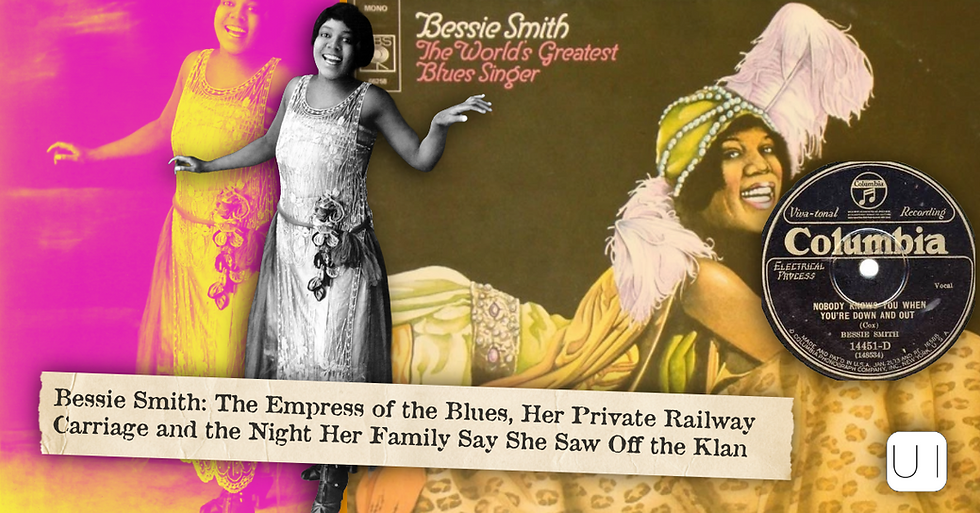
There's a story Bessie Smith's family used to tell. On a sweltering night in July 1927, a handful of robed Klansmen crept up to her show tent in North Carolina and started pulling out the stakes while the band played inside. Bessie walked out, told them exactly what she thought of them and went back in to finish her set. Nobody wrote it down at the time, but the people who knew her best never doubted it, which tells you plenty about her.
She was the biggest-selling blues singer of the 1920s. She loved women as well as men and didn't much care who in her company knew it. She crossed the segregated South in a bright yellow railway carriage she'd had built to order, spent her nights off in places called buffet flats and died after a crash on a Mississippi highway that people still get wrong. Then she lay in an unmarked grave for 33 years.
Quick Answers
Who was Bessie Smith? A blues singer from Chattanooga, Tennessee, billed as the Empress of the Blues. Her 1923 debut, Down Hearted Blues, sold around 780,000 copies in six months.
Was Bessie Smith bisexual? Yes. She was married to Jack Gee but had relationships with women too, including the chorus dancer Lillian Simpson.
What was a buffet flat? A private flat or house in a Black neighbourhood run as an after-hours club, with drink, sex shows and a bed for the night all on offer.
Did she really face down the KKK? It's a family story. Her sister-in-law and niece told it to her biographer decades later, with no 1927 report to back it up.
How did Bessie Smith die? Her Packard hit a truck on Highway 61 near Clarksdale, Mississippi, in the early hours of 26 September 1937. She died at 11:30 that morning.
Who paid for her gravestone? Janis Joplin paid half. The other half came from Juanita Green, a Philadelphia nurse who'd done housework for Smith as a child. The stone went up in August 1970.
From Chattanooga to $1,500 a week
Smith was born in Chattanooga, most likely on 15 April 1894, lost both parents young and started out singing for coins on street corners with her brother Andrew on guitar. By her late teens she was working the Black vaudeville circuit, where she shared bills with Ma Rainey.
Columbia signed her in 1923 for $125 a side. Her first release, Down Hearted Blues, sold 780,000 copies inside six months and within a couple of years her touring show was pulling in $1,500 a week. She paid cash for cars, bought her husband a $2,000 diamond ring and kept an entire company of dancers, musicians and stagehands on the payroll.
That company needed somewhere to sleep, which in the 1920s South was a real problem.

The yellow railway carriage built to order
Black performers on tour couldn't just book into a hotel. Most were whites-only, and the Green Book that later helped Black travellers find a safe bed wouldn't exist until 1936. Smith's brother Clarence came up with a fix in 1925: buy a train carriage and take the hotel with you.
She ordered one from the Southern Iron and Equipment Company in Atlanta. It was bright yellow with green lettering and two storeys high, with seven staterooms that each slept four, a kitchen and a bathroom. The lower level could sleep another 35 people. Accounts of its length don't agree (72 feet in one, 78 in another) but either way it was enormous, with room for the whole cast of her Harlem Frolics show plus the costumes, the props and the canvas tent they performed in when a town had no theatre that would take them. There was hot and cold running water on board, which plenty of the houses they rolled past didn't have.
It meant nobody had to go knocking on doors in a hostile town at midnight. It also gave her marriage a mobile battlefield. She once chased Jack Gee round the carriage emptying a pistol in his direction. She missed, possibly on purpose.
The carriage went in the early 1930s, when the Depression and the collapse of the record business cut her theatre fee in half.
Bessie Smith's sexuality: women, men and one furious husband
Smith married Jack Gee in 1923. Neither of them was faithful and neither took it well. The difference was that Gee slept with other women and so did she.
Several of her affairs were with dancers in her own chorus line. The best documented is Lillian Simpson, who danced in the show in the mid-1920s. When Simpson pulled away from a kiss in front of other people, Smith's reply was that she had "twelve women on this show" and could have a different one every night if she felt like it. Simpson left the tour not long afterwards.

He did find out eventually, when he walked in on his wife with another chorus girl in Detroit. There's also a long-running rumour that Smith and Ma Rainey were lovers in their early touring days. Nobody's ever proved it and it should be treated as gossip, though Rainey was open about her own interest in women.
Smith wasn't "out" in any modern sense, but inside the world of Black show business she barely bothered to hide it. We know as much as we do because her niece by marriage, Ruby Walker, toured with her for years and later talked on tape to the biographer Chris Albertson. It was a risky way to live. In the same decade Eve Adams was running a lesbian tearoom in Greenwich Village and paid heavily for it. A few years later women in Paris had Le Monocle to go to. Smith's version of a safe room was the buffet flat.
What was a buffet flat?
A buffet flat was a private apartment, or a house split into flats, in a Black neighbourhood of a big northern city, run by a landlady as an unlicensed after-hours club. The name was the menu. American Blues Scene's history of the term describes drink, sex shows, marijuana and other illegal entertainment laid on in different rooms, and you wandered between them picking what you fancied. The Chicago Tribune was reporting on them as early as 1911. By 1927 one newspaper estimate put the number in Manhattan and Brooklyn at around 10,000.
They started out as something more practical. Black travellers who couldn't get a hotel room could get a meal and a bed at a buffet flat, and they doubled as informal banks. Pullman porters earned good money but were always on the move, so on layovers in Detroit or New York they'd leave their wages with the landlady for safekeeping. Prohibition did the rest, turning a lot of them into speakeasies run by the same sort of women who kept America drinking through the dry years.
For Smith, the appeal was that nobody inside cared who you went home with. Drag queens who followed her tours used the flats as safe havens and same-sex couples could relax. Ruby Walker remembered a favourite in Detroit as a place where "everything goes on". One night there ended with Smith, Walker, three other women and a gay man all piled into the same bed.
Smith even put one on record. Soft Pedal Blues is about a Detroit landlady whose party is still roaring long after it should have finished, so she begs her guests to keep the noise down before the police turn up. The pianist obliges by playing with the soft pedal on.
The Klan story: what Bessie Smith's family said happened
This one comes down through the family, so it's best told the way they told it. Smith's sister-in-law Maud and her niece Ruby Walker both gave the story to Chris Albertson years after Bessie's death, and his biography is where everyone else has got it from. Maud had it from Bessie herself.
As they had it, the tent was pitched in July 1927 in a field in Logan, the historic Black neighbourhood of Concord, North Carolina. Partway through the show a musician stepped outside for some air and saw about half a dozen men in white robes working the tent stakes loose. With a full house inside, a collapsing tent could have killed people.
He ran in and told Smith. In the family's telling she marched out, swore at the Klansmen at length and asked what they thought they were doing. One line turns up in every version: "You just pick up them sheets and run." They went, the story goes, and she walked back in and carried on singing.
That's all there is to go on. It's a family memory passed on second hand, there's some doubt over whether Ruby was even in Concord that night, and the number of Klansmen shifts between six and a dozen depending on who's telling it. When a Concord truck driver called Jeff Williams, who'd first heard the story in Ken Burns's Jazz, petitioned for a state historical marker on the spot, the advisory committee voted 8-0 against recommending it. Their reason was the lack of primary sources: no newspaper from the time mentions Smith playing Concord at all. Oxford American's writer went further and said the tale "stinks of apocrypha".
Black touring shows rarely got written up in white Southern papers, so the silence doesn't prove much either way. It stays what it's always been: a story the Smiths told about Bessie, and one that fits everything else we know about her temper. North Carolina does have form here, mind. Three decades later the Lumbee people chased the Klan out of Robeson County at Hayes Pond, and that one was photographed.
The crash on Highway 61
By 1937 Smith was on the way back. The blues boom had ended but she was still working, and her last studio session, set up by John Hammond in November 1933, had Benny Goodman on clarinet. That same week Hammond put Goodman in a studio with a teenage Billie Holiday, whose own story would end even more cruelly.

Smith had separated from Gee and was living with Richard Morgan. At about one in the morning on Sunday 26 September 1937 the two of them left Memphis in her old wooden-framed Packard. She was due to open with the Broadway Rastus show in the Delta that day and they were heading for Clarksdale, 75 miles south down Highway 61. Morgan was driving.
Near Coahoma, a National Biscuit Company truck had pulled over so its driver could check his tyres. It was just moving off again, slowly, when the Packard ran into the back of it. The impact tore the roof off the car. Smith, in the passenger seat, took the full force on her right side. Morgan was barely hurt. The truck driver carried on into Clarksdale, saying he'd send help.
The first people on the scene, at around two o'clock, were a Memphis surgeon called Dr Hugh Smith and his friend Henry Broughton, who were off on a fishing trip. They found Bessie lying in the road. Her right arm was almost torn off at the elbow, which the doctor later described as "a traumatic amputation", and she had crushing injuries to her chest and abdomen. He put on a tourniquet while Broughton ran to a nearby house to phone for an ambulance.
After 25 minutes or so with no sign of one, the two men decided to drive her to Clarksdale themselves. They were clearing fishing tackle off the back seat of the doctor's Chevrolet when a car carrying a young white couple came down the highway at about 50 miles an hour and ploughed straight into it. The Chevrolet was shunted into the wrecked Packard. Now there were three smashed cars and two more casualties.

Help finally arrived from two directions. An ambulance sent after the truck driver raised the alarm took the white couple. A hearse doubling as an ambulance, driven by Willie George Miller of the L.P. Gibson Funeral Home, took Bessie Smith to the G.T. Thomas Afro-American Hospital. She was unconscious by the time she got there. Surgeons amputated her arm but she was pronounced dead at 11:30 that morning.
The hospital myth that won't die
A few weeks later Hammond wrote a piece for Down Beat suggesting Smith had bled to death after a white hospital refused to admit her. It became one of the most repeated stories in American music, and Edward Albee turned it into a play, The Death of Bessie Smith.
It didn't happen. Hammond later admitted to Albertson that he'd been working from hearsay. Clarksdale's white and Black hospitals were less than half a mile apart, and as NPR's Alison Fensterstock points out, no ambulance driver in 1937 Mississippi would have tried to take a Black patient to the white one. Dr Smith reckoned her chances were poor wherever she'd been taken.
None of which lets Jim Crow off the hook. The reason there was a separate hospital, a separate ambulance and a funeral home doing the driving is the same reason Emmett Till could be murdered elsewhere in the Delta eighteen years later. The true story is bad enough without the embellishment.
The hospital building is still there on Sunflower Avenue. It became the Riverside Hotel in the 1940s, a stop for touring blues musicians, and the room where Smith died has been kept as a tribute to her. Clarksdale is also where Highway 61 meets Highway 49, the crossroads where Robert Johnson is supposed to have sold his soul.
33 years in an unmarked grave, until Janis Joplin helped pay for the stone
Smith's body went home to Philadelphia. Her funeral on 4 October 1937 drew around 7,000 people, who pushed through police lines to get near the silver casket. Gee, still legally her husband, took centre stage while Richard Morgan sat off to one side. She was buried at Mount Lawn Cemetery in Sharon Hill.
And that was it. No headstone. Friends and musicians held benefit concerts in the late 1940s and early 1950s to pay for one, but the money went to Gee and he pocketed it at least once, possibly twice. For 33 years the grave of the Empress of the Blues was a patch of grass.

In 1970 a woman wrote to the Philadelphia Inquirer's Action Line column asking why. Two people answered. One was Juanita Green, a registered nurse who'd done housework for Smith as a girl and by then was president of the North Philadelphia branch of the NAACP. The other was Janis Joplin, then two months from the end of her own life. They split the bill between them, half each.
For Joplin it was a debt. She'd taught herself to sing from Bessie Smith and Odetta records as a girl in Texas and sometimes said she felt like Smith reincarnated. She told Hit Parader in 1969 how it had started: "I'd never sung before, and I came out with this huge voice." Paying for the stone was her way of saying where that voice had come from.
The stone was dedicated in August 1970 in front of about 50 admirers, as the Associated Press reported at the time. Joplin stayed away, reportedly so she wouldn't pull attention from the woman it was for. John Hammond, of all people, wrote the epitaph: "The Greatest Blues Singer in the World Will Never Stop Singing." The stone gives her dates as 1895 to 1937, a year out from the birth date most historians now accept.
There's one last coincidence. Janis Joplin died of a heroin overdose on 4 October 1970, aged 27, 33 years to the day after 7,000 people had filed past Bessie Smith's coffin. The following year Dory Previn wrote a song about the two of them called Stone for Bessie Smith.

Further Reading
Nearly everything we know about Smith's private life comes from Chris Albertson, who tracked down Ruby Walker, Maud Smith and Dr Hugh Smith while they were still alive. His biography, Bessie, is the one to read.
As an Amazon Associate, Utterly Interesting earns from qualifying purchases.
You Might Also Like
Sources
Oxford American, Everybody Knows You When You're Down and Out
American Heritage, Back to Bessie Smith
American Blues Scene, The Language of the Blues: Buffet Flat
American Blues Scene, Who Killed Bessie Smith?
The Charlotte Observer via Yahoo News, NC panel recommends against historic marker for Bessie Smith staring down the KKK
The Charlotte Observer via Yahoo News, The push to commemorate the night Bessie Smith cussed and chased the KKK out of Concord
GCN, Exploring the turbulent life of Black bisexual blues legend Bessie Smith
HuffPost, Bessie Smith: Music's Original, Bitchinest Bad Girl
The New York Times (Associated Press), 9 August 1970, Bessie Smith Grave, Unmarked Since '37, Finally Gets a Stone
uDiscover Music, Piece Of Her Heart: Janis Joplin Honors Blues Inspiration Bessie Smith
NPR via WFAE, Bessie Smith at the Crossroads
New World Encyclopedia, Bessie Smith
Encyclopedia.com, Smith, Bessie (1894-1937)
Phil Schaap Jazz, Bessie Smith's Final Record Date
History.com, Blues singer Bessie Smith, killed in Mississippi car wreck, is buried
Chestnut Hill Local, HBO film recalls my interviews with Bessie Smith's son
The Southland Music Line, Mississippi Blues Trail Series: Riverside Hotel


