

Aimo Koivunen: The Man Who Survived WW2 by Accidentally Overdosing on Methamphetamine
Updated: Aug 23
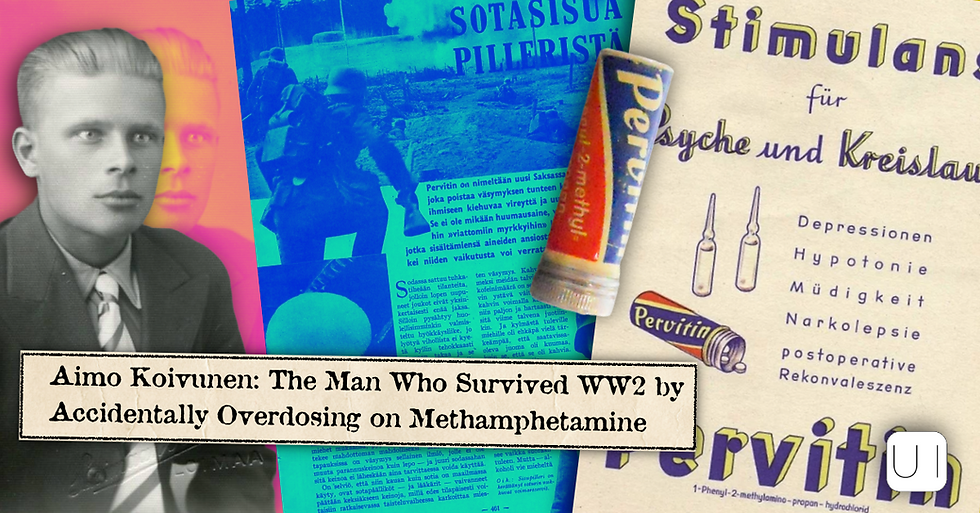
In March 1944, a Finnish corporal named Aimo Koivunen swallowed roughly thirty methamphetamine pills at once, fifteen times the recommended dose, in the middle of a Soviet ambush deep behind enemy lines. He then spent two weeks alone in the Arctic wilderness, hallucinating, half starved, blown off his skis by a landmine, before Finnish troops found him barely alive. He's still the only documented case of a soldier overdosing on methamphetamine in actual combat, and his story is stranger, and better documented, than the short version usually lets on.
Quick Answers
Who was Aimo Koivunen? A Finnish Army corporal born in 1917 who, during a ski patrol in March 1944, swallowed his unit's entire supply of methamphetamine tablets to survive a Soviet ambush, then wandered the Arctic wilderness alone for around two weeks.
How much methamphetamine did Aimo Koivunen take? He swallowed approximately 30 tablets of Pervitin, a methamphetamine based stimulant, when the recommended maximum dose was around two tablets. He remains the only documented case of a soldier overdosing on methamphetamine during combat.
Did Aimo Koivunen survive? Yes. He was found roughly two weeks later severely emaciated, weighing about 94 pounds with a heart rate of 200 beats per minute. He recovered fully, married, had nine children, and lived until 1989.

A Ski Patrol Behind Enemy Lines
By March 1944, Finland had been fighting the Soviet Union on and off for more than four years, first in the brief, brutal Winter War and then in the longer Continuation War, fought as an uneasy ally of Nazi Germany. The war was going badly. On 18 March, a small Finnish reconnaissance ski patrol operating deep in Soviet territory near Lapland, with Koivunen, an experienced 26-year-old skier, breaking trail at the front, ran straight into a Soviet ambush.
The patrol scattered and fled on skis. Koivunen, exhausted from hours spent cutting a path through deep snow for the rest of his unit, began falling behind. He was also the one carrying his squad's entire emergency ration of Pervitin, a methamphetamine based stimulant tablet issued to help soldiers stay alert on long missions.
Thirty Pills at Once
The tablets came in a small glass bottle, and Koivunen's hands, numbed by thick winter mittens and sub-zero cold, couldn't manage to work a single pill loose. Panicking, with Soviet troops somewhere behind him, he gave up trying to be precise. He unscrewed the cap and tipped the entire bottle into his mouth at once, somewhere around thirty tablets against a recommended maximum dose of roughly two. He later admitted, with typically dry understatement, that as the drug hit and his last clear thought faded, he realised "that, perhaps, was a mistake."
Unconscious and Still Skiing
For a few moments the massive dose worked exactly as intended, and Koivunen surged ahead fast enough to break trail through the snow and help his comrades gain ground on the Soviets behind them. Then he blacked out. He kept skiing anyway, apparently on some combination of muscle memory and chemical override, for a distance later estimated at around 100 kilometres, with no memory of any of it.
When his awareness returned, he was completely alone, still hallucinating, with no idea where his unit had gone. At one point he spotted what looked like his comrades standing on a distant hill and skied toward them, only to find himself in a heated, entirely one-sided argument about which direction they should all be heading in. He won the argument. There was, of course, nobody actually there.

The Booby-Trapped Camp
Still deep in enemy territory and still under the drug's effects, Koivunen came across an abandoned German supply camp and went in looking for food or equipment. It had been booby-trapped. A hidden landmine detonated as he searched it, tearing apart part of his foot and knocking him off his skis entirely. Somehow he kept moving, drifting in and out of consciousness through temperatures as low as minus 30 degrees Celsius, dragging his injured body onward through the snow.
Pine Buds and a Raw Bird
As the methamphetamine finally began wearing off after days of suppressing his appetite entirely, real hunger set in. There was almost nothing to eat in the Lapland wilderness in March. Koivunen survived on pine buds dug out of the snow and, in the ordeal's single strangest detail, caught a small Siberian jay with his bare hands and ate it raw.
Found
Finnish troops finally located him roughly two weeks after the ambush, and he was admitted to hospital at 2am on 1 April 1944. By then he'd covered an estimated 400 kilometres, around 250 miles, on skis, much of it unconscious and alone behind enemy lines. He weighed just 94 pounds, and his heart rate, still racing from the overdose weeks earlier, was measured at 200 beats per minute, more than double a healthy resting rate. Doctors nursed him back to health over the following weeks. He recovered completely.

A Quiet Life After
Koivunen didn't talk about the war much for the rest of his life, and turned down most opportunities to make more of the story than he already had. He married a woman named Elsa, and the couple settled in Central Finland and had nine children together. In 1978, he finally set his own account down in writing, contributing a first person recollection to Kansa Taisteli, a well regarded Finnish magazine built around soldiers' own wartime memories, which remains one of the primary sources for what actually happened to him that March. He died on 12 August 1989, aged 71, having quietly outlived the ordeal by 45 years.
What Pervitin Actually Was
Koivunen's overdose wasn't some rogue experiment. Pervitin was a real, widely distributed pharmaceutical, first synthesised in 1937 by Friedrich Hauschild, a research chemist at Berlin's Temmler company, and sold over the counter in Germany from 1938 as a pick me up for everything from tiredness to low mood. The German military adopted it enthusiastically once war broke out, issuing an unprecedented Stimulant Decree in April 1940 that sent around 35 million tablets to roughly 3 million soldiers, sailors and airmen ahead of the invasion of France, fuelling the relentless pace of the Blitzkrieg through the Ardennes. Nazi Germany's ally Finland received supplies of the same drug, which is how a bottle of it ended up in a ski patrol's emergency kit in Lapland four years later. The Allies weren't above it either, issuing tens of millions of their own amphetamine tablets, sold as Benzedrine, to British and American troops over the course of the war.
A Legend Reborn on Screen
Koivunen's story found an unexpected second life decades later. The 2022 Finnish action film Sisu, directed by Jalmari Helander, follows a near unkillable wartime prospector fighting his way across Lapland, and its official inspirations are usually traced to legendary Finnish sniper Simo Häyhä rather than Koivunen directly.
Even so, critics and outlets covering the film have repeatedly drawn the obvious parallel to Koivunen's own ordeal, another Lapland based tale of a lone Finnish soldier who simply refused to stop, and the film's title itself borrows the same word Finns use to describe exactly the kind of stubborn endurance Koivunen showed in 1944. Sisu is roughly translated as a stoic, almost bloody minded determination to keep going long after giving up would be the reasonable choice, and it's hard to think of a real person the word fits more precisely than a man who skied 250 miles through enemy territory while overdosing on his own squad's stimulants.
You Might Also Like
For another isolated patrol's desperate fight to survive on the same front, read The Soviet Patrol That Turned to Cannibalism in WWII.


