

Say Hello to “White Death” Simo Häyhä The Deadliest Sniper In History
Updated: Aug 23

In the winter of 1939, a quiet Finnish farmer with no formal military training became the most feared man on the Karelian front. Simo Häyhä stood barely five foot three, used a rifle with no telescopic sight, and reportedly killed more enemy soldiers than any sniper before or since, all inside a single winter of combat lasting less than 100 days. The Red Army called him Belaya Smert, the White Death.
Quick Answers
Who was Simo Häyhä? A Finnish farmer and sniper who fought in the 1939-40 Winter War against the Soviet Union. Using a rifle with iron sights rather than a telescope, he's credited with more confirmed sniper kills than anyone else in recorded military history.
How many people did Simo Häyhä kill? Official Finnish Army records from the time credit him with 219 rifle kills as of February 1940, while a military chaplain logged 259 by early March. Häyhä's own private memoir, found decades later, put his personal estimate closer to 500, though at least one Finnish historian has questioned how reliably that number could ever be confirmed.
What happened to Simo Häyhä? He was shot in the jaw in March 1940, days before the war ended, and was mistakenly left for dead. He recovered after months of surgery, farmed and hunted for the rest of his life, and died in 2002 at the age of 96.
A Farm Boy Who Could Shoot
Häyhä was born on 17 December 1905 in Rautjärvi, in rural southeastern Finland, where hunting for food was simply part of growing up rather than a hobby. He spent his childhood tracking small game and entering local shooting competitions, building the kind of patient, methodical accuracy that would later terrify an entire army. He joined the Finnish voluntary militia, the White Guard, in 1925, and by the time the Soviet Union invaded Finland in November 1939, he was serving as a sniper under Lieutenant Aarne Juutilainen in the 6th Company of Infantry Regiment 34.
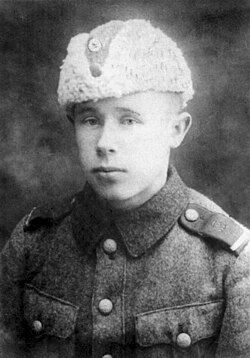
The White Death
Soviet troops began calling him Belaya Smert, the White Death, though the extent to which that specific nickname was genuine battlefield lore versus a phrase amplified by Finnish propaganda is still debated. His own countrymen actually had a different name for him, Taika-ampuja, the Magic Shooter, which says something about how his reputation split along the lines of the front.
The Winter War pitted a country of roughly four million people against a Soviet force many times its size, and Stalin's purges of the Red Army's own officer corps in the late 1930s had left it badly disorganised heading into the fight. Häyhä worked from a snow pit dug well before dawn, dressed in full white camouflage against Soviet soldiers who mostly had none, and stayed in position for hours in temperatures that fell as low as minus 40 degrees Celsius. He packed snow in front of his position to muffle his muzzle blast and hide the telltale puff it threw up, and reportedly held snow in his mouth so his own breath wouldn't give away his position in the cold air.
He deliberately avoided the telescopic sights most snipers relied on, favouring iron sights instead. They didn't fog in the cold the way scoped lenses did, didn't catch and reflect sunlight, and meant he didn't have to raise his head as high to aim, keeping less of himself exposed above the snow line.

The Soviets Couldn't Stop Him
Häyhä's own company held a stretch of the Kollaa front, a sector that became genuinely symbolic for Finland, giving rise to the wartime rallying phrase Kollaa kestää, Kollaa holds. The Soviets threw real resources at removing him specifically, not just at the Finnish line in general. They sent their own counter-snipers after him. None came back. When that failed, they turned to heavy machine gun fire and repeated artillery and mortar bombardments aimed at whatever patch of forest they suspected he was hiding in, burning through enormous amounts of ammunition on a single man. None of it worked. In February 1940, a Swedish businessman named Eugen Johansson paid for a custom honorary rifle to be presented to him in recognition of what he'd done, though by most accounts Häyhä simply kept using his old one instead, evidently seeing little reason to change a method that was already working.
How Many Men Did He Kill
The exact number has never been fully settled, and it's worth laying out why rather than just picking the most dramatic figure. Häyhä's own division commander, Colonel Antero Svensson, formally credited him with 219 confirmed rifle kills when he presented him with an honorary rifle on 17 February 1940, plus a roughly equal number attributed to submachine gun use. A military chaplain's diary put the rifle count at 259 by 7 March, the day after Häyhä was wounded. Decades later, Finnish Army sniper instructor Tapio Saarelainen, who interviewed Häyhä repeatedly between 1997 and 2002, arrived at a total as high as 542 in his biography of him.

Häyhä himself almost never discussed the number publicly. A private memoir he'd written in 1940, not discovered until 2017, put his own estimate at around 500, a figure he referred to simply as his sin list. Finnish historian Risto Marjomaa has since raised a fair point of caution: with bodies frequently left behind in enemy territory or buried under snow, verifying kills to that level of precision was genuinely difficult, and the real total may never be fully provable either way.
Wounded and Presumed Dead
On 6 March 1940, an explosive round fired by a Soviet soldier struck Häyhä in the lower left jaw. He was assumed dead on the spot and placed on a pile of bodies, and word spread on both sides of the front that the White Death had finally been killed. He regained consciousness a week later, on 13 March, the very day Finland and the Soviet Union signed the peace that ended the war. He read about his own death in the newspaper and had to write in personally to correct it.
His recovery took months and multiple surgeries, and left his face permanently scarred. When the Continuation War broke out the following year, Häyhä asked to be sent back to the front. His injuries were judged too severe, and the request was refused.

A Quiet, Difficult Peace
After the war, Häyhä was given a farm in Valkjärvi, near the Soviet border, where he built a second reputation as a skilled moose hunter and dog breeder, occasionally hosting the Finnish president on hunting trips. Fame didn't sit comfortably with him. He faced hate mail and even death threats over what he'd done during the war, avoided large public gatherings because of his scarred face, and lived out his life as a solitary bachelor, by his own account finding the nights the hardest part. As farm work grew too demanding, he eventually rented it out and moved into an apartment in the town of Ruokolahti. His honorary rifle eventually ended up in the Karelia Jaeger Battalion's own heritage collection before being transferred to the Finnish Military Museum, where it remains on display today.
He rarely spoke about the war at all. Asked in 1998 how he'd become such an effective marksman, his entire answer was "practice." In a rare 2001 interview with Helsingin Sanomat, given just before his 96th birthday, he was finally asked whether he felt any remorse for the number of lives he'd taken. "I did what I was told, as well as I could," he said. "There would be no Finland unless everyone had done the same."
Simo Häyhä died on 1 April 2002, aged 96.
A Legend for a New Generation
Häyhä's story found a new audience decades after his death through Sisu, the Finnish action film franchise directed by Jalmari Helander. The character at its centre, an almost unkillable Finnish veteran named Aatami Korpi, draws openly on Häyhä's legend, and its 2025 sequel, Sisu: Road to Revenge, leans even further into that comparison.
Sisu itself is a Finnish word without a direct English equivalent, roughly meaning a stoic, bloody minded determination to keep going long after most people would stop, and it's genuinely difficult to think of a real person the word describes better than a farmer who held off an invading army alone from a hole in the snow. It's the same word behind the title of another Winter War era survival story, that of Finnish corporal Aimo Koivunen, who overdosed on his own squad's methamphetamine supply and skied 250 miles through the Arctic to survive.

You Might Also Like
For another extraordinary Finnish survival story from the same war, read Aimo Koivunen: The Man Who Survived WW2 by Accidentally Overdosing on Methamphetamine.
Sources
3. The Finnish Sniper Who Killed Over 500 Soviet Soldiers, the Most Confirmed Kills in Military History, Military.com


