

Zeudi Araya: From Miss Eritrea to Italian Cinema Icon
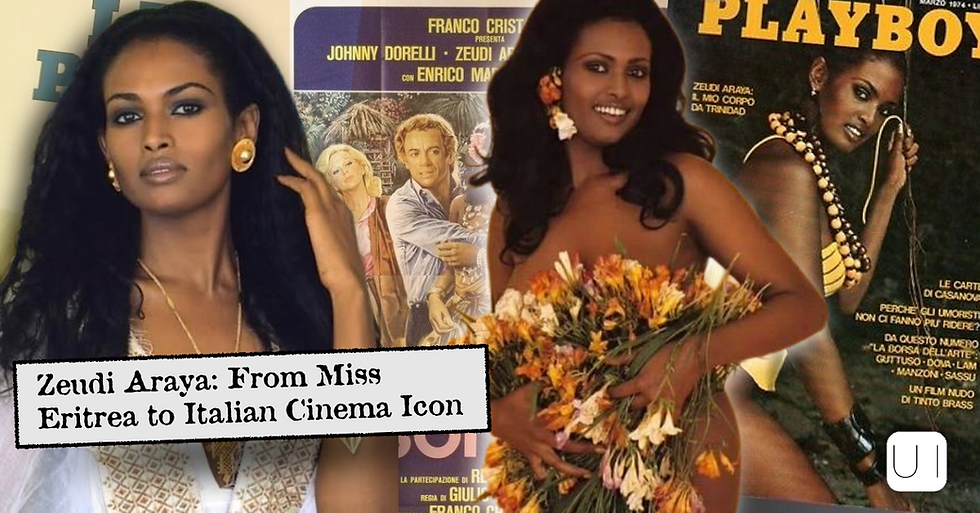
She was born in a small Eritrean town, became a beauty queen at 18, stumbled into Italian cinema almost by accident, and ended up as one of the most distinctive faces of 1970s European film. Then she quietly stepped away from it all and spent the next three decades helping preserve some of Italy's most celebrated movies. Zeudi Araya's life was genuinely extraordinary, and it didn't get the attention it deserved until her death in Rome on 24 May 2026 at the age of 75.
That date carries its own quiet significance. 24 May is Eritrea's Independence Day, and for many Eritreans, the timing of her passing gave the news an extra layer of poignancy.
A Political Family and a Beauty Crown
Zeudi Araya was born on 10 February 1951 in Dekemhare, a town in what was then the British Military Administration in Eritrea. She didn't come from nothing. Her father was a local politician, and her uncle served as a diplomat and later as the Eritrean ambassador to Italy. That connection to Rome would eventually change the course of her life.
In 1969, at just 18, she won the Miss Ethiopia title, a pageant that at the time included contestants from what is now Eritrea. She started modelling shortly after. It was a promising start, but nobody could have predicted where it would lead.
Discovered Over a Coffee Commercial
In 1972, Araya travelled to Rome, likely through her family's diplomatic connections there, and shot a commercial for the coffee brand Tazza d'Oro. It was a routine job, the kind of work a working model picks up. But the director Luigi Scattini happened to notice her, and that chance encounter reshaped her entire trajectory.
Scattini cast her in La ragazza dalla pelle di luna (1972), filmed in the Seychelles. The film was a sun-drenched, stylised erotic drama of the kind that Italian studios were churning out in the early 1970s. Araya had never acted before. She was magnetic on screen anyway.
She became one of the first Black women to achieve genuine star status in Italian cinema, a fact that often gets glossed over. Film historians who've studied this period point out that she paved the way for actresses like Laura Gemser, who followed a similar path through Italian exploitation and erotic cinema a few years later. But Araya got there first. Much like Josephine Baker had done in France decades earlier, she carved out a space for herself in a European film industry that wasn't exactly welcoming to women who looked like her.
A Run of Cult Films Through the 1970s
Between 1972 and 1983, Araya appeared in a string of Italian films that have since become cult favourites. She made her singing debut in 1973, recording two songs composed by Piero Umiliani for the soundtrack of Scattini's The Off-Road Girl. Those songs were released on a 45 rpm single, which makes them a genuine collector's item today.
Her filmography through the mid-1970s included Il corpo (1974), La preda (1974), and La peccatrice (1975). These were produced by the P.A.C. production company and largely directed by Scattini. They were provocative, sometimes deliberately exotic, and they found devoted audiences across Italy and beyond.
In 1976, the tone shifted. Having fallen for film producer Franco Cristaldi, she became an exclusive actress for his production company Vides, moving away from the erotic drama genre and into high-profile Italian comedies. That year she appeared alongside Paolo Villaggio in Il signor Robinson, directed by Sergio Corbucci. Villaggio was one of the biggest comedy stars in Italy at the time, known for his bumbling everyman character Fantozzi. The film was a commercial success.
Her final major screen appearances came in the early 1980s. She played Marfisa in the medieval epic Hearts and Armour (1983) and appeared in Giuliano Montaldo's sci-fi thriller Control (1987), which starred Burt Lancaster. After that, she walked away from acting. She was in her mid-thirties and had other plans.
The Playboy Italia Covers
Araya appeared in the Italian edition of Playboy twice during her acting years, and both appearances are part of what cemented her status as one of the most visible Black women in Italian popular culture during the 1970s.
The first was the March 1974 issue of Playboy Italia, on which she featured on the cover. It was a landmark moment. Italian Playboy had launched only a couple of years earlier, and landing the cover was a significant cultural statement. The second appearance came in the February 1977 issue, a few years into her relationship with Cristaldi. Both appearances have become highly sought-after pieces of 1970s Italian pop culture ephemera, and original copies regularly surface on collectors' sites.
It's worth noting the context. In 1974, a Black woman on the cover of a major Italian magazine was genuinely unusual. Much like Anita Berber, who had pushed boundaries in Weimar Germany half a century earlier, Araya was occupying spaces that were rarely given to women of her background. She did it without making a fuss about it, which perhaps explains why her name hasn't always featured as prominently as it should in conversations about representation in European media.
The Woman Behind Cinema Paradiso
Franco Cristaldi was one of the most important film producers in Italian cinema history. He worked with Federico Fellini, Luchino Visconti, and Francesco Rosi. He produced The Name of the Rose (1986) and Cinema Paradiso (1988), the latter winning the Best Foreign Language Film Oscar at the 62nd Academy Awards and the Grand Prix at Cannes. He'd previously had a long relationship with Claudia Cardinale, whom he'd guided through her own rise to stardom.
Cristaldi and Araya married in 1983. She starred in several Cristaldi-produced films during their relationship, and when he died in Monte Carlo on 1 July 1992, she inherited control of his company, by then renamed Cristaldifilm.
What she did next is the part of her story that almost nobody talks about. Rather than sell the company or step back entirely, Araya threw herself into preserving and promoting Cristaldi's legacy.
In 1995, she produced Marciando nel Buio, directed by her then-partner Massimo Spano. And in 1999, she produced a documentary about her late husband titled Franco Cristaldi e il suo cinema Paradiso, featuring interviews with Sean Connery, Franco Nero, Ennio Morricone, and director Giuseppe Tornatore. The woman who'd been a Seychelles-shot cult actress in the early 1970s had become one of the quiet custodians of Italian film heritage.
Much like Franca Viola, another Italian woman whose real significance was often underreported, Araya quietly reshaped the world around her without seeking recognition for it.
A Legacy That's Only Just Getting Its Due
Araya spent her later years in Rome with Massimo Spano, with whom she had a son, Michelangelo. She remained largely private, which is probably why so many film fans are only now catching up with just how remarkable her story was.
She was one of the first African women to become a genuine star of mainstream European cinema. She recorded and released music. She appeared on the cover of one of Italy's most widely circulated magazines at a time when that was genuinely groundbreaking. And then she quietly pivoted into film production and helped ensure that Cinema Paradiso and the rest of the Cristaldi catalogue stayed alive and available.
Her son Michelangelo announced her death on 24 May 2026. Italian media described her as an icon. The Eritrean community noted that she died on their country's Independence Day. Both descriptions fit.
If you've never heard of Zeudi Araya before, you've been missing out on one of the genuinely interesting lives in 20th century cinema. Now you know.
Sources
Mesob Journal — "Eritrean Film Star Zeudi Araya Dies at 75" — https://mesobjournal.com/post/eritrean-born-film-star-zeudi-araya-dies-at-75
Wikipedia — Zeudi Araya — https://en.wikipedia.org/wiki/Zeudi_Araya
Wikipedia — Franco Cristaldi — https://en.wikipedia.org/wiki/Franco_Cristaldi
Wikipedia — Cinema Paradiso — https://en.wikipedia.org/wiki/Cinema_Paradiso
IMDb — Franco Cristaldi biography — https://www.imdb.com/name/nm0188053/bio/
Audiovisiva — Franco Cristaldi e il suo cinema Paradiso (documentary record) — https://audiovisiva.org/en/documentary/franco-cristaldi-e-il-suo-cinema-paradiso


