

The Pubic Wars: How Penthouse's Bob Guccione Took On Playboy and Changed Publishing

Few rivalries in the history of American media were as brazen, as personal, or as consequential as the one that played out on newsstands throughout the 1970s. On one side stood Hugh Hefner, the silk-robed patriarch of Playboy, the most successful men's magazine ever published. On the other stood Bob Guccione, a Brooklyn-born artist turned publisher who had built Penthouse from nothing in a London bedsit and arrived in America with a single, stated mission: to knock the bunny off its perch.
What followed wasn't just a circulation battle. It was a war over how far mainstream publishing could push the boundaries of censorship, desire, and acceptable nudity. The press called it the Pubic Wars, a pun coined by Hefner himself, a nod to the ancient Punic Wars between Rome and Carthage. And like that conflict, it ended with one empire fatally weakened and the entire landscape transformed.

Two Men, Two Visions
Hugh Hefner launched Playboy in December 1953 from his kitchen table in Chicago, producing the first issue with $8,000 raised from 45 investors, including $2,000 from his own mother and brother. The undated debut, because Hefner wasn't sure there'd be a second issue, featured a nude photograph of Marilyn Monroe that he'd licensed for $500 from a Chicago calendar company without Monroe's knowledge or consent. It sold more than 50,000 copies almost immediately.
Playboy's appeal was a particular kind of aspirational fantasy. Hefner had done a semester of graduate work on Alfred Kinsey's sex research and understood exactly how wide the gap was between America's public morality and its private behaviour. His magazine offered urbane fiction, celebrity interviews, and centrefolds that were carefully lit, heavily retouched, and designed to feel warm and achievable rather than threatening or crude. Nudity, yes, but nudity with a smoking jacket and a hi-fi record playing softly in the background.
By the mid-1960s, Playboy was selling more than three million copies a month. It had its own clubs, its own mansion, its own brand of aspirational Americanism. Hefner had positioned himself not just as a publisher but as a philosopher of personal liberation. The bunny logo was second in global recognition only to Mickey Mouse.

Guccione came from an entirely different world. Born Robert Charles Joseph Edward Sabatini Guccione in Brooklyn in 1930, raised Catholic in New Jersey, he had spent time in a seminary before dropping out to pursue his dream of becoming a painter. By the early 1960s he was in London, working as a cartoonist, managing a chain of laundromats, and struggling to pay the rent.
Inspired by Playboy's success but convinced he could do something rawer and more artistically serious, he borrowed money and launched the first issue of Penthouse in Britain in 1965. It sold out within two days. The advance promotional brochure had already been confiscated by the British Post Office on the grounds that it constituted lewd material sent through the mail. Guccione won the appeal and got a windfall of free publicity in the process.
He taught himself photography and shot most of the early issues himself, developing the moody, soft-focus aesthetic that would become the magazine's visual signature. Where Playboy's images looked polished and wholesome, Penthouse looked decadent and European. Guccione wanted his models to look like art objects, like paintings.
Going Rabbit Hunting
Three years into Penthouse's London run, Guccione's British distributor mentioned something that changed his plans entirely. Penthouse was outselling Playboy two-to-one among American servicemen in Vietnam, precisely the eighteen-to-thirty demographic that Hefner had always owned. If the magazine could beat Playboy in the jungle, it could beat it in America.
In 1969, Guccione and his business partner Kathy Keeton moved to New York and set up headquarters in a suite at the Drake Hotel. On the day of Penthouse's American launch, Guccione took out a full-page advertisement in the New York Times showing the Playboy bunny logo in the crosshairs of a rifle. The caption read: "We're Going Rabbit Hunting."

Hefner didn't find it funny. He never would.
The timing of Penthouse's American arrival was significant. Due to far more relaxed European attitudes toward nudity, the magazine was already displaying pubic hair on its models at the time of its US launch. In 1950s and 1960s America, the legal consensus on obscenity had effectively drawn a bright line at pubic hair. Mainstream publications stayed carefully on the right side of it. Penthouse stepped straight over it.
In the April 1970 issue, Guccione published a small photograph of a naked blonde woman walking on a beach. A shadow at the top of her thigh was just identifiable as pubic hair. It was deliberate, carefully judged, and enormously effective.
Hefner initially vowed he'd never stoop to such tactics. The Pubic Wars had begun.
Escalation
Playboy held out for nine months. Then, with circulation numbers making the choice unavoidable, it quietly followed Penthouse's lead. Within a year of the American launch, Penthouse's circulation had passed one million, then two million, and was closing fast on Playboy. "Nine months later," Guccione said years later, still chuckling at the memory, "there was pubic hair in Playboy, because we were killing him on the newsstand."
Playboy's first clear depiction of visible pubic hair came in January 1971 with a pictorial by Liv Lindeland, and the magazine's first fully frontal centrefold followed in January 1972 with Marilyn Cole, who went on to become Playmate of the Year. It was a remarkable capitulation from a publisher who had spent years crafting an image of tasteful restraint.

As the competition intensified, the photo shoots at both magazines became progressively more explicit. Penthouse consistently stayed one step ahead, and Guccione kept escalating. During the height of the rivalry, Hefner and Guccione encountered each other in person at a private screening of Stanley Kubrick's A Clockwork Orange. It was the only time the two men were ever in the same room. "He snubbed me," Guccione recalled. "He shook my hand, said 'Nice to meet you' and disappeared. I never had any bad feelings toward him. He did toward me, with some justification, because we were making serious inroads into his territory."
By 1973, Penthouse had reached a circulation of over four million copies across sixteen countries. By 1979, it had surpassed Playboy in monthly sales, reaching roughly 4.7 million copies. Playboy itself achieved its all-time highest single-issue sales in November 1972, topping seven million copies, arguably driven in part by competitive pressure from Penthouse. Guccione, by 1982, was listed in the Forbes 400 with an estimated net worth of $400 million.
The Art Collection and the Mansion
At the height of his wealth, Guccione lived in a way that made even Hefner's famous Mansions look modest in certain respects. His 30-bedroom townhouse on East 67th Street in Manhattan's Upper East Side was reportedly the largest private residence in the borough, a 22,000-square-foot property filled with what he claimed was the largest private art collection in the United States: Dalís, Matisses, Renoirs, Picassos, all purchased with the proceeds of a magazine he'd started with a bank loan in a foreign country.
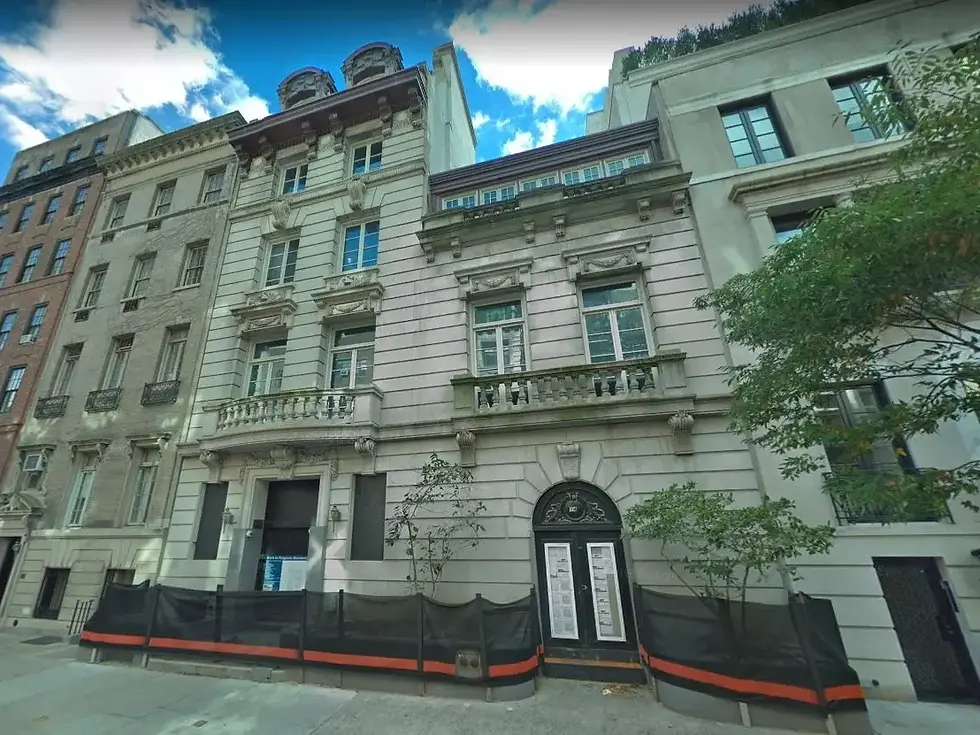
Unlike Hefner, who threw famously wild parties, life at Guccione's mansion was remarkably sedate. He preferred to work through the night, hunched over a light table poring over slides. He reportedly once had his bodyguards eject a local radio personality hired as a DJ who jumped naked into his swimming pool. He slept by day, worked at night, and was described by those who knew him as a recluse who happened to publish one of the most explicit magazines in the world.
His personal tastes ran to fine art, investigative journalism, and a genuine belief that Penthouse was doing something culturally significant. While Playboy devoted page after page to sport, celebrities, and consumer goods, Penthouse published serious literary writers including William Burroughs, Philip Roth, and Joyce Carol Oates, and its investigative journalism unit, staffed by writers including Seymour Hersh, broke genuine political scandals.
When Hustler Arrived and Changed the Rules
In 1974, Larry Flynt launched Hustler magazine and did something neither Playboy nor Penthouse had dared: he published explicit close-up photographs of women's genitalia. It was a move that effectively exposed the logical destination of the escalation both magazines had been engaged in, and it horrified both Hefner and Guccione equally.

Nicholas Guccione, Bob's son, put it bluntly years later. "They took it one step further than Penthouse," he said of Hustler. "At one point, they published a cover of a woman going through a hamburger meat grinder and coming out as ground meat. Now that's disgusting." The Gucciones drew a distinction between their own work, which they framed as a celebration of female beauty, and what they saw as Flynt's deliberately degrading content.
The arrival of Hustler forced both Playboy and Penthouse to define themselves against something even more explicit. Playboy began pivoting toward its identity as the sophisticated, softcore alternative, the one you could legitimately claim to buy for the articles. Penthouse continued its push toward explicit content and would eventually, in the mid-1990s, veer into territory that included fetish content, urination photography, and other material that cost it mainstream advertisers entirely.
The Vanessa Williams Scandal
The most notorious single issue in Penthouse's history arrived in September 1984, and it had Guccione's fingerprints all over it. The magazine published nude photographs of Vanessa Williams during her reign as Miss America 1984, the first Black woman to hold the title. Williams, then twenty years old, had posed for the photographs before her pageant career and had been assured by the photographer that they would never be published. She hadn't even told her parents about the shoot.
Guccione had obtained the photographs and published them without Williams's consent. She filed a $500 million lawsuit against him, though she later dropped it, saying she wanted to put the scandal behind her. She was pressured to relinquish her crown and became the first Miss America in history to do so. The first runner-up, Suzette Charles, completed the final seven weeks of her reign.
The issue sold nearly six million copies and reportedly earned Guccione a profit of $14 million. Interestingly, Hugh Hefner had apparently been offered the same photographs first and had refused to publish them. It was precisely the kind of distinction that defined how the two publishers were seen by the end of the 1970s: Hefner the aspiring respectable elder statesman, Guccione the man who'd publish whatever it took.
Vanessa Williams went on to build one of the most successful entertainment careers of her generation, earning Grammy, Emmy, and Tony Award nominations. In 2015, thirty-two years after the scandal, the Miss America organisation issued a formal public apology to her.
Caligula: The Ambition That Backfired
By the late 1970s, Guccione had become convinced he could do something no pornographer had ever managed: make a genuinely great film. His vehicle was Caligula, a lavish historical epic about the Roman emperor's descent into madness, written by Gore Vidal and financed by Penthouse. He recruited Malcolm McDowell for the title role, alongside Helen Mirren, Peter O'Toole, and John Gielgud, and hired Italian director Tinto Brass after being impressed by Brass's earlier film Salon Kitty.
The production was a catastrophe from nearly the first day of principal photography in Rome in September 1976. Vidal and Brass fell out publicly after Vidal gave an interview to Time magazine calling directors parasites who existed only to serve the screenwriter. An enraged Brass had Vidal thrown off the set. Guccione sided with Brass, though he privately called Brass "a megalomaniac" and complained that he'd shot enough footage to remake Ben-Hur fifty times over. Brass cast anarchists and ex-convicts as Roman senators. Maria Schneider, originally cast as Caligula's sister Drusilla, departed after growing uncomfortable with the nude scenes, reportedly sewing up the open tunics she was supposed to wear on camera.

When Guccione took over the editing after firing Brass, he secretly sent a skeleton crew back to the still-standing Roman sets with a group of Penthouse models and shot hardcore sex scenes that were then spliced into the finished film without the knowledge of the original cast. McDowell, Mirren, O'Toole, and Gielgud all discovered that unsimulated pornography had been added to a film in which they'd believed they were delivering serious dramatic performances. Every major creative figure involved disavowed the picture.
Both Brass and Vidal filed lawsuits. Anneka Di Lorenzo, who played Messalina, sued Guccione for sexual harassment in 1981, claiming he'd pressured her to have sex with business associates. A New York court ultimately awarded her $60,000 in compensatory damages and $4 million in punitive damages, though the punitive award was later vacated on appeal. Guccione had to hire out private cinemas to get the film screened at all, having bypassed the MPAA ratings system entirely, knowing it would receive an X rating no mainstream cinema would touch.
Roger Ebert called it "sickening, utterly worthless, shameful trash." Variety described it as "a moral holocaust." Despite all of this, and partly because of it, the film became profitable on the emerging home video market and has retained a cult following ever since. It remains banned in several countries. A reconstructed cut attempting to restore Gore Vidal's original vision, using 85 minutes of Tinto Brass's original workprint, screened at the Cannes Film Festival in 2023.
The Casino That Sank a Fortune
Long before Caligula destroyed his creative credibility, Guccione had already managed to lose a significant portion of his business fortune in a casino venture that belonged in a satire.
In 1972, he opened the Penthouse Adriatic Club casino inside the newly built Haludovo Palace Hotel on the Croatian island of Krk, then part of Yugoslavia. He invested approximately $45 million in the project, equivalent to well over $280 million in today's money. Fifty Penthouse Pet hostesses were stationed throughout the complex to serve food, drinks, and entertainment to the world's wealthy elite. Early guests included Swedish Prime Minister Olof Palme, Italian media tycoon Silvio Berlusconi, and a then-relatively obscure Iraqi politician named Saddam Hussein.

The problem was something Guccione had apparently failed to investigate before committing his fortune: Yugoslavian law, built on socialist principles, forbade any Yugoslavian national from gambling in a casino. The entire business model depended on a steady stream of wealthy foreign visitors, and not nearly enough of them came. The casino went bankrupt in 1973, just one year after opening. Worse, under another Yugoslavian ownership law, the hotel was officially owned by a Croatian workers' assembly company called Brodokomerc. Guccione had contracted to receive between three and seven per cent of the hotel's annual turnover. He received nothing. The loss of his $45 million investment was considered one of the contributing factors to his eventual bankruptcy three decades later.
The Haludovo Palace Hotel stood for decades afterward, serving as a refugee shelter during the Yugoslav Wars of the 1990s before closing permanently in 2001. It sits abandoned today, its modernist concrete shell slowly decaying above the Adriatic.
The Fall
The Penthouse empire began to unravel in the 1990s from multiple directions simultaneously. The IRS presented Guccione with a bill for $45 million in back taxes. He lost $20 million funding a team of eighty-two scientists in an attempt to develop a small nuclear reactor for low-cost energy generation. An Atlantic City casino project collapsed, costing him another substantial fortune. The growth of free online pornography destroyed the business model that had made him a billionaire, and Penthouse's circulation, which had stood at nearly five million in the late 1970s, fell below one million in the late 1990s and reached approximately 463,000 in 2003, the year General Media Inc. filed for bankruptcy.
Guccione resigned as chairman in 2004. His art collection, appraised by Christie's at $59 million, was sold to cover debts. His Manhattan mansion was foreclosed. He spent his final years in a modest retirement in Palm Springs, California, and died of lung cancer in a hospital in Plano, Texas, on October 20, 2010, at the age of seventy-nine.
His son Bob Guccione Jr., who had founded the music magazine Spin, was among the few who remained close to him. Nicholas Guccione, another of his sons, later said that their father had "made half a billion dollars in the eighties and thought he could do no wrong."
What the War Actually Changed
The Pubic Wars were not simply a publishing spat. The competitive escalation between Playboy and Penthouse during the 1970s genuinely moved the needle on American attitudes toward nudity and sexuality in mainstream media. Playboy's peak circulation of over seven million copies in a single month in 1972 represented a mass-market exposure to erotic content that would have been legally prosecutable less than twenty years earlier.
The rivalry also created the conditions for the harder, cruder content that came after it. When Hustler arrived in 1974 and went further than either Playboy or Penthouse had dared, it was only possible because those two magazines had already spent five years dismantling the legal and cultural barriers to explicit imagery in mainstream publications. And when home video, cable television, and eventually the internet continued down the same road, they were walking a path that Guccione and Hefner had already cleared.
Hefner spent his later decades repositioning Playboy as a lifestyle and culture brand, eventually dropping nudity from the print edition entirely in 2016, though it was restored in 2017. He died in his Playboy Mansion on September 27, 2017, at ninety-one, and was buried in the crypt he'd purchased thirty years earlier for $75,000 in Westwood Village Memorial Park, right next to Marilyn Monroe.
Guccione, characteristically, had no such tidy ending. He died broke, largely forgotten, in a state he'd never lived in.
But the term he inspired, those two blunt words that defined a decade of publishing warfare, has never gone away.
Sources
- Rolling Stone: "The Twilight of Bob Guccione" (https://www.rollingstone.com/culture/culture-news/the-twilight-of-bob-guccione-242213/)
- OG Collection / OG Gallery: The History of Penthouse Magazine (https://www.og.gallery/articles/the-history-of-penthouse-magazine)
- SBS Australia: "This is the man that gave you erotica" (https://www.sbs.com.au/whats-on/article/this-is-the-man-that-gave-you-erotica-the-bob-guccione-story/ziqa3zp3f)
- Fox News Entertainment: "Penthouse founder Bob Guccione, Playboy's Hugh Hefner had 'no animosity'" (https://www.foxnews.com/entertainment/penthouse-founder-playboys-hugh-hefner-no-animosity-battle-sex-empire-doc)
- CNN: "Secrets of Penthouse review" (https://www.cnn.com/2023/09/04/entertainment/secrets-of-penthouse-review/index.html)
- CBS News: Vanessa Williams Penthouse Photos (https://www.cbsnews.com/news/vanessa-williams-penthouse-photos-magazines-most-infamous-spread/)
- New East Digital Archive: "The story behind Haludovo" (https://www.new-east-archive.org/articles/show/13298/haludovo-luxury-yugoslav-era-hotel-international-elite-concrete-ideas)
- Variety: "Caligula: The Ultimate Cut Review" (https://variety.com/2023/film/reviews/caligula-the-ultimate-cut-review-1235744121/)
- Roger Ebert / RogerEbert.com: Caligula: The Ultimate Cut review (https://www.rogerebert.com/reviews/caligula-the-ultimate-cut-film-review-2024)
- Biography.com: Hugh Hefner (https://www.biography.com/business-leaders/hugh-hefner)
- Biography.com: Marilyn Monroe and Playboy (https://www.biography.com/actors/marilyn-monroe-playboy-first-issue-didnt-pose)
- UPI Archives: "More nude photos of Vanessa Williams" (https://www.upi.com/Archives/1984/08/24/More-nude-photos-of-Vanessa-Williams/3149462168000/)
- Find a Grave: Bob Guccione memorial (https://www.findagrave.com/memorial/60388164/bob-guccione)


