

The Jim Twins: Two Men, Two Lives, One Crazy Story

Imagine growing up without knowing you have an identical twin. No shared Christmases, no bickering over the bathroom mirror, no one to blame when something goes missing. Now imagine finally meeting that twin at age 39 and discovering you've both been living what can only be described as the same life, in different postcodes.
That's exactly what happened to Jim Lewis and Jim Springer, the Ohio twins whose reunion in 1979 left scientists, psychologists, and the general public simultaneously baffled and fascinated. Their story didn't just make headlines. It helped reshape how we understand human identity, genetics, and the age-old nature versus nurture debate.

So Far Apart, Yet Always Together
It began in 1939. Jim Lewis and Jim Springer were born on August 19th at Piqua Memorial Hospital in Ohio, to an unwed 15-year-old immigrant who immediately placed them for adoption. At just three weeks old, the boys went their separate ways, one to the Lewis family in Lima, Ohio, and the other to the Springer family in Piqua, roughly 40 miles down the road.
Here's where it gets immediately strange: both sets of adoptive parents, entirely independently of each other, chose the name James for their new son. Both boys came to be called Jim. Both adoptive families knew their child had a twin out there somewhere, but neither had any idea what had become of the other baby.
Forty miles apart, the two Jims grew up in different homes, with different parents, different schools, different everything. Or so it seemed.
A Childhood Full of Clues Nobody Noticed
As the boys grew, the coincidences were already stacking up, though they had no idea. Both Jims were brilliant at maths and enjoyed woodworking as a hobby, but were, by their own later admission, rubbish at spelling. Both had childhood dogs they'd named Toy. Both families independently chose the same beach in Florida for their holidays, though they never crossed paths there.
These aren't the kind of similarities you'd expect to chalk up to chance. And this was just the beginning.
Twin Hearts, Twin Minds: The Adult Years
If their childhoods were uncanny, their adult lives were downright eerie. Both Jims married and divorced women named Linda. Both then met and married women named Betty. Both had a son and both, without any contact whatsoever, named their boy James Alan (Jim Lewis) and James Allan (Jim Springer), differing only by a single letter.
Both men worked in law enforcement and security. Jim Lewis was a security guard and Jim Springer served as a deputy sheriff. Both were heavy smokers who favoured Salem cigarettes specifically. Both drove the same model of Chevrolet. Both suffered from tension headaches and were prone to nail-biting.

Both men also took their families on holiday to the same stretch of Florida beach. Reports suggest they'd been staying just three blocks apart from each other, year after year, without ever knowing it.
None of this was coordinated. None of it was known. These two men had never spoken, never met, and had no idea the other existed in any meaningful way until Jim Lewis, at age 37, decided to try and find his twin.
The Reunion: "Are You My Brother?"
In 1977, Jim Lewis managed to track down his brother's details through an Ohio courthouse. The first phone call between them, two men in their late thirties who were strangers sharing a face, was by Lewis's own account a carefully cautious affair. After a few tentative questions, Lewis reportedly took a deep breath and asked: "Are you my brother?" Springer's reply came back simply: "Yep."
Two years of correspondence and growing amazement followed. Then, on February 9th, 1979, the Jim Twins met in person at Springer's home. It was by all accounts deeply emotional, filled with laughter, disbelief, and a recognition that went far beyond just looking in a mirror.
Their story quickly captured national attention. They appeared on The Phil Donahue Show, The Tonight Show with Johnny Carson, and with hosts including Mike Douglas and Dinah Shore. People, Newsweek, Time, Reader's Digest and Good Housekeeping all ran features on them. Springer himself described the similarities as "downright spooky." Lewis added: "We even use the same slang."
The Science: What the Jim Twins Taught Us
The timing couldn't have been better for Dr. Thomas J. Bouchard Jr., a psychologist at the University of Minnesota with a keen interest in behavioural genetics. When the Jim Twins' story broke, he famously told reporters: "This is the kind of opportunity that comes along once in a generation of psychologists."
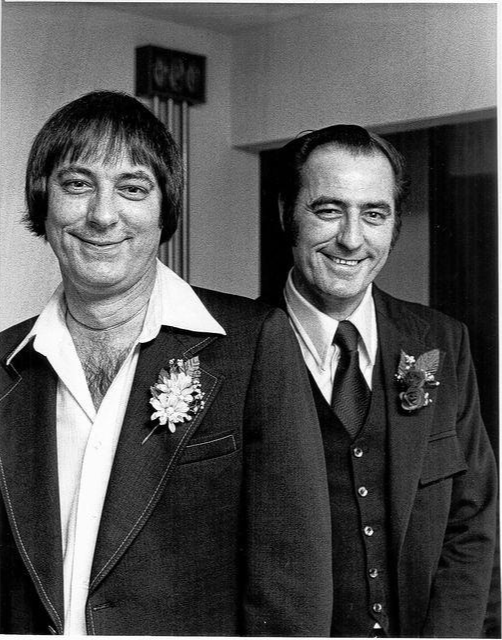
Bouchard contacted the twins and by March 1979 they'd agreed to travel to Minneapolis to take part in what would become one of the most significant psychological studies of the 20th century: the Minnesota Study of Twins Reared Apart (MISTRA).
The study ran for 20 years, from 1979 to 1999, and ultimately examined 137 pairs of twins, 81 identical and 56 fraternal, all of whom had been separated early in life and raised in different families. Each pair underwent roughly 50 hours of medical and psychological assessment over the course of a "twin week," working through more than 15,000 questions covering personality, health, intelligence, interests, and social attitudes.
The Jim Twins were arguably the most famous pair in the study. Their medical histories and brain-wave tests came back nearly identical. So did their results on personality assessments. Brain wave analyses showed remarkable synchronicity. The study found that around 70% of the variance in IQ was associated with genetic variation, a result that genuinely surprised even the researchers themselves.

Bouchard later reflected: "There probably are genetic influences on almost all facets of human behaviour." But he was careful to add that identical twins raised separately are, on average, about 50% similar, meaning environment does matter, just perhaps less than we'd once assumed.
One particularly striking example from the wider study involved a pair of female twins separated at five months old who weren't reunited until age 78, making them the world's longest-separated identical twins according to Guinness World Records. Their personality scores, when finally measured together, came back almost identical.
Nature vs. Nurture: What Does It All Mean?
The Jim Twins' story sits right at the heart of one of the oldest debates in science and philosophy. Are we shaped more by the genes we're born with, or by the environments we grow up in? The answer, it turns out, is both, but perhaps not in equal measure, and not in the ways we expected.
What the Minnesota study revealed, counterintuitively, is that shared environment tends to make twins more different, not more similar, while genetics persistently pull identical twins toward parallel outcomes regardless of where they grew up. In other words, you can separate twins at birth, raise them in completely different families, and find that their personalities, interests, and even their health histories converge anyway.
This doesn't mean your upbringing doesn't matter. Jim Lewis and Jim Springer clearly had different relationships and different perspectives shaped by different parents, schools and experiences. But the broad architecture of who they were, their temperaments, their tastes, their instincts, seems to have been built into them from the start.
Some researchers have gone a step further, using the twins' story to explore the possibility of some form of unconscious or psychic connection between identical twins. Jim Springer himself once stated that he'd "always felt an emptiness," a sense that something was missing. Whether that was a subconscious awareness of his twin, or simply the ordinary human feeling that life is incomplete, nobody can say for certain. But it's a haunting detail.

Legacy
Jim Lewis and Jim Springer didn't set out to change science. They were just two men who happened to find each other after nearly four decades apart, and who were understandably astonished by what they discovered. But their story became a cornerstone of behavioural genetics research, influencing not just the Minnesota study but countless subsequent investigations into the heritability of personality, health, and intelligence.
The Minnesota study alone produced more than 170 individual papers. Its findings have been cited, debated, and built upon ever since. And at the centre of it all are two guys from Ohio named Jim, who both drove Chevrolets, both married a Linda and then a Betty, and who both, somehow, ended up at the same Florida beach.
The Jim Twins lived and died without the scientific community ever fully explaining every parallel in their lives. Some things, it seems, genetics can account for. Others remain wonderfully, stubbornly strange.
Sources
Ripley's Believe It or Not, The Uncanny Case of the Jim Twins: https://www.ripleys.com/stories/jim-twins
CBS News / Live Science, Twin Brothers Separated at Birth Reveal Striking Genetic Similarities: https://www.cbsnews.com/news/twin-brothers-separated-at-birth-reveal-striking-genetic-similarities/
Wikipedia, Thomas J. Bouchard Jr.: https://en.wikipedia.org/wiki/Thomas_J._Bouchard_Jr.
Lima Ohio News Archive, Reunited After 39 Years: https://www.limaohio.com/archive/2015/07/28/reunited-after-39-years/
Twins Magazine, It Started with Two Strangers: Five Decades of Learning: https://twinsmagazine.com/started-with-two-strangers-five-decades-learning/
Communicating Psychological Science, Minnesota Study of Twins Reared Apart: https://www.communicatingpsychologicalscience.com/blog/minnesota-study-of-twins-reared-apart
People Magazine Archive (Vol. 11, No. 18), Two Ohio Strangers Find They're Twins at 39


