

Mae West: The Woman Who Went to Jail for Free Speech — and Changed Hollywood Forever
Updated: Apr 19
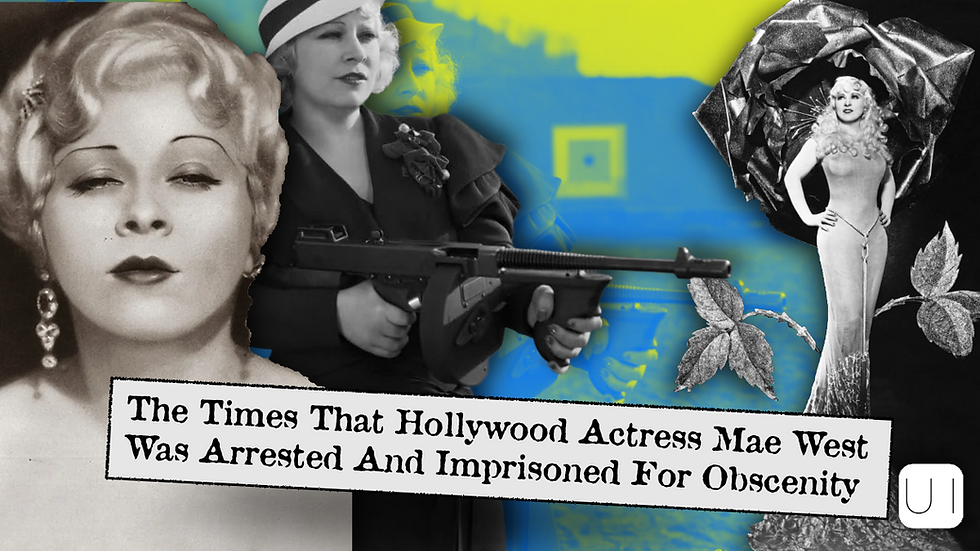
Mae West is one of the most quoted, imitated, and misunderstood figures in entertainment history. Long before #MeToo, before women were routinely in writers' rooms, before sexuality was openly discussed on screen, West was writing, producing, directing, and starring in her own work — and going to prison for it. This is the full story of a Brooklyn girl who took on Broadway censors, Hollywood studios, and the moral establishment of America, and won.

Brooklyn Born: The Making of a Performer (1893–1911)
Mary Jane West was born on 17 August 1893, in Bushwick, Brooklyn, New York, to a colourful family that would shape her personality in profound ways. Her mother, Matilda — known as 'Tillie' — was a German immigrant with frustrated showbiz dreams of her own. Despite training as a seamstress, she secretly pursued modelling and never entirely abandoned her theatrical ambitions. She became Mae's fiercest champion and remained so until her death in 1930.
Her father, John Patrick West, was a different kind of character entirely. Known locally as 'Battlin' Jack' West, he was a prizefighter whose reputation for street brawling extended to impromptu boxing exhibitions at Coney Island Amusement Park. When he later retired from the ring at his wife's insistence, he ran several businesses including, remarkably, a detective agency — a venture that little Mae would accompany him to, reportedly helping judge which clients could be trusted.
From almost the moment she could walk, Mae West performed. By age five she was entertaining crowds at a church social. By seven she was appearing regularly in amateur shows and winning local talent contests. At 14, she turned professional, signing with the Hal Clarendon Stock Company and joining the national vaudeville circuit — initially billed under the name 'Baby Mae'. She also used the alias 'Jane Mast' in her early career, experimenting with different personas including, remarkably, a male impersonator.

Her distinctive walk — that languid, rolling strut that became her signature — was said to have been inspired by two famous female impersonators of the era, Bert Savoy and Julian Eltinge, both prominent figures during the so-called Pansy Craze. She would later enhance it further with custom platform shoes designed to add height, which also deepened the sway.
In 1911, aged 17, West made a secret and legally questionable decision: she married vaudeville partner Frank Wallace in Milwaukee, Wisconsin, lying about her age on the marriage certificate since 18 was the legal minimum in the state. Both parties agreed to keep the marriage hidden from the public and her parents. The union remained secret until 1935, when a publicity staffer unearthed the marriage certificate. West was publicly evasive about it for years, and it wasn't until 1937 that she finally admitted under oath in court that the marriage had taken place. They divorced in 1943.
That same year, 1911, she made her Broadway debut in a revue called A La Broadway, staged by her former dancing teacher, Ned Wayburn. The show folded after just eight performances — but a review in The New York Times singled out 'a girl named Mae West, hitherto unknown,' calling her a notable talent. She was not yet 18, and the critics were already paying attention.

Vaudeville, Scandal, and the Shimmy (1911–1925)
After her Broadway debut, West spent years alternating between vaudeville circuits and occasional Broadway productions. In 1918, she gained significant wider attention through the Shubert Brothers revue Sometime, starring alongside comedian Ed Wynn. Her character, Mayme, performed the shimmy — a then-shocking full-body dance — and her photograph appeared on the sheet music for the popular number 'Ev'rybody Shimmies Now.' The shimmy would remain part of her repertoire and reputation for years.
She was simultaneously building her skills as a writer, working on scripts and plays under the pen name Jane Mast. West understood something that few performers of her era grasped: that controlling her own material was the only way to control her own image. By the mid-1920s, she was ready to make a move that would change everything.
Sex, Arrest, and Eight Days on Welfare Island (1926–1927)
In 1926, at the age of 32, Mae West wrote, produced, directed, and starred in a Broadway play called Sex. The title alone was incendiary by the standards of the day, and the content — West playing a sex worker navigating a world of men — was genuinely shocking to contemporaries. Critics in the mainstream press panned it as vulgar and exploitative. However, audiences disagreed entirely. Box office receipts were strong, and the production attracted the very thing its detractors feared most: massive public interest.
The show ran successfully until February 1927, when police raided the theatre following complaints from religious groups and city officials. West, along with most of her cast and crew, was arrested on charges of obscenity and public indecency. On 19 April 1927, she was fined $500 and sentenced to ten days' imprisonment on Welfare Island — the facility now known as Roosevelt Island in New York.
The incarceration, by all accounts, was not especially punishing. West reportedly dined with the warden and his wife on several occasions. She served eight days, with two days off for good behaviour — and she reportedly chose to wear silk knickers rather than prison-issue underwear throughout her stay. The media coverage of the entire episode was extraordinary, and it did precisely what censors had hoped to prevent: it made Mae West a national figure.
In her own words, written in 1929, West explained her philosophy clearly: 'What few people realise is that my work has a deliberate plan and purpose... thousands of women have asked me the most personal questions about their husbands and love life. They know nothing about sex at all, for the subject is hidden from children, kept out of our books and schools and education.' Her frustration with what she saw as wilful ignorance enforced by social convention was genuine and lasting.
Diamond Lil, The Drag, and Further Battles with Censorship (1927–1931)
Undeterred by her arrest, West immediately returned to provocative territory. Her next major work, The Drag, was a play dealing explicitly with male homosexuality — described in its full title as A Homosexual Comedy in Three Acts. West was a genuine early advocate for gay rights and had publicly condemned the police brutality that gay men routinely faced. But The Drag never made it to Broadway: it opened in Bridgeport, Connecticut, in January 1927 for a trial run, but a screening committee refused to approve it for New York, and it never played there.
Her 1928 play Diamond Lil, however, was a different matter entirely. The story of a racy, streetwise woman in 1890s New York, it became a genuine Broadway hit, running at the Royale Theatre from April 1928 through January 1929. West would revive it multiple times throughout her career. Interestingly, during the Chicago leg of the Diamond Lil tour in 1929, West suffered serious abdominal pains during performances and was treated by a spiritual healer named Sri Deva Ram Sukul — an encounter that sparked a lifelong interest in spiritualism, psychics, and the supernatural. She consulted spiritual advisers throughout her life and even sought guidance from 'the forces' when writing screenplays.
The Pleasure Man opened in September 1928 and was raided twice by police. The jury ultimately failed to reach a verdict. The Constant Sinner followed in 1931, closing quickly under pressure from the District Attorney. Each legal battle added to West's mythology and kept her name in the headlines.

Hollywood at 38: Saving Paramount Pictures (1932–1933)
By 1932, Paramount Pictures was in serious financial trouble. The Great Depression had devastated box office revenues, and the studio was teetering on the edge of bankruptcy. In an act of calculated risk, Paramount offered Mae West — then 38 years old, an age at which most actresses of the era were considered finished — a contract worth $5,000 per week (roughly equivalent to $80,000 today). Critically, West negotiated the right to rewrite her own dialogue, ensuring her sharp wit and personality would survive intact on screen.
Her film debut came in Night After Night (1932), in a supporting role. In her most famous scene, a hat-check girl exclaims over her jewels: 'Goodness! What lovely diamonds!' West's response — 'Goodness had nothing to do with it, dearie' — reportedly got such a laugh from the crew during filming that they had to stop production. The line has never lost its punch.
The following year brought She Done Him Wrong (1933), based on Diamond Lil and starring West opposite a young Cary Grant — an actor she specifically requested after seeing his potential. The film contained what became perhaps the most misquoted line in cinema history. West's actual line was 'Why don't you come up some time and see me?' — not the commonly cited 'Come up and see me sometime,' which reverses the emphasis entirely. The distinction mattered to West, who was precise about her material.
She Done Him Wrong grossed over $2 million (approximately $140 million in today's money), received an Academy Award nomination for Best Picture, and is widely credited with single-handedly saving Paramount from bankruptcy. West's follow-up that same year, I'm No Angel, also starring Grant, was even more successful — her biggest box office hit of her entire career, and one of the few of her films released before the Hays Code crackdown that remained relatively uncensored.
By 1935, Mae West was the highest-paid woman in America, and the second highest-paid person of any gender in the country. The only individual who earned more was newspaper magnate William Randolph Hearst.
The Hays Code, William Randolph Hearst, and Fighting the Censors (1934–1940)
From 1 July 1934, the Motion Picture Production Code (commonly called the Hays Code after its architect, Will H. Hays) began to be strictly and systematically enforced. For West, this meant her scripts were subject to heavy editing before production could begin. Her response was characteristically subversive: she increased her use of innuendo and double entendres, deliberately confusing the censors by layering meaning so that suggestiveness could be plausibly denied. It was a strategy that worked more often than it failed.
In 1936, West starred in Klondike Annie, a film that tackled religion and hypocrisy through the story of a woman posing as a Salvation Army worker. This drew the ire of William Randolph Hearst (the same Hearst who was the highest-paid person in America) who personally instructed all of his newspapers and magazines to refuse any advertising or editorial coverage of the film. Despite this considerable opposition, Klondike Annie performed well at the box office and is now considered by many film historians to be one of the high points of her screen career.
In December 1937, West appeared on the popular Chase and Sanborn Hour radio show alongside ventriloquist Edgar Bergen and his dummy Charlie McCarthy. A sketch recreating the Garden of Eden (with West as Eve and actor Don Ameche as Adam) caused a national furore. It resulted in West being effectively banned from American radio for years. The Federal Communications Commission received thousands of complaints. The sketch is now studied in media history as an example of how profoundly anxious American society was about any perceived sexual content in mass entertainment.
Mae West and the Cultural Footprint: Art, Fashion, and War (1930s–1940s)
The cultural impact of Mae West extended far beyond cinema. In the months following the release of I'm No Angel, references to her appeared everywhere. Cole Porter worked her into song lyrics. A Works Progress Administration mural at San Francisco's newly built Coit Tower included her image. Mexican artist Frida Kahlo painted My Dress Hangs There in part as a response to West's persona. Kahla's husband, Diego Rivera, described West as 'the most wonderful machine for living I have ever known.' F. Scott Fitzgerald called her 'the only Hollywood actress with both an ironic edge and a comic spark.'
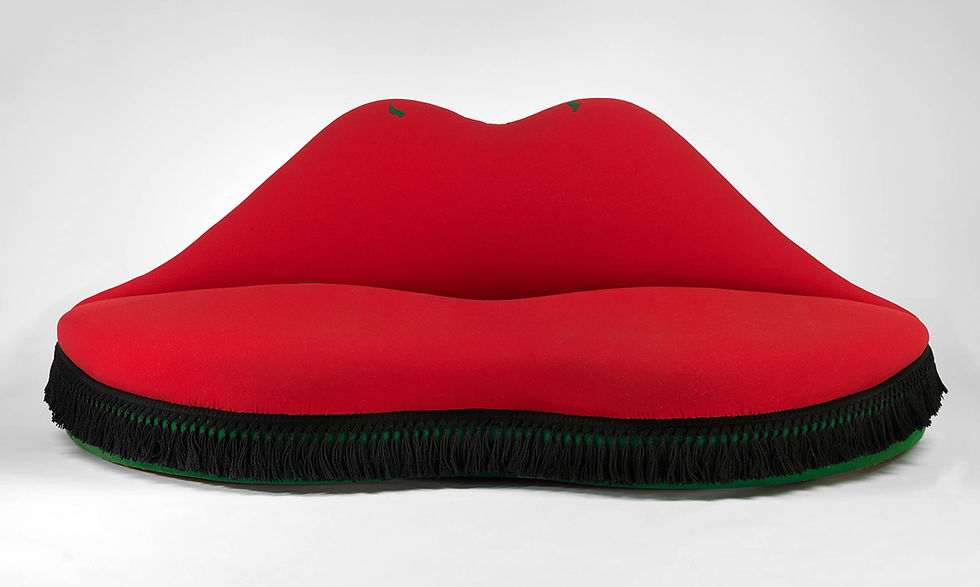
Surrealist artist Salvador Dalí was so fascinated by her that he created one of his most iconic works in her honour: the Mae West's Lips Sofa (1937), a sculpture in the shape of her lips. Fashion designer Elsa Schiaparelli modelled a perfume bottle — and the scent itself, called Shocking — on West's torso. There are also persistent claims that the famous curvature of the Coca-Cola bottle was influenced by her figure, though this has never been formally confirmed.
During the Second World War, her cultural presence took on a literal life-saving dimension. Allied soldiers (particularly US Navy and Army pilots) nicknamed their inflatable life jackets 'Mae Wests,' a tribute to her famously curvaceous silhouette. The term entered military parlance so thoroughly that it persisted in use long after the war.
Lesser-Known Facts About Mae West
Away from the cameras, Mae West was a surprisingly private and disciplined person. Despite her raucous public image, she did not drink, did not smoke, avoided large parties, and maintained a careful diet of fresh, healthy food. She kept pet monkeys throughout her life, doting on them reportedly like children, giving them names such as Boogie and Tricky.
She was a lifelong supporter of gay rights at a time when such advocacy was both socially daring and legally risky. She openly condemned police violence against gay men and built gay themes into her theatrical work decades before the mainstream began to engage with such issues.
Among her acquaintances in later years was a young Jerry Orbach (later famous worldwide as Detective Lennie Briscoe in the Law & Order television franchise) who served for a period as her chauffeur.
One of her closest friends, the boxer William 'Gorilla' Jones, became her driver after his fighting career ended, and his mother served as West's wardrobe assistant. West was fiercely loyal to those in her inner circle.
Director Federico Fellini pursued her for years, desperate to cast her in one of his films. She declined every approach. West's later film appearances (Myra Breckinridge (1970) and Sextette (1978)) were made on her own terms, with contractual guarantees that she could write her own dialogue and approve her wardrobe.
Later Life: Las Vegas, Rock and Roll, and the Beatles (1950s–1970s)
As her film career wound down, West remained relentlessly active. She performed in Las Vegas nightclub acts through the 1950s, where she attracted a devoted following that included a significant gay audience. She appeared occasionally on television and in the 1960s released several music albums, including Way Out West (1966) and Wild Christmas (1966). In a move that surprised many, she later recorded rock and roll material — a genuine reinvention that demonstrated her extraordinary instinct for staying culturally relevant.
When The Beatles approached her in 1967, seeking permission to include her likeness on the cover of Sgt. Pepper's Lonely Hearts Club Band, her response was vintage West: 'What would I be doing in a lonely hearts club?' Nevertheless, she agreed — and her image appears on what many consider the most famous album cover in popular music history. She has a star on the Hollywood Walk of Fame at 1560 Vine Street, and was inducted into the American Theater Hall of Fame. In 1999, the American Film Institute ranked her 15th among the greatest female screen legends of classic American cinema.

Mae West's Legacy: What She Really Meant for Free Speech
It is tempting to reduce Mae West to her one-liners — and they are genuinely brilliant. 'It's not the men in your life that count; it's the life in your men.' 'I believe in censorship. I made a fortune out of it.' 'A hard man is good to find.' But beneath the wit was a sustained, deliberate campaign to expand what could be said, shown, and discussed in public life.
West's battles with censors in the 1920s and 30s contributed directly to the eventual collapse of the Hays Code and its replacement with the MPAA rating system in the 1960s. By consistently demonstrating that the public wanted frank, intelligent entertainment — and by surviving every attempt to silence her — she helped shift the boundary of acceptable expression in American culture.
She also modelled something that was genuinely radical for women of her era: total creative and financial control. At a time when actresses were expected to be beautiful objects in other people's stories, West was writing, producing, directing, negotiating contracts, and fighting legal battles. She was a one-woman entertainment industry decades before the language existed to describe what she was doing.
Mae West died on 22 November 1980 in Hollywood, California, following a series of strokes. She was 87 years old. She was buried in New York — the city where she had started performing as a child, been arrested as an adult, and become a legend. Her career had spanned more than seven decades. In that time she had appeared in just 12 films — but the influence of those films, and the battles she fought to make them, reverberates still.
While you're here, enjoy a few Mae West quotes.
-------------
• “When I’m good, I’m very good, but when I’m bad, I’m better.”
• “I generally avoid temptation unless I can’t resist it.”
• “Too much of a good thing can be wonderful.”
• “It’s not the men in my life that count, it’s the life in my men.”
• “You only live once, but if you do it right, once is enough.”
• “I never said it would be easy, I only said it would be worth it.”
• “I used to be Snow White, but I drifted.”
• “Between two evils, I always pick the one I never tried before.”
• “A hard man is good to find.”
• “I always say, keep a diary and someday it’ll keep you.”
• “Good girls go to heaven, bad girls go everywhere.”
• “Marriage is a great institution, but I’m not ready for an institution.”
• “An ounce of performance is worth pounds of promises.”
• “I’m no angel, but I’ve spread my wings a bit.”
• “Give a man a free hand and he’ll run it all over you.”
• “Don’t keep a man guessing too long—he’s sure to find the answer somewhere else.”
• “It’s better to be looked over than overlooked.”
• “Anything worth doing is worth doing slowly.”
• “He who hesitates is a damned fool.”
• “Love conquers all things except poverty and toothache.”
• “Every man I meet wants to protect me. I can’t figure out what from.”
• “I believe in censorship. I made a fortune out of it.”
• “A dame that knows the ropes isn’t likely to get tied up.”
• “Is that a gun in your pocket, or are you just happy to see me?”
• “I’m no model lady. A model’s just an imitation of the real thing.”
• “You’re never too old to become younger.”
• “When women go wrong, men go right after them.”
• “I’ll try anything once, twice if I like it, three times to make sure.”
• “To err is human, but it feels divine.”
• “Too much of a good thing can be taxing.”
• “A man in the house is worth two in the street.”
• “I speak two languages—Body and English.”
• “It ain’t no sin if you crack a few laws now and then, just so long as you don’t break any.”
• “I never loved another person the way I loved myself.”
• “His mother should have thrown him away and kept the stork.”
Sources
Eells, George. Mae West: A Biography. William Morrow & Company, 1982.
Morris, Jane Gaines. Fire and Desire: Mixed-Race Movies in the Silent Era. University of Chicago Press, 2001. (Discusses West’s cultural impact.)
Watts, Jill. Mae West: An Icon in Black and White. Oxford University Press, 2001.
Parish, James Robert, and Vincent Terrace. The MGM Stock Company: The Golden Era. Arlington House, 1973. (Covers studio conflicts and censorship battles.)
American Film Institute (AFI) – Mae West film entries: https://catalog.afi.com
Biography.com – Mae West profile: https://www.biography.com/actors/mae-west
PBS American Masters – Mae West: https://www.pbs.org/wnet/americanmasters/mae-west-about-mae-west/634/
The New York Times Archive – Mae West obituaries and features: https://www.nytimes.com
Encyclopaedia Britannica – Mae West entry: https://www.britannica.com/biography/Mae-West
Library of Congress – National Film Registry (for films like She Done Him Wrong): https://www.loc.gov/programs/national-film-preservation-board/film-registry/


