

Maria Rasputin: Lion Tamer, Author, And Daughter Of 'The Mad Monk'
Updated: Sep 11

Most people who get a walk-on role in the fall of the Romanovs stay a walk-on role. Maria Rasputin didn't get that choice. She was Grigori Rasputin's eldest surviving daughter, she may have had to identify his mutilated body in 1916, and by the time she died in Los Angeles sixty-one years later she'd worked as a cabaret dancer, a circus lion tamer mauled by a bear mid-performance, a wartime shipyard riveter and, more than once, a woman formally investigated as a suspected communist purely for sharing her father's surname. Her own account of all this, written across three books, has also been picked apart by later historians as something closer to myth-management than memoir. Both things about her are true: she really did live the wild life the headlines describe, and she probably wasn't always straight with the people reading about it.
Quick answers
Who was Maria Rasputin?
The eldest surviving daughter of Grigori Rasputin, born Matryona Rasputina in Siberia in 1898. She later worked as a cabaret dancer, circus lion tamer and shipyard riveter in the US, and wrote three books defending her father's memory.
Did Maria really identify her father's body?
By most accounts, yes, alongside other family members, after Rasputin was murdered in December 1916 and his body pulled from the Malaya Nevka River days later.
What happened to her first husband, Boris Soloviev?
He claimed to run a secret network rescuing the imprisoned Romanovs, but historians now regard much of it as a fraud that took money from desperate monarchist sympathisers while doing little to actually help the family.
Are Rasputin's descendants still alive today?
Yes. His great-granddaughter, Laurence Huot-Solovieff, lives near Paris and has spoken publicly since the 2000s about researching the family's real history.

A childhood split between a Siberian village and a mystic's household
Maria was born Matryona Grigorievna Rasputina in March 1898 in Pokrovskoye, a village in the Tobolsk region of Siberia, to a peasant family that was comfortable by local standards but still worked the land. Her father, Grigori, was a starets, an unordained wandering holy man who preached and offered spiritual comfort across the countryside. From early on Maria showed a habit of quiet scepticism that stayed with her for life, and she and her siblings dreaded the long hours of enforced prayer and fasting that structured the household.
Everything changed in 1906, when Grigori was introduced to the imperial family in St Petersburg and was soon credited by Empress Alexandra with easing the suffering of her haemophiliac son, Tsarevich Alexei. In 1910, Maria and her sister Varvara were sent to live with their father in the capital so they could be turned into what the family called little ladies, while their mother stayed behind in Pokrovskoye with their brother. Rasputin's household servant, and by most accounts his mistress, was left in charge of raising them, and eventually found the girls a governess to close the gaps left by years without proper schooling.
Her father's unofficial hostess
Maria settled into life in the capital and became her father's informal hostess, greeting the stream of visitors, mostly women, who came to their small apartment at all hours hoping for an audience with the man many now called Russia's most dangerous mystic. To Maria he was simply an unpolished, devout peasant with striking pale blue eyes, who blessed his children every night and kept a strict eye on their suitors, allowing none of them more than half an hour alone with the girls before he burst in to show them the door.
Outside the apartment, Rasputin's reputation was turning toxic. To much of educated Russian society he was a drunk and a womaniser who had bewitched a desperate Empress, and his influence over the royal couple grew even as the country slid toward catastrophe. Maria would later admit that a great deal was happening around her that she simply didn't understand at the time, even as she formed real friendships with the four young Romanov grand duchesses, whom she remembered gliding into rooms so quietly you could barely hear their footsteps.

An earlier brush with death
The 1916 murder wasn't the first time Maria found herself close to her father's death. Two years earlier, on 12 July 1914, a noseless peasant woman named Chionya Guseva, a former follower of one of Rasputin's rivals, stabbed him in the stomach outside his home in Pokrovskoye, screaming that she had killed the Antichrist. Maria and her mother accompanied him to hospital in Tyumen, where he survived a seven-week recovery. By Maria's own account, her father was never quite the same afterward, and took up drinking dessert wine in the years that followed, a small but telling detail usually left out of accounts that jump straight from Rasputin's rise to his murder two years later.
The murder, and a body pulled from the river
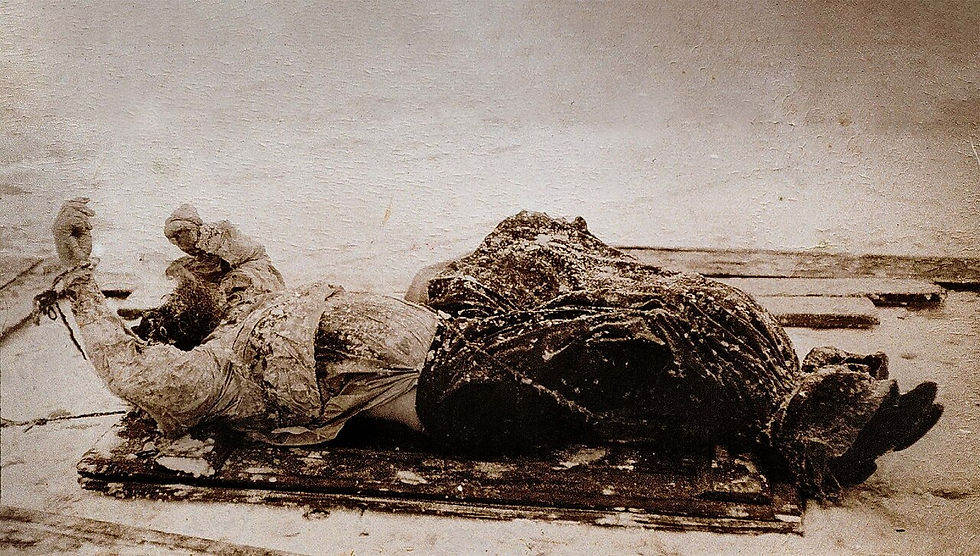
On a freezing night in December 1916, Rasputin was lured to a late gathering by Prince Felix Yusupov and his associates and murdered. His body, showing signs of beating, gunshot wounds and drowning, was recovered from the Malaya Nevka River days later. Multiple accounts of the case describe Maria among those who had to identify her father's remains. At the funeral, she later wrote bitterly, many of the same people who had knocked at her father's door for favours while he was alive didn't bother to show up and pray for him once he was dead.
The husband who turned a doomed rescue into a fraud
Maria and Varvara initially escaped to their mother's home in Pokrovskoye, and in 1917 Maria married Boris Soloviev, a man Rasputin's own circle had pushed her toward and widely expected to inherit her father's mystical standing. What Soloviev actually did with that standing was considerably darker than the vague description of him as merely a man of questionable character usually gets across.
Soloviev told the imprisoned Nicholas and Alexandra that he led a secret monarchist rescue network called the Brotherhood of St John, based near the Trans-Siberian railhead at Tyumen, and that he was coordinating their escape. Sympathisers abroad believed him enough to raise substantial sums in his name, and one of the Empress's own friends, on hearing that Rasputin's son-in-law was running the operation, told other would-be rescuers to stand aside and simply fund Soloviev's network instead.

The Brotherhood was, by most accounts, largely fictitious. Soloviev pocketed jewels the Tsarina had passed him to help fund an escape, and the false sense of security his story created is thought to have actively got in the way of other, more genuine rescue efforts during the one window when the family might conceivably have been saved.
None of that stopped Maria and Boris living a genuinely dangerous life together for a while afterward, hiding from the Red Army and once buying his release from prison with a bribe of a thousand roubles. They eventually escaped to continental Europe, where Maria gave birth to two daughters, Tatiana and Maria, while Boris worked as a soap factory hand, a night porter and a car washer to keep the family fed. He died in Paris in 1926, worn down, in Maria's own words, by work far beyond his strength.

Losing almost everyone
The family Maria had once shared quiet moments with at Tsarskoye Selo was murdered in its entirety at Yekaterinburg in 1918. Her mother and brother disappeared into the Soviet gulag system in Siberia. Her sister Varvara died in Moscow in 1924, in circumstances accounts still disagree on, either starvation or poison. Maria kept going, supporting her two young daughters by working as a lady's companion to a wealthy Russian exile in Paris.
Cabaret dancer, then “the daughter of the mad monk”
Her next career came out of nowhere. As she told the Los Angeles Times decades later, an unexpected offer arrived to dance in a Bucharest cabaret, one she always insisted came her way because of her famous surname rather than any real talent for dancing. She toured European stages for several years billed openly as the daughter of the mad monk, and in 1929 published her first book, The Real Rasputin, an unapologetic defence of her father's character.

From European circus rings to a genuine American career
Animal training came next, first with Circus Busch in Germany from 1929 and the Cirque d'Hiver Bouglione in France in 1933. Her circus work carried its own streak of dark irony: she sometimes performed a dance number built around a dramatic interpretation of her own father's death. Asked once whether she minded sharing a cage with wild animals, she replied with characteristic dry humour, in her own memoir, “Why not? I have been in a cage with Bolsheviks.”
Maria arrived in New York by steamer on 8 March 1935, speaking almost no English and getting by on German instead, to join the Hagenbeck-Wallace Circus in Peru, Indiana, then the second-largest circus in America behind Ringling Bros. and Barnum & Bailey. On 10 April 1935, while working an arena packed with two lions, two tigers, three bears, two leopards and two pumas, she lost her footing and was mauled by a Himalayan black bear badly enough to injure her legs. Her fellow performers fought the animals off, and after convalescing in Peru she insisted on rejoining the tour in Chicago just weeks later, arriving by ambulance to an ovation from a stadium crowd that had turned out specifically to see her back in the ring.
Her American immigration status was shakier than her nerve. Her two daughters, who'd stayed behind in Europe, were denied entry to the US in 1938, and Maria herself was ordered to leave the country within ninety days. She only secured the right to stay by marrying Gregory Bernadsky, a childhood friend from Russia and former White Army officer, in Miami in March 1940. It wasn't until she rejoined a circus, this time Ringling Bros. itself, in 1937 that American newspapers really took notice, running her photograph with captions calling her a self-declared daughter of Russia's mad monk, and putting her on the back of a Wheaties box alongside other circus stars endorsing it as the breakfast of champions.
Settling in Los Angeles
Maria gave up performing for good after the bear mauling and settled with Bernadsky in Los Angeles. The marriage ended in divorce in 1946; Maria told the judge that Bernadsky had called her names, struck her, and finally simply deserted her. She stayed on in a comfortable Silver Lake duplex, in a neighbourhood with a large Russian community, and went to work as a machinist at the San Pedro shipyards, telling one interviewer years later, “Lathe, drill press, I operate them all.”
Investigated as a communist for the crime of her own name
During the Red Scare, Maria found herself under suspicion for the strange crime of sharing her father's surname, and in 1948 she felt compelled to write a public letter to the Los Angeles Times insisting she was not a communist, adding that she loved the United States from the bottom of her heart for the freedom to say so. After retiring from the shipyards she supported herself through Social Security payments and odd jobs as a babysitter and carer, attending her local Russian Orthodox church most weeks and giving interviews, whose details reportedly shifted depending on the outlet, whenever money was tight.

How reliable is Maria's own version of events?
Maria wrote three books defending her father, and for decades they've functioned as one of the main sources anyone writing about Rasputin actually uses, this article included. That's a real problem, according to historian Douglas Smith, whose 2016 biography Rasputin drew on archives in seven countries specifically to strip away a century of what he called myth, fabrication, gossip and lies that had built up around the man, much of it originating with people who had every reason to shade the truth in his favour. Smith's approach was to treat every colourful old anecdote, including plenty that trace straight back to Maria's own memoirs, as a claim to be checked rather than a fact to be repeated.
It's worth remembering Maria had an obvious motive of her own: she built an entire career, and her only steady income for years, on convincing the public her father had been a good man wrongly destroyed by a cruel and manipulative society. That doesn't make everything in her books false, but it's exactly the kind of interested testimony that modern Rasputin scholarship now treats with real caution rather than quoting uncritically.
The family history that's still being written today
Rasputin's line didn't end with Maria. His great-granddaughter, Laurence Huot-Solovieff, the daughter of Maria's daughter Tatiana, lives near Paris and has spent years quietly researching the family's actual past. According to UPI, she is the only one of Rasputin's surviving descendants to have travelled to Russia, visiting Pokrovskoye itself and finding that what locals told her about her great-grandfather finally matched what her own grandmother, Maria, had always told the family privately. For decades the surname itself was close to forbidden at home. According to Russia Beyond, it was only after her father's death that a cousin insisted the family finally start talking openly about their history, and Laurence has since spoken at conferences and to journalists specifically to push back against the version of her great-grandfather that's hardened into caricature.
A strange afternoon with the woman who claimed to be Anastasia
Maria's connection to the Romanov girls she'd grown up around resurfaced one more time, decades later and an ocean away. On 13 August 1968, she travelled to Charlottesville, Virginia, to meet Anna Anderson, the best-known of the many women who claimed over the years to be Grand Duchess Anastasia, somehow having survived the massacre at Yekaterinburg. After a private conversation lasting several hours, Maria came away convinced, telling reporters afterward, “She reminded me of things I had forgotten.”
The endorsement didn't last. According to multiple accounts, Maria later tried to arrange a second meeting, this time wanting Anderson to join her for dinner in Los Angeles under the Romanov name, and Anderson refused, apparently unwilling to trade on the title so publicly. Maria took the refusal personally and quietly withdrew her support. Anderson's own claim was conclusively disproved in 1994, when DNA testing on preserved tissue identified her almost certainly as a missing Polish factory worker named Franziska Schanzkowska rather than any Romanov.
A legacy that outlived the caricature
Maria Rasputin died in Los Angeles on 27 September 1977, not long after finishing her third and final book, Rasputin: The Man Behind the Myth, written with Patte Barham. The New York Times marked her death two days later with an obituary that summed her up, in essence, as a circus performer who'd spent her life insisting she really was the mad monk's daughter, a framing that, intentionally or not, captured exactly how much of her life had been spent having to prove a fact that was never actually in doubt. Her story sits naturally alongside two very different kinds of fraud from the same turbulent decades: the fake Romanov rescue network her own husband ran on desperate monarchists, a scheme with real echoes of Victor Lustig's own confidence tricks a few years later, and the family whose actual final hours, so different from the rescue fantasies Soloviev sold, are laid out in full in the story of the Romanovs' last day in that Yekaterinburg cellar. Her own circus years, meanwhile, unfolded inside an industry with its own uncomfortable relationship to how it treated the people it put in the spotlight, a theme explored further in the darker history of the American circus sideshow.
FAQ
Why was Maria's name changed from Matryona to Maria?
She was born Matryona, sometimes shortened to Mara or Marochka within the family, and adopted the more Western-friendly Maria once she began performing and publishing outside Russia.
Which circus did Maria actually join first in America?
The Hagenbeck-Wallace Circus in 1935, not Ringling Bros. as sometimes reported. She only joined Ringling Bros. itself in 1937, after briefly having to leave and re-enter the country.
Did Maria ever fully believe Anna Anderson's claim?
Only briefly, after their 1968 meeting in Virginia. She withdrew her support once Anderson later refused a second meeting Maria had proposed.
What happened to Maria's two daughters?
Tatiana and Maria stayed in Europe when their mother emigrated to the US. Maria's descendants, including great-granddaughter Laurence Huot-Solovieff, still live near Paris today.
You might also like
The Final Day of the Romanov Family: What Really Happened in That Cellar, The Story Of Victor Lustig, The Man Who Sold The Eiffel Tower Twice and The Dark History of the Circus Freak Show


