

What Is the Mabinogion? Inside Wales's Oldest Myths, Manuscripts and Heroes

The Mabinogion is Wales's great collection of medieval prose tales, eleven stories of shapeshifting kings, cursed queens, talking heads and giants with impossible demands, and it's one of the strangest survival stories in British literature. The stories themselves are older than Britain's oldest surviving copies of them by centuries, the modern title everyone uses for the collection was basically a mistake, and buried inside one of its tales is the same fighting dragon that ended up on the Welsh national flag. If you've read The Lord of the Rings or grew up on Fleetwood Mac's Rhiannon, you've already brushed up against it without knowing. Here's the full story, the manuscripts, the characters and the myths that came out of Wales long before anyone wrote them down.
Quick answers
What is the Mabinogion?
It's a collection of eleven anonymous medieval Welsh prose tales, mixing native mythology, early Arthurian legend and Welsh versions of French romance. The core four tales are known as the Four Branches of the Mabinogi, and the rest are usually grouped as four native tales and three Welsh romances.
Where does the name Mabinogion actually come from?
From a copying mistake. The word mabinogi appears at the end of the Four Branches as a description of that group of tales, and a scribe once wrote a plural form of it, mabinogion, that doesn't correctly exist in Welsh grammar. Translator Lady Charlotte Guest picked up that one-off error in the 19th century and used it as the title for all eleven tales, and it stuck.
Is King Arthur in the Mabinogion?
Yes, in several of the later tales, though he looks quite different from the courtly Arthur of French romance. In the tale Culhwch and Olwen he's a primitive warlord commanding a court of shapeshifters and monster hunters, in a story scholars generally agree is the oldest surviving Arthurian tale of any kind.
How old are the stories, really?
Older than the books they survive in. The two main manuscripts date to the mid to late 14th century, but the tales themselves are generally dated to somewhere between 1050 and 1200, and they were told out loud by Welsh storytellers for who knows how long before anyone wrote a word down.
A name that's technically a mistake
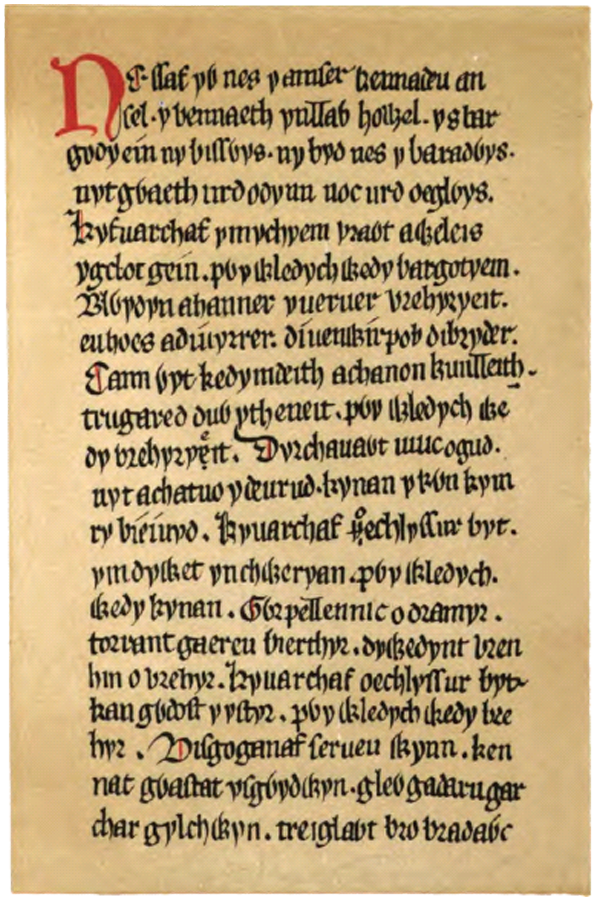
Start with the word itself, because it's stranger than it looks. In Middle Welsh, mabinogi is a real word connected to mab, meaning son or boy, and it shows up at the close of each of the first four tales in a line something like this branch of the Mabinogi is thus ended. Somewhere along the way, a scribe copying the last of those four tales wrote a form of the word, mabynnogyon, that scholars now recognize as a simple copying error, most likely the scribe mistakenly treating mabinogi as though it needed a plural ending it doesn't grammatically take.
That single slip of the pen would have stayed a curiosity if Lady Charlotte Guest hadn't picked it up centuries later and used Mabinogion as the umbrella title for her English translation of all eleven tales, not just the four it originally referred to. Modern scholars like Sioned Davies argue the name properly only belongs to the Four Branches, the tightly plotted family of tales scholars believe came from a single hand, but by the time anyone worked that out the name was already everywhere. What the word actually meant in the first place is still argued over. Linguist Eric Hamp suggested it traces back to Maponos, a Gaulish god whose name means roughly the divine son, which would make the Four Branches something like the tales of the god's kin. Others read it more simply as an early word for a body of tales or lore. Either way, the collection's entire modern name is a linguistic accident that happened to be catchy enough to survive.
Two medieval manuscripts, and centuries of storytelling before them
The Mabinogion survives mainly in two manuscripts, and neither of them was written anywhere close to when these stories were first told. The earlier and more complete of the two is the White Book of Rhydderch (Llyfr Gwyn Rhydderch), copied around 1350, most likely at Strata Florida Abbey by a team of five scribes working for a wealthy patron named Rhydderch ab Ieuan Llwyd. It's the earliest known compendium of these tales, and it's had an eventful few centuries since. The manuscript was split into two volumes at some point during early rebinding, with the pages cropped in the process, and it passed through a string of private Welsh antiquarian collections (Rhiwedog, then the library of John Jones of Gellilyfdy, then Robert Vaughan's famous Hengwrt library) before finally landing at the National Library of Wales in 1904, care of a donation from Sir John Williams. It was rebound in goatskin in 1940, and you can view digitised pages of it online today.
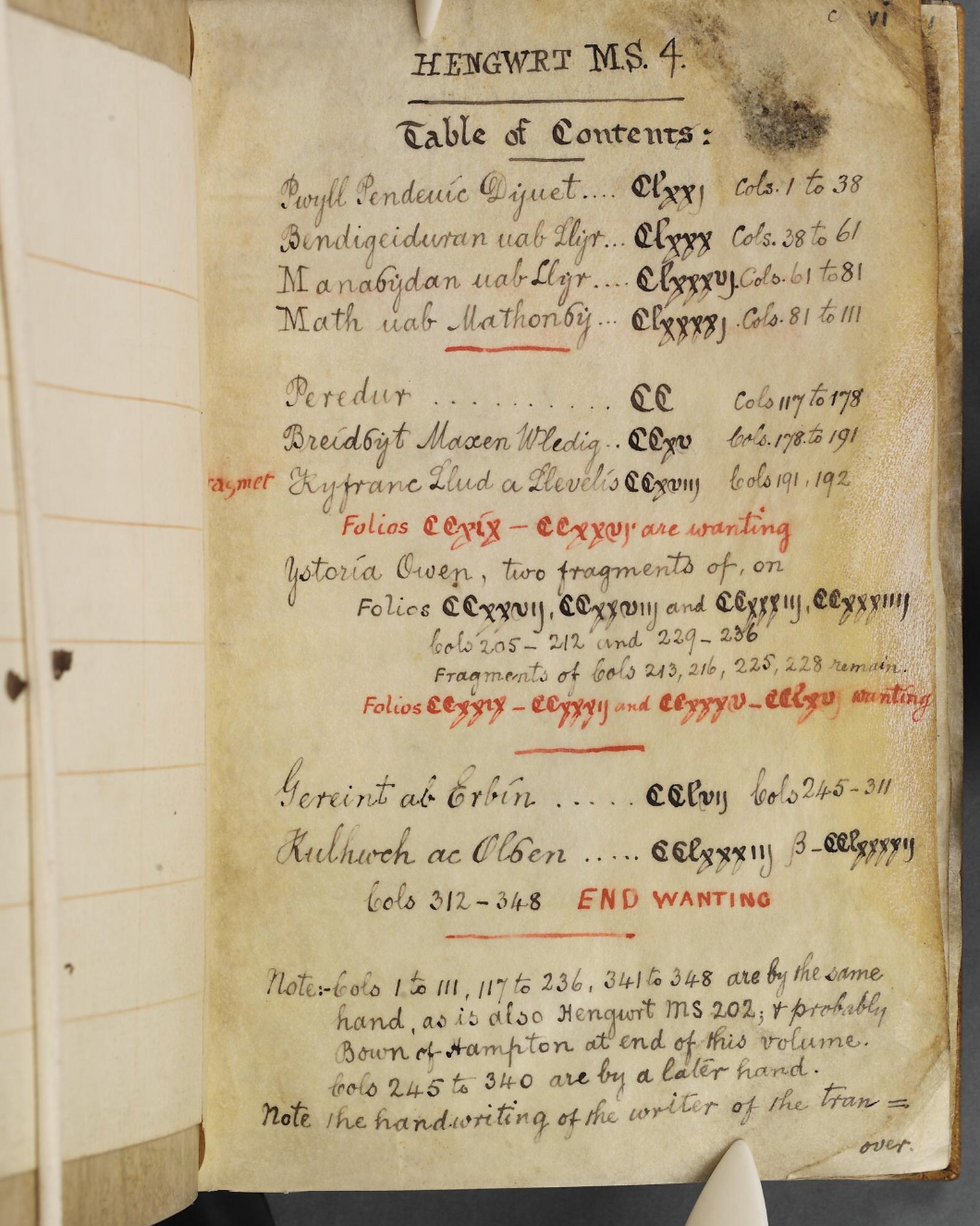
The other main source is the Red Book of Hergest (Llyfr Coch Hergest), copied somewhat later, between about 1382 and 1410. It's the more complete of the two, since it includes The Dream of Rhonabwy, a tale that's simply missing from the White Book entirely. A handful of even older fragments also survive, including sections of the second and third branches preserved in a 13th century manuscript known as Peniarth 6, which means pieces of these stories were already being copied down a full century before either of the two main manuscripts existed.
None of that tells you how old the stories actually are, though, and that question has kept Welsh medievalists arguing for decades. The scholarly range runs from as early as 1050 to as late as 1225 depending on which tale and which linguist you ask. Ifor Williams, who produced the first serious critical edition of the Four Branches, argued for a date before 1100 based on the language's grammar and vocabulary. Saunders Lewis pushed for something closer to 1170 to 1190. A 1970 study by Thomas Charles-Edwards concluded the language fits the 11th century best, somewhere around 1050 to 1120, and a widely cited 1991 study by Patrick Sims-Williams settled on a broader working range of roughly 1060 to 1200, which is close to the current scholarly consensus. What everyone agrees on is that whatever date you land on for the writing, the actual stories, plots, characters and names were circulating in oral form well before that, carried by professional Welsh storytellers who'd have known these tales the way a modern actor knows a script, changing details in performance without changing the bones of the story.
The Four Branches: Pwyll, a curse and a family it never lets go of
The heart of the whole collection is a set of four interlinked tales known as the Four Branches of the Mabinogi (Pedair Cainc y Mabinogi), and they're the only tales in the collection that actually use the word mabinogi in their own text. Scholars increasingly think they were composed by a single author, since the four stories share a consistent style, a recurring cast and a habit of circling back to unfinished business from earlier branches.

The first branch, Pwyll Pendefig Dyfed (Pwyll, Prince of Dyfed), opens with Pwyll accidentally offending Arawn, the king of the Welsh Otherworld Annwn, during a hunting mishap. The two strike an unusual deal: they'll swap appearances and kingdoms for a year, with Pwyll ruling Annwn in Arawn's place, on the condition that Pwyll doesn't sleep with Arawn's wife the entire time. He keeps the bargain honourably, wins Arawn's lasting friendship, and returns home to fall for Rhiannon, an Otherworldly woman who arrives on a horse no rider can catch and effectively proposes to him herself rather than marry a suitor she doesn't want, a nobleman named Gwawl. Pwyll tricks Gwawl into climbing into a magic bag at the wedding feast and has his men beat him inside it until Gwawl agrees to give Rhiannon up, a scene that's played almost for comedy. The couple's son, who becomes Pryderi, later vanishes from his cradle on the night he's born, and Rhiannon is falsely accused of murdering and eating her own child. Her punishment, sitting by the castle gate confessing her supposed crime and carrying visitors in on her back like a horse, is one of the most quietly brutal images in the whole collection, and it only ends when the boy turns up alive, raised by a lord named Teyrnon who'd found him abandoned and noticed the boy's uncanny resemblance to Pwyll.

The second branch, Branwen ferch Llŷr (Branwen, Daughter of Llŷr), is the collection's most violent tale by a wide margin. Branwen, sister of the giant king Bendigeidfran (Bran the Blessed), is married off to Matholwch, the king of Ireland, in a peace-building alliance. The marriage collapses almost immediately when Branwen's own half-brother Efnisien, furious he wasn't consulted about the match, mutilates Matholwch's prized horses out of spite. The insult spirals into open war between Wales and Ireland, and Bran, described as too enormous for any ship to carry, simply wades across the Irish Sea himself with his army following behind. The Irish possess a cauldron of rebirth that can revive their dead warriors overnight, though the ones brought back lose the power of speech forever, and it's Efnisien again, in one final act of self-destructive heroism, who ends the war by hiding among the corpses and breaking the cauldron from the inside, dying in the process. Nearly everyone on both sides is killed. Branwen herself dies of grief on the journey home, and Bran, mortally wounded, orders his surviving men to cut off his head, which keeps talking and keeping them cheerful company for eighty-seven years before it's finally buried facing France beneath the White Mount in London (widely identified with the site of the Tower of London) as a permanent charm against invasion. Later legend has it that King Arthur, unwilling to accept any protection but his own strength, dug the head back up.
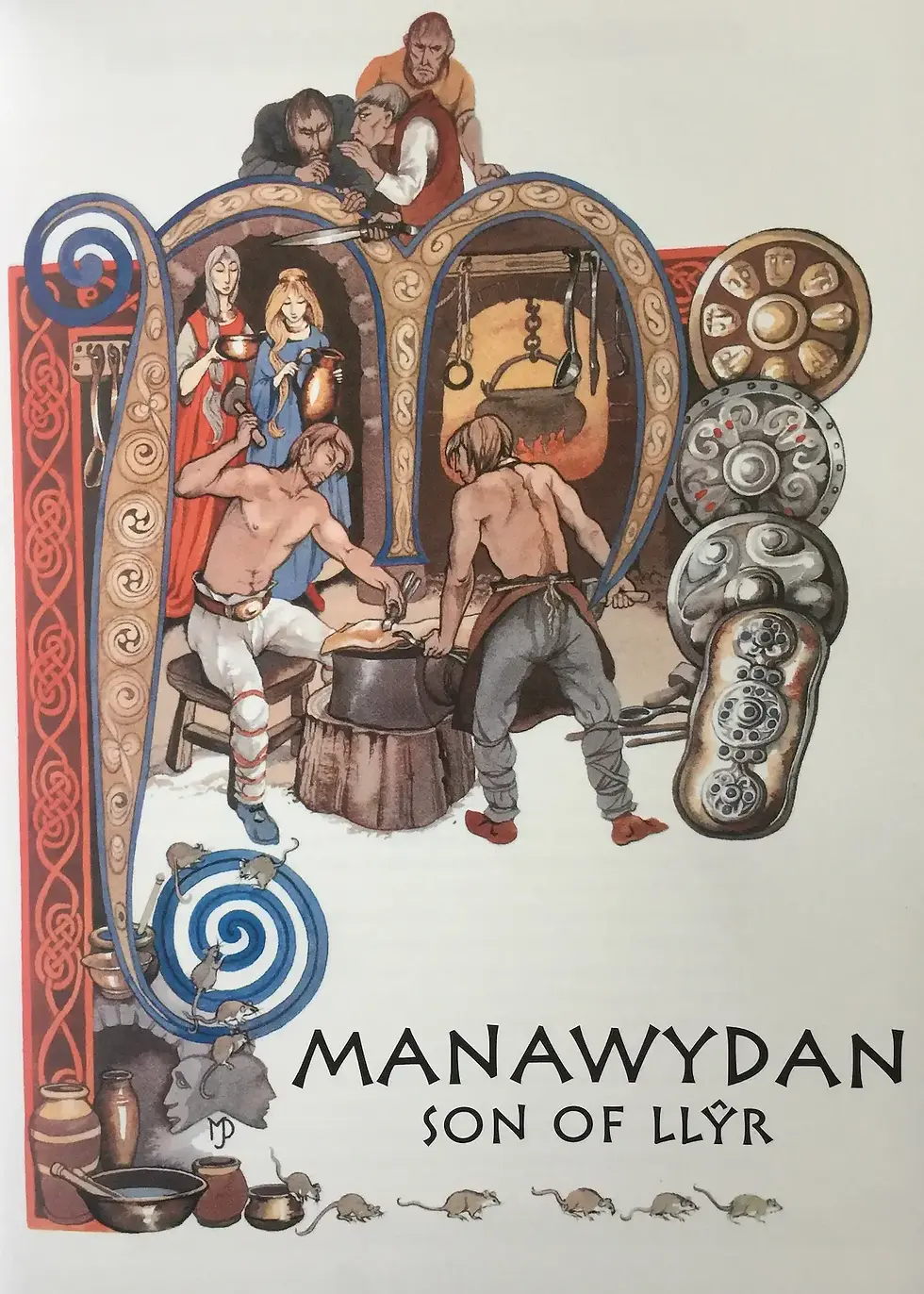
The third branch, Manawydan fab Llŷr (Manawydan, Son of Llŷr), follows Bran's surviving brother Manawydan back to Wales, where he marries the now-widowed Rhiannon and settles with Pryderi and Pryderi's own wife Cigfa. A mysterious enchantment suddenly empties the entire kingdom of Dyfed of every living thing except the four of them. They try rebuilding a life in England as craftsmen, first as shoemakers and then saddlers, but are repeatedly driven out of town by local tradesmen who resent how good they are at the work. Back in Dyfed, their crops are destroyed by a plague of mice, and when Manawydan catches the slowest of them and prepares to hang it as a thief, its true identity is revealed: it's the pregnant wife of a magician named Llwyd fab Cil Coed, who cast the whole enchantment on Dyfed as revenge for the earlier humiliation of his friend Gwawl (the same suitor Pwyll had tricked into the magic bag back in the first branch). Manawydan trades the mouse's life for the lifting of the curse and Pryderi's freedom, and the branch ends as one of the few flat-out happy resolutions in the entire collection.

The fourth and final branch, Math fab Mathonwy (Math, Son of Mathonwy), is the strangest and most eventful of the four. King Math of Gwynedd can only survive with his feet resting in the lap of a virgin footholder when he's not at war, and his nephews Gwydion and Gilfaethwy scheme to start a war purely so Gilfaethwy can rape Math's footholder Goewin in his absence. Gwydion pulls it off by disguising himself as a cyfarwydd (a professional storyteller) and turning up at Pryderi's own court in Dyfed, where he charms his way into a trade for Pryderi's prized pigs, animals so valuable they'd originally been a gift from the Otherworld. What Gwydion actually offers in exchange is an illusion: twelve horses and twelve hounds conjured out of nothing but mushrooms and dry leaves, an enchantment that holds only until morning. Once it wears off and Pryderi realises he's been cheated, he marches north in fury, dragging Math's entire army out of Gwynedd to meet him and leaving the court undefended, exactly the opening Gwydion needed. Math eventually catches both brothers and punishes them by transforming them into pairs of breeding animals, first deer, then boars, then wolves, for three consecutive years. Math then needs a new virgin footholder, and chooses his own niece Aranrhod, who fails the virginity test spectacularly, giving birth to two sons on the spot, one of whom, Dylan, immediately vanishes into the sea.
Aranrhod, humiliated, lays a series of curses on the second son meant to keep him forever without a name, without weapons and without a human wife, and it's Gwydion who spends the rest of the tale tricking his own sister into unknowingly lifting each curse in turn, giving the boy his name, Lleu Llaw Gyffes (Lleu of the Skillful Hand), and his arms. For a wife, Math and Gwydion conjure one from scratch, a woman named Blodeuwedd made entirely out of the flowers of oak, broom and meadowsweet. Blodeuwedd falls for a neighbouring lord, Gronw Pebr, and the two plot Lleu's murder, discovering that he can only be killed under a near-impossible set of conditions: not indoors or outdoors, not on horseback or on foot, and only by a spear that's been forged over the course of a full year, worked on exclusively during the hours of Sunday mass. Gronw manages it, but the blow only turns Lleu into an eagle rather than killing him outright, and Gwydion eventually finds him rotting in a treetop, nurses him back to human form, and takes his revenge by letting Gronw hide behind a stone slab before hurling the same spear straight through both the stone and Gronw himself. Blodeuwedd's own punishment is to be transformed into an owl, condemned to be shunned and mobbed by every other bird for the rest of time, which is also, according to the tale, the mythic origin of the owl's Welsh name, Blodeuwedd itself, still used today.

The professional storytellers hiding inside the stories themselves
That trick Gwydion pulls on Pryderi is worth pausing on, because it's the Mabinogion quietly telling on itself. Medieval Wales had a recognised professional class of storytellers called the cyfarwyddiaid (singular cyfarwydd, meaning roughly skilled or knowledgeable), and they were a different job entirely from the court poets, or beirdd, that most people picture when they think of a medieval Welsh bard. A cyfarwydd's training reportedly started in childhood and demanded a genuinely enormous memory, not just for the tales themselves but for genealogies stretching back generations, legal precedent and geography, all held in the head and delivered through learned patterns and formulas rather than word-for-word memorisation, which is exactly why the same story could shift slightly from telling to telling without losing its shape. Rather than staying tied to one noble household, cyfarwyddiaid travelled between villages and farmhouses, performing at communal gatherings known as a noson lawen (a merry evening), which is part of how the same stories ended up understood the same way by a shepherd on a mountainside and a lord in his hall.
Gwydion's disguise in the Math branch works precisely because the audience listening to this tale would have immediately understood what he was pretending to be. And it's not the only place the profession surfaces in the text. Gwydion is directly described elsewhere in the same branch as the best teller of tales in the world, a line that reads less like incidental praise and more like the tale's own author quietly signalling what kind of skill actually built the world he's writing about. It's a rare case of a piece of medieval literature naming and dramatising the exact tradition of oral performance that produced it.
Four older, stranger tales that stand on their own
Alongside the Four Branches sit four so-called native tales, stories with little or no French influence that most scholars consider even older in their roots. The most famous of them is Culhwch and Olwen, generally regarded as the oldest surviving Arthurian story of any kind, quite possibly composed before 1100. It opens with a classic folk-tale setup: Culhwch's dying mother makes his father promise not to remarry until a two-headed briar grows over her grave, a condition his father eventually cheats his way around, and Culhwch's new stepmother curses him to marry no one but Olwen, daughter of the giant Ysbaddaden. To win her, Culhwch has to complete a punishing list of roughly forty impossible tasks (the anoethau) set by the giant, most of which turn out to be logistics for a single enormous hunt: cornering the magical boar Twrch Trwyth to retrieve the razor, comb and shears hidden between its ears. Culhwch calls on his cousin, King Arthur, for help, and the Arthur who shows up here is nothing like the courtly monarch of later legend.
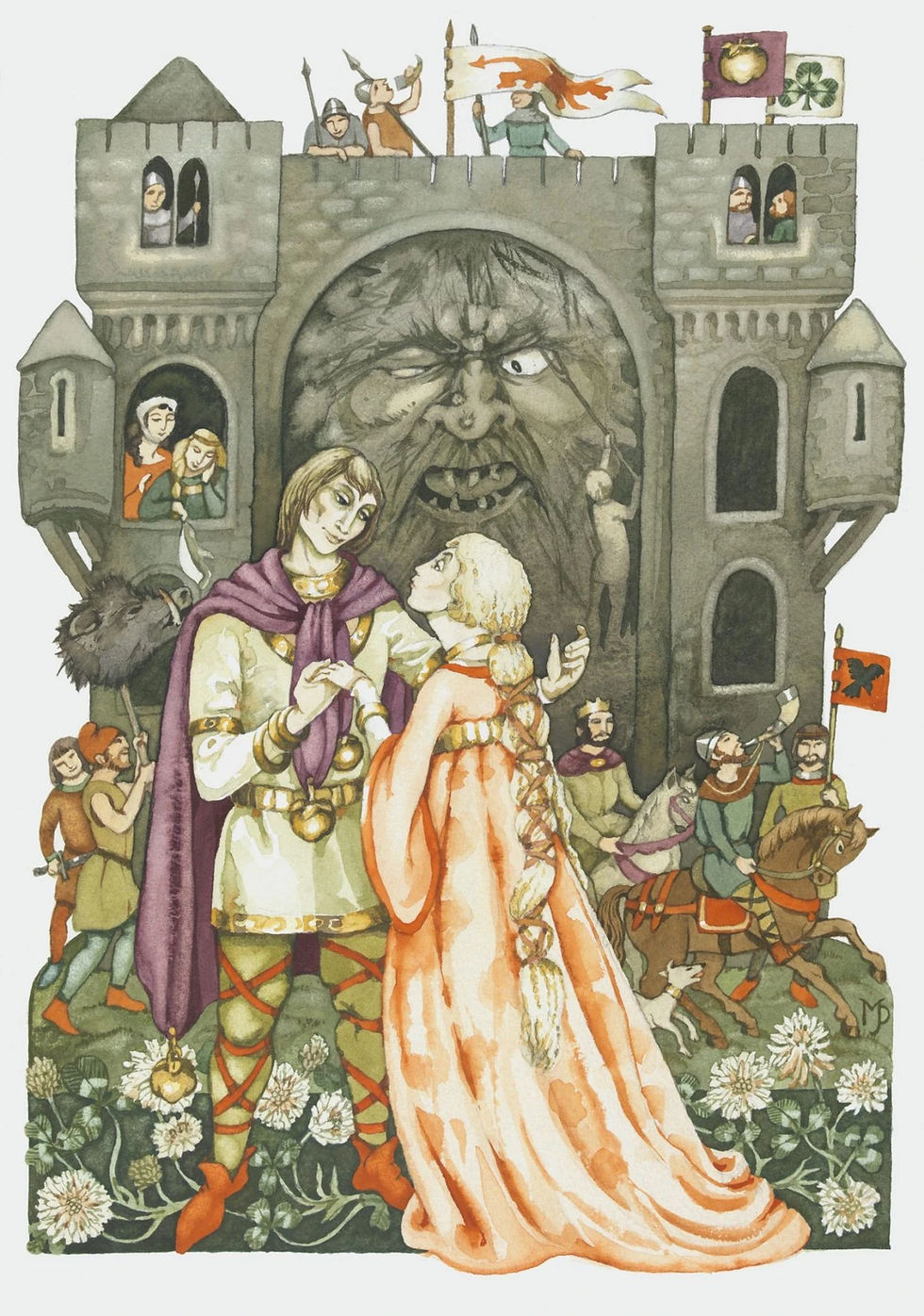
He commands a court of borderline superhuman specialists, among them Gwrhyr, who can shapeshift and speak the language of animals, and the hunt for Twrch Trwyth rages across Ireland and Wales before ending with the boar driven into the sea off Cornwall, never to be seen again. The boar hunt itself is old enough to be independently referenced by the 9th century historian Nennius, meaning versions of this exact story were already circulating in Wales two centuries before Culhwch and Olwen was likely written down.
Lludd and Llefelys tells of a British king, Lludd, whose kingdom is afflicted by three separate plagues, and it's here that one of the collection's best differentiating details lives. Lludd secretly travels to France to consult his brother Llefelys, communicating through a bronze speaking-tube that a hidden demon keeps garbling until Llefelys flushes it out with strong drink. The first plague is a spying, supernaturally sharp-eared people called the Coraniaid, defeated with an insect powder that harms only them. The third is a giant sorcerer who magically puts Lludd's court to sleep each night and steals its provisions, ultimately overpowered by Lludd staying awake in a vat of cold water. The second plague, though, is the one worth lingering on: a horrifying scream heard every May Eve across the land, caused by two fighting dragons, one native and one invading. Lludd traps both dragons, still fighting, in a vat of mead, then buries them in a stone chest beneath what later becomes known as Dinas Emrys in Snowdonia. Centuries later, in the separate but related legend recorded by Geoffrey of Monmouth, the tyrant king Vortigern tries to build a fortress on that exact same spot, only for the walls to keep collapsing until the young Myrddin (Merlin) reveals the buried dragons underneath as the cause. Geoffrey's version of that fight, a red dragon against a white one, is the story that eventually gave Wales its own flag, meaning the Y Ddraig Goch flying over Cardiff today traces straight back to a dragon first buried in this one Mabinogion tale.
The remaining two native tales round out the set. The Dream of Macsen Wledig reimagines the real Roman emperor Magnus Maximus (Macsen), who briefly ruled a breakaway Western empire in the 380s, as a man who dreams of a beautiful woman in a distant land, tracks her down in Wales and marries her, a romanticised Welsh origin story loosely tied to the founding of Caernarfon. The Dream of Rhonabwy is the odd one out structurally and the most purely literary of the eleven tales. Rhonabwy falls asleep on a flea-infested yellow ox hide and dreams himself into the court of King Arthur, where Arthur and a version of Owain calmly play a board game called gwyddbwyll while their own armies fight and die around them without either man seeming to care much. It's framed around the historical 12th century Welsh king Madog ap Maredudd, and scholars generally read it as a satire, arguably mocking nostalgia for a heroic Arthurian golden age that never quite matched the messier reality. It's also the one tale of the eleven missing entirely from the White Book of Rhydderch, surviving only in the Red Book.
Three Welsh romances, and their French twins
The final three tales are usually grouped together as the Three Welsh Romances (Y Tair Rhamant), and they're notable for having near-identical counterparts written in French by the poet Chrétien de Troyes. Owain, or the Lady of the Fountain follows a knight of Arthur's court who defeats the guardian of a magical fountain, marries the fountain's widowed countess, and then all but abandons her when he gets swept up in tournament life with his old companions. He eventually descends into madness in the wilderness, is nursed back to sanity, and redeems himself in part by rescuing a lion from a serpent, a lion that becomes his loyal companion for the rest of the story. Peredur (Peredur fab Efrog) follows a naive young man raised in total isolation by his mother, who lost her husband and other sons to knightly violence, only for Peredur to stumble into King Arthur's court anyway and become a knight himself. His most striking scene, a vision of a bleeding lance and a severed head carried on a platter inside a mysterious castle, closely echoes the famous Grail procession in Chrétien's version, except Peredur's tale never actually mentions a grail at all, one of the clearest signs the Welsh and French versions share deep roots without one simply copying the other.
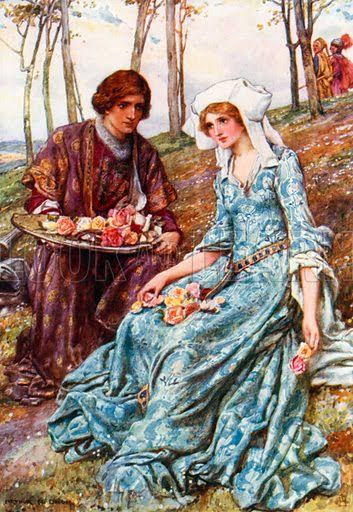
The third, Geraint and Enid, follows a knight so besotted with his new wife that he neglects his own reputation, then misreads Enid's tears of concern as evidence of unfaithfulness and drags her on a punishing, silence-enforced journey to test her loyalty before the two are finally reconciled.
Whether these three Welsh tales came first and inspired Chrétien, or whether the Welsh authors adapted his French poems for a Welsh audience, or whether both drew independently on older shared Celtic material, is still disputed. What's fairly well agreed is that Chrétien himself likely drew on some form of earlier Celtic storytelling for his own Arthurian material in the first place, which would make the borrowing, if there was any, closer to a round trip than a one way street.
The Victorian noblewoman who named it all
Lady Charlotte Guest is the reason most English speakers know these stories at all, and her own life is nearly as colourful as the tales she translated. Born Charlotte Elizabeth Bertie in Lincolnshire in 1812, she was largely self-taught, picking up Arabic, Hebrew and Persian on her own before she ever encountered Welsh at all. That changed after her 1833 marriage, at just twenty-one, to Josiah John Guest, a much older Welsh ironmaster who ran the vast Dowlais Ironworks near Merthyr Tydfil, employing around 7,000 workers. Within days of moving to Wales, she began learning Middle Welsh under the local rector, and went on to study the language seriously with two Welsh clergymen scholars, Thomas Price (known by his bardic name Carnhuanawc) and John Jones (known as Tegid), building on earlier groundwork laid by the Welsh scholar William Owen Pughe, who'd died shortly before her project began and who'd actually coined the name Mabinogion himself back in 1795, in an earlier partial translation nobody much remembers today.

Guest's own translation appeared gradually, published in seven separate installments between 1838 and 1849 (the very first, fittingly, was the Owain romance The Lady of the Fountain) before being gathered into a lavishly illustrated three-volume set in 1849. It became the standard English version of the Mabinogion for well over a century, revised into a single volume in 1877, and it's still in print and freely available today. It wasn't a flawless piece of scholarship, though. Guest worked at a time when a great deal of Middle Welsh scholarship was still being pieced together, and she's known to have softened or trimmed passages she considered too indelicate for Victorian readers. Decades later, when J.R.R. Tolkien worked through his own partial translation of the first fifth of Pwyll, Prince of Dyfed (a manuscript now held at the Bodleian Library, produced purely for his own study rather than publication), he actually noted in the margin that one specific phrase had been wrongly translated by Lady Guest, a small but pointed reminder that even the version everyone grew up reading had its rough edges.
Guest didn't stop at translation. After her first husband's death in 1852, she took over as sole active trustee of the entire Dowlais Ironworks and personally negotiated the company through a major workers' strike the following year, running a heavy industrial operation the way few Victorian women of her class ever got the chance to. She remarried in 1855, to the classical scholar Charles Schreiber, and spent much of her later life building one of the era's most celebrated collections of English porcelain, china, fans and playing cards, much of which she eventually donated to the Victoria and Albert Museum. Later scholarly translations have since replaced hers as the academic standard, most notably a 1948 version by Gwyn Jones and Thomas Jones prized for combining accuracy with real literary style, along with more recent translations by Patrick Ford in 1977 and Sioned Davies in 2007, whose Oxford World's Classics edition pays particular attention to how these tales would have actually sounded read aloud by a medieval Welsh storyteller. None of those later, more precise translations would exist for people to compare against, though, without Guest having done the difficult, unpaid, unglamorous work of getting the Mabinogion into English in the first place.
From Dinas Emrys to Middle-earth
The Mabinogion's fingerprints are all over modern fantasy fiction, often in ways readers never clock. Tolkien's engagement went well beyond that private Pwyll translation. His entire legendarium borrows structurally from the Mabinogion's model of linked mythic tales, right down to naming his own core mythology The Silmarillion in an echo of the Welsh collection's own layered, many-authored feel, and his fictional Red Book of Westmarch, the in-universe source for The Lord of the Rings, is a direct nod to the real Red Book of Hergest. American author Evangeline Walton got there first in a sense, beginning her own novelisation of the Four Branches all the way back in 1936 with The Island of the Mighty, then finishing the remaining three books decades later between 1971 and 1974, all four eventually published together as The Mabinogion Tetralogy. Alan Garner's 1967 novel The Owl Service reworks the entire Blodeuwedd, Lleu and Gronw love triangle into a modern Welsh setting, and Lloyd Alexander borrowed pieces of the mythology, including the cauldron of rebirth, for his beloved Chronicles of Prydain series. Even Fleetwood Mac's 1975 hit Rhiannon traces back here, though at one remove: Stevie Nicks wrote the song after reading Mary Leader's novel Triad, then went on to buy the film rights to Walton's Mabinogion novels specifically because of how taken she was with the real mythological Rhiannon underneath it all.
One name causes constant confusion, and it's worth clearing up here. The popular Korean fantasy MMORPG simply titled Mabinogi borrows only the name and a loose fantasy aesthetic from the real collection, with no meaningful connection to the actual Welsh tales, characters or plots, so it's a fun bit of trivia rather than an adaptation worth digging into if you're after the source material.

You can still walk parts of these stories today
The Mabinogion hasn't just survived in books and borrowed fantasy titles. In Pontypridd, a permanent trail called the Mab Trail winds through Ynysangharad Park, Berw Road Field and Pontypridd Common, marked out with eleven illustrated story stones you can actually take rubbings from, one set for each tale in the collection, built around a bilingual children's retelling and launched at the town's Children's Book Festival in 2022. And in a nice piece of full-circle staging, a Cadw-backed theatre company called Struts and Frets spent that same autumn touring a bilingual, puppet-driven adaptation of the Four Branches to a dozen historic Welsh sites, Caernarfon Castle and Kidwelly Castle among them, putting Rhiannon, Blodeuwedd and Bendigeidfran back in front of Welsh schoolchildren at the actual medieval fortresses built not far from where these stories were first being told out loud.
Why a set of medieval Welsh tales still matters
What's remarkable about the Mabinogion is how much of Wales's older cultural instinct for keeping stories alive by mouth long before writing them down still shows up in the country's living traditions. The same pattern, an oral custom eventually catching a written record almost by accident, shows up again in the Mari Lwyd, Wales's midwinter horse skull custom, which survived door to door in Welsh long before anyone thought to write its rhymes down. It's there too in the near-extinct language and customs of Welsh Kale communities, preserved almost entirely through memory and practice rather than paper, and in the older, blurrier line between folk belief, pre-Christian custom and outright accusations of witchcraft in north Wales, which the Mabinogion's own cast of Otherworldly queens and flower-born wives sits surprisingly close to. The Mabinogion isn't a museum piece. It's the clearest written trace of a storytelling culture that Wales never actually stopped practicing, it just moved on to different stories.


