


Mari Lwyd: The Welsh Horse Skull Tradition a Preacher Tried to Kill
Updated: Oct 6

Somewhere in south Wales, most likely between Christmas and Twelfth Night, a dead horse might knock on your door. Its skull has been stripped, dried and mounted on a pole, its eye sockets are stuffed with baubles or old bottle bottoms, and someone is crouched underneath a sheet controlling its jaw so it can snap at you while its friends sing for their supper. If you can out-rhyme it, it leaves. If you can't, it comes inside. This is the Mari Lwyd, and it's one of the strangest customs still practised anywhere in Britain, not because it's rare exactly, but because it should, by every reasonable account, have died out a hundred years ago. It very nearly did. The story of why it didn't is stranger than the horse skull itself.
Quick answers
What is the Mari Lwyd? A Welsh midwinter custom in which a horse's skull, decorated with ribbons and ridden on a pole by someone hidden under a sheet, is carried from house to house or pub to pub. The group sings for entry, the household sings back refusing them, and the two sides trade increasingly cheeky verses until someone wins.
What does "Mari Lwyd" actually mean? Nobody agrees. The most literal reading is "grey mare," but the folklorist Iorwerth C. Peate argued it really meant "Holy Mary," tying the horse to a nativity legend about a pregnant mare turned away from the stable. Both readings have defenders and neither has settled the argument.
Is Mari Lwyd pagan or Christian? Both explanations get argued seriously, and that's part of what makes it interesting. Some historians point to pre-Christian midwinter animal customs found across Britain and Ireland. Others tie it directly to Christian nativity folklore. The tradition itself has survived both readings without picking a side.
Is Mari Lwyd still practised today? Yes, and it's grown rather than shrunk in recent decades. Events now run in Chepstow, Llangynwyd, Dinas Mawddwy and elsewhere across Wales, plus an annual pub crawl version in London, and the custom has turned up as far away as Los Angeles.
A skull, a sheet and a sense of humour
Strip away the folklore for a moment and the mechanics are fairly simple. A real horse's skull, or occasionally a substitute, is decorated with coloured ribbons and rosettes, fitted with glass or bottle-bottom eyes and mounted on a pole so the jaw can be worked with a string or spring to snap shut with an audible clack. A white sheet drapes over the person carrying it, hiding them completely, and the whole assembly is led from house to house by a small entourage that traditionally included stock characters with names like the Sergeant, the Merryman and a Punch and Judy pair, all trailing along to sing, cause mischief and generally make a nuisance of the group's arrival. In parts of south Wales the same skull was reused year after year, kept preserved in lime the rest of the time so it would hold up for the next winter's rounds. Not every parish could produce a real skull on demand.
A 1935 group in Swansea reportedly made do with a pillow standing in for the horse's head, which tells you something useful about the custom: the skull matters less than the ritual built around it.

The rhyme battle that decides who gets in
The centrepiece of the whole custom is the pwnco, an improvised rhyming contest fought out on the doorstep between the Mari's party and whoever answers the door. The visitors sing to request entry, the household sings back a refusal, and from there it turns into a genuine battle of wit conducted entirely in verse, sometimes for close to an hour, full of insults, teasing and increasingly far-fetched excuses for why the horse can't possibly come in tonight. Tradition holds that the household is supposed to eventually run out of clever responses and lose, at which point the Mari and its escort are finally let inside for food, drink and a share of whatever luck the visit is meant to bring for the coming year. It's a custom that only works if both sides are, at least a little bit, in on the joke. It's also, according to the traditional culture archive Trac Cymru, genuinely unique among Britain's horse customs: of all the skull-and-pole processions still performed around the British Isles, Mari Lwyd is apparently the only one built around an actual poetry competition, a detail that fits a country that's always taken its verse seriously.
Where the name actually comes from
There isn't a single agreed origin for either the name or the custom, and the people who've studied it most closely tend to admit as much rather than pretend otherwise. The most common translation renders "Mari Lwyd" as "grey mare," pointing toward older Celtic associations between pale horses and the world beyond the everyday. The folklorist Iorwerth C. Peate offered a competing reading, "Holy Mary," linking the custom to a piece of nativity folklore in which a pregnant mare is turned away from the stable in Bethlehem and wanders the countryside looking for shelter for her foal, a story that would explain why a skeletal horse shows up begging at doors in the depths of winter. Whether the custom itself started as a pre-Christian midwinter animal ritual that Christianity later absorbed, or as homegrown Welsh folklore that only looks pagan in hindsight, is a question nobody has definitively answered, and probably never will.

A dating argument nobody's fully settled
Even the paperwork disagrees with itself. The National Museum of Wales dates the first written mention of the Mari Lwyd to 1798, while other institutions, including the Horniman Museum, point instead to 1800, citing the traveller J. Evans's book A Tour through Part of North Wales as the earliest surviving reference. The two-year gap probably comes down to different scholars citing slightly different editions or secondary sources rather than any real dispute over the facts, but it's a useful reminder that a custom this old was being passed door to door in Welsh long before anyone thought to write it down, which means the written record almost certainly understates its real age.
A south Wales stronghold, not a south Wales monopoly
Where the custom took deepest root is easier to pin down than when it started, though it's worth being precise about what that actually means. The strongest, most consistent written accounts come overwhelmingly from south Wales, with Glamorgan, Monmouthshire and Carmarthenshire producing the bulk of the historical record; the traditional culture archive Trac Cymru specifically credits Llangynwyd, in Bridgend county, with keeping the strongest and most unbroken version of the custom running of anywhere in Wales. But "strongest" isn't the same as "only." The same sources that establish the south Wales heartland also record a genuinely separate northern thread: in the northeast, the Mari figure was folded into Cadi Ha, a different Welsh custom tied to May Day rather than midwinter, while Anglesey and the Gower Peninsula each kept their own smaller, localised versions running quietly alongside the bigger southern tradition. So the honest picture is a strong southern core with real, if patchier, roots elsewhere in Wales, not a custom that stopped at some invisible line and never crossed it. That distinction matters even more once you look at where the custom is actually being performed today, which has spread a long way past its historical stronghold.

The minister who tried to kill it and saved it by accident
By the mid-1800s, the Mari Lwyd had earned itself real enemies. Wales's growing nonconformist Christian movement, heavy on chapel-going Baptists and Methodists, took a dim view of a custom built around door-to-door drinking, rowdy verse and a genuinely spooky-looking prop, and pushed hard against it as the century wore on. The clearest surviving example of that hostility comes from the Baptist minister Reverend William Roberts, who devoted space in his 1852 book The Religion of the Dark Ages to condemning the custom outright as sinful. What makes Roberts genuinely useful to history, rather than just another disapproving Victorian clergyman, is that in the process of building his case against the Mari Lwyd, he sat down and transcribed roughly twenty of the pwnco verses being used at the time, which means the man trying hardest to stamp the tradition out ended up leaving behind one of the best surviving written records of exactly how it was performed. It's the kind of irony that folklorists love, a hostile witness accidentally becoming an archivist.
Nearly extinct by the twentieth century
Roberts's campaign was one ingredient in a longer decline, not the whole story. Falling numbers of Welsh speakers chipped away at a custom built entirely around improvised Welsh-language verse, and the same reputation for excessive drinking and rowdiness that drew nonconformist ire also made it an easy target for anyone looking to modernise or clean up local customs. By the early twentieth century the Mari Lwyd had all but vanished from most of Wales, and by the 1960s only a small handful of processions were still running anywhere, most notably in Pencoed and Pentyrch, kept alive by little more than local stubbornness. For a custom with roots that may stretch back centuries, it came remarkably close to simply running out of people willing to carry it on.
Brought back from near-death by a museum and a folk club
The revival, when it came, had two clear engines behind it. St Fagans, the National Museum of Wales's open-air history museum near Cardiff, began systematically collecting and documenting surviving Mari Lwyd verses in the 1960s, effectively rebuilding the custom's script at the exact moment it was closest to disappearing for good. Around the same time, the town of Llangynwyd revived its own procession, and from the 1970s onward the Llantrisant Folk Club took up the custom as a cause, helping spread it back out to more towns and villages across Wales over the following decades. It's a genuinely unusual survival story: a custom saved not by staying hidden in an unbroken folk tradition, but by being deliberately reconstructed from written and remembered fragments, including, in no small part, the very verses a hostile Baptist minister had written down more than a century earlier specifically to condemn them.

From the world's largest Mari Lwyd to a three-generation pub
Modern Mari Lwyd events range from small village affairs to genuinely large public occasions. Aberystwyth marked the 2000 millennium celebrations by organising what's generally described as the world's largest Mari Lwyd gathering, turning a near-forgotten local custom into a headline event. In Chepstow, a border town where the River Wye meets the Severn estuary, the modern Chepstow Wassail and Mari Lwyd has been running in its current form for roughly two decades, blending the Welsh horse-skull custom with English apple-orchard wassailing traditions on the same afternoon; the event drew around forty separate Mari Lwyd groups at its 2019 peak before the pandemic forced a pause, and it's since returned under new local organisers. Further west, the Old House Inn in Llangynwyd, reputedly one of the oldest pubs in Wales, has hosted Mari Lwyd visitors across three successive generations of the same landlord family, a level of institutional memory that few midwinter customs anywhere can claim.
How a Welsh teacher brought the tradition north
The clearest proof that Mari Lwyd is no longer a south-Wales-only affair is the version that now runs every January in Dinas Mawddwy, a small village in Gwynedd, well into what's traditionally been considered the north. It isn't an ancient local survival either, which makes it a genuinely different kind of case study. The event was started in 2003 by Arfon Hughes, a former Welsh teacher who wanted a fun, social way for adult Welsh learners to practise the language outside a classroom, and simply borrowed a tradition from the south to do it. It's grown steadily ever since on nothing but reputation. "We don't advertise it, it's just grown through word of mouth as it's a good night," Hughes has said, crediting a broader wave of interest in Welsh heritage for pulling in newer, younger crowds who want, in his words, "to be part of an old celebration for the new year." The modern event now draws somewhere between 170 and 200 people dressed in eighteenth-century costume for a pub crawl on the 11th of January, complete with an eight-foot Mari Lwyd figure, live accordion, fiddle and drums, plus cèilidh dancing outside the last pub of the night. It's a useful reminder that a lot of what feels like ancient, unbroken folk practice today is really a fairly recent, deliberate act of cultural borrowing, no less genuine for being only two decades old.

The horse skull goes global
The custom has travelled well beyond Wales entirely in recent years, not just beyond its southern heartland. London has run its own Mari Lwyd pub crawl on New Year's Eve, now in its fourth outing, with the folk band the Spring Heeled Jacks leading a procession of singalongs across several Bloomsbury pubs before finishing at the London Welsh Centre with traditional ceilidh dancing. Further afield, Mari Lwyd appearances have been recorded at Pagan Pride events in Los Angeles, carried by members of the Welsh diaspora keen to keep the custom alive an ocean away from Glamorgan. Accessibility has helped the spread along: organisations including Music Traditions Wales now produce flat-pack, cardboard Mari Lwyd kits for people who don't happen to have a spare horse skull lying around, which would have solved the 1935 Swansea group's pillow problem rather neatly had it existed at the time.
A ghost story that made it into serious poetry
The Mari Lwyd's eerie visual, a skeletal horse's head appearing out of the winter dark to demand entry, has made it durable material well beyond folklore circles. The Welsh poet Vernon Watkins built an entire long narrative poem, Ballad of the Mari Lwyd, around the custom's midwinter menace, treating the horse skull less as a quaint local curiosity and more as a genuine visitation from the world of the dead knocking to be let in. It's a reminder that for all its modern reputation as a slightly kitsch Christmas oddity worth a social media clip, the custom's original emotional register was closer to a ghost story than a pantomime, something Welsh audiences understood instinctively even when English-language accounts flatten it into a curiosity.

Not the only skull knocking on a British door
Mari Lwyd isn't quite as isolated a custom as it can look from the outside, and it isn't even the only Welsh winter tradition of its type. Wales has its own second midwinter house-visiting custom in the Hunting of the Wren, in which a captured or, in its modern and considerably kinder form, a fake wren is paraded from door to door with its own songs and rhymes; St Fagans now performs the two side by side every December, with an explicit note that no actual wrens are harmed in the process.
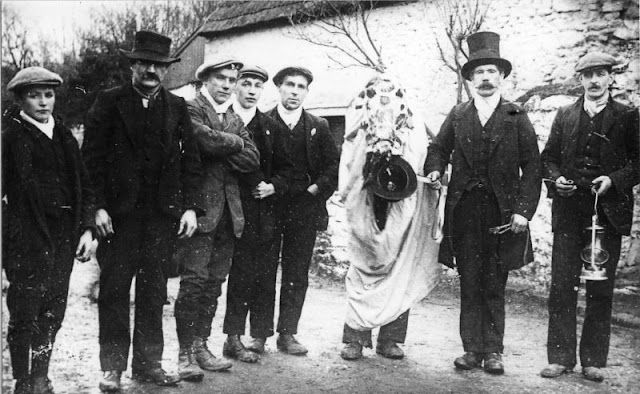
Beyond Wales, Kent has its own tradition of Hoodening, in which a wooden horse's head on a pole is carried house to house by farm workers around Christmas, and parts of Nottinghamshire and Derbyshire have long kept a similar custom known as the Old Tup, built around a sheep's head rather than a horse's. All of these customs share the same basic winter logic: an animal, skull or head, a concealed operator, a house-to-house visit, and a performance traded for hospitality. None of them borrowed directly from the others as far as anyone can tell. They seem to be separate regional expressions of a much older, broader impulse across the British Isles to bring something a little unsettling to the door in the darkest weeks of the year and see whether the household can talk their way past it. That same appetite for eerie midwinter imagery shows up in plenty of unexpected places once you start looking for it, including, further south and rather later in the calendar, the genuinely unsettling illustrations Victorians put on their Christmas cards, which suggests a spooky midwinter and a cosy one were never as far apart as the modern, sanitised version of Christmas likes to pretend.

Wales's other survivors
The Mari Lwyd's near-death and recovery isn't a one-off story in Welsh cultural history, either. Language and custom in Wales have a long track record of hanging on by remarkably thin threads before finding their way back, whether that's a midwinter horse skull rescued by museum archivists and a folk club, or, in a very different corner of Welsh heritage, the quieter, centuries-long story of the Kale of Wales, whose own traditions were preserved against fairly similar odds. And the debate over whether the Mari Lwyd's roots are genuinely pagan or a Christian folk legend dressed up to look older than it is sits inside a much wider Welsh conversation about what actually survived from before Christianity arrived, a question that comes up again in the folklore of witches and witchcraft in North Wales, where the line between old belief and later invention is just as blurry.
None of that uncertainty seems to bother anyone showing up to sing at a stranger's door with a horse's skull on a pole. If anything, it's the point. A custom that can't fully explain its own name, can't agree on its own birth year and was nearly killed off by the very sermon that ended up preserving its verses word for word has earned the right to stay a little mysterious. Every winter it comes back anyway.
Sources
10. FolkWales Online Magazine, "Mari Lwyd: Make no bones about it, the tradition is just galloping away"


