The Tragic Downfall of Frances Farmer: A Hollywood Starlet's Struggle with Mental Health

Frances Farmer was once the kind of actress Hollywood columnists predicted would be bigger than Garbo. Louella Parsons said as much, and at the time it didn't seem like empty flattery. Farmer was striking, talented, and in her first year at Paramount she turned out four films and earned rave notices. Then the industry she'd signed up to chewed her apart. What happened to Frances Farmer is a story about stardom, yes, but it's also a story about what happens when a woman refuses to conform, and what powerful people will do about it.
From Seattle to Paramount: A Reluctant Star
Born in Seattle, Washington, on 19 September 1913, Farmer was the daughter of a lawyer father and a deeply controlling mother, Lillian, whose involvement in her daughter's life would prove catastrophic. Farmer was intellectually precocious and politically minded from an early age. In 1935, as a student at the University of Washington, she entered a subscription contest for a left-wing newspaper and won first prize: a trip to the Soviet Union to see the pioneering Moscow Art Theatre. She went, despite her mother's fierce objections. It was the first of many times she'd refuse to do as she was told.
Returning from the Soviet Union, she stopped in New York and caught the eye of Paramount Pictures talent scout Oscar Serlin. On her 22nd birthday, she signed a seven-year contract with the studio. Hollywood came to her. She didn't chase it.

Her early career was genuinely impressive. She excelled in Come and Get It (1936), directed by Howard Hawks and William Wyler, playing a dual role that earned her serious critical attention. She then left Hollywood entirely to star on Broadway in the premiere of Clifford Odets' Golden Boy in 1937, creating the role of Lorna Moon. Abandoning a Paramount contract mid-stride to do theatre wasn't the done thing. Farmer did it anyway. She didn't make many friends at the studio.
Like Audrey Munson, America's first supermodel, Farmer discovered that being celebrated by an industry and being protected by it are two entirely different things.
The Untold Months of 1942
By the early 1940s, Farmer's career was in decline and her personal life was deteriorating fast. Little is known about the first nine months of 1942. In her purported autobiography, published two years after her death, she described this period as one of isolation and bitterness. She felt herself "beginning to slip away" and turned to writing as a way of purging her thoughts. It didn't help.
She'd become dependent on alcohol and Benzedrine, a brand of amphetamine that was widely available at the time and frequently prescribed by doctors as an appetite suppressant. The dangers of amphetamines weren't well understood yet, but heavy abuse can produce symptoms indistinguishable from schizophrenia. Whether Farmer was genuinely mentally ill or a victim of substance abuse and catastrophic stress has never been definitively established. By late 1942, it didn't matter much, because her behaviour was making headlines either way.
During this time, she became increasingly dependent on alcohol and amphetamines. Worried about her weight, she began taking Benzedrine, which was widely available and often prescribed by doctors as an appetite suppressant. The dangers of amphetamines were not understood until much later, but they can mimic the symptoms of schizophrenia when abused. Whether Farmer was truly mentally ill or simply a victim of substance abuse remains uncertain, but by late 1942, her erratic behaviour made headlines.
The Arrests and Public Unravelling
On 19 October 1942, Farmer was arrested in Santa Monica for driving with her headlights on during a wartime blackout. After an altercation with the arresting officer, during which she reportedly told him "You bore me", she was charged with drunk driving. Her jail sentence was suspended, but the incident was just the beginning.
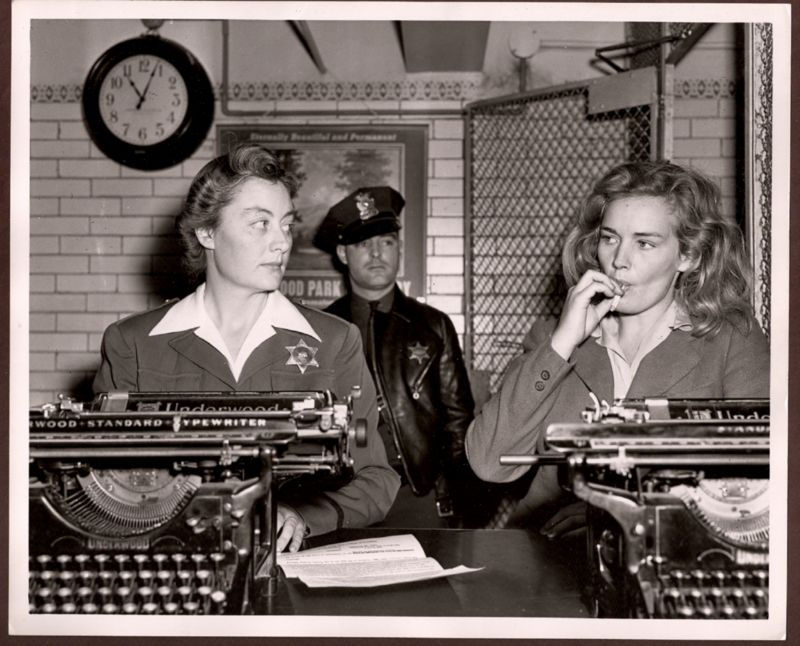
In January 1943, she was cast in a low-budget melodrama called No Escape, a title that was uncomfortably apt. On her first day of filming, she slapped a hairdresser. When police came to apprehend her (and execute a warrant for an unpaid fine from the earlier drunk driving charge), she was found at the Knickerbocker hotel and had to be dragged out. Her arrest and court appearance made the front pages.
Once arrived at the station, upon being asked her profession, she responded, “cocksucker.”
In court, she didn’t even try to hide her contempt for the system…
Police Judge Marshall Hickson: Miss Farmer, were you fighting at the Hollywood Knickerbocker Tuesday night?
Farmer: (calmly, sarcastically) Yes. I was. I was fighting for my country and for myself.
Light laughter in the courtroom.
Hickson: Control your mouth, Miss Farmer. Have you driven a car since you were put on probation?
Farmer: No I haven’t. But only because I couldn’t get my hands on one.
Sounds in the press gallery of pencils scratching on pads.
Hickson: Since you appeared in this court October 24th, have you had anything to drink?
Farmer: (loudly) I drank everything I could get, including Benzedrine.
Hickson: (raising voice) You were advised that if you took one drink of liquor or failed to be a law-abiding citizen —
Farmer: (louder) Listen, I get liquor in my milk. I get liquor in my coffee and in my orange juice. What do you expect me to do, starve to death?
Hickson: (standing, shouting) 180-day sentence to be served in the Los Angeles County jail! Immediately!
Farmer: Fine!
Hickson: (beet-red, leaving the bench) Take her to jail.
Farmer: But I haven’t any lawyer.
(no answer)
Farmer: (louder) What I want to know is, do I have any civil rights?
(no answer)
Farmer: (turning to the cop next to her) I want my phone call.
COP: Nope.
After this interaction, the police had to, again, take her away yelling and screaming. This time she called out, “Have you ever had a broken heart?”
She admitted to using Benzedrine and drinking heavily. The judge sentenced her to 180 days in jail. She screamed at the courtroom, was physically restrained, and was dragged out. Reporters noted her dishevelled appearance with gleeful detail.
The public unravelling of a woman who'd refused to play nice was treated as entertainment. It's a dynamic that's depressingly familiar, and one explored in cases like that of Anita Berber, the Queen of the Weimar Republic, whose personal excesses were similarly weaponised against her.

Institutionalisation and Inhumane Treatment
Following her courtroom breakdown, Farmer was moved to the psychiatric ward of Los Angeles General Hospital. She was diagnosed with "manic depressive psychosis" and soon transferred to a sanitarium in La Crescenta. It was the beginning of a decade of institutionalisation.
At her mother's request, she was committed to Western State Hospital in Washington, where she remained a patient until 1950. The treatments she endured there were, by any modern standard, barbaric. Insulin shock therapy was used routinely: patients were injected with large doses of insulin to induce comas, then revived. It was considered legitimate medicine at the time. Electroconvulsive therapy was also administered, in its early and particularly brutal form, without the anaesthetics or muscle relaxants that are standard today.
Rumours also circulated for decades that Farmer had been lobotomised. Pioneering lobotomist Walter Freeman actually visited Western State Hospital on 19 August 1947 and performed the procedure on 13 patients that day. Whether Farmer was among them has never been conclusively confirmed or disproved. The 1982 film Frances, starring Jessica Lange, depicted a lobotomy scene as fact. Most historians now consider it unsubstantiated. What is certain is that the treatments she did receive would be considered serious human rights violations today.
She spent years in an institution at the request of the very family who should have protected her, a grim echo of cases like that of Blanche Monnier, the lady hidden in a room for 25 years.

The Final Years
By the late 1950s, Frances Farmer was released from the psychiatric system, but she was a shell of the woman she had once been. She attempted to revive her career, taking on minor roles in theatre and television, but the spark that once made her a star was gone. Farmer moved back to her hometown of Seattle, where she lived a quiet and reclusive life. Her later years were marked by a return to the spotlight through a ghostwritten autobiography, Will There Really Be a Morning?, published in 1972, two years after her death. The memoir provided insight into her harrowing experience with mental illness and her time in the psychiatric system, but it remains unclear how much of it was truly her own words.
Release and the Attempt at a Second Act
Farmer was released from Western State Hospital in 1950. She was 36 years old and had lost nearly a decade of her life. What followed was a quiet, grinding attempt at reconstruction.
She made a few television appearances, including on This Is Your Life in 1950, where producers reunited her with figures from her past on live television without warning her who would appear. She endured it with characteristic composure. In 1957, a talent agent helped her secure a handful of roles, and by 1958 she'd moved to Indianapolis to host Frances Farmer Presents, an afternoon movie and interview programme on NBC affiliate WFBM. It was rated number one in its time slot for six years. She was good at it.
Her final film role came in the 1958 drama The Party Crashers. After that she drifted toward local theatre, performing in productions staged by Purdue University through much of the 1960s. By 1964, her alcoholism had become acute enough that WFBM let her go.
In her final years she quit drinking, converted to Roman Catholicism, and took up painting and poetry. She agreed to record hours of interviews with a writer who proposed a biography. Before the project could be completed, she was diagnosed with esophageal cancer in April 1970. She died on 1 August 1970, aged 56, and was buried in a simple grave in a small cemetery outside Indianapolis.

The Myth That Outlived Her
The autobiography Will There Really Be a Morning? was published the year after her death, in 1972. It was largely written by her friend Jean Ratcliffe, based on recorded interviews and Ratcliffe's own recollections. Historians have since noted it's unreliable in its facts, though it captures something true about the horror of what Farmer endured.
Since her death, Frances Farmer has become a genuine cult figure. The 1982 film with Jessica Lange introduced her story to a new generation. Kurt Cobain wrote a song about her, "Frances Farmer Will Have Her Revenge on Seattle", which contains the line: "She'll come back as fire, to burn all the liars, and leave a blanket of ash on the ground." His daughter, Frances Bean Cobain, was named after her.
The standard narrative around Farmer tends toward martyrdom: a brilliant woman destroyed by a vindictive industry and a monstrous mother. The reality is more complicated and, in some ways, more troubling. The industry didn't set out to destroy her. It simply didn't care enough to protect her. That's a different thing, and in some ways worse.
For more on women whose public falls from grace were shaped as much by the era as by their own actions, see Evelyn Nesbit: The Girl on the Velvet Swing and the Gilded Age Scandal That Shook America and Barbara Daly Baekeland.
Sources
1. Wikipedia: Frances Farmer: en.wikipedia.org/wiki/Frances_Farmer
2. IMDb: Frances Farmer biography: imdb.com/name/nm0002068/bio/
3. HistoryLink.org: Frances Farmer (1913-1970): historylink.org/file/5058
4. Encyclopedia.com: Farmer, Frances (1913-1970): encyclopedia.com
5. Farmer, Frances, Will There Really Be a Morning?, Putnam, 1972