

The Rollercoaster Life and Loves of Errol Flynn
Updated: Sep 7

Errol Flynn packed enough drama into fifty years to fill six ordinary lives. He got kicked out of practically every school he ever attended in Tasmania, then somehow became the biggest swashbuckler Hollywood had ever seen inside two years of his first film role. After that came a statutory rape trial that turned into a full-blown media circus, persistent rumors that he'd spied for the Nazis, a house rigged with two-way mirrors, and a final adventure trailing after Fidel Castro through the hills of Cuba with his teenage girlfriend in tow. He was dead of a heart attack at fifty, and even his death came with a detail so strange the coroner had to stop his own pathologist mid-autopsy. This is the real story, not the sanded-down version.
Quick answers
Was Errol Flynn actually acquitted of rape?
Yes. In 1943 he stood trial for statutory rape against two teenagers, Betty Hansen and Peggy Satterlee, and a jury acquitted him on all counts after less than a day of deliberation. His defense lawyer Jerry Giesler ran a courtroom campaign that painted the girls as unreliable and Flynn as the real victim, and it worked.
Does "in like Flynn" actually come from his rape trial?
Probably not, even though almost everyone assumes it does. Language researchers have found the phrase in newspapers from 1940 and 1942, before Flynn's trial even started, which means his name got attached to an expression that already existed rather than the other way around.
Did Errol Flynn really spy for the Nazis?
There's no solid evidence he did. The claim comes from a single controversial 1980 biography, and while Flynn did have a close friend who really was a German agent, FBI surveillance never turned up proof that Flynn passed along anything himself. Historians who've dug into it mostly conclude he was used rather than complicit.
How did Errol Flynn die?
He suffered a fatal heart attack in a Vancouver apartment on October 14, 1959, at just fifty years old, after a lifetime of heavy drinking, malaria and a body that had been breaking down for years. His seventeen-year-old girlfriend, Beverly Aadland, was in the next room when it happened.
A childhood built for trouble
Errol Flynn was born on June 20, 1909, in Battery Point, Tasmania, to a father who spent more time with dead fish than with him. Theodore Thomson Flynn was a respected marine biology professor, and by most accounts a decent, quiet man who never quite figured out how to handle a son with that much restless energy. Young Errol got expelled from basically everywhere he went: Albuera Street Primary School, The Hutchins School, Hobart College, The Friends School. He wasn't shy about it later either, he just kept getting thrown out.

At fourteen he was shipped off to South West London College in Barnes, a proper English boarding school a world away from the Tasmanian bush. He hated it and lasted about a year before heading home in 1926. Back in Australia, he enrolled at the more prestigious Sydney Church of England Grammar School, known as Shore, and that ended badly too. The official record says he was expelled for theft. Flynn's own version, which he told for the rest of his life, was that it was actually over an incident with the school laundress. Nobody's ever fully sorted out which story is true, and that ambiguity followed him his entire career.
From treasure hunter to leading man in under two years
Before acting, Flynn drifted through jobs that sound made up: tobacco plantation overseer, gold prospector and reportedly a slave trader and smuggler in New Guinea, though how much of that is true and how much is Flynn's own myth-making is hard to pin down. His first time in front of a camera came in 1933 in the Australian film In the Wake of the Bounty, where he played Fletcher Christian in a scrappy, low-budget dramatization of the Bounty mutiny.
That was enough to convince him acting was worth chasing seriously, so he sailed for England. He talked his way into a spot with the Northampton Repertory Company, padding his resume to sound far more experienced than he was, and spent about seven months learning stagecraft on the fly. From there he landed the lead in Murder at Monte Carlo (1935), shot at Teddington Studios, and that performance is what got him noticed by Warner Bros. talent scouts. They signed him almost immediately and shipped him to Hollywood. Two years after his amateur debut in Australia, he was a contract player at one of the biggest studios in the world.
Captain Blood, Michael Curtiz and becoming the face of the swashbuckler
Captain Blood (1935), directed by Michael Curtiz, made Flynn a star practically overnight. He had the look, the physicality and just enough danger in his manner to sell a pirate captain, and the film was a massive hit. Warner Bros. immediately understood what it had and kept casting him in one adventure epic after another: The Charge of the Light Brigade, The Adventures of Robin Hood (1938), The Sea Hawk (1940), The Private Lives of Elizabeth and Essex (1939). He was paired with Olivia de Havilland in eight of these films, and their onscreen chemistry became one of the defining partnerships of the era. Robin Hood alone left enough of a mark that the American Film Institute later named it the 18th greatest hero in American film history.
Behind the scenes, Flynn and Curtiz couldn't stand each other. By the time they made Virginia City in 1940, Flynn actively tried to get Curtiz removed from the picture, and the feeling was mutual. Curtiz's reputation for pushing safety past reasonable limits didn't help. During the filming of Robin Hood, one actor jabbed Flynn with a sword that had its safety tip removed entirely, on Curtiz's direct instruction, apparently to make the fight look more convincing, and Flynn confronted him about it on the spot. Basil Rathbone, who played Guy of Gisbourne and dueled Flynn in the film's climactic swordfight, actually got hurt for real in a separate scene: he was knocked down and trampled by extras during the castle escape sequence and needed eight stitches in his foot. The stunt team wore steel breastplates padded with balsa wood so they could survive being shot at with real arrows by professional archer Howard Hill, who reportedly got paid $150 for every one he fired.
The love he never got to keep: Olivia de Havilland
Of the eight films they made together, the real story might be the one that never made it to screen. De Havilland said flatly, decades later, that the attraction between them was mutual: “I had a crush on him, and later I found he did for me.” Flynn reportedly asked her to marry him at one point, but she turned him down because he was still married to Lili Damita and she wasn't willing to be the reason a marriage ended.
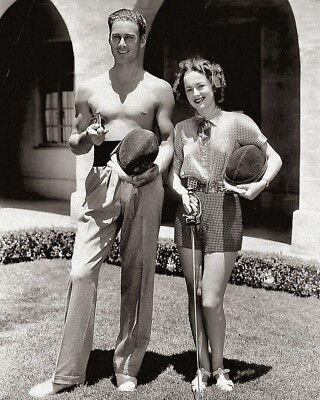
They stayed close anyway, in the complicated way people do when the timing never lines up. Years after they'd stopped making films together, she ran into him at a Hollywood party and didn't recognize him at first, until he kissed the back of her neck and she turned around. “His eyes were so sad,” she said. “I had stared into them in enough movies to know his spirit was gone.” Not long before he died, she watched Robin Hood again while living in Paris and sat down to write him a letter about it, then tore it up, worried he'd think she was being foolish. He died a few months later. She spent the rest of her life saying the same thing about it: “I'll always be sorry I didn't mail that letter.”
Lili Damita and a marriage as loud as his movies
In 1935, the same year Captain Blood made him famous, Flynn married French actress Lili Damita. She was every bit as strong-willed as he was, and the marriage was volatile from the start, full of public arguments and mutual infidelity. Their son, Sean Flynn, was born in 1941. The couple divorced in 1942, right around the time Flynn's own life was about to get a lot more complicated. Sean grew up to become a photojournalist, and his own story, including his disappearance while covering the war in Cambodia in 1970, is one of the more haunting footnotes to his father's legacy. We've covered what happened to him in full elsewhere on the site.

1943: the trial that nearly finished him
In 1942, Flynn was charged with statutory rape in two separate incidents. Peggy Satterlee, fifteen at the time, alleged that Flynn assaulted her aboard his yacht Sirocco in August 1941, during a trip built around a Life magazine photo shoot, claiming he'd spiked her drink first and assaulted her on two separate nights. Betty Hansen, seventeen, said she was invited to a party at Flynn's Bel-Air home by a Warner Bros. employee who suggested Flynn could help her career if she “played up to him,” and that after a drink he gave her, she felt ill and was assaulted.
The trial opened on January 11, 1943, and turned into one of the biggest media circuses Hollywood had ever produced. Women lined up outside the courthouse for hours, with crowds so large that medical teams were kept on standby in case fans fainted. Flynn reportedly received thousands of letters from adoring fans during the proceedings, and Warner Bros. rushed his film Gentleman Jim into production to cash in on the publicity rather than distance itself from him. It's the same instinct that studio fixers like Eddie Mannix, MGM's notorious problem-solver, built entire careers on: protect the asset, whatever the cost to anyone else involved.
His defense attorney, the famous Jerry Giesler, ran a scorched-earth campaign, portraying the two accusers as unreliable, working-class girls with “suspect virtue” while keeping Flynn's own well-documented sexual history off the table entirely. A doctor's examination that reportedly found evidence consistent with the assault was discounted. Giesler secured a jury of nine women and three men, and by most accounts Flynn spent the trial exchanging warm smiles with the older women on the panel. During closing arguments he reportedly leapt into the witness box and acted out an impression of one of the accusers for dramatic effect. The judge's instructions to the jury told them to weigh the accusers' testimony “with great care and caution,” effectively undercutting the statutory rape charges before deliberations even started.

On February 6, 1943, the jury acquitted Flynn on all counts. He rushed to shake hands with each juror and told reporters his confidence in “essential American justice” had been justified, pointedly noting his American citizenship, which he'd only been granted the previous August. The verdict made him more famous than ever. Flynn wasn't the only Hollywood star of that era to walk free while his accuser's credibility got shredded in public. It happened to Roscoe “Fatty” Arbuckle two decades earlier too, though Arbuckle's acquittal ended his career anyway, which says something about how differently the same outcome can land depending on who's standing trial.
The phrase everyone gets wrong
Almost every retelling of Flynn's story repeats the same claim: that his acquittal is where the phrase “in like Flynn,” meaning to succeed easily or get away with something, came from. It's a great story. It's also probably not true. Language researchers digging through old newspaper archives have found the expression showing up as early as 1940, and again in a 1942 San Francisco Examiner piece, before Flynn's trial had even started. The more likely explanation is that the phrase already existed, possibly tied to Edward J. Flynn, a hugely effective Democratic Party boss in the Bronx whose candidates seemed to win office automatically, and Errol Flynn's fame and matching surname just made the two stick together in the public imagination. A 1967 spy spoof called In Like Flint muddied the whole thing even further. Flynn reportedly liked the phrase enough that he wanted to title his autobiography In Like Me, but his publisher talked him into the punchier My Wicked, Wicked Ways instead.
Two-way mirrors, hidden cameras and a reputation he never shook
Flynn's Mulholland Drive mansion earned its own reputation independent of anything he did on screen. He reportedly had a secret door behind the bar leading to a small sitting room with a two-way mirror looking into the women's bathroom, and a bedroom mirror accessible through an attic crawlspace with a trap door, so he and guests could watch the room below without being seen. Robert Douglas, his co-star in The Adventures of Don Juan, later described pressing hidden buttons that lowered a screen and projected films for unsuspecting guests in the bedroom below. Bruce Cabot, who'd starred in the original King Kong, reportedly discovered the setup firsthand and was furious about it, though the friendship survived. Actress Hedy Lamarr wrote in her own memoir that “many of the bathrooms have peepholes or ceilings with squares of opaque glass,” a fairly direct confirmation from someone who'd actually been a guest.
Rolling Stones guitarist Ronnie Wood, who looked at buying the property decades later, put it bluntly: “Errol had two-way mirrors [and] speaker systems in the ladies' room... Not for security. Just that he was an A-1 voyeur.” The scandal sheet Confidential ran a story about the bedroom mirror in 1955, and Flynn actually sued the magazine for a million dollars, though technically over a separate allegation that he'd abandoned a bride at the altar. He settled for $15,000 and later more or less confirmed the mirror story himself in his autobiography. He wasn't Hollywood's only walking open secret when it came to sex, either. Decades later a gas station attendant named Scotty Bowers claimed he'd spent nearly forty years secretly arranging hookups for stars just like him, and the setup in Flynn's own house suggests he never needed much help.
Was Errol Flynn a Nazi spy?
This claim has floated around for decades, and it deserves a straight answer: almost certainly not, though the story behind it is a strange one. Flynn had a close friend named Hermann Erben, an Austrian doctor he met in 1933 while traveling and prospecting, and later reconnected with in Hollywood. Erben was openly pro-Hitler and antisemitic, and it later came out that he really had worked for German military intelligence between 1941 and 1945, photographing military installations and even Germans fighting for the Loyalists during the Spanish Civil War so the Nazis could later use the images for blackmail.
In 1980, biographer Charles Higham published Errol Flynn: The Untold Story, claiming Flynn himself was a Nazi agent and calling Erben “one of the most important and ingenious Nazi agents of the twentieth century.” It's a dramatic claim that mostly doesn't hold up. The FBI kept Flynn under near-constant surveillance during the war, mainly chasing draft-dodging suspicions, and never found evidence of espionage. Flynn actually tried to enlist in both the U.S. Army and the OSS. His own wartime diaries, including from his time covering the Spanish Civil War, show no interest in intelligence work. Historians who've reviewed the case generally conclude Flynn was more likely a naive dupe, loyal to a friend who was using him, than an actual collaborator. That said, he wasn't blameless either. He made real antisemitic remarks over the years, reportedly once telling Jack Warner “we don't allow any Jews on the set,” which is its own kind of ugly, even if it's a different kind of ugly than espionage.
Three wives, a plantation in Jamaica and children scattered across two families
Flynn married three times in total, and the pattern of his life is basically visible in the gaps between them. After Lili Damita came Nora Eddington, a nineteen-year-old courthouse gift-counter clerk he met, fittingly, during his own rape trial. They married in secret in 1943, had two daughters together, Deirdre in 1945 and Rory in 1947, and divorced in 1949.

His third marriage lasted the rest of his life, even if it barely resembled a normal one by the end. He met actress Patrice Wymore while filming Rocky Mountain in 1950, and they married that October in Nice, France, when she was twenty-three and he was forty-one. They had a daughter, Arnella Roma Flynn, born on Christmas Day 1953. Flynn's drinking and drug use eventually pushed the couple apart in practice, and they lived mostly separate lives by the late 1950s, but they never divorced. When he died, he left Wymore a 2,000-acre coconut plantation in Portland Parish, Jamaica, along with a mansion and cattle ranch, part of the life he'd built for himself on Navy Island after moving there partly to shelter from crushing debts. Wymore spent decades afterward running a boutique and furniture business on the island and managing what was left of his estate until her own death in 2014. Arnella, tragically, died of an apparent drug overdose in 1998 at forty-four, a grim echo of patterns that ran through more than one of Flynn's children.
Beverly Aadland and the last chapter
By the late 1950s, Flynn's career had cratered. Warner Bros. dropped him in 1950, and years of drinking and money trouble caught up with him fast. In the middle of that decline, he began a relationship with Beverly Aadland, a teenage aspiring actress he met on the Warner Bros. lot in 1957, when she was fifteen and working as a dancer on Marjorie Morningstar. According to Aadland's own later account, a costume designer fetched her from set because Flynn wanted to meet her, and within a short time he'd invited her to his estate alone. The relationship that followed became the most controversial of his life. Their visibility together, an aging film legend well into his forties trailing a teenager to premieres and parties, drew exactly the scrutiny you'd expect, and Flynn spent his final two years trying and failing to launch her into stardom, including casting her in his last film.
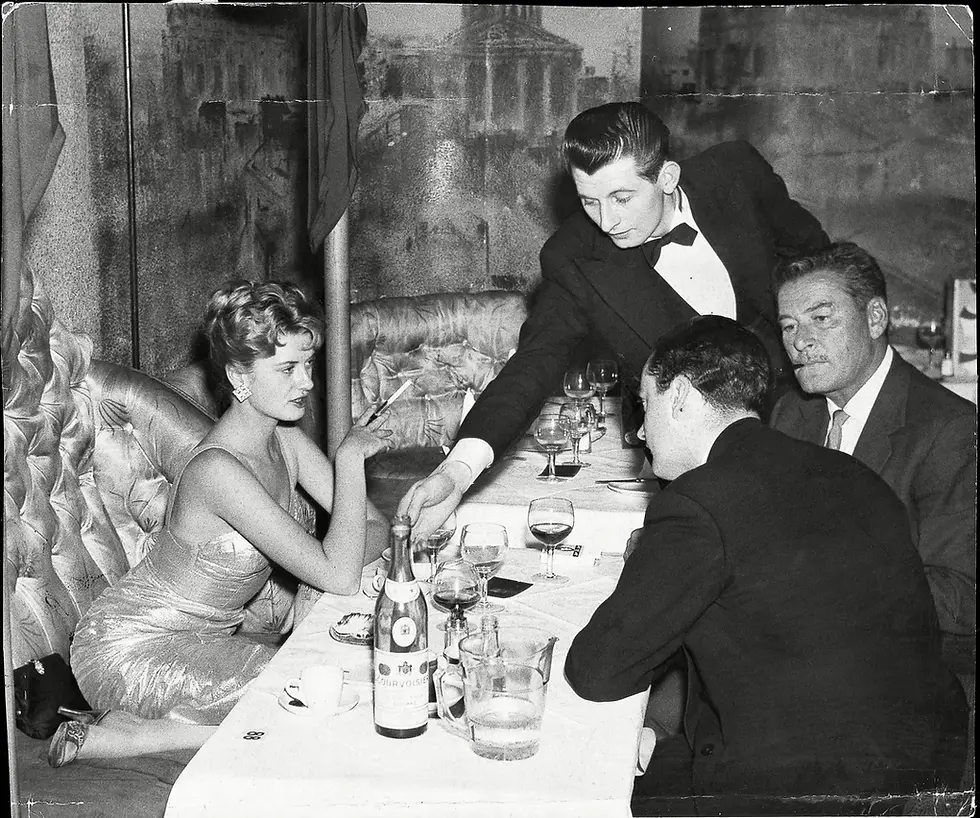
In a People magazine interview from 1988 Aadland described meeting Flynn for the first time:
"It was 1957, and I was 15 and working on the Warner Bros, lot as a dancer in a scene with Gene Kelly in Marjorie Morningstar (a film with a character played by a 46 year old Gene Kelly seducing an 18 year old Natalie Wood) when Orry-Kelly, the designer, came fluttering over from the next set saying that Errol Flynn wanted to meet me. I wasn’t very enthusiastic—I had met a lot of movie stars. I was taught to be very polite, so I went.
I met him in his dressing room, where his secretary was making coffee. No, I hadn’t heard about the statutory rape charges, about the teenage girls he had supposedly seduced. He asked me if I wanted to read for a play. I said I had to ask my mother, he said to use the phone. Errol said the reading would be at Huntington Hartford’s Hollywood estate, where he was staying. He said his secretary, his stuntman and his agent would be present, and also that he would like to take me to dinner. Mother finally said okay, that it would be a great opportunity.I remember driving up to the estate; it was gorgeous.
I read for the part, but the whole thing was a ruse—somebody else already had the part. Then we went to dinner at the Imperial Gardens—no shoes and hot saki. I didn’t drink, but I had a little hot saki that night. Back at the house, the others just disappeared. The scene was lovely—a great fire was roaring in the fireplace. There were thick bearskin rugs on the marble floors. Outside the lodge, deer would come to the great front window. The lighting was soft. Errol invited me down on the rug…"
One last adventure: Errol Flynn in revolutionary Cuba
In an odd final flourish, Flynn spent the last weeks of 1958 in Cuba, working as a correspondent for the Hearst press with Aadland in tow, covering the final days of the Cuban Revolution. According to biographer Jeffrey Meyers, Flynn had a secret meeting with a Castro agent at Havana's Hotel Nacional on Christmas night, and within two days he was face to face with Fidel Castro himself, spending five days observing the fighting around Santiago. He picked up a minor shin wound from shell fragments, which the press predictably exaggerated into something far more serious, echoing similar exaggerations from his earlier reporting during the Spanish Civil War decades before.
Flynn stayed through Batista's flight from Cuba on New Year's Day 1959 and was still around when Castro rolled into Havana about a week later. Screenwriter Budd Schulberg later recalled running into the pair walking arm in arm through the city. It wasn't all glamour: explorer Robin Hanbury-Tenison, who was also in Cuba at the time, said Flynn was expected to attend executions during the new regime's consolidation of power, lending his celebrity a kind of legitimacy to what was happening whether he liked it or not. Flynn cashed in on the whole experience with Cuban Rebel Girls, a cheap 1959 film starring himself as a war correspondent and Aadland as an American rebel fighter, mixing reenactments with real combat footage. A New York Times reviewer at the time noted that Flynn looked “very, very tired” throughout the whole picture, which in hindsight reads less like a review and more like a diagnosis.

The night in Vancouver
On October 14, 1959, Flynn was in Vancouver trying to sell his yacht, partly to keep it out of reach of the IRS, when he began suffering severe back and leg pain. He and Aadland went to the apartment of Dr. Grant Gould, at 1310 Burnaby Street in the city's West End, along with a stock promoter named George Caldough and a local hotel manager. Gould, incidentally, was the uncle of the pianist Glenn Gould. After receiving an injection for the pain, Flynn went to lie down in the bedroom. Fifteen minutes later, Aadland found him unresponsive. Paramedics worked on him for ninety minutes without success. He was fifty years old, and it was his third heart attack, on top of cirrhosis, chronic back pain he'd been managing with heroin, recurring malaria and a body a doctor had warned him just a month earlier needed to slow down.

The strangest detail of his death didn't come out until later. During the autopsy, the pathologist reportedly tried to remove and preserve some of Flynn's venereal warts in formaldehyde as an educational specimen. The coroner, Glen McDonald, objected, and the warts ended up taped back onto the body with scotch tape before it was flown back to Los Angeles. It's a bizarre, undignified footnote to a life that had specialized in exactly that kind of thing.
His autobiography, My Wicked, Wicked Ways, hit shelves that December, just weeks after he died. He'd spent August through October of 1958 dictating it to ghostwriter Earl Conrad at his Jamaica home, and the finished book sold over a million copies and has stayed in print ever since. Critics were kinder to it than they'd been to Flynn himself for years; The Guardian compared it to the confessional writing of Casanova and Frank Harris, and it remains one of the more candid Hollywood memoirs of its era, unsparing about Jack Warner, John Barrymore, Michael Curtiz and his own complicated feelings for Olivia de Havilland.
On the 16th October 1959 The Daily Mirror reported:
In the last hour of his life Errol Flynn gave his finest performance. Last night, while an audience of seven people in a doctor’s house at Vancouver, Canada, rocked with laughter, Errol leaned nonchalantly against a wall in the living-room, pantomiming his entire fantastic career. Racked with pain, but with a grin on his face, Errol made merciless fun of himself and the whole Hollywood merry-go-round.When he finished his show he went towards another room. At the door Errol turned, raised a finger and said: ‘I shall return'.
Except he didn’t. Ten minutes later Aadland went to see if he was alright. He was already dead.
The Daily Mirror reported that a few hours later:
Beverly Aadland was found wandering in the streets of Vancover wearing only underclothes and a negligee. She appeared to be in a daze, and said: “I can’t understand why everyone is so upset about Errol Flynn. He’s at hospital, but is coming home in the morning”. She bent down to pat a dog, and said: ‘You’re lonely, too, aren’t you?”.
What happened to everyone else
Beverly Aadland's life after Flynn's death stayed just as chaotic as the years leading up to it. Within a year she'd moved on to a relationship with a man named William Stanciu, who was later found unconscious in her apartment from a head injury and died on what would have been his twenty-first birthday. It was ruled accidental, though Aadland's own account of what happened shifted over time, from an initial suggestion of suicide to a later claim it had been an accident during horseplay. Her mother Florence was later convicted of contributing to Beverly's delinquency and served two months in jail, protesting to reporters that “there's no telling what she'll learn from those nasty girls in there.” Beverly eventually settled into a quieter life, marrying twice more, with her final marriage to a car dealership owner reportedly her happiest years, before she died in 2010 at sixty-seven from complications related to diabetes and heart disease.
Flynn's children carried their own share of tragedy forward. Sean Flynn followed a path that looked almost deliberately opposite to his father's Hollywood image, working as a war photojournalist in Vietnam before he vanished in Cambodia in 1970 while covering the conflict there, never to be found. Arnella, his youngest, died of a drug overdose in 1998. His daughters Deirdre and Rory both lived quieter lives largely out of the spotlight, with Rory eventually writing and speaking publicly about her father's legacy.

The legend that outlived the man
Errol Flynn spent his life playing dashing, heroic figures on screen while his real one careened between scandal, addiction and genuine brilliance. Not long before he died, he summed himself up better than any biographer has managed since: he'd made seven million dollars, he said, for “brandishing a sword, riding a horse and screaming ‘Charge!’” and he didn't think he deserved it, but he certainly didn't mind spending it. He remains one of Hollywood's most complicated golden age stars, a man whose actual life turned out to be even harder to believe than the movies that made him famous. If half of what got attached to his name over the decades was exaggerated, so was the swashbuckler on screen, and somehow both versions of Errol Flynn feel true at the same time.
Sources


