My Lai Massacre: The Cover-Up, the Song and the Men Who Stopped It
Updated: Sep 22
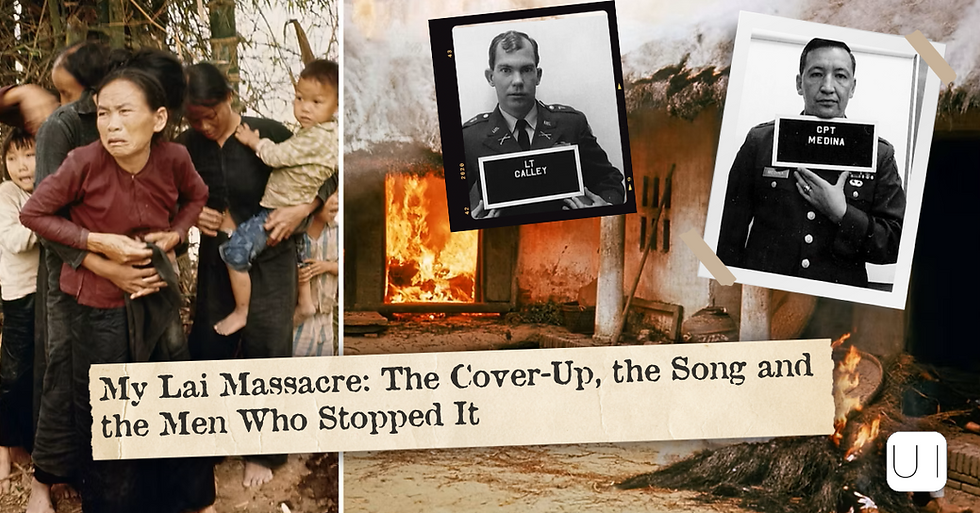
On the morning of 16 March 1968, American soldiers killed hundreds of unarmed Vietnamese civilians in a small hamlet called My Lai. That much is well known. What gets left out more often is what happened next. A helicopter crew landed between the guns and the villagers and threatened to open fire on their own side to make it stop. A junior officer investigating an early complaint about the unit involved, a man who would one day become US Secretary of State, wrote back that everything was fine. And when the one soldier ever convicted was sentenced to life in prison, so many Americans were furious about it that a spoken-word record defending him sold a million copies in days.
Quick Answers
• When did it happen? Early on the morning of 16 March 1968, in the hamlet of My Lai in Son My village, South Vietnam.
• How many died? The US Army’s own count is 347. The memorial at the site lists 504 names, aged from one to 82.
• Who stopped it? Helicopter pilot Hugh Thompson and his crew, Glenn Andreotta and Lawrence Colburn, landed and threatened to fire on American troops to halt the killing.
• Who was punished? Only Lieutenant William Calley was convicted, of murdering 22 people. He served three and a half years under house arrest.
• How did it come out? A soldier’s letter to Congress, then journalist Seymour Hersh’s reporting and a set of colour photographs, broke the story more than 18 months later.
The Briefing
Charlie Company had been in Vietnam for three months and had already lost men to snipers and booby traps without ever seeing an enemy soldier in the open. On the night of 15 March, their commander, Captain Ernest Medina, briefed them for an assault on My Lai 4, a hamlet his superiors believed was sheltering an entire Viet Cong battalion, along with most of its civilian population supposedly away at the local market that morning. Army intelligence turned out to be wrong on both counts.

What Medina actually told his men that night became one of the central arguments of the court martial that followed. Medina always maintained that when a soldier asked whether women and children were to be killed, he told the room not to, and to use common sense, firing back only if they were armed and engaging. Calley told a very different story on the stand. He said Medina had briefed the company to kill everything living, men, women, children and animals alike, and to leave nobody behind as they swept through. Other soldiers who were there backed up both versions in roughly equal numbers, which is part of why nobody was ever able to prove exactly what was said.
The Assault
Three platoons went in by helicopter shortly after 7am on 16 March, with Calley’s 1st Platoon on the first lift. The company met no hostile fire at all going in or at any point that morning. What they found instead was an ordinary hamlet of farming families, many of them still eating breakfast. Soldiers began gathering villagers, including infants still in their mothers’ arms, into groups and moving them to collection points in the centre of the settlement.

Calley later testified that Medina radioed him twice, demanding to know why his platoon was taking so long, and that when Calley explained a large group of villagers had been detained, Medina told him to “waste them”. Medina denied ever giving that order. Whatever the truth of the radio call, Calley returned to one of the collection points, where Private First Class Paul Meadlo was guarding around 40 villagers, and ordered him to help kill them. Meadlo later described Calley telling him “get with it, I want them dead” when he hesitated.
A second, larger group of villagers, mostly women, children and elderly people, was marched to a drainage ditch on the eastern edge of the hamlet. Calley ordered them in, telling Meadlo there was another job for them to do, then he and Meadlo opened fire into the ditch together. Not everyone obeyed. Private First Class James Dursi refused to fire on the group despite Calley’s direct order, and Specialist Robert Maples refused to hand over his machine gun for the same purpose. Elsewhere in the hamlet, other soldiers set fire to homes, killed livestock and destroyed food stores and wells, following instructions that, unlike the killing itself, Medina never denied giving.

Private First Class Michael Bernhardt, who arrived partway through the operation and refused to take part, said later that he walked through a village where he never saw one body that looked like a fighting-age man, armed or not.
The Army’s own count of the dead is 347. The Son My memorial at the site lists 504 names. The gap between the two numbers has never been resolved, partly because a US Army investigation into the killings was hampered from the start by destroyed records and conflicting testimony. A later inquiry, the Peers Commission, also found evidence that at least 20 women and girls, some as young as ten, were raped or sexually assaulted during the operation. Nobody was ever charged with those crimes.
The Helicopter Crew Who Turned Their Guns on Their Own Side
Hugh Thompson was flying reconnaissance that morning with two crewmen, Glenn Andreotta and Lawrence Colburn, when they realised what was happening on the ground. Thompson landed his small helicopter between a group of fleeing villagers and advancing American soldiers, and ordered Andreotta and Colburn to train their machine guns on their own countrymen if anyone tried to keep killing. He then coaxed several villagers out of a bunker himself and called in two other helicopters to fly the civilians to safety, saving at least ten lives that morning by the Army’s own later account. Andreotta also spotted movement in the ditch full of bodies and pulled a small child out alive.

Thompson reported what he had seen by radio, more than once, while he was still in the air. It didn’t stop the killing that day, and it didn’t do him much good afterwards either. He received death threats and had mutilated animals left on his doorstep for testifying about what he’d witnessed, and a member of Congress publicly called him a traitor. It took 30 years, until 1998, for the Army to award Thompson, Colburn and Andreotta the Soldier’s Medal, its highest honour for bravery that doesn’t involve fighting an enemy. Andreotta never knew he’d get one. He was killed in action three weeks after My Lai.
Thompson and Colburn went back to the site in 1998 to meet survivors in person. One veteran who later heard Thompson speak about it said he felt devastated and proud in equal measure, which is about as fitting a reaction to the whole story as any.
The Complaint That Was Waved Away
My Lai wasn’t the first warning sign to reach a desk in Vietnam. Eight months after the massacre, in December 1968, a former soldier named Tom Glen wrote to the US Army’s commanding general describing troops in the same brigade shooting at civilians without provocation. Glen didn’t name My Lai specifically, and the letter landed with a young major at division headquarters whose job was to check it out. That major spoke to a few officers, found nothing to it and wrote back that relations between American soldiers and Vietnamese civilians were excellent. He never interviewed Glen himself. The major’s name was Colin Powell, who would go on to become a four-star general and, decades later, US Secretary of State. He has always maintained he knew nothing of the actual massacre at the time, and journalists who examined the episode years later noted his response never claimed to rule out the specific events at My Lai, since Glen’s letter hadn’t named it. Either way, the complaint went nowhere, and the official story that Charlie Company had killed 128 enemy fighters in a clean engagement stood unchallenged for another year.
The Letter, the Photographs and Two Words on Television
It was another soldier, Ron Ridenhour, who forced the issue. Ridenhour hadn’t been at My Lai, but he’d heard enough from friends who had been there that he spent months collecting accounts before he left the Army. In March 1969 he wrote a detailed letter and sent it to 30 officials in Washington, including members of Congress. The letter triggered an Army investigation, and seven months later a young freelance reporter named Seymour Hersh tracked down soldiers who’d been there, including a young man named Paul Meadlo, and broke the story in print in November 1969.
Days later, the Cleveland Plain Dealer published a set of colour photographs taken at the scene by Army photographer Ronald Haeberle, who had kept them on his personal camera separately from his official military film. Life magazine bought and ran a larger set weeks later. The images made it impossible to treat My Lai as a rumour any longer.
Warning: graphic content The images below are real photographs from My Lai, and they're difficult to look at. We've kept them in because softening them would soften what actually happened, and that's not something this story can afford to do.
The moment that stuck hardest, though, was two words on CBS. Interviewed by Mike Wallace, Meadlo described shooting into a crowd of villagers. Wallace asked if that included women and children. “And babies?” Wallace asked. “And babies,” Meadlo answered. Anti-war artists later put the exchange on a poster alongside one of Haeberle’s photographs, and it became one of the most reproduced images to come out of the entire war.
Charges Against Fourteen Men, and a Trial for One
The Army eventually brought charges against more than a dozen officers and enlisted men, both for the killings and for the cover-up that followed. Almost all of them were acquitted, had their charges dropped or were never court-martialled in the first place. Many of the men who’d actually witnessed the worst of it refused to testify at all, citing their right against self-incrimination, which made building a case against anyone above Calley’s rank extremely difficult.
Calley’s own court-martial ran from November 1970 to March 1971 at Fort Benning, Georgia, in front of a six-officer jury, five of whom had served in Vietnam themselves. He was originally charged with the premeditated murder of well over 100 villagers. Prosecutor Aubrey Daniel presented evidence that Calley had personally thrown a baby into the ditch and shot it, and had rifle-butted an elderly man in the face before killing him. Daniel later said the true number of Calley’s victims was impossible to pin down exactly, but that it ran well beyond the charges that could actually be proven. Calley took the stand himself for three days and showed no remorse, insisting throughout that he had simply been following Medina’s orders.
After nearly 80 hours of deliberation, spread over almost two weeks, the jury found Calley guilty on 29 March 1971 of the premeditated murder of 22 infants, children, women and elderly men, plus a separate charge of assault with intent to murder a child of about two years old. Two days later he was sentenced to life imprisonment at hard labour. Standing before the jury at his sentencing hearing, a tearful Calley made a brief final statement, telling them, “Yesterday you stripped me of my honour”, and asking them not to do the same to every future soldier.
The Captain Who Walked Free
Ernest Medina faced his own court-martial later that year, charged with manslaughter, assault and responsibility for the killings carried out by the men under his command. His defence rested on the claim that he hadn’t known the scale of what was happening until it was essentially over, a claim the prosecution argued was hard to believe given he’d been in constant radio contact with his platoons throughout the operation. Medina denied ever ordering the killing of civilians and denied the “waste them” exchange Calley described under oath.

A jury of five combat officers deliberated for just 60 minutes before finding Medina not guilty on every count. He resigned from the Army shortly afterwards. Two decades on, asked to reflect on it, “I have regrets for it, but I have no guilt” over it, he said decades later, since he felt he hadn’t caused what happened. Of the roughly two dozen men eventually investigated, Calley was the only one ever convicted of anything.
The Prosecutor Who Turned on the President
The public reaction to Calley’s conviction wasn’t what anyone might have expected from a mass murder trial. A huge number of Americans saw him as a scapegoat for a war policy set far above his rank, and the backlash was immediate and enormous. A pro-Calley record called ‘The Battle Hymn of Lieutenant Calley’, sung from his point of view to the tune of an old patriotic hymn, sold 200,000 copies in its first three days alone and eventually passed a million. Governors ordered flags lowered to half mast. Telegrams flooded the White House. Within three days, President Richard Nixon had Calley moved out of the stockade and placed under house arrest instead, and announced he would personally review the case.
That intervention prompted an extraordinary response from Calley’s own prosecutor. Captain Aubrey Daniel wrote an open letter directly to Nixon, published a few days later, accusing him of undermining military justice in the middle of public outcry. “I was totally shocked and dismayed at the reaction of many people” to the verdict, Daniel wrote, arguing that anyone who’d actually seen the evidence could have reached no other conclusion. Nixon never replied publicly, and Calley went on to serve three and a half years under house arrest before a federal judge ordered his release.
What Happened After
Calley stayed almost completely silent about My Lai for over 40 years, running a jewellery store in Georgia and turning down interview requests. Then in August 2009 he agreed to speak, unannounced, to a Kiwanis Club lunch in Columbus, Georgia. “There is not a day that goes by that I do not feel remorse”, he told the room for what happened at My Lai, adding that he was very sorry for the Vietnamese families, the American soldiers involved and their families too. It was the closest thing to a public apology the massacre ever produced from anyone connected to it. One survivor, Pham Thanh Cong, who lost his mother and three siblings that morning, said he would rather have had an apology addressed to Vietnam directly, in writing. Cong went on to run the museum at the site.
Thompson never sought out fame for what he did, and by most accounts, he never fully made peace with the years of hostility that followed it either. He died of cancer in 2006, two years before Calley finally spoke. A US Army general who presented Thompson, Colburn and Andreotta with their medals in 1998 said their actions set the standard for every soldier to follow. It took the Army three decades to say so out loud.
You Might Also Like
• Larry Burrows Shows Us the Vietnam War Through His Camera Lens: the photojournalist who documented the conflict from the ground.
• David Funchess: The First Vietnam Veteran Executed in America: the uncomfortable questions raised by his case.
• The Amritsar Massacre: Possibly the British Empire’s Darkest Day: another state massacre and the cover-up that tried to follow it.