

The 1984 McDonald's Massacre: A Tragic Day in San Ysidro
Updated: May 1
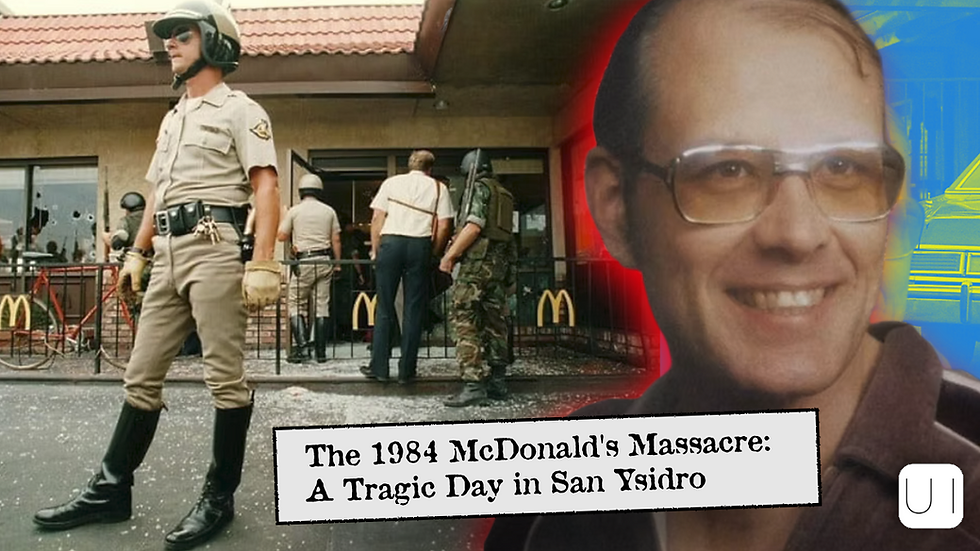
On a warm Wednesday afternoon in July 1984, a man walked into a McDonald's restaurant in one of San Diego's quietest border communities and opened fire on everyone inside. Families eating lunch. Children playing. Teenagers working summer shifts. He killed 21 people and wounded 19 others in 77 minutes. The only thing that stopped him was a single bullet from a police sniper on the rooftop opposite.
The San Ysidro McDonald's massacre was, at the time, the deadliest mass shooting by a lone gunman in American history. Forty years on, it remains the deadliest mass shooting in California's history. And yet, outside of San Ysidro itself, many people have never heard of it.
"This is probably our 9/11," longtime San Ysidro resident Raymond Robles told reporters on the 40th anniversary. "At the time it was the biggest massacre in US history, but as the years went by it seems everybody just forgot."
This is the full story: the man behind it, the missed warning signs, what happened inside that restaurant, and the community that's never truly recovered.

Who Was James Huberty?
James Oliver Huberty was born in Canton, Ohio on October 11, 1942, the second child of Earl Vincent Huberty, a quality inspector, and Icle Evalone Huberty, a homemaker. Both parents were devoutly religious, regular attendees at local United Methodist Churches. From the very beginning, Huberty's life was shaped by loss and instability.
At age three, he contracted polio. For years he was forced to wear steel-and-leather braces on both legs, and though he eventually recovered well enough to live a relatively normal life, he was left with a mild limp that would follow him everywhere. In 1950, his father bought a 155-acre farm in Mount Eaton, but his mother flatly refused to go. Icle abandoned the family shortly after to pursue sidewalk preaching as a Pentecostal missionary in Tucson, Arizona. Huberty's father later recalled finding his young son slumped against the chicken coop, sobbing.
It was a wound that never healed. A minister who knew the family later claimed that Huberty "blamed God" for taking his mother away. Classmates at Waynedale High School saw a sullen, withdrawn boy who was bullied relentlessly, partly because of his limp and partly because of his family's extreme religious beliefs. He graduated 51st out of a class of 77 in 1960, more or less invisible to everyone around him. His one consistent passion was guns. By his teens, he was already something of an amateur gunsmith.
In 1962, Huberty enrolled at Malone College, initially studying sociology before switching paths entirely to attend the Pittsburgh Institute of Mortuary Science. He graduated with honours in 1964 and earned both a funeral director's licence and, the following year, an embalmer's licence. The owner of a funeral home where he later trained as an embalmer summed him up perfectly: "He was a good embalmer but just didn't relate to people. That's why he was better as a welder. He could just put that mask down and be by himself."
Marriage and Mounting Instability
In early 1965, Huberty married Etna Markland, a woman he'd met at Malone College. The couple initially settled in Canton, where he worked at a funeral home before becoming a welder, first for a firm in Louisville and then for Babcock & Wilcox from June 1969 onwards. By the mid-1970s, he was earning between $25,000 and $30,000 a year (equivalent to roughly $150,000–$180,000 today). They moved into a three-storey home in an affluent part of Massillon, Ohio. Daughters Zelia and Cassandra were born in 1972 and 1974.

From the outside, it looked like stability. Inside, it was anything but. Huberty had a long history of domestic violence. He would slap and punch his daughters, holding knives to their throats, and beating his wife. On one occasion, Etna filed a report with the Canton Department of Children and Family Services stating that her husband had "messed up" her jaw. Beginning in 1976, she repeatedly urged him to seek counselling. He always refused.
To manage him, Etna developed an unusual coping mechanism: she claimed she could read his future through tarot and playing cards. Huberty believed her completely. Her "readings" would calm him temporarily, and he'd follow whatever recommendations she made. It was a small, strange window of control in an increasingly unpredictable household.
Neighbours and colleagues described him as sullen, paranoid, and obsessed with guns. He kept a running mental tally of every perceived slight or injustice against him or his family, referring to these as "debts" he intended to settle. According to a family acquaintance named Jim Aslanes, Huberty's home was bedecked with loaded firearms to such a degree that wherever he happened to be sitting, he "could just reach over and get a gun." Every single one had the safety catch disabled.
By the late 1970s, Huberty had fallen deep into survivalist ideology, convinced that a Soviet escalation of the Cold War was inevitable and that both Jimmy Carter and Ronald Reagan were personally conspiring against him. He stockpiled non-perishable food and weapons, preparing for what he believed would be an imminent societal collapse through nuclear war or economic catastrophe.
The Fall
In November 1982, the Babcock & Wilcox plant shut down and Huberty was laid off. A former co-worker later recalled that, upon hearing about the closure, Huberty had made it clear that if he couldn't provide for his family, he intended to commit suicide and "take everyone with him." Shortly after losing his job, Etna said he began hearing voices. In early 1983, he pressed a loaded pistol to his own temple. She grabbed his arm and pried the gun free, hiding it in another room. When she came back, she found him sitting on the sofa, crying.
Unable to find lasting work in Ohio, the Hubertys sold their six-unit apartment building and their home and relocated to Tijuana in October 1983, hoping their savings would stretch further in Mexico. Etna and the girls adapted quickly, making friends with their new neighbours. Huberty, who spoke barely any Spanish, hated it. Within three months they moved again, this time to San Ysidro, a largely low-income district of San Diego right on the US–Mexico border, with a population of around 13,000.
In San Ysidro, Huberty took a job as a security guard in Chula Vista after completing a federally funded training course in April 1984. On July 10, just eight days before the massacre, he was fired. His employer cited poor performance and "general physical instability."

The Days Before: A Cry Nobody Heard
On July 15, 1984, Huberty told his wife he thought he had a mental health problem. Two days later, on the morning of July 17, he called a San Diego mental health clinic and asked for an appointment. He left his contact details and was assured someone would call back within hours.
According to Etna, he sat quietly beside the phone for several hours, waiting. The call never came. The receptionist had misspelled his name as "Shouberty." On top of that, his calm, polite manner on the call had given no sense of urgency, and he'd mentioned he'd never been hospitalised for mental health issues, so the inquiry was logged as "non-crisis" to be handled within 48 hours.
After waiting in vain, Huberty got up and rode off on his motorcycle. About an hour later he came back, apparently in good spirits. That evening, he and Etna watched a film together on television while the girls slept.
The following morning, Wednesday 18 July 1984, the family visited the San Diego Zoo. During their walk, Huberty told his wife he believed his life was effectively over. He said, referring to the clinic's silence: "Well, society had their chance."
After a lunch at a McDonald's in the Clairemont neighbourhood, they returned home. Then Huberty walked into the bedroom where Etna was resting, leaned toward her, and said: "I want to kiss you goodbye."
She kissed him. She asked where he was going. He calmly replied he was "going hunting… hunting for humans."
Carrying a 9mm Browning HP semi-automatic pistol, a 9mm Uzi carbine, a Winchester 1200 12-gauge pump-action shotgun, and a box and cloth bag stuffed with hundreds of rounds of ammunition, he glanced at his eldest daughter Zelia in the hallway and said: "Goodbye. I won't be back."
Inside the Restaurant: 77 Minutes of Terror
At 3:56pm on July 18, Huberty pulled his black Mercury Marquis into the parking lot of the McDonald's at 460 West San Ysidro Boulevard. The restaurant had 45 customers inside. It was a typical Wednesday afternoon: families, children, teenagers. Ordinary life.
The First Shots
He walked in and aimed his shotgun at 16-year-old employee John Arnold from about fifteen feet away. The assistant manager, Guillermo Flores, shouted a warning. Huberty pulled the trigger. The gun jammed. As he inspected it, the restaurant's 22-year-old manager, Neva Caine, walked toward the counter. Arnold, thinking it was some kind of bad joke, started walking away.

Huberty fired his shotgun toward the ceiling, then swung the Uzi at Caine and shot her once beneath her left eye. She died minutes later. He turned the shotgun on Arnold, wounding him in the chest and arm, then ordered everyone onto the floor, calling them "dirty swine, Vietnam assholes." He claimed he'd "killed a thousand" and intended to "kill a thousand more." When a 25-year-old customer named Victor Rivera tried to reason with him, Huberty shot him fourteen times.
The Slaughter Continues
As staff and customers hid beneath tables and booths, Huberty worked through the restaurant methodically. He killed 19-year-old María Colmenero-Silva with a single shot to the chest, then shot nine-year-old Claudia Pérez repeatedly with the Uzi. He wounded Claudia's 15-year-old sister Imelda, then fired his shotgun at 11-year-old Aurora Peña. Aurora's 18-year-old pregnant aunt, Jackie Reyes, tried to shield her. Huberty shot Jackie Reyes 48 times. Eight-month-old Carlos Reyes sat wailing beside his mother's body. Huberty shot the baby in the back.
A 62-year-old trucker named Laurence Versluis was killed. Nearby, a family near the play area were also targeted: Blythe and Ronald Herrera, who were shielding their 11-year-old son Matao and his friend 12-year-old Keith Thomas. Ronald Herrera was shot six times and survived. Blythe and Matao were both killed by multiple gunshots to the head. Keith Thomas was shot in the shoulder, arm, and wrist, but survived.

Three women hiding beneath a booth were also shot: Guadalupe del Río, Gloria Ramírez, and Arisdelsi Vuelvas Vargas. Vargas received a single gunshot wound to the back of the head. She'd be the only person fatally wounded who lived long enough to reach hospital, dying the following day. Huberty killed 45-year-old banker Hugo Velázquez Vasquez with a single shot to the chest.
The Chaos Outside
The first emergency call was made just after 4pm, but the dispatcher sent responding officers to the wrong McDonald's, two miles away. The only warnings given to people approaching the restaurant came from passers-by on the street.
A young woman named Lydia Flores drove into the parking lot, noticed shattered windows and gunfire, reversed until she crashed into a fence, then hid in nearby bushes with her two-year-old daughter Melissa until it was over.
Around 4:05pm, a Mexican couple, Astolfo and Maricela Félix, drove toward the restaurant with their four-month-old daughter Karlita. Astolfo initially assumed the shattered glass was from renovation work and that Huberty was a repairman. Huberty fired at all three. Maricela was blinded in one eye and permanently lost use of one hand. Baby Karlita was critically wounded in the neck, chest and abdomen. All three survived after bystanders rushed them to safety.

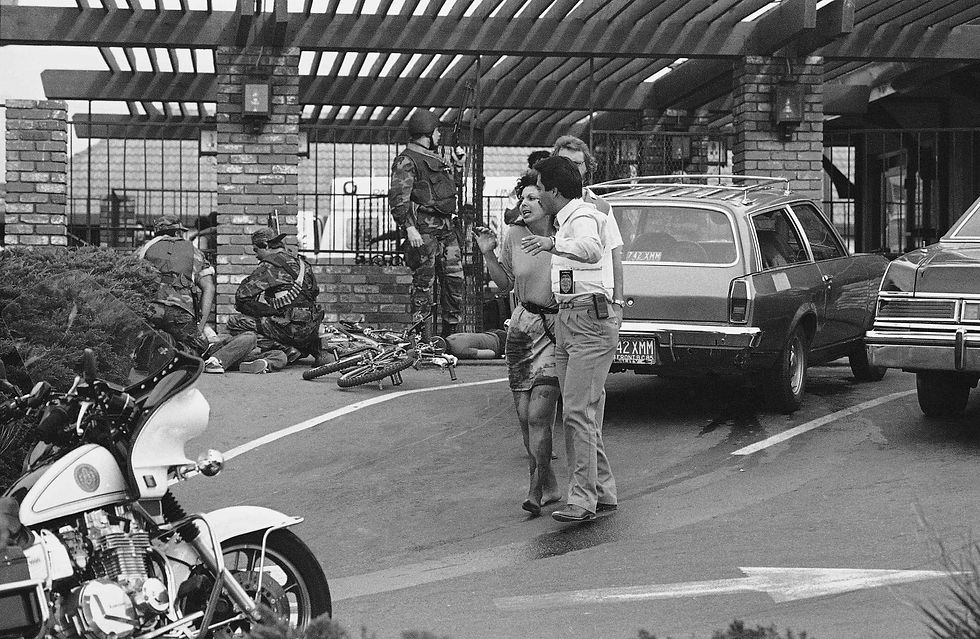
Three 11-year-old boys rode their BMX bikes into the west parking lot. A member of the public shouted a warning from across the street, but before they could react, Huberty shot all three. Joshua Coleman survived by lying still. His two friends were killed: Hernandez from multiple gunshot wounds to his back and Delgado from wounds to his head.
An elderly couple, 74-year-old Miguel Victoria Ulloa and 69-year-old Aída Velázquez Victoria, were walking toward the entrance when Huberty opened fire. Aída was killed with a single shot to the face. Miguel tried to cradled her, screaming curses at Huberty. Huberty walked to the doorway and shot Miguel in the head.
Inside the Kitchen
Survivors later recalled watching Huberty walk to the service counter and fiddle with a portable radio, apparently searching for news reports of his own shooting, before selecting a music station and continuing to shoot people while dancing to it.

He then discovered six employees hiding in the kitchen. "Oh, there's more," he shouted. "You're trying to hide from me, you bastards!" He opened fire, killing 21-year-old Paulina López, 19-year-old Elsa Borboa-Fierro, and 18-year-old Margarita Padilla. Seventeen-year-old Albert Leos was critically wounded, shot five times, and would later crawl to a basement utility room where six other employees and a customer with her infant were hiding.
Before Huberty began shooting in the kitchen, Padilla had grabbed the hand of her friend and colleague Wendy Flanagan, 17, and the two had started to run. Padilla was shot and killed. Flanagan made it to the utility room.
At one point, Huberty noticed Aurora Peña, the 11-year-old still alive beside the bodies of her dead aunt, baby cousin, and two friends. He swore, threw a bag of french fries at her, then retrieved his shotgun and shot her in the arm, neck, and jaw. Aurora Peña survived, but spent longer in hospital than any other survivor.
The Police Response
About ten minutes after the first emergency call, officers arrived at the correct restaurant. The first on the scene, Officer Miguel Rosario, immediately radioed the situation to the San Diego Police Department as Huberty fired at his patrol car. A lockdown was imposed across six blocks. A command post was set up two blocks away, 175 officers were deployed, and SWAT team members began taking positions around the building.

The situation was complicated. Most of the restaurant's windows had been shattered by gunfire, and the shards were reflecting light in ways that made it nearly impossible to see inside clearly. Police weren't sure how many shooters were involved. One escaped survivor confirmed there was a single gunman, holding no hostages and shooting everyone he encountered.
At 5:05pm, over an hour into the massacre, all responding law enforcement personnel were authorised to kill Huberty if they could get a clear shot. The SWAT commander had been delayed by rush-hour traffic.
A fire engine that drove within range was shot at repeatedly, with one occupant slightly wounded. Huberty carried on shooting for another twelve minutes.

The Shot That Ended It
At 5:17pm, Huberty moved from the service counter toward the doorway near the drive-through window. That movement gave 27-year-old SWAT sniper Charles Foster, positioned on the roof of the post office directly opposite, a clear view from the neck down through his telescopic sight.
"I never did see his face. The first time I was actually able to see him, he was sitting on a counter in about the middle of the building. Then he got up and started walking toward the door, where we had a better view of him from the neck down… he stopped about six feet from the door, so I took the shot. He dropped the Uzi and was thrown back a few feet." - Charles Foster, SWAT sniper, July 1985
Foster fired a single round from approximately 35 yards. The bullet entered Huberty's chest, severed his aorta just beneath his heart, and exited through his spine, leaving a one-square-inch exit wound. Huberty was thrown backwards onto the floor in front of the service counter and died almost instantly.
The entire incident had lasted 77 minutes. Huberty fired a minimum of 257 rounds of ammunition. Twenty-one people were dead. Nineteen more were wounded. Of the fatalities, thirteen died from gunshot wounds to the head and seven from gunshots to the chest. The victims ranged in age from four months to 74 years, and were predominantly, though not exclusively, of Mexican or Mexican-American heritage.
Only ten people inside the restaurant escaped physically uninjured. Six of them had been hiding in the basement utility room.
The Aftermath
A Community Shattered
San Ysidro was a small, tight-knit border community of around 13,000 people. The McDonald's on San Ysidro Boulevard wasn't just a fast food restaurant. It was a neighbourhood hub. "There were two McDonald's in San Ysidro, but this one was right in the centre of our community, everybody came here," Raymond Robles recalled. "You have to remember, those people were grandparents, parents, children, people who grew up in the community."
Because of the sheer number of victims, local funeral homes couldn't cope. The San Ysidro Civic Center was used to hold wakes, and Mount Carmel Church held back-to-back funeral masses to ensure every victim could be buried in time. Bullet holes made by stray shots from the massacre are still visible in the brickwork of the post office next door and they've never been repaired.
The Restaurant
McDonald's initially refurbished the restaurant and planned to reopen it. The community was outraged. Nobody wanted it open. Following discussions with community leaders, McDonald's announced on July 24, less than a week after the massacre, that the restaurant would not reopen. It was demolished at midnight on September 26, 1984.

McDonald's donated the land to the city with the stipulation that no restaurant be built on the site. After over four years of debate about what to do with it, the land was sold in February 1988 to Southwestern College for $136,000. A 300-square-foot area in front of the college's campus extension was set aside as a permanent memorial to the 21 victims.
A permanent memorial was formally unveiled in 1990. Designed by former Southwestern College student Roberto Valdes, it consists of 21 hexagonal white marble pillars of varying heights, each bearing the name of a victim. "The 21 hexagons represent each person that died," Valdes explained, "and they are different heights, representing the variety of ages and races of the people involved. They are bonded together in the hopes that the community, in a tragedy like this, will stick together, like they did." Each anniversary, the memorial is decorated with flowers. On the three days of the Day of the Dead, candles and offerings are placed there on behalf of the victims.
The Financial Response
McDonald's pledged $1 million to a survivors' fund. Joan Kroc, widow of McDonald's founder Ray Kroc, added a personal contribution of $100,000 for burial costs, financial aid for relatives of the deceased, and counselling for survivors. Total donations exceeded $1.4 million. In a show of solidarity, rival chain Burger King also suspended all advertising.
Amid protests from some San Ysidro residents and donors who felt it was deeply inappropriate, Etna Huberty, the killer's widow, received the first payout from the fund.
The Lawsuits
Several survivors and families of victims filed lawsuits against both McDonald's and the San Diego Police Department. All were consolidated and dismissed before trial. On July 25, 1987, the California Court of Appeal upheld those dismissals, ruling that McDonald's had no duty of care to protect patrons from an unforeseeable assault by a "murderous madman," and that standard security measures like guards and CCTV couldn't have deterred someone who had no interest in his own survival. The SDPD were also exonerated. The final lawsuits were dismissed in August 1991.
In 1986, Etna Huberty filed a separate civil suit against both McDonald's and Babcock & Wilcox, seeking $5 million in damages. She claimed her husband's behaviour had been triggered by a combination of high levels of lead and cadmium found in his body at autopsy, likely accumulated over 13 years of welding without adequate respiratory protection, and also by monosodium glutamate in the McDonald's food he'd been eating heavily in the weeks before the shooting. No alcohol or drugs were found in his system. The lawsuit was dismissed in 1987 for lack of scientific evidence linking MSG with violent behaviour.
Huberty's Body and Family
James Huberty's body was cremated on July 23, 1984, with no religious service. His ashes were returned to Etna and later interred in Ohio. Etna and their daughters received numerous death threats in the weeks after the massacre and temporarily lived with a family friend. All three attended counselling for over nine months. The daughters enrolled in new schools under assumed names. Etna Huberty died of breast cancer in 2003.
The Survivors
Albert Leos, the 17-year-old McDonald's employee who was shot five times and crawled to the basement utility room, later became a police officer. He served in several South Bay police departments and eventually joined the San Diego Police Department. On the 40th anniversary of the massacre, Leos said: "I remember every single thing that happened that day. I saw the shooter killing babies, women, and children." Asked why he chose law enforcement, he said the San Ysidro community had rallied around him when he was recovering, putting food on the table and paying his bills, and becoming a cop was his way of giving back. His PTSD manifested as nightmares for years. One night, responding to a car fire, he heard a man trapped inside. Protocol said wait for the fire brigade. Leos reached into the flames and pulled the man out. The car exploded as he dragged him to safety. The nightmares stopped.
Wendy Flanagan, the 17-year-old employee who'd just been chosen for her school's varsity cheerleading squad, survived by hiding in the utility room. She's spent decades in therapy managing survivor's guilt. "If I can help somebody else with something that I may have learned from that incident, here I am. I'm willing, and I'm grateful," she said in 2024.
The Legacy: What Changed (and What Didn't)
The San Ysidro massacre prompted San Diego to radically reassess its tactical response methods and the weapons available to officers. The SWAT commander's delay due to rush-hour traffic was a particular sticking point. Police training for special units was overhauled and more powerful weapons were procured. One officer admitted he'd felt "inadequate" carrying only a .38-calibre revolver during the incident. Crucially, the massacre also led to the widespread adoption of post-incident psychological debriefing and professional counselling for officers involved in traumatic events, something that wasn't routine before 1984. A 1985 study confirmed that multiple officers had developed PTSD as a result.
San Diego Police Chief William Kolendar held a press conference on August 2 to address the department's response. He said the suggestion that officers should have stormed the restaurant was "ludicrous". The spider-webbed, bullet-shattered windows made direct sunlight visibility almost impossible. He concluded: "I believe the operation was handled the way it should have been handled." When asked about a racial motive (the victims were predominantly Mexican-American), Kolendar said simply: "He didn't like anybody."
The massacre also, indirectly, influenced US legal precedent around mass shooting liability. The 1987 California appellate ruling, which found that businesses have no duty to protect customers from unforeseeable attacks by gunmen who don't care about their own survival, was later cited in 2012 by Cinemark's defence team after the Aurora, Colorado cinema shooting.
As for legislative change at a national level, there was very little. The massacre generated enormous media coverage in 1984, but no major federal gun control legislation followed.
Two documentary and fictional works have since explored the massacre. The 1988 film Bloody Wednesday was loosely inspired by the events. The 2016 documentary 77 Minutes, directed by Charlie Minn, features interviews with many of the survivors, including Charles Foster, the sniper who took the shot, and remains the most comprehensive screen account of the day.
The Missed Chance
More than anything else, the San Ysidro massacre is a story about a phone call that wasn't returned. James Huberty was clearly deteriorating. His wife knew it. He knew it. On July 17, he picked up the phone and asked for help. He waited for hours. Nobody called back. A misspelling. A polite tone of voice. A tick on a form: non-crisis.
"Well, society had their chance," he told Etna the next morning at the zoo.
It would be wrong to reduce 21 deaths to a single administrative failure. Huberty was violent long before that phone call, and might well have reached this point regardless. But the missed call is one of those details that's impossible to shake. Joshua Coleman survived the parking lot by lying still and pretending to be dead. Aurora Peña survived by lying still among bodies that included her aunt, her baby cousin, and two friends. Wendy Flanagan survived by running. Albert Leos survived by crawling.
The bullet holes in the post office wall have never been filled in. Every July 18, flowers appear at the 21 white marble pillars. The community remembers, even if the rest of the country has largely moved on.


