

Tarrare, The 18th-Century French Showman Who Ate Everything From Human Flesh To Live Eels

It's 1798 and a surgeon is standing over a dead man in a Versailles hospital, looking for a fork. The man on the table is around 26, painfully thin and, according to everyone who met him, had never once felt full. Before he died he swore that a golden fork he'd swallowed two years earlier was killing him. Now the surgeon wants to know if he was telling the truth.
The dead man is Tarrare, the only name history kept for him. In his short life he was thrown out by his family, paraded as a sideshow, fed to military doctors as an experiment and sent into Prussian territory as a human courier. The story of what he ate is famous. What gets lost is how little of it we can actually check, and how much of it comes down to one doctor's pen.
Quick answers
• Who was Tarrare? A Frenchman born around 1772 near Lyon who suffered from what doctors of the time called polyphagia, an appetite that can't be satisfied.
• When did he live? Roughly 1772 to 1798. He enlisted in 1792, which is often mixed up with his birth year.
• What killed him? Tuberculosis, according to the accounts, at a hospital in Versailles when he was about 26.
• Did he really eat a child? Nobody can prove it. A toddler vanished from a hospital where he was staying and he was suspected, but the sources say no record proves what happened.
• Where does the story come from? Almost entirely from one case study by the army surgeon Pierre-François Percy, written a few years after Tarrare's death.
• What was wrong with him? Nobody knows for certain. Modern writers point to an overactive thyroid, damage to the brain's hunger controls or a mix of parasites and an unusually large stomach.
A boy who ate his family out of house
Tarrare was born in the countryside near Lyon in the early 1770s, and that's about as precise as anyone can get. His exact birth date and family name are undocumented. Accounts of his youth say he was thrown out of the family home as a teenager because feeding him cost too much. By seventeen he could reportedly eat his own body weight in beef.
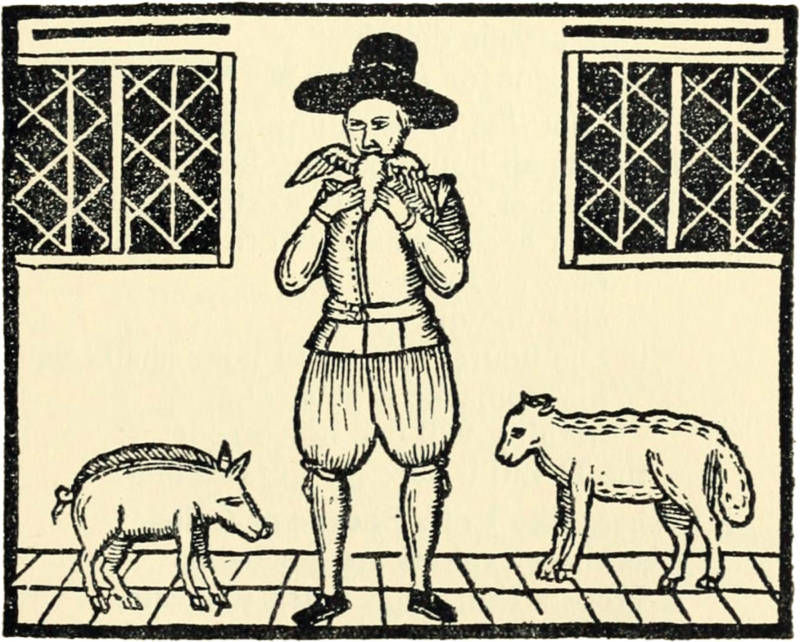
After that he drifted around with a rough crowd before hooking up with a travelling charlatan, a mountebank who put his stomach to work as a sideshow. Crowds paid to watch him swallow corks, stones and whole apples, and he moved on to live animals. He'd tear a cat apart and eat it, then bring the fur and bones back up afterwards. By 1788 he'd landed in Paris as a street performer, swallowing baskets of apples, corks and flints for coins. One write-up says he was also treated for an intestinal blockage around then, which is hardly a shock.
Here's a detail that gets skipped a lot. Despite everything he consumed he was tiny. One source puts him at only about 45 kilograms, with hardly any body hair and skin that hung in loose folds. He sweated heavily and, by all accounts, smelled terrible.

The army and the hospital at Soultz
When France went to war with most of Europe in 1792, Tarrare joined up. Standard army rations didn't come close to filling him, and he ended up in the military hospital at Soultz in Alsace. Doctors gave him four soldiers' portions and he still wanted more.
That's where two surgeons entered the story. One was a Dr Courville. The other was Pierre-François Percy, a rising army surgeon who'd go on to become one of Napoleon's chief medical men. Percy wrote up the case, and a 2024 scholarly paper on the Tarrare story is blunt about what that means: Percy's case study is the only written archive, and "Tarrare's voice" is absent from it. We never hear him describe his own hunger. We only hear the man in the white coat.

So the tests began. Percy and Courville reportedly served him a meal made for fifteen labourers, with two large meat pies and plenty of milk, and he cleared the lot. Afterwards he reportedly passed out, which one summary says Percy called the "itis". They fed him a live cat, which he tore open and drank the blood of. They gave him a live eel, which he slurped down like pasta. Snakes, lizards and puppies were on the menu too. Sharp bones that would have shredded another man's insides apparently did him no harm.
Then they tried to cure him. According to one summary, laudanum, vinegar, tobacco pills and soft-boiled eggs all failed. Another mentions vinegar baths and opium. Nothing touched the hunger.
Percy's own conclusion is worth noting. He didn't think Tarrare was mentally ill. He saw a body in the grip of something physical. The paper on the case also notes that Percy wrote that Tarrare seemed to fear rather than wish for his recovery, so much pleasure did he take in eating.

The human courier
Then the army had an idea. If Tarrare could swallow anything, why not a message? According to the story, Courville had him swallow a wooden box containing a document and then waited for it to reappear. It did, intact, and Tarrare was given official work as a courier.
His first and only mission was to reach a French colonel held prisoner by the Prussians. One account places the colonel near Landau, and another names General Alexandre de Beauharnais as the man who recruited him. Beauharnais, the story goes, was Josephine's first husband, so you can see why the detail gets repeated. I haven't found solid confirmation of his involvement, so treat it with care.
Tarrare didn't make it. His huge mouth, his smell and his lack of any German gave him away almost at once. Prussian soldiers stripped him and beat him, and one retelling has him chained near a latrine for around 30 hours while they waited for the box to come out. When it finally did, the joke was on everyone. One version says the message inside was just a note asking whether the courier had succeeded. He was then released, and by some accounts subjected to a mock execution first. Another version has him furious at being tortured over a message that didn't matter. Every part of this is thinly sourced, so take the details as folklore with a kernel of truth.
If you're into Napoleonic-era medicine, the world Percy worked in was brutal and improvised. We covered one famous example in the story of Henry Paget's leg at Waterloo, and Napoleon's own post-mortem has its own odd afterlife in this piece on his preserved relic.

Back to the hospital, and the missing toddler
Tarrare went back into hospital care, and by the sound of it his hunger got worse. He was said to drink the blood of other patients and to scavenge scraps from slaughterhouses. Some retellings say he went after corpses in the morgue too. Hospital leeches and rubbish reportedly went down as well.
Then a toddler, around 14 months old in most retellings, disappeared from the ward. Tarrare was the obvious suspect and was chased out. No record proves he ate the child, and it's worth saying so plainly, because plenty of websites don't. Think about how the accusation would have looked to the staff. A famously ravenous man, a missing baby and a hospital where he'd already been caught eating things he shouldn't. The rumour wrote itself. A rumour isn't evidence.

The golden fork
Tarrare wandered off but eventually turned up at Versailles in 1798, seriously ill with tuberculosis. He told the staff a golden fork he'd swallowed some two years before was lodged inside him and killing him. He died around a month later. Nobody can say where the fork came from or whether it ever existed.
What happened next matters more than it sounds. The Purcell-Gates paper describes Percy's search for the fork as one of the first pathological autopsies in Western Europe, taking place just as medicine was shifting from simple dissection to hunting for the cause of a disease inside the body. Percy wasn't just curious about a freak. He was trying out a new way of doing medicine.
Accounts differ on who did the cutting. The Purcell-Gates paper says Percy performed it. Other summaries name a surgeon called Tessier, with one saying he was the man who pushed for the autopsy. I couldn't settle that, so I'd say only that the two names appear in different retellings.
The findings, as relayed by several summaries, describe a gullet so wide you could see straight down it, a stomach that filled much of his abdomen and was lined with ulcers, an enlarged liver and gallbladder and a body cavity full of pus. The body had begun to rot badly by the time the doctors got to it. One account says the delay left the examination incomplete and that the stench drove the surgeons back. What they didn't find was the fork.
So what was wrong with him?
We can't diagnose someone from 1798, and Dr Alan Bates of the Tarrare Project at Bristol makes the same point. It's far from clear a single diseased organ explained his hunger, and Percy may have gone hunting for something he could never have found.
Modern guesses include an overactive thyroid, which fits the heat, the sweating and the weight that never went on. Another is damage to the hypothalamus, the brain region that tells you you've eaten enough. A third is a huge stomach from birth combined with tapeworms that stole his nutrition. Uncontrolled diabetes gets mentioned too. Any of them, or a mix, could account for what the doctors saw. None can be proved.
One more caution. At least one modern write-up asks whether Percy's records were exaggerated or even falsified. That's a fair question about any dramatic account written after the event, and it's the reason I'd trust the medical outline more than the spy story.
The puppets that brought him back
Tarrare hasn't stayed buried. In 2017 the company Wattle & Daub staged a puppet chamber opera called The Depraved Appetite of Tarrare the Freak. It was set inside Percy's autopsy room, with living performers working fragmented puppet corpses while Percy recounts the case. Odd as that sounds, it's a fitting way to tell the story. Percy is the only source, and putting him centre stage, notebook in hand, makes that obvious.
Why the legend sticks
Tarrare works as a story because it has everything: a body that breaks the rules, a doctor with a notebook, a spy mission that goes wrong and a missing fork nobody could find. The version doing the rounds online is louder than the evidence, though. Stripped back, it's the case of a ravenous young man who was mocked, experimented on and shunted between hospitals, and who died at 26 without anyone working out why. Whatever he was, he wasn't a monster. He was a patient nobody knew how to help.
You might also like
Sources
1. Staging corpses: reanimating medical history through puppetry (Laura Purcell-Gates). The Routledge Companion to Performance and Medicine, 2024. https://researchspace.bathspa.ac.uk/16089/1/16089.pdf
2. Looking for the Golden Fork. The Tarrare Project, University of Bristol. https://egjl2015.blogs.bristol.ac.uk/2015/08/30/looking-for-the-golden-fork/
3. What Was Tarrare's Bizarre Medical Condition?. ScienceInsights. https://scienceinsights.org/what-was-tarrares-bizarre-medical-condition/
4. Tarrare, the Greatest Glutton of All Time. Mental Floss. https://www.mentalfloss.com/article/66508/tarrare-greatest-glutton-all-time
5. The Medical Mystery of Tarrare, a Cannibalistic French Spy. Ripley's Believe It or Not. https://www.ripleys.com/stories/tarrare
6. History's Hungriest Man: The True Story of Tarrare and the Mysterious Autopsy Results. Bored Panda. https://www.boredpanda.com/tarrare-autopsy/
7. Strangest Medical Cases: Tarrare, the Man Who Can Eat Everything. History Collection. https://historycollection.com/this-18th-century-man-literally-ate-everything-which-led-to-one-of-the-most-disturbing-medical-cases-in-history/2/
8. The Strange Life of Tarrare, the Insatiable Glutton. History Defined. https://www.historydefined.net/life-of-tarrare/
9. The Bizarre Case of Tarrare. Weird History Facts. https://weird-history-facts.com/the-bizarre-case-of-tarrare-eat-a-corpse/
The Man Who Could Not Stop Eating: The Story of Tarrare. Retrofuturista. https://retrofuturista.com/the-insatiable-tarrare-a-man-of-unfathomable-hunger/


