

Sam Giancana: The Madman of Chicago Who Knew Too Much
Updated: Jun 19

It's often said that Chicago built its empire on the backs of immigrants and the muscle of men willing to do what others wouldn't dare. Few gangsters epitomised this better than Salvatore "Sam" Giancana, the Chicago mob boss whose career stitched together juvenile delinquency, bootlegging, bribery, CIA intrigue and a brutal death in his own kitchen, on the eve of the testimony that might finally have explained what he actually knew.
Giancana was born Gilormo Giangana on 24 May 1908, in a gritty Italian enclave of Chicago known locally as The Patch. His parents, Antonio and Antonia, had arrived separately from Castelvetrano, Sicily, hoping to carve out a quiet life in a city already humming with rackets and opportunity. By the time little Gilormo toddled around The Patch's narrow alleys, the neighbourhood already had its share of bootleggers and bookmakers. When Antonia died in 1910, Sam's father remarried a local widow, Mary Leonardi, and the extended brood eventually swelled to eight siblings, a cramped, turbulent household that offered few prospects other than the streets.

Cutting His Teeth on Chicago's Rough Streets
By his teens, Giancana gravitated towards the 42 Gang, a rowdy band of young thieves and hijackers. The name was a cocky twist on Ali Baba and the Forty Thieves; these boys claimed they were two better. In reality, they were small cogs in the larger political machinery of the First Ward, working muscle for old-school ward boss Joseph Esposito. Sam's skill behind a wheel and a gun made him stand out early. He was known to be an unflappable getaway driver and, more chillingly, a reliable triggerman who could collect debts with a smile and a pistol.
When Esposito was gunned down in 1928, a murder that whispers often pinned on Giancana himself, the 42 Gang fell neatly into the orbit of the Chicago Outfit, then rising to national infamy under Al Capone's successors. Arrests came quickly for Sam: first for stealing cars in 1925, then burglary and bootlegging through the late 1920s and 30s. By age 20, he'd dodged conviction for at least three murders and served time at Joliet and Leavenworth.
Climbing the Outfit's Ladder
By the end of the 1930s, Giancana had secured his place within the Outfit proper. Unlike many roughnecks who fizzled out as expendable foot soldiers, Sam had the nerve and the charm to manage men and grease palms. He aligned himself with Tony Accardo and Paul Ricca, rising stars who would one day become the hidden hand behind Chicago's criminal machine.
A turning point came in the 1940s, when Giancana masterminded the Outfit's hostile takeover of Chicago's Black "policy" rackets, an illegal lottery game that poured millions into the pockets of local kingpins. Local bosses like Eddie Jones and Theodore Roe resisted fiercely. Roe even killed one of Giancana's made men in self-defence. It sealed his fate: Roe was murdered in 1952, clearing the path for the Outfit to run the lucrative South Side numbers game unchallenged. By the mid-1950s, Sam Giancana was pocketing sums that dwarfed his early stick-up jobs. When Frank Nitti and Ricca eased into semi-retirement, they anointed Sam as the new face of the Outfit in 1957, but insiders knew the old guard still called the final shots.
The Apalachin Meeting and a "Locked-Up" Chicago
Giancana's newfound power earned him a seat at the infamous 1957 Apalachin summit, a secret gathering of top Mafia dons at a remote upstate New York farmhouse. When local cops stumbled upon it, dozens of mobsters in slick suits fled into the surrounding woods. Back in Chicago, Sam grumbled that the meeting should have happened in his town instead: "safest place in the world," he boasted, claiming the Outfit had the police brass and city hall "locked up tight."

Poison Plots and Presidential Affairs: Giancana's Brush with Cold War Espionage
If Hollywood screenwriters had tried to invent a more tangled plot, they'd have struggled to match the real-life collision between Sam Giancana's Chicago rackets and America's Cold War paranoia. By the late 1950s, Washington's fear of Communism was so feverish that its spies were prepared to do deals with the very gangsters they spent decades trying to jail. At the centre of this double life stood Giancana, a man who never missed an opportunity to turn dirty work into easy money.
Fidel Castro's revolution in 1959 threw a spanner in the works for both American businessmen and the Mafia's Caribbean cash cow. Under Fulgencio Batista, Cuba had been a gangster's playground: plush casinos, backroom roulette tables, and luxury hotels where Chicago, New York and Tampa crime syndicates skimmed millions under the nose of a corrupt government. Castro shut it down overnight, booted out the mob's pit bosses and nationalised the casinos. In Miami, gangsters raged about their lost fortunes, and the CIA listened.

Documents now in the public record show just how desperate the agency was. In 1960, CIA middleman Robert Maheu discreetly reached out to Johnny Roselli, a slick mob fixer with deep connections to both Las Vegas and Havana's pre-revolution gambling scene. Roselli, no fool, roped in two old associates: Santo Trafficante Jr., who once ruled the Tampa-to-Havana corridor, and Giancana, whose influence stretched wherever there were dollars to skim.
The plan sounded simple in a Langley boardroom: get trusted waiters or kitchen staff to slip a poison capsule into Castro's food or drink. But Havana, post-revolution, was not Chicago's South Side. Giancana's nominated inside man, a crooked Cuban official named Juan Orta, lost his nerve after a few clumsy attempts and begged to be let off the job. A replacement scheme involving a Cuban exile leader, Anthony Verona, fizzled too, bogged down in arguments about expense money and covert radio gear.

Through it all, Giancana gleefully milked the operation for cash and prestige. His daughter Antoinette later claimed her father never seriously expected to kill Castro, he just enjoyed the CIA paying Mafia men to dream up gangster solutions to political problems.
Yet if his CIA ties read like pulp fiction, his personal entanglements with the White House turned scandal into legend. Judith Campbell, a glamourous socialite with a weakness for powerful men, fell into Giancana's orbit first. He liked her style and trusted her enough to play courier when needed. Before long, Campbell had also charmed John F. Kennedy, then a rising political star whose weakness for beautiful women was an open secret among insiders. Frank Sinatra had introduced the pair in Las Vegas in 1960; within weeks, Campbell later said, she was in bed with Kennedy at the Plaza Hotel in New York. "When you talked to Jack, he talked just to you," she told People magazine decades later. "He was so loving, more concerned about my feelings, more considerate, more gentle."
Decades later, by then known as Judith Exner following her marriage to golfer Dan Exner, she swore under oath that she carried sealed notes back and forth, from the president's people to Sam and back again, discussing everything from political favours to the simmering Castro plots. She claimed she made ten or twelve courier trips, and that Kennedy had told her, repeatedly, not to worry about anything the FBI asked her about Sam: "Sam works for us."
In a 1988 tell-all interview with Kitty Kelley for People magazine, for which she was reportedly paid around $50,000, Exner went further than she ever had before, admitting she had lied to the original Church Committee investigators out of fear of Mafia retaliation, and confirming she had personally arranged face-to-face meetings between Kennedy and Giancana during the 1960 West Virginia primary. She also revealed, for the first time, that she had become pregnant by Kennedy at the end of 1962, and that Giancana had helped arrange an illegal abortion in Chicago, a decade before Roe v. Wade. Kennedy loyalists disputed much of her account for years; phone logs later showed she had spoken to the President around 70 times and visited the White House on several occasions.

Whether JFK knew how deep the Mob's fingers were in the plan is still debated, but one thing is certain: Giancana believed he'd helped nudge Chicago's crucial union votes toward Kennedy's razor-thin 1960 victory.
If Sam expected gratitude, he miscalculated spectacularly. No sooner had Kennedy moved into the Oval Office than his brother, Robert F. Kennedy, made busting the Mafia his personal crusade. Giancana, who had once bragged that no politician could touch him, now found federal wiretaps in his clubs and IRS agents crawling through his gambling books. To his dying day, he raged about the "ungrateful Kennedys", convinced that their betrayal deserved a far bloodier payback than politics could offer.
In the end, this unholy triangle of mobsters, spies, and presidents left a trail of declassified files and unanswerable questions, but for Giancana, it was just proof that in America's dirtiest business, there were no clean players, only men willing to be more ruthless than the next.
Sam's Tumultuous Private Life
For a man who thrived on secrets and double-dealing, Giancana's family life was surprisingly straightforward, at least at first glance. In 1933, at just twenty-five, he married Angeline DeTolve, a soft-spoken young woman whose Basilicata roots matched his Sicilian ones well enough for their old-country families to approve. They set up home in The Island, a working-class pocket of Chicago, before upgrading to a comfortable brick house in Oak Park, a quiet, leafy suburb that seemed a world away from the blood-soaked backrooms where Sam did business.
Together, Sam and Angeline raised three daughters: Antoinette, born in 1935 and destined to write a tell-all book decades later; Bonnie Lou, born in 1938, whom the family affectionately nicknamed La Bonita; and Francine, the youngest, born just as the Second World War ended. By the early 1950s, the family appeared, at least on the surface, to be living the American dream: a handsome father in tailored suits, a devoted mother keeping Sunday dinners on time, and three giggling daughters doing well in Catholic schools.

But the domestic bubble burst abruptly in 1954 when Angeline died unexpectedly. To this day, some accounts suggest complications from a longstanding illness; others hint at stress from knowing too much about her husband's hidden life. Whatever the cause, her passing turned Giancana's home into a mausoleum of half-eaten dinners and whispered gossip. His daughters recalled a man who could be playful one moment and terrifyingly silent the next, a father figure overshadowed by the weight of criminal legend.
As the years rolled on, Giancana filled the void Angeline left behind with a string of mistresses, but none turned more heads than Phyllis McGuire. Phyllis was the youngest of the chart-topping McGuire Sisters, a pop trio whose prim stage presence belied a fierce appetite for powerful men. She met Sam at a Las Vegas show, and despite her squeaky-clean public image, the pair carried on a scandalous affair that tabloid editors devoured with glee.
Their favourite hideout was Sinatra's Cal-Neva Lodge on the shores of Lake Tahoe, a rustic playground where the worlds of Hollywood, the Mob and Washington power brokers blurred into late-night cocktails and whispered favours. It was a reckless arrangement: FBI agents staking out the lodge snapped photos of Giancana and McGuire strolling arm-in-arm by the lake, sometimes even sharing a suite under Sinatra's nose. The press smelled blood, and when the Bureau leaked evidence of Giancana's presence on casino grounds, Nevada's gaming commission pounced. Sinatra, who had invested heavily in the Cal-Neva and the Sands, lost his gambling licences practically overnight, an embarrassment that strained friendships Sinatra could never fully repair. Privately, Sinatra's tight-knit crew blamed Giancana's brazen confidence for the scandal that cost Ol' Blue Eyes millions and painted a target on the Lodge for the feds.

Even years later, McGuire insisted their romance was genuine, not just a gangster's trophy fling. Yet few in Chicago doubted that Sam relished the power of walking into America's most glittering showrooms with a chart-topping star draped on his arm. In his mind, it proved what he always believed: no law, no Kennedy, no kingpin could tell Momo Giancana where to sit, what to say, or who to love.
Fall from Grace
By the time the 1960s were halfway spent, the glitter began to tarnish. Federal prosecutors, egged on by Robert F. Kennedy's all-out war on the Mafia, hauled Giancana before a grand jury in 1965. Given full immunity, he answered every question with silence, an old-school stand-up act that won him respect behind bars but cost him dearly on the outside. He spent over a year in prison for contempt, reading the newspapers that speculated about his diminishing authority.
While he stewed in a cell, the Outfit moved on without him. Tony Accardo and Paul Ricca, his old mentors, had lost patience with Sam's high-profile lifestyle. They favoured quiet earners, not flamboyant operators who played footsie with showgirls and the CIA in the same breath. In the shadows, they installed Joseph "Joey Doves" Aiuppa as the new man to keep Chicago's rackets profitable and its headlines dull.
When Sam emerged blinking in 1966, he saw the writing on the wall. Rather than stick around for fresh subpoenas, he decamped to Cuernavaca, a Mexican hideaway for wealthy Americans dodging various troubles. There, he played the part of an ageing Don in exile: good suits, fancy meals, and local officials bribed to look the other way. For eight years, Giancana convinced himself that the Outfit still needed him, and that the Americans would eventually lose interest. He ran his own gambling operations from Mexico without cutting Chicago in on the proceeds, a serious breach of Outfit protocol that did nothing to improve his standing back home.

A Senate Subpoena and a Body in the Basement
He was wrong about being forgotten. Mexican police, under pressure from the FBI, dragged him back across the border in 1974. Back in Oak Park, Giancana found his old neighbourhood changed. The feds tailed him relentlessly, neighbours gossiped, and old friends avoided his calls. Worst of all, Congress had him firmly in its sights: the newly formed Church Committee, a Senate panel chaired by Idaho senator Frank Church investigating decades of intelligence abuses, had uncovered the CIA-Mafia Castro plots and wanted Giancana's testimony directly.
He spent a year in prison on contempt charges after his extradition, refusing to testify before a grand jury, before finally being released in 1975. He returned to Oak Park under FBI surveillance, his health failing after recent gallbladder surgery, and the surgical wounds still tender. Senate Intelligence Committee staffers arrived in Chicago that same week, fully aware, as one report later put it, that Giancana had "little taste for a grilling by a congressional committee." He was scheduled to appear in Washington the following morning, 20 June 1975.
On the night of 19 June, his youngest daughter Francine, always his favourite, visited the Oak Park house with her husband and their child. They shared dinner. Two old friends from the Outfit, Chuckie English and Butch Blasi, joined them. Giancana, weak and visibly thinner since his surgery, chatted with the group until they all left around 11pm. The undercover detectives who had been parked outside watching the house for weeks had, by an unfortunate coincidence, already left for the night.

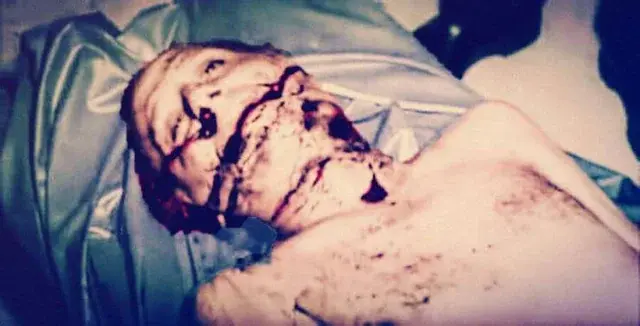
Sometime after his family departed, Giancana went down to the basement kitchen to fry up his favourite late-night snack of sausage and peppers. He let someone in. It was, by every account, a person he knew and trusted enough to turn his back on while cooking, the basic precondition of every classic Mob hit. A single .22 calibre round, fitted with a silencer, struck the back of his head first. Then six more shots followed, into his face and chin, in what investigators recognised as a message as much as an execution: a warning to anyone else who might be tempted to talk. His caretaker, Joseph DiPersio, found the body on the basement floor that night.
No arrest was ever made. Giancana died less than twelve hours before he was due to testify in Washington about exactly the kind of CIA-Mafia entanglement this article has just described.
Who Killed Him?
The leading suspect named over the decades since is Charles "Chuckie" Nicoletti, a veteran Outfit hitman with a long history of contract killings, though he was never charged. Some accounts have also floated a young Outfit enforcer named Tony Spilotro, who would go on to his own infamy in Las Vegas. Chuckie English, who had shared that final dinner with Giancana hours before his death, was himself murdered in near-identical fashion only months later, fuelling theories that the Outfit was systematically silencing anyone close to Giancana who might know too much. Nicoletti himself was assassinated in 1977, shot in the back of the head and left in a burning car, shortly before he was due to testify before the House Select Committee on Assassinations about the Kennedy killing. Whether his death was retaliation for the earlier Giancana hit or simply more of the same pattern, silencing men before they can speak to Congress, remains unresolved.

Rumours about the hit swirl even now. Some say it was Tony Accardo's final verdict: a lesson to any wiseguy who confused celebrity for loyalty. Others whisper it was Santo Trafficante, fearful Sam would betray their Cuban dealings to Congress. A darker corner of conspiracy theory insists it was the CIA, tying off a loose end before he could talk too much about poison pills and Havana plots. His daughter Antoinette, who spent decades defending her father's complicated legacy, once said simply: "My father knew too much." The timing has drawn the same kind of conspiracy theorising that surrounds other underworld figures whose deaths came suspiciously close to their congressional testimony, and Giancana's case remains one of the most cited examples of it.
Today, in Mount Carmel Cemetery, Sam Giancana lies among the same mob bosses, hitmen and crooked politicians he once outmanoeuvred. His polished marble crypt gives no clue that the man beneath it once played puppet-master to presidents and spies alike, proof that in Chicago, even the loudest lives can end in silence.
Sources
1. Sam Giancana, Spartacus Educational: https://spartacus-educational.com/JFKgiancana.htm
2. Sam Giancana, The Mob Museum: https://themobmuseum.org/notable_names/sam-giancana/
3. How Did Sam Giancana Get Killed?, National Crime Syndicate: https://nationalcrimesyndicate.com/sam-giancana-death/
4. Mafia Spies: Sam Giancana Is Gunned Down Before He Can Be Called Before Senate, Chicago Sun-Times: https://chicago.suntimes.com/2019/4/6/18343958/mafia-spies-sam-giancana-is-gunned-down-before-he-can-be-called-before-senate
5. Sam Giancana Murder, Sir Storia: https://sirstoria.com/locations/united-states/illinois/oak-park/organized-crime/sam-giancana-murder/1161/
6. Charles Nicoletti, Wikipedia: https://en.wikipedia.org/wiki/Charles_Nicoletti
7. Sam Giancana, Wikipedia: https://en.wikipedia.org/wiki/Sam_Giancana
8. Who Killed JFK? The Mob Did It, GlobalSecurity.org: https://www.globalsecurity.org/intell/ops/mongoose-jfk-mob.htm
9. Judith Campbell Exner and JFK, JFK Countercoup: https://jfkcountercoup2.blogspot.com/2014/09/judith-campbell-exner-and-jfk.html
10. Judith Exner and the Affair That Exposed Everything, Factinate: https://www.factinate.com/people/facts-judith-exner
11. Judith Campbell, the Mistress Who Carried Messages Between JFK and the Mob, Did It for Love, The Daily Beast: https://www.thedailybeast.com/judith-campbell-the-mistress-who-carried-messages-between-jfk-and-the-mob-did-it-for-love/
12. Judith Campbell, Spartacus Educational: https://spartacus-educational.com/JFKcampbellJ.htm
13. Judith Exner, Wikipedia: https://timenote.info/en/Judith-Exner


