

Ross McWhirter: The Guinness World Records Co-Founder Killed by the IRA, and the Six-Day Siege That Followed

Ross McWhirter spent his career counting things. He and his identical twin brother Norris built the Guinness Book of Records out of a talent for tracking down the fastest, the tallest, the heaviest and the most, and it made both of them minor celebrities, regulars on the BBC quiz show Record Breakers where kids wrote in with dares for them to settle. Then, in the autumn of 1975, Ross put a price on the heads of the IRA unit bombing London and was shot dead outside his own front door for it. The men who killed him weren't caught for another two weeks, and only after a car chase through the West End tipped into one of the strangest hostage standoffs in British history.
Two Twins and a Book About Records
Ross and Norris McWhirter were born eleven minutes apart in Winchmore Hill, north London, in August 1925, sons of a newspaper editor. Both served in the Royal Navy during the war, both became sports journalists after it, and in 1954 both were hired by the Guinness brewery to compile a reference book of facts and superlatives for pub arguments. The Guinness Book of Records sold out its first print run within months of publishing in 1955 and turned the twins into a fixture of British broadcasting: they went on to appear on Record Breakers answering viewer questions live, and their photographic recall of trivia made them recognisable well beyond anyone who'd actually bought the book.

Off camera, Ross was the more overtly political of the two. He stood twice as a Conservative candidate and lost both times, but he stayed active on the right of British politics through the 1960s and into the 1970s, and he had a habit of using the courts to fight battles other people wouldn't touch. In 1973 he went after a television documentary about Andy Warhol, made by the photographer David Bailey, and got Lord Denning to sit the Court of Appeal late into the evening to hear an emergency injunction just hours before broadcast. Denning banned it. It's a strange footnote given what came next: a man who spent part of his career trying to stop broadcasters airing things he found indecent became, two years later, the top story on every one of their bulletins.
The £50,000 Bounty
By 1975, London had been living with IRA bombs for the best part of two years. A Provisional IRA active service unit, sent over from Ireland specifically to carry the Troubles onto the British mainland, had been detonating devices in restaurants, hotels and streets across the capital since the autumn of 1974, and the bombings had already claimed dozens of lives. McWhirter, through an organisation he'd set up called Self Help, announced on November 4, 1975 that he was offering a reward of £50,000, worth somewhere north of £380,000 today, for information leading to the conviction of those responsible. He told a reporter at the time that a price on their heads would speed up justice, comparing it, only half joking, to the Wild West.
It wasn't originally his idea. The reward scheme had been suggested by John Gouriet, a fellow campaigner McWhirter had recently been in talks with about setting up a new political pressure group built around opposing trade union power and what its founders saw as Britain's post-war decline. That group would become the National Association for Freedom. McWhirter helped draft its founding charter of rights and liberties in the weeks before his death, though he never lived to see it launched.
The IRA's Army Council read the reward exactly the way McWhirter had framed it: as a bounty on their volunteers. It's generally accepted that this is what got him killed.
Shot Outside His Own Front Door
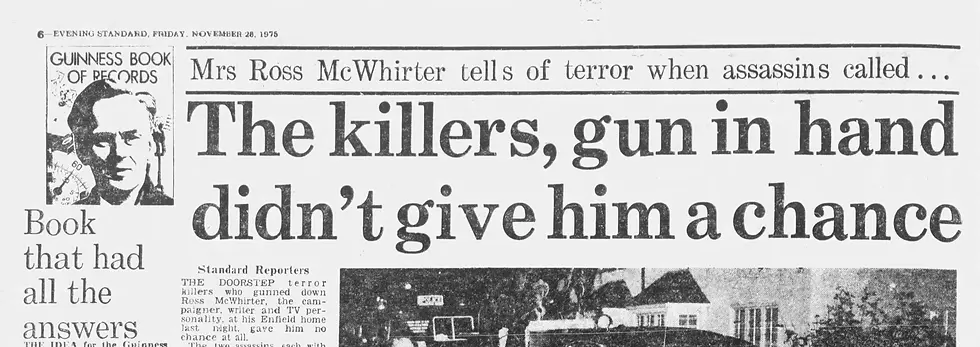
At around 6:45pm on November 27, 1975, McWhirter arrived home to Village Road in Bush Hill Park, Enfield. Two men were waiting for him. Harry Duggan and Hugh Doherty, both IRA volunteers, shot him at close range in the head and chest with a .357 Magnum revolver as he stepped out of his car. He was rushed to Chase Farm Hospital but died soon after being brought in. According to one early police theory, the gunmen may originally have intended to kidnap McWhirter's wife, Rosemary, whose car they used to make their escape from the scene.
Duggan and Doherty weren't working alone. They were two members of a six-man IRA active service unit that had been operating in London since August 1974, and the two who pulled the trigger on McWhirter would go on to become, alongside two accomplices, the most notorious IRA cell of the entire Troubles.
Fifteen Months, Forty Bombs
The unit responsible for McWhirter's murder had been active in England for well over a year by the time he died, part of a wider IRA mainland bombing campaign that had already killed dozens of people in London alone since 1974. That campaign wasn't limited to one cell.
Two years earlier, a separate IRA active service unit that included Dolours and Marian Price had carried out a car bombing outside London's Old Bailey courthouse, a reminder that McWhirter's killers weren't operating in isolation but as part of a much wider campaign to bring the Troubles to the British mainland.
The unit that killed McWhirter, later dubbed the Balcombe Street gang by the press, was made up of Joe O'Connell, Eddie Butler, Harry Duggan and Hugh Doherty, with two further members, Liam Quinn and Brendan Dowd, operating alongside them without being present for the eventual siege. Between them they carried out something like forty bomb and gun attacks across London through 1974 and 1975, hitting restaurants, hotels, a pub and members of the public more or less at random. Scotland Yard's Bomb Squad had noticed a pattern in their behaviour by late 1975: the unit tended to strike previously hit locations again, and it avoided attacking on rainy days or at weekends.
One of their targets was Scott's, a seafood restaurant in Mayfair, which they bombed on November 12, 1975, killing one person and injuring fifteen more, just over two weeks before they shot McWhirter.

The Other Six Names
McWhirter's murder tends to dominate any account of this IRA unit, partly because he was famous and partly because his death led directly to the siege. But he was only the last of seven people this active service unit killed over roughly fourteen months, and the others rarely get mentioned in the same breath.
Captain Roger Goad, an Army bomb disposal officer, was killed in August 1975 while trying to defuse a device the gang had left outside a shoe shop on Kensington Church Street. One of the bombers later admitted from the dock that the choice of target hadn't been accidental: their stated intention had been to kill a bomb disposal expert specifically, and Goad, in their words, hadn't taken his precautions. Two months later, in October 1975, the unit killed Gordon Hamilton-Fairley, a leading cancer specialist, with a car bomb planted outside his Kensington home. The bomb hadn't been meant for him at all; it was intended for his next-door neighbour, Conservative MP Sir Hugh Fraser, and Hamilton-Fairley was killed simply because he was out walking his dog when it went off.
The same campaign also produced the London Hilton bombing in September 1975, which killed two people and injured more than sixty in the hotel's Park Lane lobby, and the bombing of Walton's restaurant in Chelsea that November, which killed two more. By the time police finally cornered the gang outside Scott's in December, the unit's own bombing and shooting campaign had claimed seven lives in total, and McWhirter was the only one of the seven who'd been targeted by name rather than caught in an attack aimed at a building, an institution or, in Hamilton-Fairley's case, somebody else entirely.
The Chase to Balcombe Street
On the evening of December 6, 1975, police watching Scott's, who by now had the unit under surveillance, saw a stolen Ford Cortina pull up and gunmen fire shots into the restaurant. Officers gave chase, first in cars and then, after their vehicle was outpaced, on foot. Two unarmed constables, John Purnell and Peter McVeigh, kept up the pursuit despite the gunmen firing back at them; other officers joined in as the chase wound through the streets of Marylebone. Purnell was later awarded the George Medal for his part in it.

Cornered, the four men, Doherty, O'Connell, Butler and Duggan, ran into a block of council flats on Balcombe Street, next to Marylebone station. They forced their way into flat 22B, home to a married couple, John and Sheila Matthews, who'd been watching an episode of Kojak on television and had assumed the sound of gunfire outside was coming from the show. John Matthews had his legs tied together with a pair of his wife's tights; Duggan reportedly dragged Sheila Matthews into the hallway at gunpoint, shouting obscenities at the police massing outside. The gang announced they were IRA and demanded a plane to fly them and their hostages to Ireland.
Scotland Yard refused, and what followed was a six-day standoff, the longest siege London had seen, played out in front of television cameras and watched by a national audience as it unfolded. Chief Superintendent Peter Imbert led the negotiation, cutting off the flat's food supply and feeding the gang misleading information to wear them down without a shot being fired. The gang, for their part, tried to hide their own numbers by giving Imbert only first names, Tom, Mick and Paddy, so police couldn't be sure exactly how many gunmen they were dealing with. At one point Imbert needled the group's leader, O'Connell, by suggesting they were betraying the memory of Wolfe Tone, the father of Irish republicanism, by holding an ordinary couple hostage; Duggan responded by hurling the negotiating telephone out of the window. On the third day, police arranged for Sheila Matthews's sister to make a direct appeal to her over the BBC, telling her the family was thinking of her and that she was sure the gunmen would let her go. It was a deliberate piece of psychology, meant to re-humanise the hostages in the gang's eyes, and it appears to have worked, rattling O'Connell enough that Imbert began pushing harder in the hours that followed. It wasn't the only hostage siege of its kind that decade to end through patient standoff rather than force.
A similar approach, on a much smaller scale, would later play out in France during the 1985 Nantes courthouse hostage crisis, where a lone gunman held staff for hours rather than days.
By December 11, six days in, the gang had heard reports that the SAS might be brought in to storm the flat. Whether or not that was ever genuinely on the table, it appears to have been enough. On December 12, exhausted and out of options, all four surrendered and released the Matthewses unharmed.
The Trial, and the Confession Nobody Acted On
O'Connell, Butler, Duggan and Doherty went on trial at the Old Bailey in January 1977, facing charges that eventually ran to seven murders, conspiracy to cause explosions and false imprisonment of the Matthewses. In February 1977, O'Connell, Butler and Duggan were each handed twelve life sentences; Doherty received eleven. The trial judge recommended none of them serve less than thirty years.
But it's what the four men said from the dock, almost as an aside to their own sentencing, that turned the case into one of the defining scandals of the Troubles. Joe O'Connell told the court directly that four other people, Gerry Conlon, Paul Hill, Paddy Armstrong and Carole Richardson, the so-called Guildford Four, were serving life sentences for pub bombings in Guildford and Woolwich that he and his own unit had actually carried out. It wasn't a spur-of-the-moment claim. Detectives had reportedly taken a full confession from members of the Balcombe Street unit covering the Guildford and Woolwich attacks as early as 1976, months before the Guildford Four's own case had even exhausted its avenues, and yet nobody was charged over it and nothing was disclosed to the Guildford Four's defence team at the time.
The Guildford Four weren't freed until 1989, after their convictions were finally quashed as unsafe, thirteen years after members of the actual bombing unit had confessed to the crime in open court. Prime Minister Tony Blair issued a formal apology in 2005. To this day, nobody else has ever been charged over the Guildford and Woolwich bombings, and inquests into the case have repeatedly run up against the same wall: coroners have ruled that establishing who actually carried out the attacks falls outside their remit, leaving the confession heard at the Balcombe Street trial as, officially, exactly that and nothing more.
Released Under the Good Friday Agreement
The four men served roughly twenty-three years in English high-security prisons before being transferred to Portlaoise Prison in the Irish Republic in early 1998. Sinn Féin's Gerry Adams introduced them to that year's party conference as, in his words, the movement's own Nelson Mandelas. In April 1999, all four were released alongside Quinn and Dowd under the terms of the Good Friday Agreement, having served roughly half of the minimum term the trial judge had recommended.

Norris McWhirter didn't get to see any of that unfold with much distance from his brother's death. Days after Ross was shot, still in the earliest stages of grief, he pressed ahead with launching the National Association for Freedom, the pressure group the two of them had been planning together that summer, later renamed the Freedom Association. He described his brother's murder as making him feel, in his own words, not half a man but two, and folded what had been Ross's project into a personal mission that occupied him for the rest of his life. Norris continued editing the Guinness Book of Records alone until 1985 and remained involved with the Freedom Association until his own death in 2004.
What's Left of the Story
Ross McWhirter is remembered today mostly for the book that made him famous, not the reward that got him killed, and the Balcombe Street siege has largely faded from public memory outside true crime and Troubles history circles, eclipsed by the miscarriage of justice it inadvertently helped expose. But the two stories were never really separate. The bounty, the assassination, the chase through Mayfair, the six days at gunpoint in a stranger's front room, and the confession that took thirteen years to actually free four innocent people all trace back to the same fifteen months of bombing campaign, and to a reward that was meant to end it faster than it ever could.


