

The Co-Pilot Who Never Got Over Hiroshima: The Story of Robert Lewis

Ask most people who flew the plane that dropped the first atomic bomb and you'll get one name: Paul Tibbets. He's the one who named the Enola Gay after his mother, the one who spent decades insisting he never lost a night's sleep over Hiroshima, the one whose life has been written up in a bestselling autobiography and a dozen documentaries. Sitting next to him that morning was a co-pilot named Robert Lewis, a man who was actually supposed to be flying that plane as its commander, and whose reaction to what he'd just witnessed is one of the most quoted lines to come out of the entire mission. Almost nobody knows the rest of his story.
The Man Who Was Bumped From His Own Plane
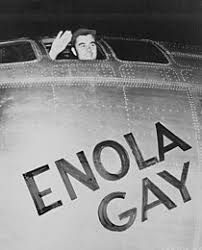
Lewis wasn't originally the co-pilot of anything. He was the regular aircraft commander of Superfortress 44-86292, the B-29 that would become the Enola Gay, and had flown it on its first six missions with his own hand-picked crew. Days before the Hiroshima flight, Colonel Paul Tibbets, who led the 509th Composite Group training for the mission, decided to take command of the aircraft himself, bumping Lewis into the co-pilot's seat on what had been his own plane. Then, hours before takeoff, a maintenance airman painted the name Enola Gay, Tibbets' mother, under the cockpit window. According to the historians Gordon Thomas and Max Morgan Witts, Lewis was furious when he saw it, reportedly demanding to know what the name was doing on his plane.
Briefed, But Not Prepared
A few days before the mission, Lewis and the other officers were shown film of the Trinity test, the first detonation of an atomic device in the New Mexico desert that July. So he wasn't walking into the mission blind, he knew this was some kind of atomic weapon. The enlisted crew had a different experience. Several later said Tibbets only told them what they were actually carrying partway through the flight itself, informing them they were "going to split the atom" once the plane was already in the air. But knowing the concept and being ready for the reality turned out to be two different things. Nothing in a black and white film of a desert test had prepared Lewis for what an atomic bomb actually looked like over a real city full of people, which is a large part of why his reaction that morning reads so differently from the calm, procedural tone of Tibbets' own account.
The Line Everyone Remembers
At the request of New York Times science reporter William Laurence, who was supposed to fly along on the mission but arrived at Tinian too late, Lewis kept a running account of the flight in a War Department notebook, addressed like a letter to his parents. He wrote through take-off, the climb to altitude, and the drop itself at 8.15am on 6 August 1945, working partly in pencil after his pen ran out of ink somewhere over the Pacific. In the minutes after the blast, groping for words to describe what he'd just watched, Lewis wrote the line that outlived almost everything else about the mission: "My God, what have we done."
That notebook has become one of the most valuable documents connected to the entire war. It first sold at Sotheby's in 1971 for $37,000, then again in 1978 for $85,000, then in 2002 as part of the Malcolm Forbes collection for $391,000, then in 2022 for $543,000. As of early 2026 it was back on the market again with an asking price of $950,000, a piece of paper that's now worth roughly what a house costs, written by a man most people have never heard of.

A Near-Disaster Before the Mission Even Began
The tension between the two men showed up again within minutes of leaving the ground. The Enola Gay was roughly 15,000 pounds over its rated weight that morning, carrying a five ton uranium bomb, a full fuel load for the round trip, and twelve men down a runway that had been extended specifically for the mission. As the plane ate up the tarmac without lifting off, Lewis grew alarmed enough to shout at Tibbets to pull the nose up immediately. When Tibbets didn't respond, Lewis reportedly reached for the duplicate control yoke in front of his own seat, ready to take over the aircraft himself. Tibbets pulled the nose up at what witnesses later described as the last possible moment, and the bomber cleared the end of the runway by a matter of feet. It's a detail that rarely makes it into the retellings that focus on the bombing itself, but for a few seconds that morning, the mission's most famous flight nearly ended in the ocean before it ever reached Japan.
Ambushed on Live Television
In May 1955, Lewis found himself in front of a very different kind of audience. The NBC show This Is Your Life had invited Reverend Kiyoshi Tanimoto, a Hiroshima survivor and Methodist minister, onto the programme, ostensibly to discuss his fundraising work for a group of young Japanese women disfigured by the bombing, known as the Hiroshima Maidens. Tanimoto had no idea what was actually planned. Partway through the episode, host Ralph Edwards revealed a surprise guest waiting behind a screen: Robert Lewis, introduced as the co-pilot who had flown the plane that dropped the bomb over Tanimoto's city.
Accounts from the studio that night describe Lewis looking close to breaking down on stage, and some reports claim he'd gone to a bar before the broadcast and returned visibly drunk. He pledged a donation to Tanimoto's fund for the Hiroshima Maidens on behalf of his crew and his family, shook Tanimoto's hand, and left the stage quickly. The segment drew immediate backlash from critics, including a New York Times television writer who accused the show of exploiting both men's private grief for ratings, and one paper's headline flatly called the episode a new low in poor taste. It's one of the stranger television moments of the 1950s, and one that's almost entirely absent from the standard Enola Gay retellings.
A Quiet, Unglamorous Second Life
Unlike Tibbets, who stayed in the Air Force and rose to brigadier general before retiring into a long, comfortable public role as the mission's chief spokesman, Lewis left the service and spent the next three decades as a personnel and eventually plant manager at Henry Heide, a candy manufacturer in New Brunswick, New Jersey. He married, raised five children, and by most accounts settled into an ordinary suburban life that gave no outward sign of the document sitting somewhere in a vault, worth more than most people's houses.
There was a second logbook kept on the Enola Gay that morning, written by navigator Theodore Van Kirk, and it's worth noting how differently the two men handled the same few hours. Van Kirk's entries stuck almost entirely to course headings, airspeed and coordinates, the dry mechanics of navigation. Lewis's notebook is the only firsthand account from the flight that reads like a man actually processing what he was watching in real time, doubt, awe and horror included. Van Kirk went on to become one of the mission's most comfortable public voices for decades. Lewis wrote the version everyone still quotes, then largely stopped talking about it.
In his later years Lewis also took up sculpture. One piece, depicting a mushroom cloud with streams running down its side, was given to Dr Glenn Van Warrebey, the psychiatrist who treated him, seemingly for what would now be recognised as post-traumatic stress disorder. It's a small, private detail that sits oddly next to the image of a settled family man with five children and a steady career, and it suggests whatever Lewis was carrying from that morning in 1945 never fully resolved itself, whatever he said publicly about it.

Death and an Unequal Legacy
Lewis retired to Smithfield, Virginia, in 1981 and died two years later, on 18 June 1983, of a heart attack at his home, at 65. His daughter told reporters at the time that her father had taken his role in the mission very seriously but never believed it had been a mistake, a more measured position than the tortured legend that grew up around his most famous sentence might suggest.
Part of why Lewis's version of events got buried is simpler than any feud: he just didn't live long enough to compete with it. Tibbets died in 2007, Ferebee in 2000, and navigator Theodore Van Kirk, the last surviving crew member, lived until 2014, doing decades of interviews, documentaries and book signings that cemented their place in the official record. Lewis died in 1983, more than twenty years before any of them, missing the entire era in which the Enola Gay's story calcified into the version most people know today, one with Tibbets front and centre and almost everyone else reduced to a supporting name in the crew list. He's mostly remembered now, if he's remembered at all, for six words scrawled in pencil somewhere over the Pacific, sold and resold at auction for sums that keep climbing, while the man who wrote them spent three decades managing a candy factory and rarely spoke about it again.
The atomic bomb program had a way of quietly rearranging the rest of ordinary people's lives, whether they were flying the plane or, like the girls at a New Mexico dance camp fifty miles from the Trinity test site, simply close enough to feel it. Lewis's version of that story just happened to come with a front row seat, a psychiatrist's sculpture, and a notebook that's now worth a fortune.


