

The Arrest of Ian Brady and Myra Hindley: A Bread Man's Coat, a Phone Box and Four Lost Days

Britain abolished hanging for murder a month and a day after Ian Brady was arrested. That's how fine the timing was when a police superintendent, dressed as a bread delivery man, knocked on the back door of a council house in Hattersley on the morning of Thursday 7 October 1965.
Ask most people when the Moors Murderers were arrested and they'll give you that one date. There were actually two. Brady was led out of the house that morning. Hindley walked into the police station beside him with her dog under her arm, said almost nothing and was allowed to go home. She stayed free until the following Monday.
Those four days are the bit of the story that usually gets squeezed into half a sentence. They shouldn't be. In that gap Hindley went back to the office where she and Brady worked and set fire to some of his papers. And the whole thing only happened at all because a frightened 17-year-old spent the night on a balcony waiting for it to get light enough to walk to a phone box.
Quick Answers
When was Ian Brady arrested? On the morning of 7 October 1965 at 16 Wardle Brook Avenue, Hattersley, after police found the body of 17-year-old Edward Evans in a locked upstairs bedroom.
When was Myra Hindley arrested? Four days later, on 11 October 1965. She was first charged as an accessory to Evans's murder.
Who turned them in? David Smith, Hindley's 17-year-old brother-in-law, who had watched Brady kill Evans the night before.
Why wasn't Hindley arrested straight away? Police had nothing tying her to the killing beyond Smith's word, and at least one historian of the case argues detectives simply didn't picture a woman being involved.
What did she do while free? She went to Millwards, the firm where she and Brady worked, and burned papers belonging to him.
Could they have been hanged? No, but it was close. The death penalty for murder was abolished 32 days after Brady's arrest and months before the trial.
A Night on the Balcony
On the evening of 6 October 1965, Brady killed Edward Evans, an apprentice he'd picked up at Manchester Central station, with an axe in the living room of the house he shared with Hindley and her grandmother. David Smith, who was married to Hindley's younger sister Maureen, had been brought round on a pretext and saw it happen. He then helped clean up and carry the body upstairs, because he was fairly sure that refusing would make him next.

What he did afterwards is set out in Evil Relations, the memoir he wrote decades later with Carol Ann Lee. He made himself walk down the path past the lit window, then ran the 300 yards or so to the flat he and Maureen shared in Underwood Court. He was sick in the bathroom. He told Maureen what he'd seen and she kept asking about her sister, until he had to spell it out: Myra was part of it.
Then he waited. Smith was convinced someone from Wardle Brook Avenue might be watching the flats, so he kept watch from the balcony until around six, when the milkman turned up and lights started coming on. Only then did he tell Maureen to get her coat. Before they left he took a bread knife and a heavy screwdriver from the kitchen drawers and tucked them into his waistband.
The Call Nobody Could Make Sense Of
They walked rather than ran, taking their dog with them, to a public telephone that Smith places on the corner of Hare Hill Road. (Mark Pulham's long reconstruction for Crime Magazine puts the call box on Hattersley Road West, so even this detail isn't settled.) Smith's book says the call was logged at 6.07am by a Police Constable Edwards, the duty officer at Hyde station.
It wasn't a tidy confession-style phone call. Smith couldn't work out how to squeeze the night into a couple of sentences, so he didn't try. He told the operator it was an emergency, that they needed a car and that he'd explain at the station. When no car appeared he rang again. He and Maureen waited out of sight behind a privet hedge, and when a patrol car finally pulled up his reaction was one he never forgot: "I've never been so glad to see a copper in my life."

The driver said nothing and jumped every red light on the way to Hyde. In a windowless room with a coal fire, with Maureen crying next to him and the dog on her lap, Smith eventually got two words out: it's murder. He then had to explain it all again to Superintendent Bob Talbot, a senior officer he remembered mainly for the braid and brass on his uniform. Neither took to the other. Smith's teenage record for violence didn't help, and police were wary of his story at first. It was Smith who warned the room that Brady kept guns in the house.
The Superintendent in the Bread Man's Coat
Talbot had only recently been promoted and was meant to be starting a holiday that morning. Instead, by Pulham's account, he had around two dozen uniformed officers and half a dozen detectives tucked out of sight around Wardle Brook Avenue by eight o'clock. The plan was to take Brady in the open when he left for work at about 8.20am.

Brady didn't come out. So Talbot improvised. He stopped a bread delivery man on his round and borrowed his long white coat and basket. At about 8.40am he knocked on the back door of number 16 looking like the morning delivery. Hindley opened it. Talbot told her who he really was and walked in, with Detective Sergeant Jock Carr following through the kitchen.
Brady was in the living room, lying on a divan bed and writing a letter. The room was tidy. There was a budgie. Talbot said he had reason to believe a murder had been committed in the house and asked to look round. Everything was open to him except one upstairs bedroom, and Hindley said the key for that was at work. It was Brady who ended the stand-off, telling her in his Glasgow accent: "Ye best give him the key."
Under the bedroom window was a long, neatly wrapped bundle. Talbot ran his hand along it, felt a row of small rounded shapes and realised they were toes. Brady was arrested on suspicion of murder and went without a struggle.

Why Hindley Went Home
Hindley insisted on going to the station too. She sorted out someone to look after her grandmother, picked up her dog, Puppet, and went. Once there she refused to say anything beyond denying there'd been a murder. And then, remarkably, she was let go.
There are two explanations and they aren't mutually exclusive. The practical one is that the evidence against her on day one was thin. There was a body, an axe and Brady's flat insistence that she'd had no part in it. Crime+Investigation's case file describes her as questioned but not charged for want of evidence. The less comfortable explanation comes from Chris Cook, author of a full-length history of the case, who argues that detectives didn't believe a woman would be mixed up in murder. Smith had been telling anyone who'd listen since about three in the morning that she was.
Pulham adds a detail that, if accurate, shows how the gap began to close. Brady asked an officer whether he and Myra could share a solicitor, apparently not realising she hadn't been charged with anything. It's a small slip and it rests on that single retelling, but it's the sort of thing a detective writes down.
Saturday at Millwards
Hindley and Brady had met at Millwards Merchandising, a chemical wholesaler in Gorton where she was a typist and he was a stock clerk. On Saturday 9 October, with Brady in custody and the office empty, she went back. Pulham's account has her going to a disused filing cabinet Brady used, taking out papers that set out his plans for getting rid of a body and burning them.
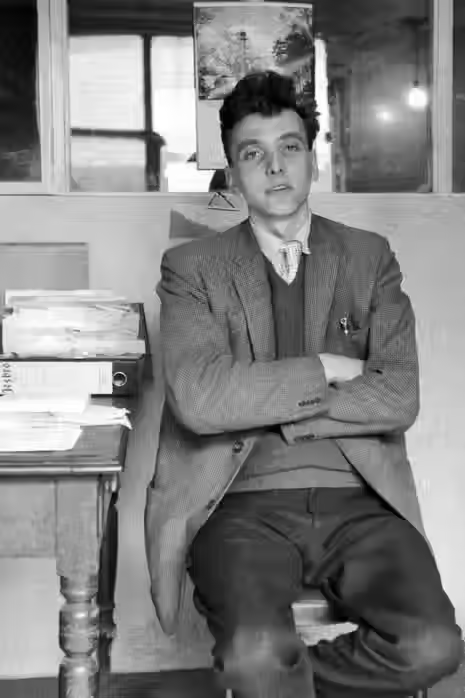
It's worth being careful here. Nobody else was in the room, the papers are ash and what was written on them comes down, in the end, to what Hindley and Brady later chose to say. What isn't in dispute is the outline: a suspect in a murder inquiry was free for a weekend and used part of it to destroy documents at her workplace. Cook's summary is blunt. The delay let her get rid of key evidence.
We'll never know what a search of that cabinet on the Thursday would've turned up. Two of Brady and Hindley's five victims, Pauline Reade and Keith Bennett, weren't even linked to them in 1965.
Monday 11 October
What finally did for Hindley was paperwork she hadn't reached. Detectives searching her car found a three-page document in Brady's hand laying out, step by step, how Evans's killing was to be handled. It showed the murder was planned, and it was sitting in her car. At the house, officers had also turned up an old exercise book covered in doodles and scribbled names. One of the names was John Kilbride, a 12-year-old who'd vanished from Ashton market nearly two years earlier.
On Monday 11 October Hindley was brought back in, charged as an accessory to the murder of Edward Evans and remanded to Risley. She was also photographed. That police picture, bleached hair and a flat stare, taken four days later than it might have been, went on to become probably the most reproduced mugshot in British criminal history.
It also had a second life nobody at Hyde could have predicted. In 1995 the artist Marcus Harvey recreated the mugshot on a huge canvas using children's handprints. When it went on show in the Royal Academy's Sensation exhibition in 1997, four academicians resigned, Keith Bennett's mother Winnie Johnson picketed the opening and two artists attacked the painting on the first day, one with ink smuggled in inside camera cases and the other with eggs bought round the corner. Hindley herself wrote from prison asking for it to be taken down.
The Prayer Book, the Suitcases and the Probationer
The case was still officially one murder. That changed fast. Smith had mentioned that Brady had a thing about railway stations, and on Friday 15 October police recovered two suitcases from the left luggage office at Manchester Central. The claim ticket was found tucked into the spine of Hindley's communion prayer book. Inside the cases were photographs and a tape recording of ten-year-old Lesley Ann Downey, missing since Boxing Day 1964. Ian Fairley, a young detective on the inquiry, later described opening them as "the Pandora's Box".
The next morning a second search of Saddleworth Moor went ahead, largely because Detective Joe Mounsey, who'd been hunting for John Kilbride, pushed for it after 150 officers had found nothing the day before. One of the dozen or so men sent up was PC Bob Spiers, 23 years old and a month into the job. He spotted what he took for a dried-out stick poking from the peat. It was a forearm. When the digging uncovered fabric, as he told the Lancashire Post in 2017, someone suggested it might be an animal and he answered: "If that's a sheep, then it's wearing clothes." It was Lesley Ann. John Kilbride was found nearby five days later.

One more casualty of those weeks gets a strange amount of attention in the record. Police had Puppet examined by a vet to work out his age, which would help date photographs taken on the moor. The dog didn't come round from the anaesthetic. Hindley, who'd shown officers nothing at all up to that point, screamed that they were murderers.
The Girl From Two Doors Down
Among the people detectives spoke to that month was a child. Patricia Hodges was 11 or 12 and lived two doors from number 16. Her witness statement, released by the National Archives in 2005, describes a neighbourly friendship that reads very differently with hindsight. She was a regular visitor to the house, where she was given wine, whisky and gin. And she was taken up to Saddleworth Moor at least twice.
One of those trips was at 11.30pm on Christmas Eve 1964. She went out with Hindley, they walked near the rocks where Lesley Ann Downey would later be found, and Patricia was dropped home at about half past one on Christmas morning. Lesley Ann was abducted from a fairground two days later.

Patricia was never harmed, and the usual explanation is a cold one: a child who vanished from two doors away would have led police straight to them. Lesley Ann's stepfather, Alan West, put it more simply when the file was opened: "Why Brady didn't kill her, only he knows." What her statement gave detectives in October 1965 was something Smith couldn't. It put Hindley on that stretch of moor, late at night, with a child in tow.
A Month and a Day
Timing shaped what happened next. The Murder (Abolition of Death Penalty) Act received Royal Assent on 8 November 1965, a month and a day after Brady's arrest. Had the arrests come a year earlier, both could have faced the gallows. Instead, at Chester Assizes on 6 May 1966, Brady was convicted of three murders and Hindley of two, plus harbouring Brady after the killing of John Kilbride. The judge called them "two sadistic killers of the utmost depravity" and gave them life. Unlike the Kray twins, whose trial came three years later, nobody ever tried to turn these two into folk heroes.
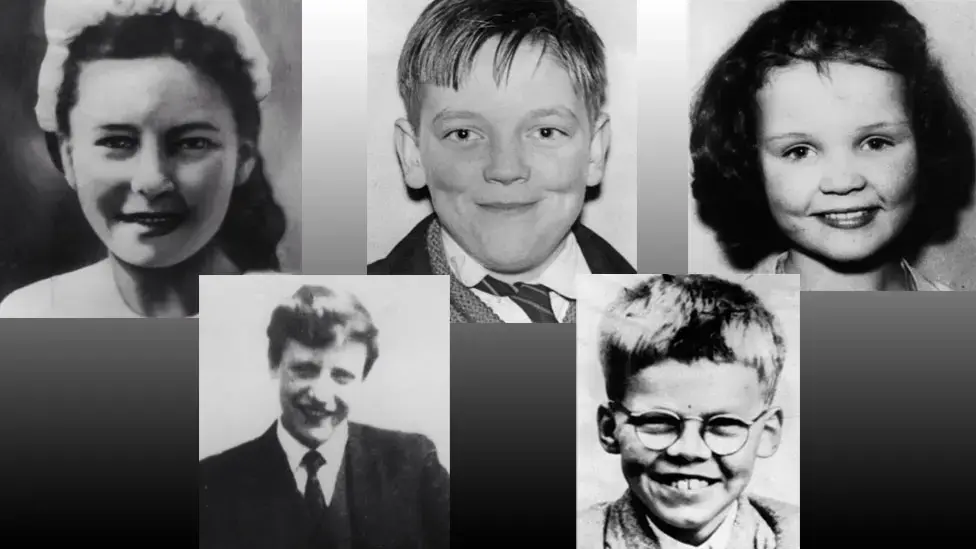
Neither was released. Hindley died in custody on 15 November 2002. Brady died at Ashworth Hospital on 15 May 2017, by which point he'd been locked up for more than half a century, a stretch only a handful of prisoners such as Robert Maudsley have matched. In the 1980s the pair finally admitted killing Pauline Reade and Keith Bennett. Pauline's body was recovered from the moor in 1987. Keith's never has been, and a fresh police search in autumn 2022 ended with nothing found.
What It Cost the Boy in the Phone Box
David Smith stopped a pair of serial killers at 17. For his trouble he was treated as a suspect, branded a bad 'un and told for years that he must have known more than he let on. During the trial Maureen, eight months pregnant, was attacked in the lift of their block. Their home was vandalised. Hate mail arrived. When Smith died in Ireland in 2012, one Manchester obituary pointed out that the public had blamed him when it should have thanked him.
He didn't make it easier for himself. Under cross-examination at Chester, Smith admitted he'd taken money from the News of the World for his story. The defence leapt on it, since a witness with a newspaper deal has an obvious interest in a guilty verdict, and for a moment the prosecution's star witness looked like its biggest liability. Five days after the verdicts the Attorney-General, Sir Elwyn Jones, told the Commons there was no evidence the payments had changed anyone's testimony and that the paper wouldn't be prosecuted. He added a warning, hoping "Fleet Street will now put its house in order". The row over paying witnesses that started with a 17-year-old from Hattersley has never really gone away.
It's a pattern you see again and again in cases that grip the country, from the murder of James Bulger to the Great Train Robbery: the public settles on its villains quickly and isn't always fussy about who else gets caught in the blast. Smith's reward for making that call was a lifetime of being asked why he hadn't made it sooner.
He made it at 6.07am, with a bread knife in his belt, the moment it got light.
FAQ
Is 16 Wardle Brook Avenue still standing? No. The house was demolished in 1987 and the plot has been left empty ever since. Locals have complained about coach parties still turning up to look at the gap.
What happened to Maureen Hindley? She and David Smith divorced in 1973. Maureen died suddenly on 3 October 1980, aged 34. Myra was given permission to visit her in hospital but didn't get there in time.
Did Brady and Hindley ever go back to the moor? Yes. When the case was reopened in the mid-1980s, Detective Chief Superintendent Peter Topping took each of them back to Saddleworth Moor to help search for Pauline Reade and Keith Bennett.
Was David Smith ever charged with anything over the murders? No. He was the chief prosecution witness and was never charged in connection with any of the killings, despite Brady and Hindley's efforts to implicate him.

You Might Also Like
Sources
David Smith with Carol Ann Lee, Evil Relations: The Man Who Bore Witness Against the Moors Murderers (Mainstream Publishing, 2011)
Mark Pulham, Murders on the Moors (Crime Magazine, 27 September 2011)
Myra Hindley crime file (Crime+Investigation UK)
Ian Brady: the arrest (Crime+Investigation UK)
How Ian Brady and Myra Hindley, the Moors Murderers, were caught (Crime+Investigation UK)
Chris Cook, author guest post on The Moors Murderers (Pen & Sword Books blog)
Lancashire police officer who found the first body on the Moors speaks about his involvement (Lancashire Post, 16 May 2017)
Moors Murders 50 years on: Ian Fairley interview (Huddersfield Examiner)
Ian Cummins, Marian Foley and Martin King, Serial Killers and the Media: The Moors Murders Legacy (Palgrave Macmillan, 2019)
David Smith R.I.P. (New Manchester Walks)
Murder (Abolition of Death Penalty) Act 1965 (legislation.gov.uk)
No human remains on Saddleworth Moor (The Mill, October 2022)
The eerie mystery of Ian Brady's unopened suitcases (Crime+Investigation UK)
Child's 'friendship' with Moors Murderers revealed (Irish Examiner, 31 December 2005)
World: A Most Unusual Trial (Time, 29 April 1966)
Witnesses (Payments by Newspapers) (House of Commons debate, Hansard, 11 May 1966)
Myra Hindley portrait which caused a sensation in 1997 to go on show at Damien Hirst's London gallery (The Art Newspaper, 21 May 2024)
'Myra': the most controversial artwork of the 1990s (Far Out Magazine)
What happened to Britain's most notorious murder houses? (Crime+Investigation UK)
Moors murder detective has 'no closure' from Brady's death (Yorkshire Post)


