


Marcus Wesson: The Horrific History of the 'Vampire God' of Fresno
Updated: Oct 13

On the afternoon of 12 March 2004, Fresno police were sent to a small blue house at 761 West Hammond Avenue for what sounded like a routine custody row. Two young women wanted their children back. A huge man with grey dreadlocks hanging to his knees stood in the doorway and calmly chatted to officers while everyone around him screamed. Then he went inside and shut the door.
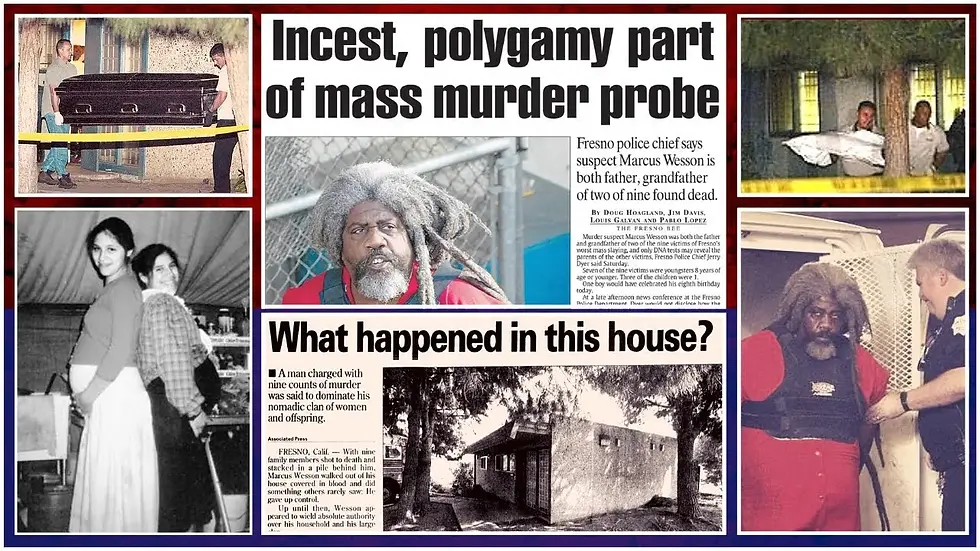
When Marcus Wesson came back out, he was covered in blood. Behind him, in a back bedroom, were nine bodies: one of his adult daughters and eight children, all shot through the eye. Every single victim was his own child. Seven of them were also his grandchildren, nieces or nephews, because he'd fathered them with his own daughters and nieces. Fresno's police chief called it the worst mass murder in the city's history, and two decades on he was still angry about it.
Quick Answers
Who was Marcus Wesson? A self-proclaimed messiah and patriarch from Fresno, California, who spent decades abusing his daughters and nieces and fathering children with them.
What happened? On 12 March 2004 nine of his children, aged 1 to 25, were shot dead in his home during a stand-off with police.
Who pulled the trigger? It's disputed. His defence blamed his daughter Sebhrenah, who died with the others. Jurors decided Wesson shot at least some of the victims himself.
Where is he now? Still under a death sentence handed down in July 2005. California hasn't executed anyone since 2006, and his automatic appeal was finally argued before the state's Supreme Court in September 2026.
The stand-off on Hammond Avenue
The two women at the door were Sofina Solorio and her sister Ruby Ortiz (some trial coverage calls her Ruby Sanchez). Both were Wesson's nieces, both had grown up in his house, and both had children by him. They'd left the household as adults and had agreed, years earlier, to leave their kids with Wesson. By 2004 they wanted them back, and they turned up on 12 March with friends and relatives in tow.
Inside, the rest of the household closed ranks. One of Wesson's teenage sons, Serafino, had physically blocked police at the door in support of his dad, and the women still living in the house shouted abuse at the two sisters. Wesson himself was strangely calm, and officers took that as a sign he'd help them sort things out. They didn't have a warrant, and he didn't invite them in.
At some point he slipped back inside. Someone told police there was a .22 in the house, a SWAT team was called and the street was cleared. By the time it was all over, Wesson walked out with his black clothes soaked in blood and reportedly asked officers to link three sets of handcuffs because his wrists were too thick for one.
Officer Eloy Escareno, 33, was among the first inside. He passed caskets stacked against the living room wall before finding the back bedroom. The bodies were piled on top of each other and were still warm. Jerry Dyer, the police chief, later said they'd been "stacked up like cordwood". Several officers were put on leave and given counselling afterwards, and six police chaplains turned up at the house.

Did anyone hear the shots?
This is still one of the most uncomfortable parts of the story. Every officer at the scene said they never heard gunfire, and the chief backed them. But neighbours told a different story. Chris Tognazzini said he heard two shots moments before police arrived, and another neighbour, Maria Leyva, told the Fresno Bee she heard four shots just after 3.30pm and fired off an email to her sisters saying there'd been a shooting. If the neighbours were right, the killings may have been happening while police waited outside. Nobody's ever settled it.
The nine victims
DNA testing confirmed that Wesson was the father of all nine. Only the two eldest, Sebhrenah and Elizabeth, were born to his wife. The spellings of some names vary between reports, but these are the names and ages given by KMPH and Fox News:
Sebhrenah April Wesson, 25
Elizabeth Breahi Kina Wesson, 17
Illabelle Carrie Wesson, 8
Aviv Dominique Wesson, 7
Johnathon St Charles Wesson, 7
Ethan St Laurent Wesson, 4
Marshey St Christopher Wesson, 1
Jeva St Vladensvspry Wesson, 1
Sedona Vadra Wesson, 1
Johnathon was Sofina Solorio's son. She'd come to take him home that afternoon and never saw him alive again.

Where Marcus Wesson came from
Marcus Delon Wesson was born in Kansas in 1946 and dragged around Missouri, Indiana, California and Washington as a kid. His father Benjamin rarely worked and drank heavily, and court testimony later painted him as sexually predatory. His mother Carrie was a devout Seventh-day Adventist who drilled her children on the Bible and, according to a relative, beat them with an electrical cord. Young Marcus liked to play at being a preacher.
He served as an army medic during the Vietnam era and then settled in San Jose, where he moved in with Rose Solorio, a mother of eight who was 13 years older than him. They had a son. Then Wesson turned his attention to Rose's daughter Elizabeth, who'd first met him when she was just eight. She was 14 when he got her pregnant, and they married in August 1974, when she was 15. Accounts put the number of children she had with him at nine or ten.

Tents, boats and a burned-out house
Wesson didn't work. The family lived on welfare and moved constantly, from an army tent to a trailer to old boats. In 1989 Elizabeth's sister Rosemary left her seven children with the Wessons, which brought the number of kids in the household to 16. Sofina, Ruby and Rosa Solorio were among them.
The boats are a recurring theme. The family lived on one moored off Santa Cruz before moving into the mountains near Watsonville, and in 1990 Wesson was convicted of welfare fraud for failing to declare a boat as an asset. He spent a short spell in jail.
In 1999 a lawyer called Frank Muna sold Wesson and the women of the house the remains of his burned-out home. Muna said Wesson controlled the women's money and that his appearance got scruffier and stranger every year. The family moved to Hammond Avenue around eight months before the killings, partly because neighbours had complained. Less than a fortnight before the massacre, on 1 March 2004, the city had cited them for living in a commercially zoned building and told them to get a permit or get out.
Neighbours on Hammond Avenue barely knew there were children inside. One, Johnny Rios, said he'd hear loud banging at night, as if people were building something. "There was something up over there," he said. A big yellow school bus sat in the drive.
Life inside Wesson's house
Wesson ran the household like a cult, and Dyer later compared him to Charles Manson. The children were home-schooled because he distrusted public schools. The women wore dark robes and headscarves, didn't speak in his presence and handed over whatever money came in.
He told the children he was Jesus Christ. Boys and girls were kept apart, even siblings, and Sofina Solorio testified that something as small as laughing with their brothers earned the girls a beating with a stick wrapped in duct tape. The boys had their own rules. A martial arts teacher, Florian Tan, said Wesson's sons were told they had to earn a black belt in aikido before they could leave home as men.
Like the Turpin family in California years later, the Wesson children learned to stay silent around outsiders. To strangers they looked polite. In reality they'd barely been allowed to meet anyone.

Child brides and 'children for the Lord'
The abuse of the girls started when they were small. Sofina Solorio told the court it began for her at 12, and that Wesson called it loving and said it was preparation for marriage. As they grew up, he asked each girl whether she wanted to "have children for the Lord". One by one, they said yes.
He held mock wedding ceremonies in the house with two of his teenage daughters and three nieces, and handed out gold bands they wore on their ring fingers. Ruby said she was 13 when she "married" him. He was 44. He read them Bible passages about men with several wives, which puts him in the same grim tradition as Warren Jeffs.
The 1993 siege at Waco seems to have tipped him further. The family watched the coverage of the Branch Davidian stand-off together, the same siege that helped radicalise Timothy McVeigh, and Wesson saw himself in David Koresh. "This man is just like me. He is making children for the Lord," he told the family, according to the Fresno Bee. Not long after, he started fathering children with his daughters and nieces. The girls saw themselves as stand-ins for Elizabeth, who couldn't have more babies.
Some of the girls still wanted ordinary lives. When Wesson caught Ruby flirting with boys he beat her badly. She ran away three times and came back every time because she didn't want to leave her child. Eventually she and Sofina both got out for good.
The coffins and the vampires
Then there's the furniture. Around 1999, Lois Dugovic, who ran an antiques shop in Fresno, sold Wesson a set of hand-carved mahogany caskets. He told her he wanted the wood to fix up a houseboat. She told AP he seemed to enjoy frightening people with the way he looked. Police later took 12 wooden coffins out of the Hammond Avenue house, and Frank Muna summed up what everyone was thinking: "who would need ten caskets unless you're in the funeral business?"
At the trial, Wesson's niece Rosa Solorio stuck to the houseboat story and added, with a straight face, that the coffins could be used as beds.
The vampire side of things is where it gets properly strange. The family watched dozens of vampire films and the children were given vampire-inspired middle names, which is how a baby ended up called Jeva St Vladensvspry. Wesson saw no conflict between being Christ and loving vampires because, as he put it, both were immortal. Dyer went further in 2024, saying Wesson had convinced his family that Jesus was a vampire. It's a long way from the "Vampire of Düsseldorf" Peter Kürten, but the nickname stuck.
The suicide pact
The coffins mattered because of the plan Wesson had drilled into everyone. Sofina told the court that if the authorities ever tried to break up the family, the girls were to kill their children and then themselves. Wesson would stay alive to explain it all to the world. She said the family held monthly meetings to go over the details, including how to shoot so that it was fatal.
He'd also struck a deal with the nieces: if they ever left, their children stayed. So when Sofina and Ruby turned up demanding their kids, and police appeared on the doorstep, the household had already rehearsed what came next. Frank Muna said police had told him Wesson killed the children because he didn't want them taken away, and that Wesson really believed he'd done the right thing.
The pact didn't end with the arrest either. Once he was in jail, Wesson was banned from visits and calls from relatives, because the authorities feared some of them might ask his permission to kill themselves. It's a chilling echo of the mass suicides at Jonestown and Heaven's Gate.

The trial
Wesson was charged with nine murders and a long list of sex offences. Prosecutors later added 33 counts of sexual abuse, some dating back to 1988 and involving six women and girls who'd lived with him. He pleaded not guilty to everything.
The trial began in June 2005 and ran for about three months, with around 50 witnesses. His public defenders, Pete Jones and Ralph Torres, argued that Sebhrenah fired the .22 Ruger, shooting each child through the eye before killing her sister Elizabeth and herself. Sebhrenah was known to love guns, and an expert said the two sisters died an hour or two after the younger victims. Neither her fingerprints nor Wesson's were on the pistol, though her DNA was.
Prosecutor Lisa Gamoian said it didn't matter who pulled the trigger. Wesson, she argued, was a "master manipulator" who had primed his whole family to kill and die on his say-so, much as Hilma Marie Witte turned her sons into killers.
Some of the family stayed loyal. Rosa Solorio, whose two children Ethan and Sedona were among the dead, wore Wesson's gold ring on the witness stand and said she still saw herself as his wife. His daughter Kiani testified that sexual contact between a father and daughter wasn't wrong, even though both her children by him had been killed. Elizabeth said nobody ever told her who fathered her daughters' and nieces' babies, and that she didn't think it was polite to ask.
Guilty, and sentenced to death
On 17 June 2005 the jury found Wesson guilty of nine counts of first-degree murder and 14 sex abuse counts. They'd deliberated for more than two weeks and decided he'd shot at least some of the victims himself.
At the end of June the same jury recommended death. On 27 July 2005 Judge R.L. Putnam agreed, sentenced him to death and added 102 years for the sex crimes. He said Wesson's family had done his bidding until their death, and he turned down a defence request for a new trial or a life sentence.
Sofina Solorio got the last word that day. Facing the man who'd raised her, abused her and taken her son, she told him: "Those were not children who belonged to you." Kiani, her voice breaking, said she was proud of her family and the way they'd been raised.

What happened to the survivors
The people left behind had nothing. A few weeks after the killings, KMPH reporter Alysia Sofios took Elizabeth, Kiani and Rosa into her own flat, and she later wrote about the family's recovery with true crime author Caitlin Rother.
By 2009 the Fresno Bee found the survivors in very different places. Elizabeth was taking English and typing classes, had filed for divorce and called herself a bad mother for not seeing what was happening. Gypsy, who'd left home at 19, had a high school diploma and a job in hotel catering. Serafino, the son who'd blocked the door in 2004, was working as a security guard and had once lied about his surname to avoid the questions. His support for his father had gone.
None of them visited Wesson on death row. Many of the family changed their names and stayed around Fresno, and the district attorney described them as the walking wounded. The house on Hammond Avenue was knocked down in 2006 and the plot was still an empty lot in 2024.
It stayed with the professionals too. Ralph Torres, one of Wesson's defenders, told ABC30 in 2024 that one of the dead children looked like his own five-year-old son, and that nothing in 16 murder trials since had come close.

Where is Marcus Wesson now?
Wesson went to San Quentin's death row in 2005. By 2009 he was refusing to meet his own appeal lawyers, and in around 2011 his appeals attorney Mark Cutler was still wading through a 25,000-page trial transcript. Cutler didn't think his client would ever be executed: "He will die a natural death long before the case is over."
So far he's been right. Governor Gavin Newsom halted executions in 2019, and in 2024 California began moving condemned prisoners out of San Quentin's segregated death row and into other prisons. Dyer, who visited Wesson in prison in 2008 and went on to become Fresno's mayor, has said he's angry Wesson is still alive.
His automatic appeal, People v. Wesson (case S136171), has taken more than two decades to crawl through the courts. The opening brief was filed in 2015, with supplemental briefs still arriving in 2024, 2025 and August 2026. The California Supreme Court finally heard oral argument on 9 September 2026, with a judge sitting in as justice pro tempore. At the time of writing no opinion had been filed. Whatever the ruling, Wesson is now around 80 and almost certain to die in prison.
In 2009 Lisa Gamoian said she wanted people to remember the victims rather than the name Marcus Wesson. They had names: Sebhrenah, Elizabeth, Illabelle, Aviv, Johnathon, Ethan, Marshey, Jeva and Sedona.

Further Reading
If you want the full story of what happened to the family after 2004, Deadly Devotion by Alysia Sofios and Caitlin Rother (first published as Where Hope Begins) follows Elizabeth, Kiani and Rosa from the day of the killings through the trial and their long climb out of Wesson's world. Sofios lived with the women for years, so it's as close to the inside as you'll get.
As an Amazon Associate, Utterly Interesting earns from qualifying purchases.
You Might Also Like
Sources
Crime Library: Marcus Wesson: Control, Incest and Murder (chapters 1, 2, 5, 7, 9, 11 and 13)
ABC30: 20 years since the worst mass murder in Fresno history (13 March 2024)
Deseret News / Associated Press: Murder suspect linked to polygamy (14 March 2004)
CBS News / Associated Press: Many questions in Fresno slayings (16 March 2004)
Fox News: Suspect charged in nine Fresno slayings (17 March 2004)
Janja Lalich: Out of the Shadows: The Wesson Family (Fresno Bee feature, 11 September 2009)
The Cinemaholic: What happened to the Wesson family? (30 March 2024)
Simon & Schuster: Deadly Devotion by Alysia Sofios and Caitlin Rother
Supreme Court of California: Oral argument calendar, 9 September 2026
Supreme Court of California: 9 September 2026 oral argument cases and briefs


