Lillian La France: The Girl Who Flirts With Death
Updated: Oct 6

A Kansas farm girl from a strict Catholic family ran off to join a traveling carnival in 1916, taught herself to ride a motorcycle sideways around a vertical wooden wall at full throttle, and spent the next couple of decades billed as the world's foremost woman motorcycle stunt rider. That part of Lillian La France's story shows up on plenty of vintage photo blogs. What most of them leave out is what happened to her memory decades later, when an experimental filmmaker tracked down La France's own home movies and turned them into a documentary that premiered at Sundance. Between those two points sits a genuinely strange life, and a real mystery about who she actually was.
A Farm Girl Who Wasn't Built for the Farm
She was born Agnes Micek in Kansas in 1894, the second of nine daughters in a strict Catholic farming family. By her own account, she spent her childhood dreaming of anything other than the life laid out for her, later saying she was always alone, dreaming of adventures, imagining herself riding a pony out west and chasing some kind of fame. She put it even more bluntly when talking about the domestic path she was supposed to take, saying she was never meant to have children or to be a plain housewife. In 1916, at twenty two, she left home for good and joined a traveling carnival.

Running Away to the Carnival
She wasn't the only woman of her generation to trade a conventional life for one on the road built around a motorcycle. Around the same years La France was leaving Kansas, Effie and Avis Hotchkiss were riding a Harley-Davidson nearly nine thousand miles across America and back, proving a woman on two wheels could handle distance most men wouldn't attempt. La France's version of that same restlessness took her into the carnival circuit instead, where she adopted the stage name La France and spent the better part of a decade working her way toward the attraction that would make her name: the motordrome, better known as the wall of death.
The World's Foremost Woman Motorcycle Stunt Rider
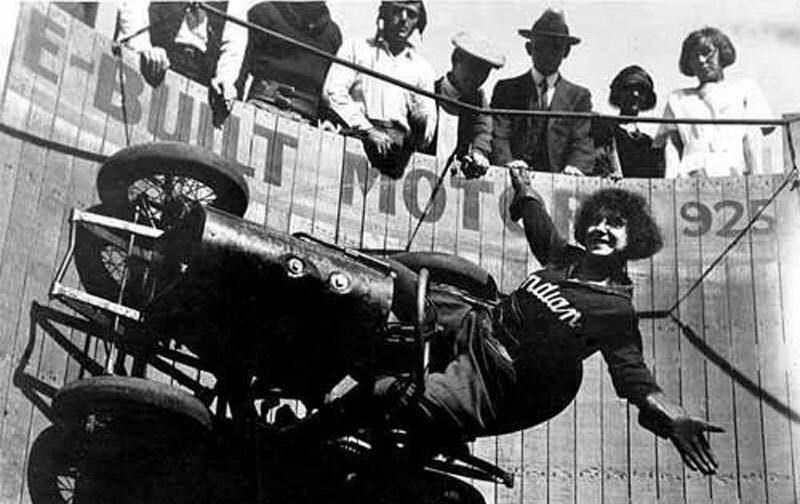
La France made her wall of death debut in 1924 at thirty, which made her something of a late starter compared to some of her contemporaries, and quickly became billed as the world's foremost woman motorcycle stunt rider. The act itself was genuinely dangerous, not just dressed up to look that way.
Riders circled a wooden barrel roughly thirty feet across at speeds close to sixty miles an hour, held up by nothing but centrifugal force, and injuries were routine rather than rare. One rider from the era put it plainly: there wasn't one performer on the circuit who wasn't cut and scarred all over, with broken limbs an expected part of the job. Fatal accidents happened too. Wall of death rider Una Langmead died in 1952 when her motorcycle slipped out from under her mid-performance, a reminder of exactly what La France was risking every time she rode. The same appetite for paying to watch someone flirt with disaster kept diving horse shows packing crowds in around the same decades, though La France was the one actually putting her own body on the line rather than an animal.

She rode in aviator goggles, jodhpurs and a jersey stamped with a skull and crossbones, a look distinctive enough that it became her personal brand. She was equally comfortable on motorcycles and in four wheeled vehicles, and became the first person to ride the wall in a scaled down midget racing car, a stunt that pushed the act beyond what most of her competitors, male or female, were willing to try. She also rode hands free at full throttle, and in her own words summed up the whole appeal simply: it was the thrill of risking her life that made her take up drome riding in the first place, and she was, by her own description, the girl who flirts with death.
Injuries, Hawaii and Life on the Road
The job took its toll. At least one surviving photograph shows her performing with a broken arm in a sling, riding anyway because the show, and the paycheck, didn't wait for a fracture to heal. Around 1930 she took the act to Honolulu, Hawaii, performing alongside other touring sideshow attractions, including a seven foot tall performer named Johan Aasen, a reminder that the carnival and motordrome circuits of the era were part of the same traveling ecosystem as the sideshow acts audiences also came to gawk at. She never married and never had children, a fact that lines up with her own stated feelings about the domestic life she'd walked away from in Kansas.
Who Was She, Really?
Here's where most of the existing coverage of La France gets sloppy. A handful of blogs give her birth name as Lillian Ossage rather than Agnes Micek, with no source attached to back it up. The stronger evidence points firmly to Agnes Micek. Reference works that have actually done the legwork, including a 1990 book on carnival history and a 2010 anthology of Harley-Davidson writing, cite her under that name, and a 1953 trade publication placed her on the midway under it too. Genealogical records back it up further: a 1924 obituary notice out of Atwood, Kansas, for a man named John Micek names his granddaughter as Lillian LaFrance, also known as Agnes Micek, which lines up almost exactly with the year she made her wall of death debut under her new stage name.
Trading the Wall of Death for a Shooting Gallery
Eventually La France stepped away from the wall itself and moved into running a long range shooting gallery, a common second act for carnival performers whose bodies could no longer take the punishment of the drome but who weren't ready to leave the midway behind entirely. She died in 1979, having spent roughly half a century connected to traveling shows in one form or another, first as the rider audiences paid to watch risk her neck, and later as the operator running her own attraction instead of performing in one.
A Sundance Film Built From Her Own Home Movies
The strangest part of La France's story happened almost two decades after her death. In 1998, filmmaker Kim Wood, whose work focuses on the histories of relatively unknown adventurers and eccentrics, made a short experimental documentary called Advice to Adventurous Girls, built around an actual, genuine discovery: La France's own home movies had survived. Wood combined that footage with hand processed, optically printed color and black and white imagery to build what's described as an experimental portrait of a Kansas farm girl who ran away with a traveling carnival and became a world renowned motorcycle daredevil.
The film premiered at the Sundance Film Festival and went on to win the Silver Hugo at the Chicago International Film Festival along with a Director's Citation from Thomas Edison's Black Maria Film Festival. It's since been preserved as part of an archived collection of independent women's filmmaking held at the Getty Research Institute, which is a considerably longer afterlife than most 1920s carnival performers ever get.
Quick Answers
Who was Lillian La France? She was a motorcycle stunt performer, born Agnes Micek in Kansas in 1894, who ran away from her farming family in 1916 and became known in the 1920s and 30s as the world's foremost woman wall of death rider, billed as the girl who flirts with death. She died in 1979.
Is there a documentary about Lillian La France? Yes. Filmmaker Kim Wood made a short experimental documentary called Advice to Adventurous Girls in 1998, built from La France's own surviving home movies. It premiered at Sundance and won the Silver Hugo at the Chicago International Film Festival.


