Gene Vincent: The Broken Sailor Britain Turned Into Rock 'n' Roll's First Dark Antihero

Picture Gene Vincent and you probably see the same thing everyone does. Black leather from head to toe, a hunched shoulder, a dragging leg and a microphone gripped like he was trying to strangle it. It's one of the most copied looks in rock history. The funny thing is that it wasn't really his. It was dreamt up by a British television producer who thought the real Gene was a bit too polite.
What happened next was anything but polite. Within a few months of becoming Britain's leather-clad bad boy, Vincent was sitting in a taxi on a dark Wiltshire road when it smashed into a lamppost and killed his friend Eddie Cochran. He never really recovered. Along the way he also crossed paths, again and again, with four lads from Liverpool who'd learned to play rock 'n' roll on his records.
Quick Answers
Who was Gene Vincent? An American rock 'n' roll singer, born Vincent Eugene Craddock in Norfolk, Virginia, best known for 1956's Be-Bop-A-Lula.
Why did he limp? His left leg was crushed in 1955 when a car hit him on his motorcycle while he was in the US Navy. He refused amputation and wore a steel brace for the rest of his life.
Who created his leather image? British TV producer Jack Good, when Vincent came over to appear on Boy Meets Girls in December 1959.
Was he in the crash that killed Eddie Cochran? Yes. He was in the taxi that crashed in Chippenham on 16 April 1960. Cochran died the next day. Vincent broke his collarbone and ribs.
Did he know The Beatles? Yes. He shared a bill with them in Hamburg and headlined above them at Liverpool's Cavern Club in 1962, and Be-Bop-A-Lula was sung on the day John Lennon met Paul McCartney.
How did he die? From a ruptured, bleeding ulcer on 12 October 1971, at his parents' home near Newhall, California. It was eight days after his last ever gig, in Liverpool. He was 36.
Who was driving the taxi? A 19-year-old Bristol driver called George Martin. He was convicted of dangerous driving, fined £50 and banned for 15 years.
A Sailor, a Bonus Cheque and a Triumph Motorbike
Vincent Eugene Craddock was born in Norfolk, Virginia, in February 1935. Even that's a bit muddled. Most books give his birthday as 11 February, but Encyclopedia.com's biography points out that he was actually born on the 17th and the earlier date came from a misread handwritten application for his birth certificate.

He joined the Navy at 17, with his dad signing the papers. In March 1955 he re-enlisted for six years and spent his re-enlistment bonus of $612.39 on a new Triumph motorcycle. A few months later, in July 1955, he was on leave in Norfolk when a car hit him. His left leg was crushed.
Doctors wanted to take it off. Vincent begged his mum not to sign the forms and she couldn't bring herself to do it. Years later she admitted she wished she had. He spent around six months in and out of Portsmouth Naval Hospital and came out with a heavy metal brace he'd wear for the rest of his life. The pain never left him either, and neither did the pills he took to deal with it.
Be-Bop-A-Lula and the Elvis Problem
While he was recovering, Vincent started singing around Norfolk and caught the attention of local DJ Bill Davis, who went by the name Sheriff Tex and became his manager. A demo of Be-Bop-A-Lula helped land him a deal with Capitol Records, a label that badly wanted its own answer to Elvis Presley. The songwriting credit was split between Vincent, Davis and Donald Graves, a man Vincent had met the year before, uDiscover Music notes.
He recorded it with his band the Blue Caps on 4 May 1956 at Owen Bradley's studio in Nashville, with Cliff Gallup on lead guitar. Capitol actually thought the A-side was a track called Woman Love, but radio DJs flipped the record over and Be-Bop-A-Lula made the American top ten.
The trouble was that America already had Elvis, and the man pulling Elvis's strings was much better at keeping his star on top. Vincent had a handful of hits, including Lotta Lovin', but by the end of the 1950s the American industry had largely moved on. His band was falling apart, his tax problems were mounting and he'd been through a short first marriage. Britain, though, was a very different story.
Limp, You Bugger: How Jack Good Invented Gene Vincent
Jack Good was the producer behind British rock 'n' roll TV shows like Oh Boy! and Boy Meets Girls. In December 1959 he brought Vincent over to appear on Boy Meets Girls, and he wasn't impressed by what turned up. Vintage Rock says Good found the American star "worryingly mild".
So he rebuilt him. Good dressed Vincent in black leather and pitched him as something between Hamlet and Richard III. That leg brace stopped being something to hide and became the centrepiece of the act. Vive Le Rock repeats the long-told story that at his first appearance on the show Good stood in the wings yelling at him to limp.
It worked brilliantly. British audiences had never seen anything like this menacing, tortured figure, and they lapped it up. Vincent was suddenly a bigger star in Britain than he'd ever been at home. That black leather look went on to define the British rocker, the bikers who'd later be fighting mods on the beaches of the south coast. You can draw a straight line from Good's TV makeover to Jim Morrison's leather trousers, and Morrison knew it. The two later drank together in Los Angeles.
The 1960 Tour With Eddie Cochran
In early 1960 Vincent went out on a package tour of Britain with Eddie Cochran, the young Californian behind Summertime Blues and C'mon Everybody. The two became close friends, though it wasn't all easy. Vincent started out at the top of the bill, but Vintage Rock notes that Cochran's less edgy act often went down better, and there was pressure on Vincent to let Cochran close the shows. During the tour Vincent also recorded Pistol Packin' Mama at Abbey Road, which gave him a UK Top 20 hit later that year.
Rock 'n' roll was still reeling from the plane crash that killed Buddy Holly, Ritchie Valens and the Big Bopper barely a year earlier. Nobody expected the next tragedy to happen on a main road in Wiltshire.

The Last Night of the Tour
By April 1960 everyone on that tour was running on fumes. It had been billed as Britain's first major rock 'n' roll package tour and was originally meant to last five weeks. Alley61's history of the crash site notes that it ended up being stretched to fifteen. The final week was at the Bristol Hippodrome, finishing on Saturday 16 April, the night before Easter Sunday.
Cochran was desperate to get home. He was due to fly to New York for his first appearance on The Ed Sullivan Show, music writer Dean Goodman points out, and he wanted the earliest flight he could get. The last train to London left too late, so a Bristol taxi was booked to take him straight from the Hippodrome to London Airport. It was a Ford Consul, not a black cab, and the driver was a 19-year-old called George Martin.
Cochran squeezed into the middle of the back seat next to Sharon Sheeley, the songwriter he planned to marry, who'd only just turned 20. Tour manager Pat Thompkins was also in the back. Vincent, by most accounts, was up front in the passenger seat and dozing off. Disc magazine later reported that he was asleep when it happened.
Rowden Hill, Chippenham: 11:50pm, 16 April 1960
The A4 between Bath and Chippenham was a dark, twisting road in 1960. HISTORY.com estimates the Consul was doing more than 60mph. Goodman's account says Cochran asked the driver more than once to slow down.
About 30 miles into the journey, at roughly ten to midnight, the car was coming down Rowden Hill into Chippenham, just past the railway viaduct on a left-hand bend. A tyre blew. Martin lost control and the Consul spun across the road and smashed into a lamppost. No other vehicle was involved.

In the split second before the impact, Cochran threw himself across Sheeley to shield her. The rear door burst open and he was flung out onto the road. He hit his head and was knocked unconscious. Sheeley later remembered lying next to him in the ambulance while a medic held both their hands.
They were taken to St Martin's Hospital in Bath. Cochran never woke up. A detailed 60th anniversary piece records that he was declared dead at 4:10pm on Easter Sunday, 17 April 1960. He was 21 years old.

Everyone else walked away, more or less. Sheeley was treated for shock and bruising, while Thompkins and Martin weren't seriously hurt. Reports at the time said Vincent broke his collarbone and ribs, though some later write-ups, like this one from Grunge, say it was his leg that took the worst of it. Either way, his already wrecked left leg was badly knocked about again, and he limped worse than ever afterwards.
The story was on the front of the Daily Mirror the next morning. In a grim twist, the paper later reported that it was the mother of Ritchie Valens, killed in the Buddy Holly plane crash just over a year earlier, who broke the news to Sheeley's mother back in California.
There are a couple of odd footnotes to that night. Magnatone's history of the crash notes that the car and its contents, including Cochran's Gretsch guitar, were impounded at the local police station. A young police cadet there called David Harman is said to have taught himself to play on it. He later became Dave Dee of Dave Dee, Dozy, Beaky, Mick and Tich. Earlier on the tour, a 12-year-old called Mark Feld had carried that same guitar to Cochran's car. He grew up to be Marc Bolan.
What Happened to the Driver?
The exact cause of the crash was never nailed down, although the anniversary account says "excess speed was an undoubted factor". George Martin was convicted of dangerous driving, fined £50, with six months in prison if he didn't pay, and banned from driving for 15 years. Magnatone says some accounts claim he never served any jail time, and that he got his licence back in 1969.
Today there's a memorial at the spot where the lamppost stood. A plaque went up in 1990, and in 2018 it was reset into a larger stone monument shaped like three steps, a nod to Three Steps to Heaven, the single that went to number one in Britain after Cochran died. There's also a memorial at St Martin's Hospital, and in 2023 a blue plaque was unveiled at the Bristol Hippodrome to mark his last ever show. Cochran himself is buried at Forest Lawn in Cypress, California, with a memorial to Sharon Sheeley, who died in 2002, beside him.
How Eddie's Death Broke Gene Vincent
Physically, Vincent got off lightly compared to his friend. Disc magazine, in a report reproduced by uDiscover Music, said at the time that he'd been asleep when the car crashed. He phoned his wife the next day, was out of hospital by the Tuesday and flew back to America on the same journey as Cochran's body.
But he couldn't face the funeral. His wife Darlene later said he sent flowers instead because he didn't think he could handle being there. She summed it up simply: "Gene was really shook up."
And then, incredibly, he was back in Britain within a fortnight to carry on. A new run of dates was booked to start at Hanley on 30 April, and on 3 May he topped the bill at a show in Liverpool that had originally been booked for both him and Cochran. The man who'd been sharing a stage, a taxi and a friendship with Eddie Cochran was now expected to go out and do it alone, in pain, with a broken collarbone and his friend barely buried.
Some people cast the blame in Vincent's direction for the circumstances that led to that taxi ride, and whether or not it was fair, it stuck to him. Everyone who wrote about him afterwards describes a man coming apart. Record Collector says his life became "quite unmoored" after Cochran's death. The Tombstone Tourist describes the crash as the moment he slid further into a self-destructive lifestyle, shuttling between England and Los Angeles.
The drinking got worse. He took his painkillers with whisky and by the mid-1960s was drinking more than ever. His son Gene Jr was born six months after the crash, but by 1961 Darlene had left and taken the children with her. Two more marriages came and went over the following decade.
He became obsessed with guns and knives. He once turned up at a BBC Saturday Club session carrying a dagger. He allegedly pulled a gun on his friend Johnny Kidd. After his last British recording sessions in 1963, an incident in a London hotel lift involving him waving a pistol around left him more or less unemployable in the country that had made him a star.
The stories kept coming. One round-up of his darker moments lists him pulling a gun on Shadows bassist Jet Harris on a 1963 tour, with Harris hiding behind John Leyton until things calmed down. In Germany in 1968 he reportedly fired several shots at Paul Raven, the singer later known as Gary Glitter, and missed. Raven left the country the next day. In 1969 he threatened to fetch a gun from his car and shoot the producer Paul Rothchild, who sensibly left the studio.
Gene Vincent and The Beatles
If you want a measure of how much Vincent mattered in Britain, look at The Beatles. On 6 July 1957, at a church fete in Woolton, John Lennon's skiffle group the Quarrymen played Be-Bop-A-Lula. The Beatles Bible records that it was the first time Lennon had sung it on stage, and it was the same day he met Paul McCartney. When McCartney showed off afterwards, he did it by playing Be-Bop-A-Lula, Eddie Cochran's Twenty Flight Rock and some Little Richard.
Stop and think about that for a second. The two songs that helped kick off the most successful songwriting partnership in history belonged to the two men who'd be sitting in that taxi in Chippenham less than three years later.
That Liverpool show on 3 May 1960 is part of the story too. It was promoted by Allan Williams at Liverpool Stadium, a boxing venue run by Pete Best's grandfather, Johnny Best. Synthesizing the Beatles explains that Larry Parnes had offered Vincent and Cochran as joint headliners and let the show go ahead after Cochran's death, with Vincent topping a bill packed with local groups like Rory Storm and the Hurricanes and Gerry and the Pacemakers. The Beatles weren't on it. A few days later, Lennon asked Williams to do something for his band too. Williams eventually did, and sent them to Hamburg.
Hamburg and the Cavern, 1962
By the spring of 1962 The Beatles were back in Hamburg, opening at Manfred Weissleder's brand new Star-Club on 13 April. They'd arrived in Germany to the news that their former bassist Stuart Sutcliffe had died the day before. Vincent was on the Star-Club bill during that run, and there's a photo of him posing with Lennon, McCartney, Harrison and Pete Best at the club in April or May 1962. Encyclopedia.com goes further and says the then-unknown band backed him at one Hamburg show when his own musicians didn't turn up in time.
The club's own newsletter, Star Club News, later ran a cover photo of Vincent signing an autograph for John Lennon. These weren't just colleagues. They were fans.
A few weeks later, on Sunday 1 July 1962, Vincent headlined the Cavern Club in Liverpool, backed by Sounds Incorporated, with The Beatles second on the bill. It was the first Sunday night the Cavern had ever booked without a jazz act. The Beatles Bible's account of the night includes some great memories from people who were there. A woman fainted in the heat during Vincent's set and had to be passed out over the heads of the crowd. Paul's brother Mike remembered Vincent seemed to know Paul was going to be important.
Best of all, the DJ Billy Butler recalled that Vincent asked where he could get a drink and was horrified to learn the Cavern didn't serve alcohol. Butler gave him a bottle of beer and got a polite thank you for his trouble. Seven weeks later Ringo Starr played his first Cavern gig as a Beatle. The band supporting Gene Vincent were about to make him look like yesterday's news.
Vincent seemed to understand what had happened. Talking to Melody Maker in 1969, he said "The Beatles came out and groups started", a blunt summary of how the beat boom swept away solo rockers like him. Still, the Beatles never forgot him. Lennon opened his 1975 album Rock 'N' Roll with Be-Bop-A-Lula, and George Harrison painted the word "Bebopalula" on his psychedelic Stratocaster, Rocky.
The Last Years
The rock 'n' roll revival of the late 1960s gave Vincent a bit of work again. Jim Morrison, who drank with him at the Shamrock bar on Santa Monica Boulevard, insisted he open for The Doors at the 1969 Toronto Rock and Roll Revival, where he was backed by Alice Cooper's band. A couple of years later The Doors made their own final masterpiece.
Vincent toured Britain again in 1969, the subject of a BBC documentary called The Rock and Roll Singer. He was broke and in poor health. Record Collector says he looked about two decades older than he was. He was still only in his mid-thirties.
The Final Tour and the Death of Gene Vincent
In 1971 Vincent was still working, just about. A few weeks before he died he recorded four tracks for Rockin' Ronny Weiser's Rolling Rock label, which were later released on a tribute compilation. In September he flew back to London, partly because he had an alimony case to fight in court, Vintage Rock's interview with Houseshakers singer Graham Fenton explains.
His last run of British dates started on 19 September 1971. He was backed by guitarist Richard Cole and a pick-up band called Kansas Hook, and they recorded four songs at the BBC's Maida Vale studios for Johnnie Walker's Radio 1 show. Then came a gig at the Garrick Night Club in Leigh, Lancashire, and two nights at the Wookey Hollow Club in Liverpool on 3 and 4 October. It's a strange bit of symmetry. Gene Vincent's last ever shows were in the same city where The Beatles had once opened for him.
He was in a terrible state. Fenton remembered him coughing up blood in his car and said the shows fell apart as he got sicker. On top of his health, he was being squeezed from three directions at once, by his ex-wife Margaret Russell, by the Inland Revenue and by the promoter Don Arden. He gave up and flew home to California.
Eight days after that last Liverpool gig, on 12 October 1971, he was at his parents' home in Saugus, right next to Newhall, when he collapsed. Encyclopedia.com says he fell and had a seizure brought on by a bleeding ulcer. He was rushed to Inter-Valley Hospital in Newhall, where he died. The Tombstone Tourist gives the cause as a ruptured ulcer, internal haemorrhage and heart failure combined. He was 36.
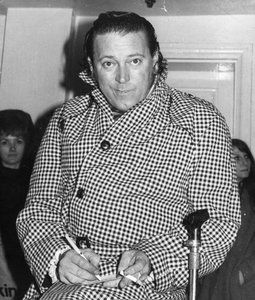
Fenton has his own theory about what finished him off. He thinks the stress of the court case, the heavier drinking and the aspirin Vincent kept taking for his leg all played a part. That's speculation, but it fits. Years of washing down painkillers with whisky would have done his stomach no favours at all.
He's buried at Eternal Valley Memorial Park in Newhall, in the Repose section. Jim Morrison, his old drinking partner, had died in Paris just three months earlier. In 1998 Vincent was inducted into the Rock and Roll Hall of Fame, a long time after America had stopped paying attention.
He stayed a rocker to the very end. Jack Good may have given him the leather and the limp, but the pain, the grief and the hard drinking were all his own. Somewhere on Rowden Hill in Chippenham, on a dark April night in 1960, the act stopped being an act.
Further Reading
If you want the full story, Susan VanHecke's Race with the Devil: Gene Vincent's Life in Rock 'n' Roll is the most detailed biography out there, packed with interviews from the people who knew him.
As an Amazon Associate, Utterly Interesting earns from qualifying purchases.
You Might Also Like
Sources
'Be-Bop-A-Lula': Gene Vincent Didn't Mean Maybe (uDiscover Music)
Eddie Cochran dies and Gene Vincent is injured in a UK car accident (HISTORY.com)
Live: Cavern Club, Liverpool, 1 July 1962 (The Beatles Bible)
The Beatles at the Star-Club, 13 April 1962 (The Paul McCartney Project)
Star-Club third residency, December 1962 (The Paul McCartney Project)
The Eddie Cochran Fatal Car Crash Site, Chippenham (Alley61)