

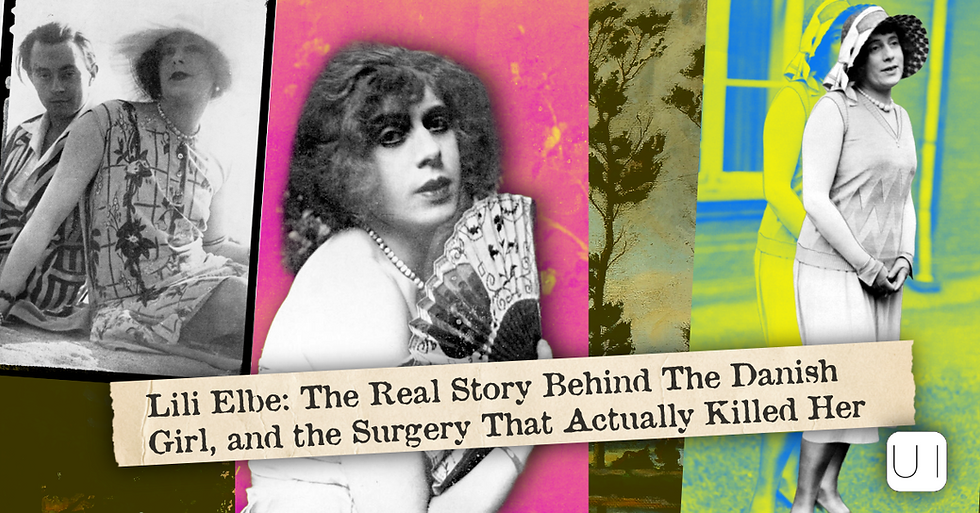
Lili Elbe: The Real Story Behind The Danish Girl, and the Surgery That Actually Killed Her
In August 2026, Santa Fe Opera put on an American premiere that Hollywood never quite managed to get right. The opera is called Lili Elbe, it's scored by a Grammy winning composer, and its libretto was written by a working neuroradiologist who spends his days reading brain scans and his evenings, it turns out, correcting the historical record. His reason for writing it was blunt: he'd seen The Danish Girl and decided Lili's actual life deserved better than the film gave it.
He had a point. The real story of the Danish painter who became one of the first people anywhere to undergo surgical gender transition is stranger, messier and considerably less romantic than the 2015 film made it look, and the detail almost everyone gets wrong is the one that actually killed her. It wasn't the surgery that made her a woman. It was the one she gambled her life on afterwards, in a last attempt to become a mother.
Quick answers
• What actually killed Lili Elbe? Not the operations that reassigned her sex. A later, experimental uterus transplant, carried out purely so she could try to have a child, caused a fatal organ rejection months afterwards.
• Was she really the first person to have this kind of surgery? No. The Berlin institute that treated her had reportedly already carried out similar operations on other patients whose names barely survive in the historical record.
• Is The Danish Girl a true story? Loosely. Both the 2000 novel and the 2015 film invented large chunks of it, including Gerda's entire backstory.
• What happened to Gerda Wegener afterwards? She remarried, divorced within five years, and died broke and largely forgotten in 1940, less than a decade after Lili's death.
The portrait sitting that started it all
Lili Elbe was born Einar Wegener in December 1882 in Vejle, a market town on Denmark's Jutland peninsula, the youngest child of a merchant family. Fair haired and fine featured, Einar was reportedly mistaken for a girl more than once growing up. At nineteen, Einar enrolled at the Royal Danish Art Academy in Copenhagen, where a fellow student named Gerda Gottlieb became first a friend, then a wife, in 1904.

Einar built a real reputation as a landscape painter in his own right, winning Denmark's Neuhausen Prize in 1907. But the moment that mattered more happened the following year in a Copenhagen studio, when an actress named Anna Larsen failed to turn up for a modelling session. Gerda needed a figure to draw and asked her husband to put on the stockings and dress instead. Einar later put it plainly: "I cannot deny that I enjoyed myself in this disguise."
Over the following decade, that disguise had a name. Gerda's friends and colleagues started referring to her husband's feminine alter ego as Lili, and Lili began turning up, again and again, as the subject of Gerda's illustrations. Most people who saw the pictures had no idea they were looking at the same person twice.

A marriage that moved to Paris and turned into something else
In 1912 the Wegeners left Copenhagen for Paris, where the city's looser social codes suited them both. Gerda's career took off there. Her Art Deco illustrations ran in Vogue and La Vie Parisienne, and three of her paintings eventually found their way into the Louvre's collection, since transferred to the Centre Pompidou.
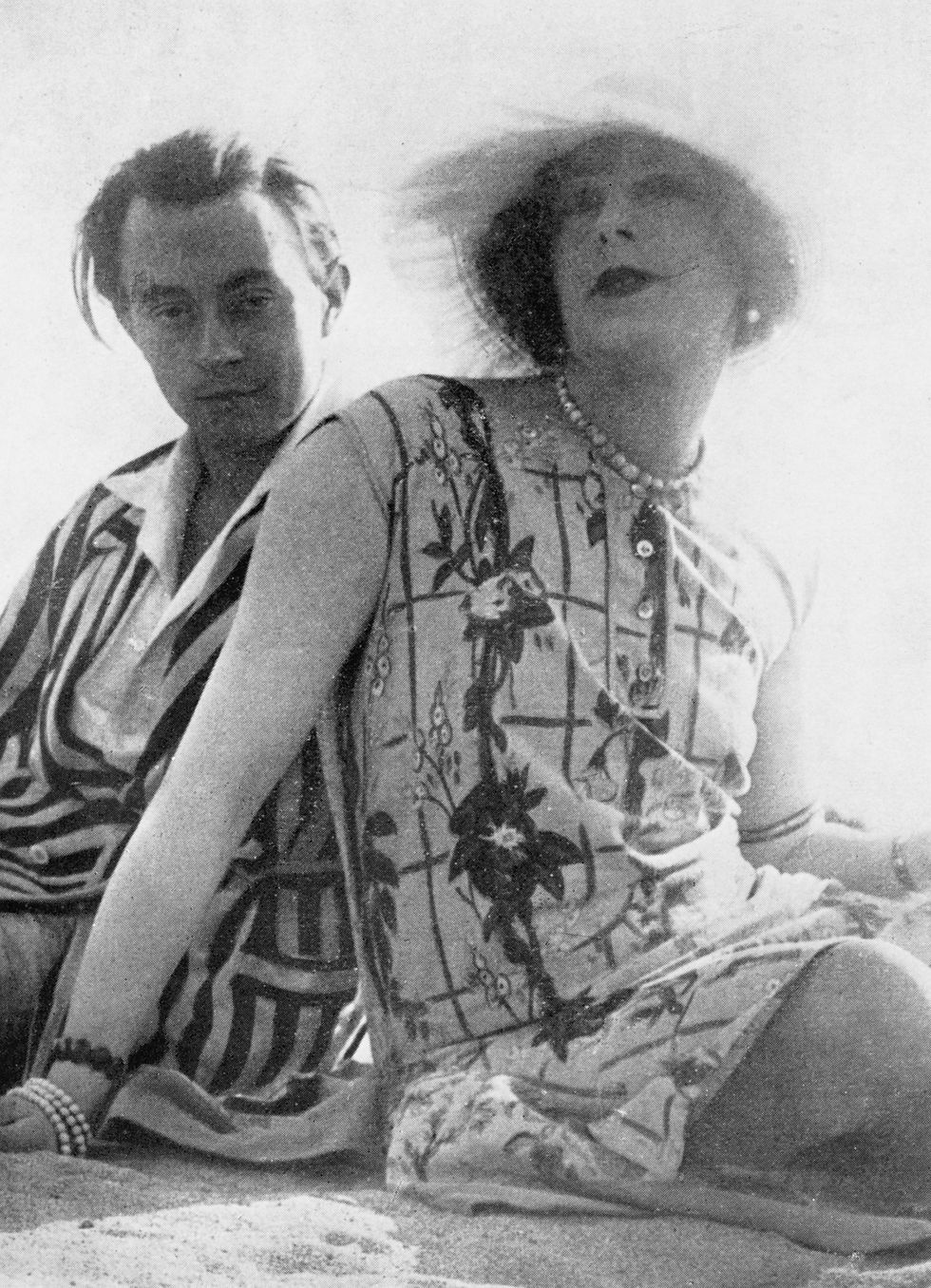
As Lili's presence in their lives grew from an occasional costume into something closer to a second identity, the Wegeners' marriage shifted with it. At Parisian parties and social events, Gerda began introducing Lili as her sister rather than her husband. What had started as a romance between two art students had, by the late 1920s, settled into something more like a devoted creative partnership, with genuine love on both sides but very little left of a conventional marriage.

The date she'd picked to die
By 1929, the strain of living as two people had become unbearable. According to later accounts, Lili had settled on the first of May 1930 as the date she planned to end her own life, seeing it as the only real way out of a situation she couldn't otherwise resolve.
She never had to keep that appointment. A friend in Paris put her in touch with a French gynaecologist that year, who in turn pointed her towards Kurt Warnekros, a German surgeon in Dresden, and towards Magnus Hirschfeld's Institute for Sexual Research in Berlin, one of the only places on earth doing anything like the surgery she needed. Lili travelled to Berlin in February 1930 for an initial evaluation by Hirschfeld and his colleague Felix Abraham.
Four operations that had barely been attempted before
What followed was not one surgery but a sequence of them, spread across more than a year, at a time when almost none of the underlying medicine had been tested. On the fifth of March 1930, surgeon Ludwig Levy-Lenz carried out the first operation in Berlin. Further procedures followed that spring, and on the twenty sixth of May 1930 Warnekros performed a second stage in Dresden that included an ovary transplant.

During that operation, doctors reportedly found what they described as rudimentary ovarian tissue already present, a detail some modern writers have pointed to as evidence Lili may have had an undiagnosed intersex condition rather than fitting neatly into the medical categories of the day. It's impossible to say for certain either way, since most of the clinical records were destroyed during the Second World War. By July 1930 she'd been discharged in good health and travelled back to Copenhagen with Gerda at her side.
A king's decree that made her a woman on paper before almost anywhere else did
On the sixth of October 1930, Christian X of Denmark issued a royal decree annulling the Wegeners' marriage and, by most accounts, formally recognising Lili's new name and legal sex on her Danish papers. It's one of the earliest known instances anywhere of a national government putting something like this in writing, though record keeping across Europe at the time was patchy enough that it's worth stopping short of calling it an outright global first.
She wasn't even the first one through that particular door
Here's the detail that gets left out of almost every telling of this story, including the film: Lili wasn't the first patient at Hirschfeld's institute to go through a surgical transition. The Berlin clinic had already been performing what staff called Genitalumwandlung, castration, penectomy and vaginoplasty carried out in stages, on other patients before her case became internationally known, and by 1930 the institute reportedly employed several post-operative patients on its own staff.
Because Lili's own memoir became the version of this story the world actually read, later writers built an entire "first in the world" myth around her specifically, quietly erasing the patients who came before her and whose names have mostly been lost to history altogether.

The operation nobody warns you about, because it wasn't about becoming a woman at all
Here's the part of the story The Danish Girl leaves out completely. On the seventeenth of June 1931, more than a year after her transition had already been medically and legally completed, Lili underwent one more operation: a uterus transplant, attempted specifically so she could try to carry a child of her own.
This wasn't a natural extension of her earlier care. It was an entirely separate, experimental gamble, undertaken years before surgeons anywhere had a working understanding of tissue rejection, let alone a successful transplant of that kind to point to. It fits, unnervingly well, into a wider pattern running through European medicine in exactly this period, when transplanting reproductive and glandular tissue for near miraculous results had become something of a craze among ambitious surgeons and the wealthy patients willing to pay for it. Fewer than a decade earlier, a Paris based surgeon named Serge Voronoff had built an entire fortune, and a genuine following among European aristocracy, transplanting monkey testicle tissue into ageing millionaires for much the same reason: a belief that the right piece of borrowed tissue could reverse what medicine otherwise couldn't touch.
Death by rejection, not by transition
Within weeks, Lili's body began rejecting the transplanted organs. She developed serious complications and died at the Dresden Women's Clinic on either the twelfth or thirteenth of September 1931, depending on the source, at forty eight years old. She was buried on the fifteenth.
The precise clinical cause is still disputed. Some accounts point to organ rejection and infection. Others describe cardiac failure, and at least one source frames it in terms closer to a cancer diagnosis. With the original clinical records lost during the war, there's no single surviving document that settles it, so it's worth treating any confident single-cause claim, including some of the more dramatic modern retellings, with a healthy amount of scepticism.
The memoir that made her famous also rewrote her
Almost everything the public has ever known about Lili's inner life comes from one book, Man into Woman, published in 1932 and 1933 under the pen name Niels Hoyer. It reads like the work of a single author. It wasn't. At least six people had a hand in it: Lili herself, Gerda, a friend named Poul Knudsen who supplied documents and records, a journalist named Loulou Lassen who assembled and largely wrote the finished narrative, a German writer called Ernst Harthern who produced the text under the Hoyer pseudonym and Warnekros himself, who checked the medical sections.
Scholars who've since gone back through the different Danish, German and English editions have found real, meaningful differences between them, and Lassen is now understood to have deliberately shaped the book using a literary device borrowed from Aldous Huxley, splitting the narrator into two competing characters rather than simply reporting one person's account of their own life. Einar comes across in the text as sickly and repressed, Lili as vivacious and alive, a contrast that reads more like crafted fiction than a plain transcript. It means plenty of the quotations attributed to Lili that still circulate today are best read as reflecting the spirit of what she felt rather than her word for word voice.

What happened to Gerda
Gerda stayed close to Lili right through her medical care, sending flowers and support throughout her recovery. After Lili's death, she remarried quickly, to an Italian officer, aviator and diplomat named Fernando Porta, and moved with him to Morocco. That marriage ended in divorce by 1936.
She returned to Denmark in 1939 to find the art world had moved on without her. The bold, playful Art Deco style that had once made her one of Europe's most sought after illustrators had fallen out of fashion, and she spent her final years selling cheap, hand painted Christmas cards to get by rather than the fine art that had once hung in the Louvre. Gerda died alone in Frederiksberg on the twenty eighth of July 1940, less than nine years after Lili, having gone from celebrated artist to genuine poverty within a single decade.
What The Danish Girl simply made up
David Ebershoff's 2000 novel, which the 2015 film closely follows, relocates Gerda's entire backstory from Denmark to Pasadena, California, and invents a previous husband and a child for her that never existed in reality. The film keeps that fictional skeleton and largely writes Hirschfeld out of the story altogether, sidelining the one doctor whose institute made the whole medical breakthrough possible in the first place. It also leaves out the uterus transplant entirely, along with the fact that it was Lili's own choice, made in pursuit of motherhood rather than survival, that ultimately killed her.
A 2026 opera puts the real history back
That gap is exactly what composer Tobias Picker and librettist Aryeh Lev Stollman set out to close with their opera Lili Elbe. Stollman, who works full time as a neuroradiologist at Mount Sinai Health System in New York, wrote the libretto for his husband's score after watching The Danish Girl and deciding the real version deserved telling. "We based our story on historical sources," he's said of the project.
The title role went to Lucia Lucas, a transgender Heldenbaritone who made history of her own in 2019 as the first openly transgender performer to take a leading role with an American opera company, playing the title character in Tulsa Opera's Don Giovanni. The opera premiered at Theater St. Gallen in Switzerland in October 2023, won Best World Premiere at the 2024 Oper! Awards, and got a world premiere recording in July 2026. Its American premiere opened at Santa Fe Opera on the first of August 2026, with Lucas reprising the role. Santa Fe's general director Robert K. Meya has described the piece as "a moving portrait of courage and love," nearly a century after the woman it's about died trying to become something the medicine of her own era simply wasn't ready to give her.
Further reading on the site
Lili's care only happened at all because of the institute Magnus Hirschfeld built in Berlin, and its own story, including what the Nazis did to it, is told in full in Magnus Hirschfeld and the World's First Trans Clinic the Nazis Burned to the Ground. The same era produced other cases of gender identity being misunderstood, misreported or flatly mythologised by the press, including Dora Ratjen: The Athlete Who Lived a Dual Identity, and decades later The Tragic Case of David Reimer and the Gender Identity Experiment That Failed shows medicine getting a similar question badly wrong in a very different way. For more on the wider fashion for transplanting glands and tissue that Lili's final operation belonged to, there's Dr. Serge: The Man That Made Millions in the 1920's Transplanting Monkey Testicle Tissue into the Ballsacks of Millionaires.


