

Jackie Coogan: How His Mother and Stepfather Spent His $4 Million Fortune

Jackie Coogan made Hollywood's first child star fortune and never got to spend a dime of it himself. Between 1923 and 1936 alone he earned just over three million dollars, with a few million more in property and contracts on top of that, and he'd been told the whole pile would be his once he turned 21. By the time he actually asked for it, his mother told him flatly that none of it had ever been his to begin with. What happened in between, the mansion, the furs, the diamond studded pocket watch, the courtroom fight that followed and the law that came out of it, is a much stranger and more detailed story than the usual one line summary about a kid who got robbed.

The Kid Who Built an Empire
Charlie Chaplin spotted four year old Jackie Coogan doing the shimmy, a popular dance craze of the era, on the stage of the Orpheum Theatre in Los Angeles in 1919. What caught Chaplin's eye wasn't really the dancing. It was how naturally the kid could mimic anything put in front of him. Chaplin gave him a small role in A Day's Pleasure that year, then built an entire feature around him in 1921, The Kid, casting Coogan as an abandoned boy that Chaplin's tramp character raises as his own. It made him arguably the first true child star in movie history, and he followed it a year later with the title role in Oliver Twist. His look from The Kid, the pageboy haircut, the oversized overalls, the flat cap, got copied everywhere. Department stores sold the same outfit for other people's kids, and even some of the child performers in Hal Roach's Our Gang shorts borrowed the same haircut trying to catch a bit of his popularity.
Coogan wasn't just acting. He became one of the first people ever merchandised like a modern celebrity brand, with his name and face sold on peanut butter jars, stationery, whistles, dolls, records and figurines. By 1936 he'd personally earned $3,012,422 as a performer, and his parents had put roughly another $1.5 million of his money into Los Angeles real estate held in his name. Add it up and he was closing in on $4 million or so, somewhere around $55 million in today's money, and he was told it would be handed over once he turned 21. Day to day, he saw almost none of it. His allowance ran him six dollars and twenty five cents a week, worth about $115 today.
The Crash That Changed Everything
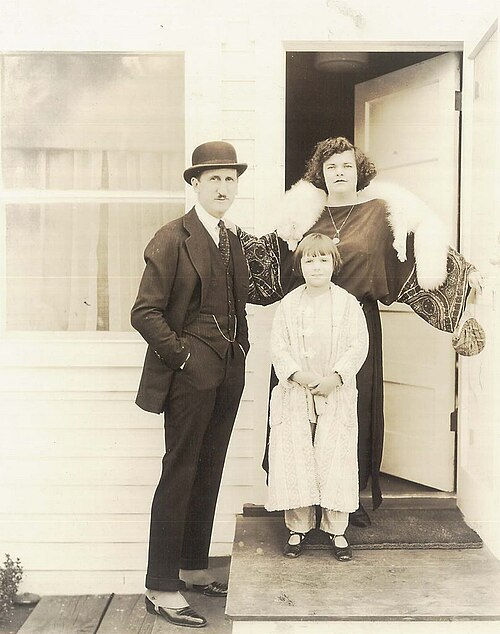
For most of Jackie's childhood, his father, Jack Coogan Sr., kept a fairly tight and careful handle on the money, which is part of why what happened next felt so sudden. That control ended in May 1935, five months before Jackie's twenty first birthday, when the car his father was driving rolled seven times outside San Diego and crashed into a creek. His father and three other people died, including his close friend and fellow child actor Trent Durkin. Jackie survived the crash cushioned by sacks of dead doves the group had shot on a hunting trip that day, and he later said the birds acted like feather pillows and probably saved his life. Not long after the funeral, his mother, Lillian, married the family's financial advisor, Arthur Bernstein. Within about a year, the fortune Jackie's father had spent a childhood protecting was almost entirely gone.
Where the Money Went
Lillian and Bernstein spent Jackie's earnings on furs, diamonds, expensive cars and property. They lived in what was reportedly the largest private house in Los Angeles at the time, built around one of the first residential swimming pools in Southern California. Bernstein reportedly bought himself a diamond studded pocket watch. None of the spending was slowed down by the fact that none of it was technically in Jackie's name, and none of it came with an accounting he was ever allowed to see. Meanwhile his own life was starting to come apart too. In November 1937, right as the money situation was quietly falling apart behind the scenes, Jackie married actress Betty Grable. It didn't last. The marriage collapsed within about two years, right around the same time his fight with his mother was about to go public.
It's All Mine and Arthur's
When Jackie finally confronted his mother about the money, she didn't pretend there was anything left to negotiate. In court, under oath, she said it outright: you haven't got a cent, there never has been a cent belonging to you, it's all mine and Arthur's, and so far as we are concerned you will never get a cent. Asked directly on the stand about her legal right to spend her son's earnings however she pleased, she answered just as plainly, saying I believe that is the law. She also called him a bad boy and claimed no promises had ever been made to give him anything. Bernstein backed her up with a legal argument dressed up as sympathy, telling reporters the law was on their side, since lawyers had told them every dollar a child earns before turning 21 legally belongs to the parents. It wasn't entirely made up. At the time, it mostly was the law, which is exactly what made the case worth fighting.

The Lawsuit
Jackie filed suit against his mother and Bernstein in April 1938. The court appointed a receiver, John E. Biby, to go through the family's finances and figure out what was actually left, and what he found was worse than anyone had said publicly. Of the roughly three million dollars Jackie had earned as a child, only about $250,000 remained. His late father's estate still owed Jackie Coogan Productions $84,948. Lillian's own personal assets, meanwhile, totaled just $39,443, with only $519 dollars sitting in the bank. The case dragged on for almost two years before it finally settled in February 1940. The roughly $252,000 that was left got split in half between Jackie and his mother, putting his official share at about $126,000. Jackie later said what he actually walked away with, after legal fees and cashing in a life insurance policy to cover his own debts, was closer to $35,000, somewhere in the range of $790,000 to $2.8 million today depending which figure you're measuring.
Coogan wasn't the first young performer whose money and future ended up in someone else's hands. Evelyn Nesbit had already lived through a version of it a generation earlier, and Audrey Munson, America's first supermodel, saw her own career and finances collapse around the same era, both proof that Coogan's case wasn't some isolated fluke of bad parenting.
The Coogan Law
The case moved fast through Sacramento once it became public. In 1939, California passed the Child Actor's Bill, generally known as the Coogan Law, giving judges the power to order part of a child performer's earnings into a trust the parents couldn't touch. It had a loophole from the start, the protected trust only covered net income after managers and agents took their cut, and it stayed on the books largely unchanged for sixty one years. In 2000, California finally closed that gap, making it mandatory rather than optional, requiring 15 percent of gross earnings to go into trust, and stating explicitly for the first time that a child actor's earnings belong to the child, not the parent or guardian.
A War Behind Enemy Lines
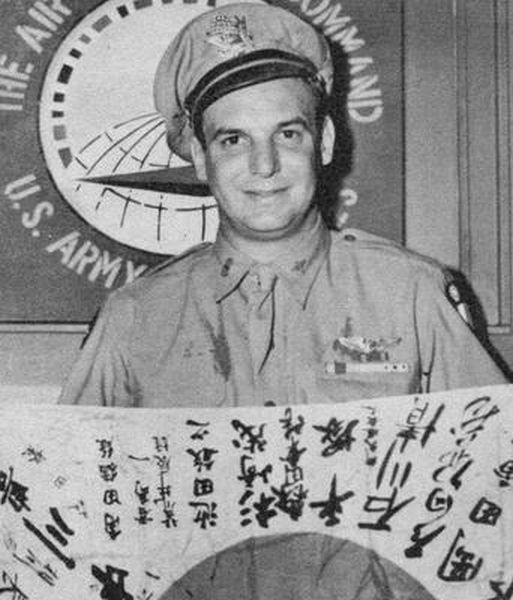
Jackie had learned to fly before Pearl Harbor, and he enlisted in the Army on March 4, 1941, volunteering for the dangerous work of flying gliders specifically because of that civilian flying background. He trained at glider school in Lubbock, Texas and Twentynine Palms, California, and earned the rank of Flight Officer with the 1st Air Commando Group under Colonel Phil Cochran. He deployed to India in December 1943, and on the night of March 5, 1944, he flew as part of Operation Thursday, the aerial invasion of Burma, piloting a Waco CG-4A glider carrying British troops under General Orde Wingate roughly a hundred miles behind Japanese lines into a jungle clearing the operation had code named Broadway. Beyond flying, he was personally responsible for the unit's tow ropes, the nylon lines that connected each glider to its tow plane, since losing one mid flight could strand an entire glider crew behind enemy lines. He came home in May 1944 and was discharged in December 1945, the same man who'd once had his own money spent without him ever getting a say in it, now flying troops into some of the most dangerous airspace of the war on his own terms.
What Happened to Jackie
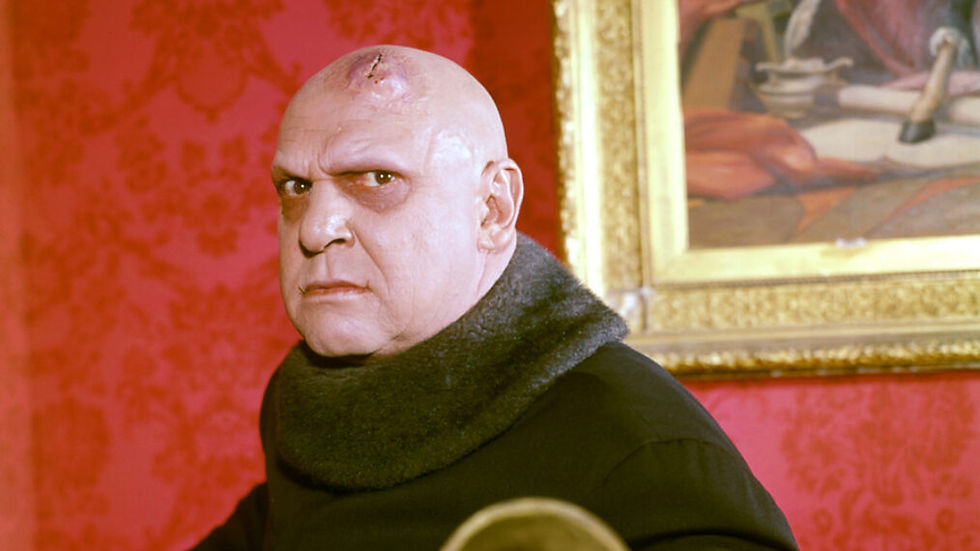
Coogan kept working through all of it, picking up smaller film and television roles once he was back from the war. His personal life took a while longer to settle than his career did. After Betty Grable, he married actress Flower Parry in August 1941, divorced her in June 1943, married Ann McCormack in December 1946, divorced her in 1951, and finally married Dorothea Odetta Hanson, known as Dodie, in April 1952. That one stuck, and the two of them stayed together for more than thirty years, right up until his death. At one particularly broke stretch along the way, Charlie Chaplin, the man who'd discovered him as a boy, sent him $1,000. Coogan finally found a second wave of real fame in 1964 playing Uncle Fester on The Addams Family, a role that introduced him to a whole new generation who had no idea he'd once been the most famous child in the world. He kept working steadily through the 1960s and 70s, turning up on Perry Mason, The Brady Bunch, I Dream of Jeannie, The Partridge Family, Hawaii Five-O and McMillan and Wife before retiring in the mid 1970s. He died of cardiac arrest on March 1, 1984, in Santa Monica, at 69, after a run of strokes and heart and kidney problems.
Jackie Coogan never got his fortune back. What he got instead was a law with his own name attached to it, one that's still the reason every child actor's contract in California sets aside a piece of their earnings before their parents can touch a cent.


