

Felice Schragenheim and Lilly Wust: The Doomed Love Story Behind Aimée and Jaguar
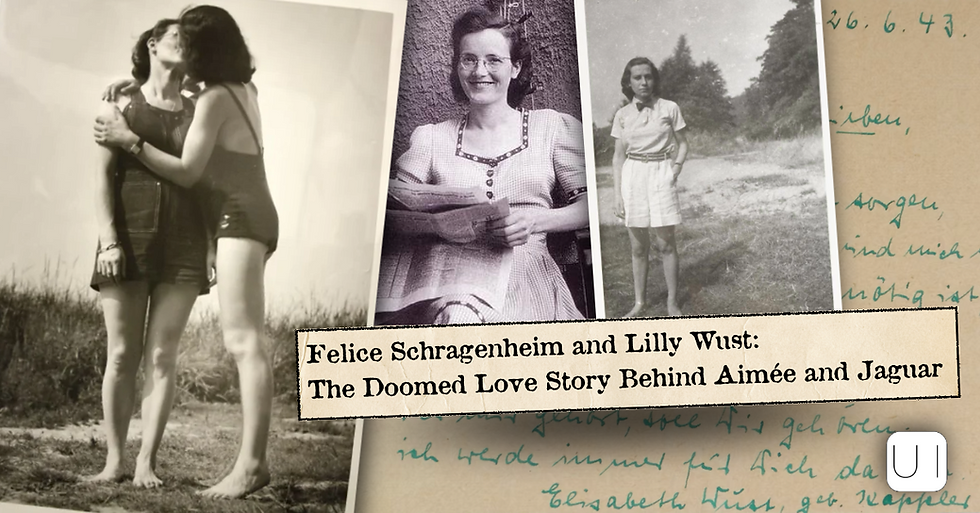
In November 1942, in a Berlin coffee shop, a Jewish woman living under a fake name sat down with a woman married to a soldier serving Hitler's army, a woman who reportedly liked to boast that she could smell a Jew. Two years later, the Gestapo had one of them, and the other was writing letters to a concentration camp that would never be answered. In between, the two women fell in love, wrote each other a private marriage contract, and exchanged rings, all while one of them was hiding in plain sight from the government the other one's husband was fighting for. Their story became the book and film Aimée and Jaguar. Here's what actually happened.

A Jewish Woman Hiding in Plain Sight
Felice Schragenheim was born in Berlin on March 9, 1922, to a middle class Jewish family, the daughter of two dentists. Both her parents died before she turned 13, and she and her sister were raised by a stepmother. After the November 1938 Kristallnacht pogrom, new Nazi laws barred Jewish students from finishing their education, and Felice was pulled out of school. Her sister managed to emigrate to London in 1939, but Felice's own attempts to leave for Palestine, Australia, and the United States all failed. From 1941 to 1942 she was forced into labor at a bottle cap factory, one of the only things briefly protecting her from deportation. In August 1942 she watched her grandmother, her last remaining close relative in Germany, get deported. When her own deportation papers arrived that October, twenty year old Felice went underground instead, hiding at a friend's home and taking the false name Felice Schrader.
She didn't just hide. Felice joined a small, loosely organized circle of women running an underground operation out of Berlin, forging identity papers and ration cards and helping other Jews survive or escape the city. For cover, she reportedly took a job at a Nazi-run newspaper, a startlingly bold move for a woman the regime had already marked for deportation, and used the position to feed information back to the underground.
The Nazi Officer's Wife Who Could "Smell a Jew"
Elisabeth "Lilly" Wust was born in Berlin in 1913 and married Günther Wust, an accountant who was later drafted into the Wehrmacht, in 1933. It was not a happy marriage. Both of them had affairs throughout it, and one of Lilly's resulted in a fourth son, which qualified her for Nazi Germany's bronze Mother Cross, an award given to women for bearing multiple children for the Reich. The Mother Cross came with a practical benefit: eligibility for a government-assigned housemaid. The young woman who took the position, Inge Wolf, was serving out a period of compulsory domestic labor. She was also, secretly, part of Felice's underground network, and for months she hid Felice from the household she worked in without Lilly ever knowing.

A Meeting Over Coffee
Inge eventually told Felice something Lilly had reportedly said, that she could "smell a Jew." Rather than staying away, Felice was intrigued enough to ask Inge for an introduction. The two met at a Berlin café on November 27, 1942. Lilly was 28. Felice, using her false surname, was 20. Whatever Lilly believed about Jewish people in the abstract, she was immediately taken with the woman in front of her, and the feeling, however guarded on Felice's side at first, turned out to be mutual.
Falling in Love While Berlin Burned
That winter, helped along by Lilly's larger food rations as a mother of four, Felice and Inge became regular dinner guests, and Lilly's circle of visitors widened to include more of Felice's queer friends. By February 1943, Joseph Goebbels was delivering his "total war" speech and Berlin's remaining Jews were being swept up in a new deportation drive nicknamed Operation Factory, with Goebbels reportedly promising the city would be free of Jews by Hitler's birthday that April. Against that backdrop, Felice left Berlin for a few weeks to avoid detection. When she came back, Lilly had just been hospitalized with a jaw infection, and Felice visited every day with red roses. On March 24, Felice wrote to her: "There's so much I want to give you, with only one thing in mind: You!" Lilly wrote back three days later: "I want to live, Felice, live, live with you." Around this time, in their letters, Felice started calling Lilly "Aimée," the French word for beloved, and gave herself the nickname "Jaguar."
The Marriage Contract
Felice moved into Lilly's apartment that May as conditions in the city worsened. Not long after, Lilly confronted her about her mysterious, unexplained absences, and Felice finally told her the truth: she was Jewish, and part of a group forging papers and running escape routes for other Jews in hiding. Lilly's response was to pull her closer rather than push her away, and soon members of Felice's network were using the apartment itself as a place to stash their materials, with Lilly's own household serving as unlikely cover. In June 1943 the two women wrote out a private marriage contract by hand: "I will love you without limits, be faithful to you unconditionally... What belongs to me should belong to you." Lilly filed for divorce from Günther that summer. He died on the Eastern Front not long after the divorce was finalized that October. On September 2, 1943, the couple exchanged rings, marking what they now counted as their anniversary.

26.6.43
Marriage contract
I will love you without limits,
be faithful to you unconditionally,
ensure order and cleanliness,
work hard for you, the children and me,
be very frugal when necessary,
generous in all things, trust you!
What belongs to me should belong to you;
I will always be there for you.
Elisabeth Wust, née Kappler
A Complicated Rescue
Lilly's transformation from indifferent bystander to active protector wasn't instant or uncomplicated. Some of Felice's underground contacts were reportedly uneasy that she'd confided in a woman with a Nazi Party-affiliated husband and a Mother Cross on her mantle, worried it put the whole network at risk. Historians have since debated how sincere Lilly's turn really was, and how much of the story, drawn largely from her own later recollections, holds up as history rather than self-mythology. What isn't in dispute is that by early 1945, as Allied bombing intensified, Lilly was sheltering three more middle-aged Jewish women in her home, the same kind of risk that had once seemed unthinkable for a soldier's wife with four sons to protect. It's the same tangle of complicity, denial, and eventual defiance that runs through so much of ordinary German life under the Nazis, the same one that had already destroyed the Institut für Sexualwissenschaft a decade earlier, just a few miles across the same city.
The Arrest
On August 21, 1944, Felice and Lilly biked out to the Havel river for the day, swam, and set up a camera on a timer to photograph themselves in the sun, a small, ordinary act of vanity that turned out to be one of the last images taken of them together. When they got back to the apartment that evening, the Gestapo was already inside waiting, and according to Felice's surviving case file, they arrived carrying a surveillance photograph of her taken a few years earlier, evidence that she'd been identified and watched for some time before that day. Both women were detained and interrogated on the spot. Lilly was released. Felice was not. Exactly how the Gestapo finally connected Felice Schrader to Felice Schragenheim has never been fully settled. Some accounts point to an unnamed acquaintance who may have tipped them off.

A darker theory, one that surfaced among Felice's own underground friends after the war and has never been substantiated, was that Lilly herself might have given her away, whether deliberately or carelessly. No evidence has ever supported it, and Lilly spent the rest of her life acting like a woman who believed she'd lost, not betrayed, the person she loved. That night, alone in the apartment, she started keeping a diary. Her first entry read: "Dear God, protect the girl I love above all else. Give her back to me safe and sound."
Theresienstadt, Auschwitz, and the Death March
Felice was held at a repurposed Jewish hospital used as a collection point before deportation. Lilly visited as often as she was allowed, and saw her for the last time on September 7, 1944. The next day, Felice was deported to Theresienstadt. Lilly traveled there herself later that month hoping to see her and was turned away, so she sent food and clothing packages almost daily instead. On October 9, Felice was sent on to Auschwitz, then forced onto a two week march to the Gross-Rosen camp and its Kurzbach subcamp. In one of her last surviving letters, sent from Gross-Rosen that November, she wrote to Lilly asking if she still loved her "now that my ears stick out and I have lung troubles."
Kurzbach was evacuated on January 25, 1945, and its prisoners forced onto a winter death march toward Gross-Rosen proper; roughly two hundred women reportedly died along the way from cold and exhaustion. Survivors, Felice likely among them, were then loaded onto cattle cars bound for Bergen-Belsen, where tens of thousands of prisoners died in the war's final months. Felice never came home. She was 22.
What Happened to Lilly
Lilly spent the rest of her life defined by Felice's absence. She kept writing to her for weeks after the deportation, telling her children "Aunt Felice is coming back," and continued sheltering other Jewish women through the war's final months. In 1949, still waiting for news that never came, she attempted suicide and was saved by a friend. A second marriage, to a neighbor's son, lasted less than four years. She lived much of the rest of her life in poverty, working odd jobs, and for decades kept a photo of Felice and a menorah displayed in her home. In 1981 West Germany awarded her the Federal Service Cross for hiding Jewish women, and in 1995 Yad Vashem recognized her as Righteous Among the Nations. In 1994 she gave her letters, photographs, and story to writer Erica Fischer, who turned it into the book Aimée and Jaguar: A Love Story, Berlin 1943, adapted five years later into a film of the same name. For the rest of her life, the nameplate on her front door read "Elisabeth Wust-Schragenheim." She died in Berlin on March 31, 2006, at 92, having outlived the woman she'd married in secret by more than sixty years.

A Contested Legacy
Felice's letters, photographs, and poems eventually made their way into the Jewish Museum Berlin, donated by Lilly herself, and a small brass Stolperstein, a stumbling stone memorial set into the pavement, now marks her last known address in Berlin-Schmargendorf. The book that made their story famous has had a rockier afterlife. In a 2018 peer-reviewed paper in the journal CLCWeb, literature scholar Anne Rothe argued that Fischer's book is less a straightforward record of events than a counter-narrative, one that quietly pushes back against the version of the story Lilly herself wanted told, particularly around how much credit Lilly deserved as Felice's rescuer versus how much of the danger she may have downplayed in hindsight. It's a reminder that most of what's known about the relationship comes from one surviving partner's memory, recorded decades later, and that memory, even a loving one, isn't the same thing as a transcript.
Interviewed in 2001, the 89-year-old Wust recalled her time with Schragenheim:
It was the tenderest love you could imagine.... I was fairly experienced with men, but with Felice I reached a far deeper under-standing of sex than ever before....There was an immediate attraction, and we flirted outrageously.... I began to feel alive as I never had before....She was my other half, literally my reflection, my mirror image, and for the first time I found love aesthetically beautiful, and so tender...
It's a story that resists a clean moral, which is probably why it's endured. Felice's fate sits alongside those of Eve Adams, another queer Jewish woman the Nazis eventually caught up with, and countless others whose relationships, papers, and lives were treated as crimes under the same regime. Lilly's own role in it, part rescuer, part reluctant bystander who took years to fully reckon with what she'd witnessed, is exactly the kind of complication that gets flattened out of most love stories. This one never quite lets you flatten it.


