

Elsa Sørensen: Miss Denmark, Dane Arden, and the Double Life of a 1950s Glamour Model
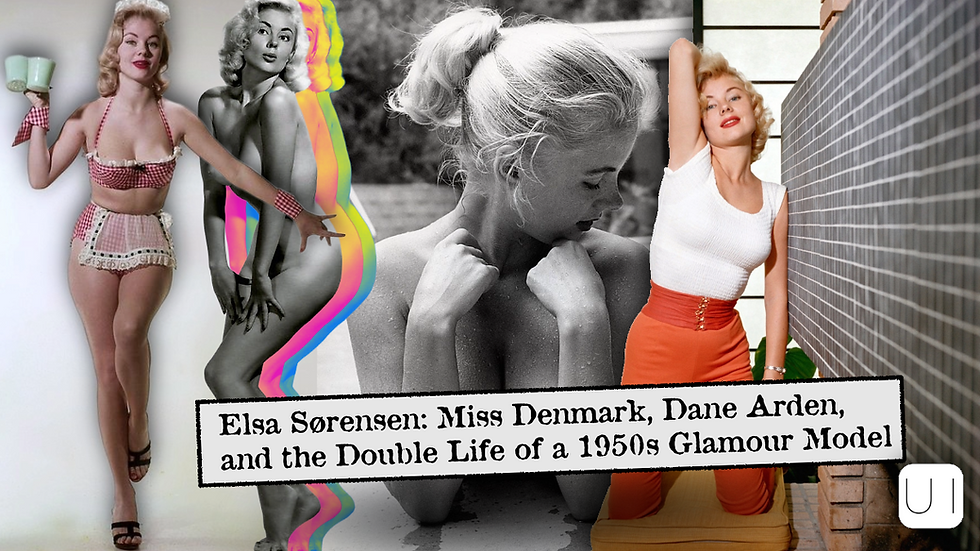
In the September 1956 issue of Playboy, a young Danish woman appeared as Playmate of the Month under her real name. For almost everything else she did during her modelling career, she used a pseudonym. The split was deliberate and practical, and it tells you something about how women navigated the mid-century glamour world without permanently burning their options.
Elsa Sørensen was born in Copenhagen on 25 March 1934. She won the Miss Denmark title as a teenager, which gave her a foothold in the modelling world at a time when Scandinavian beauty was having a significant cultural moment in Europe and America. The family emigrated to Vancouver, Canada, and Elsa eventually made her way to Los Angeles, where the serious work in glamour photography was being done.
Dane Arden
For most of her professional career, Elsa Sørensen worked under the name Dane Arden. The choice of pseudonym is almost too neat: Dane for her nationality, Arden as an anglicised surname that was easy for American editors and readers. It gave her a working identity that was separate from her Miss Denmark title and her real name, and it meant she could move between different kinds of publications without one career automatically attaching itself to the other.
The men's magazine landscape of the 1950s was a particular ecosystem. Playboy was at the top of it, with genuine cultural ambitions and a readership that liked to think of itself as sophisticated. Below that were publications like Adam, the US edition of an Australian magazine, and titles like Cavalier and Rogue, which occupied similar territory with less pretension. Studio Manassé in Vienna had done something similar a generation earlier, creating a house style of glamour that crossed national borders and found markets in multiple countries. Dane Arden appeared in Adam multiple times across the late 1950s and into the 1960s, alongside her Playboy work.
She later described the business with dry good humour, saying there was no nuttier business to be in than posing for cheesecake pictures. She noted that achieving a convincingly dishevelled look in a swimsuit for a beach shoot took considerably longer than getting ready for a formal occasion. This kind of matter-of-fact self-awareness was typical of the more experienced models of the era, women who understood exactly what they were selling and had worked out a practical relationship with it.

Peter Gowland and the Playboy Centrefold
The photographer who shot the September 1956 Playboy centrefold was Peter Gowland, one of the most significant glamour photographers working in Los Angeles at the time. Gowland was the son of two Hollywood actors and had grown up on film sets, learning lighting techniques by watching movies being made. After serving as a photographer in Germany during World War II, he built a career in glamour and pin-up work that would eventually span over 1,000 magazine covers.
The New York Times named him America's number one pin-up photographer. He invented his own equipment, including the Gowlandflex twin-lens camera in the late 1950s, which was later used by photographers including Annie Leibovitz and Yousuf Karsh.
Gowland and his wife Alice worked as a team, and the Sørensen centrefold was one of nine Playboy Playmates they photographed together over the course of their career. His approach was rooted in the same tradition as photographers like Peter Basch, who were bringing a European eye to American commercial glamour in this period. Gowland's work had a clean, lit quality that suited the Playboy aesthetic: controlled, professional, and technically precise without being cold.
The Sørensen centrefold appeared in the same year that Gowland also shot Lynn Turner for the January issue, making 1956 a significant year in his Playboy output. Elsa appeared under her real name for this shoot, which was the exception in her career rather than the rule.
Inside the Playboy Office
One detail that sets Sørensen apart from many of her contemporaries is that she worked as a secretary in Hugh Hefner's Chicago Playboy offices during this period. The overlap between her modelling work and her office role gives her a different relationship to the Playboy operation than most of the women who appeared in its pages. She wasn't just a face on a centrefold; she was someone who understood the business from the inside. This was not entirely unusual in the early Playboy years, when the operation was small enough that people wore multiple hats, but it's a detail that doesn't get much attention in the standard accounts of the magazine's history. The broader story of how Playboy shaped mid-century American attitudes is covered in our piece on how Penthouse's Bob Guccione took on Playboy and changed publishing.
Bunny Yeager and the Films
In 1963, Sørensen appeared in Bunny Yeager's Nude Camera, a low-budget sexploitation film directed by Barry Mahon and built around the figure of photographer Bunny Yeager, who was by then famous for her work with Bettie Page. The film was a semi-documentary about the mechanics of nude modelling, shot in Miami and aimed at the adult cinema market that existed in the years before explicit pornography became widely legal. It played in adult theatres and had no pretensions beyond delivering what its audience came for, but it exists now as a document of a specific and short-lived moment in American film history.
She also appeared in a second film, Intimate Diary of Artists' Models, working under her legal name Marie Perry. The two films represent a different side of her career from the Playboy centrefold, aimed at a different market and with a different kind of cultural currency. That she moved between these registers without much apparent difficulty says something about how permeable the categories were in practice, even if they looked more distinct from the outside.
Marriages and Later Life
Sørensen married twice. Her first husband was Guy Mitchell, the American singer born Albert Cernik, who was one of the most commercially successful pop performers of the early 1950s. Mitchell sold 44 million records over the course of his career and had six million-selling singles, including Singing the Blues and She Wears Red Feathers. At the peak of his fame in the mid-1950s he was a genuine star in the US, UK, and Australia. He and Elsa married in 1956, the same year as the Playboy centrefold, and divorced in 1965.

Her second husband was Philip Mattingly, whom she outlived. After her modelling career wound down she settled into private life, eventually based in Florida. She died on 18 April 2013, aged 79, from complications following a bicycle accident in Vero Beach. It's a quietly unexpected end for someone whose image had been so carefully constructed around glamour and beauty, and it went largely unreported at the time.
What She Represents
Elsa Sørensen sits in a specific moment in the history of glamour photography, the period in the mid-1950s when Playboy was establishing what a mainstream nude photograph could look like, and when the network of men's magazines below it was providing work for a generation of models who understood the business pragmatically. The dual identity, Elsa Sørensen for Playboy, Dane Arden for everything else, was a sensible piece of career management in a world where the line between respectable and not was drawn differently depending on who was doing the drawing.
Her work sits alongside that of contemporaries like Bettie Page and the models photographed by Irving Klaw on 14th Street, women who were building careers in a niche that was commercially significant but culturally marginal, and who navigated that with varying degrees of calculation and good humour. Sørensen's own description of the business as the nuttiest she could imagine being in suggests she was firmly in the good humour camp.
Read More on Utterly Interesting
Sources


