

Diane Arbus: The Photographer Who Found Beauty Everywhere
Updated: Aug 10
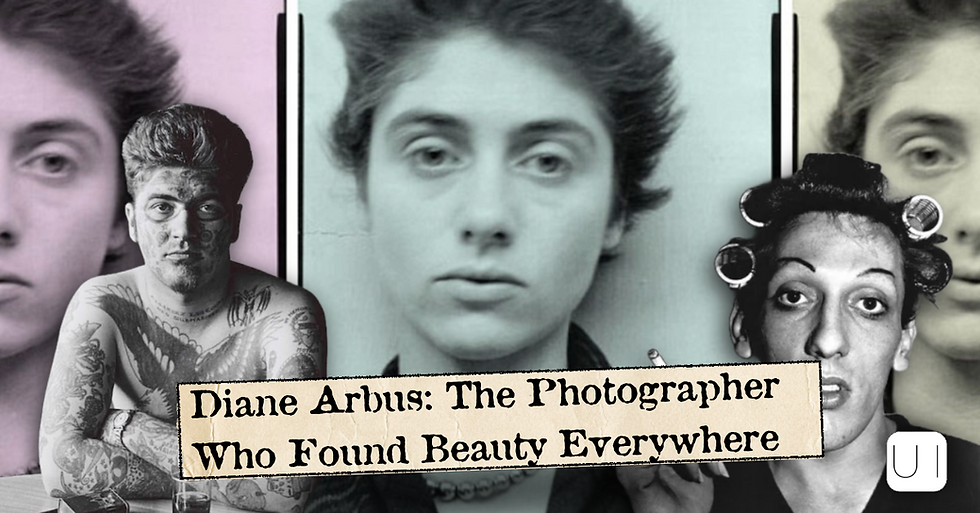
Diane Arbus spent her career pointing a camera at the people most of America pretended not to notice, carnival performers, nudists, people living in institutions, strangers on the street who just looked a little bit off. She got closer to her subjects than almost anyone had before her, and it cost her something. She died by suicide at 48, a year before she became the first photographer ever given a solo spot at the Venice Biennale. Her career lasted barely 15 years, but it's hard to find a documentary photographer working today who isn't still answering to her in some way.
Growing Up Rich and Lonely on Fifth Avenue
She was born Diane Nemerov on March 14, 1923, into money. Her family owned Russek's, a high-end fur and fashion department store on Fifth Avenue, and her mother reportedly called her "Dee-Ann" as a kid. The wealth didn't translate into warmth. Diane described her childhood as comfortable but distant, and that sense of being on the outside of her own life, watching rather than belonging, shows up again and again in how people describe her later work.

She had a complicated pairing in her older brother, Howard Nemerov, who went on to win the Pulitzer Prize for poetry in 1978 and served as U.S. Poet Laureate from 1988 to 1990. Howard wasn't always kind about his sister's work while she was alive, once describing her photographs as "spectacular, shocking, dramatic" in a way that read more like discomfort than praise. He came around later. At her memorial in 1971, he spoke about how close they'd been as children and how much he regretted losing touch with her in her final years.
Married at 18, and a Decade Shooting Fashion
Diane fell for Allan Arbus when she was just 14 and he was 19, working the counter at her family's store. Her parents weren't thrilled, but she married him anyway the day she turned 18, in 1941. Allan is the one who taught her photography, and the couple turned their apartment bathroom into a darkroom before they'd even built a real career out of it.
For most of the 1940s and 50s, Diane and Allan worked as a team shooting fashion spreads for Vogue, Glamour and Russek's own ad campaigns, with Allan usually behind the camera and Diane directing the shoot. They were good enough at it that a picture from their partnership ended up in Edward Steichen's landmark 1955 exhibition The Family of Man at MoMA. But Diane found the work hollow. Fashion photography was about hiding flaws and selling a fantasy, and she wanted the opposite of that.
Ditching Fashion to Photograph "What Is Evil"
Around 1956, Diane walked away from the commercial partnership and started studying under photographer Lisette Model at the New School. Model's advice to her, by Diane's own account, was to go photograph "what is evil," which her daughter Doon later said really meant whatever felt forbidden, the subjects everyone else was too polite or too scared to point a camera at.
She took that seriously. Arbus started wandering New York looking for circus performers, nudist colonies, people living on the margins in flophouses and morgues, calling her growing collection of subjects her "butterfly collection." Her real break came in July 1960, when Esquire published a spread of her early street photography that readers had genuinely never seen the like of before. She didn't photograph people to flatter them. She photographed them to spend time with them, sometimes returning to the same subject over days or weeks until they stopped performing for the camera.
The Twins Photo That Became a Horror Movie
In 1962 Arbus switched from a 35mm camera to a boxier 2¼ format, which forced a slower, more deliberate way of working and produced the sharp, square, unnervingly direct images she's now known for. Her most famous shot from this period came in 1967, when she photographed seven-year-old identical twins named Cathleen and Colleen at a small Christmas party in Roselle, New Jersey, standing side by side in matching corduroy dresses and white headbands. Arbus said what drew her in wasn't how alike they looked but what she called "differentness in identicalness," the small details that made two supposedly identical people not identical at all.

Stanley Kubrick clearly saw something else in it. The image is the direct visual template for the twin ghosts in 1980's The Shining, right down to the matching dresses and the flat, straight-on composition, though Kubrick pushed it toward horror in a way Arbus never intended. It's a strange kind of afterlife for a photograph, showing up as the visual DNA of one of cinema's most famous scares. It's also a funny echo of Kubrick's own start behind a lens as a teenage photographer roaming the same city Arbus did, before he ever picked up a film camera, and both of them are proof that New York in that era was crawling with people who'd end up defining how the rest of the century saw itself.
New Documents, and a Grenade in a Child's Hands
By the mid 1960s, Arbus had real institutional backing. She won Guggenheim Fellowships in 1963 and 1966, and in 1967 the Museum of Modern Art put 32 of her photographs into a show called New Documents alongside Lee Friedlander and Garry Winogrand, curated by John Szarkowski. It's now considered one of the exhibitions that dragged street photography out of photojournalism and into the fine art world for good.
Her subjects didn't always love the results. Norman Mailer, who she photographed sitting with his legs spread in a deliberately unflattering pose that ran in the New York Times, reportedly complained that "giving a camera to Diane Arbus is like giving a hand grenade to a baby." It stung as an insult and worked as a compliment at the same time, and it's one of the more quoted lines about her to this day. In May 1971, one of her photographs, a boy clutching a toy grenade in Central Park, became the first photograph ever to run on the cover of Artforum, a milestone for a medium that critics still weren't fully convinced counted as art.
The Last Project She Never Finished
Between 1969 and 1971, Arbus spent time at institutions for people with intellectual disabilities, returning again and again for picnics, dances and Halloween parties, building the kind of trust with residents that took months rather than minutes. The resulting pictures, known simply as Untitled, weren't published until 1995, put together by her daughter Doon nearly a quarter century after Arbus's death. Critic Susan Sontag later accused Arbus of turning vulnerable people into spectacle, arguing her wealth and privilege made the whole project voyeuristic. Others have pushed back on that reading, pointing out that Arbus shot her disabled subjects in exactly the same head-on, unposed style she used for everyone else, refusing to treat them as visually different from her wealthy Manhattan neighbors. It's the same instinct that runs through her whole body of work, treating the people society pushed to the edges with the same camera, the same distance and the same patience she'd give anyone else. Photographer Anders Petersen would build a career on a similar approach a few years later in Hamburg, spending years inside a single bar to earn the trust of the regulars rather than shooting them as outsiders passing through.
Marriage, Depression and a Death at Westbeth
Diane and Allan separated in 1959 and divorced a decade later, after Allan moved to California to chase an acting career that eventually landed him a long-running role on M*A*S*H. Diane, meanwhile, had been struggling with depression for years, something she described in her own words as "chemical," like her energy was simply leaking out of her. She was also involved for years with Marvin Israel, the art director at Harper's Bazaar, in a relationship that ran alongside and then past the end of her marriage.
On July 26, 1971, Arbus took barbiturates and cut her wrists in the bathtub of her apartment, Unit A on the ninth floor of the Westbeth artists' housing complex in the West Village, a converted former Bell Labs building. It was Marvin Israel who found her body, two days after her death. She was 48.
A Legacy Built After She Was Gone
Most of what made Diane Arbus famous happened after she died. MoMA staged a major retrospective of her work in 1972 that drew enormous crowds and split critics right down the middle, some calling it deeply humane and others calling it exploitative, an argument that still hasn't fully settled. That same year she became the first photographer to have a solo presentation at the Venice Biennale, a first for the medium as a whole and not just for her. The monograph her estate published through Aperture was considered such a financial risk that the publisher nearly passed on it. It ended up selling close to 400,000 copies and had to go back to print within weeks.
Her market has only grown since. In May 2024, her 1967 photograph of Cathleen and Colleen, the same image that inspired The Shining, sold at Christie's for $1.2 million, a new auction record for her work and a staggering jump from the $65,000 it fetched at auction back in 2000. A major traveling retrospective called Diane Arbus: Revelations toured internationally through the mid 2000s, introducing her to a generation that had grown up watching photographers who'd learned everything from her without necessarily knowing it. Both of her daughters stayed in the arts too: Doon Arbus became a writer and has spent decades managing her mother's estate and archive, while Amy Arbus built her own career as a photographer. Diane Arbus never got to see any of it. She barely got a decade and a half behind the camera, and it was enough to change what a photograph was allowed to be.


