

My Good Friend Roosevelt: The Time Young Fidel Castro Wrote to the U.S. President (and Asked for 10 Dollars)
Updated: Jul 24
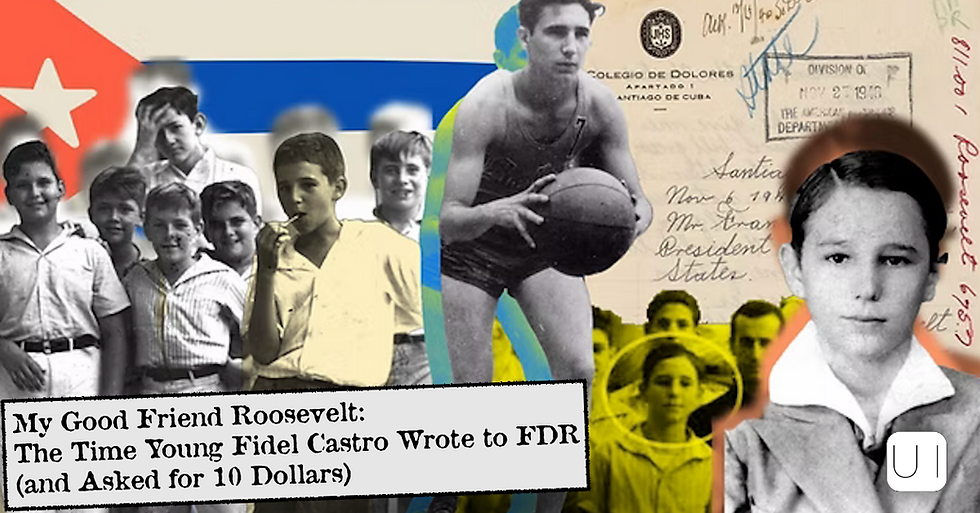
It's an amusing yet historically revealing episode that, in 1940, a young Fidel Castro, yes, that Fidel Castro, decided to write a letter to President Franklin Delano Roosevelt. On official Colegio Dolores stationery, in painstaking cursive but charmingly broken English, the 14 year old Castro, who for reasons likely tied to school admissions claimed to be 12, reached out to the leader of the free world with a straightforward and rather audacious request: “If you like, give me a ten dollar bill green American.”
Dear Mr. President: About That Ten Dollars... Yours, Castro
One day after FDR's landslide re-election victory on 6 November 1940, young Fidel, then a student at the prestigious Jesuit run Colegio Dolores in Santiago, Cuba, sat down to pen what's surely one of the most unexpected pieces of diplomatic correspondence in history. His letter begins grandly, “My good friend Roosvelt,” a level of familiarity most world leaders would hesitate to use even after years of negotiation. Better than anyone, it seems, Castro understood from an early age just how entwined Cuba's fate was with that of the United States.
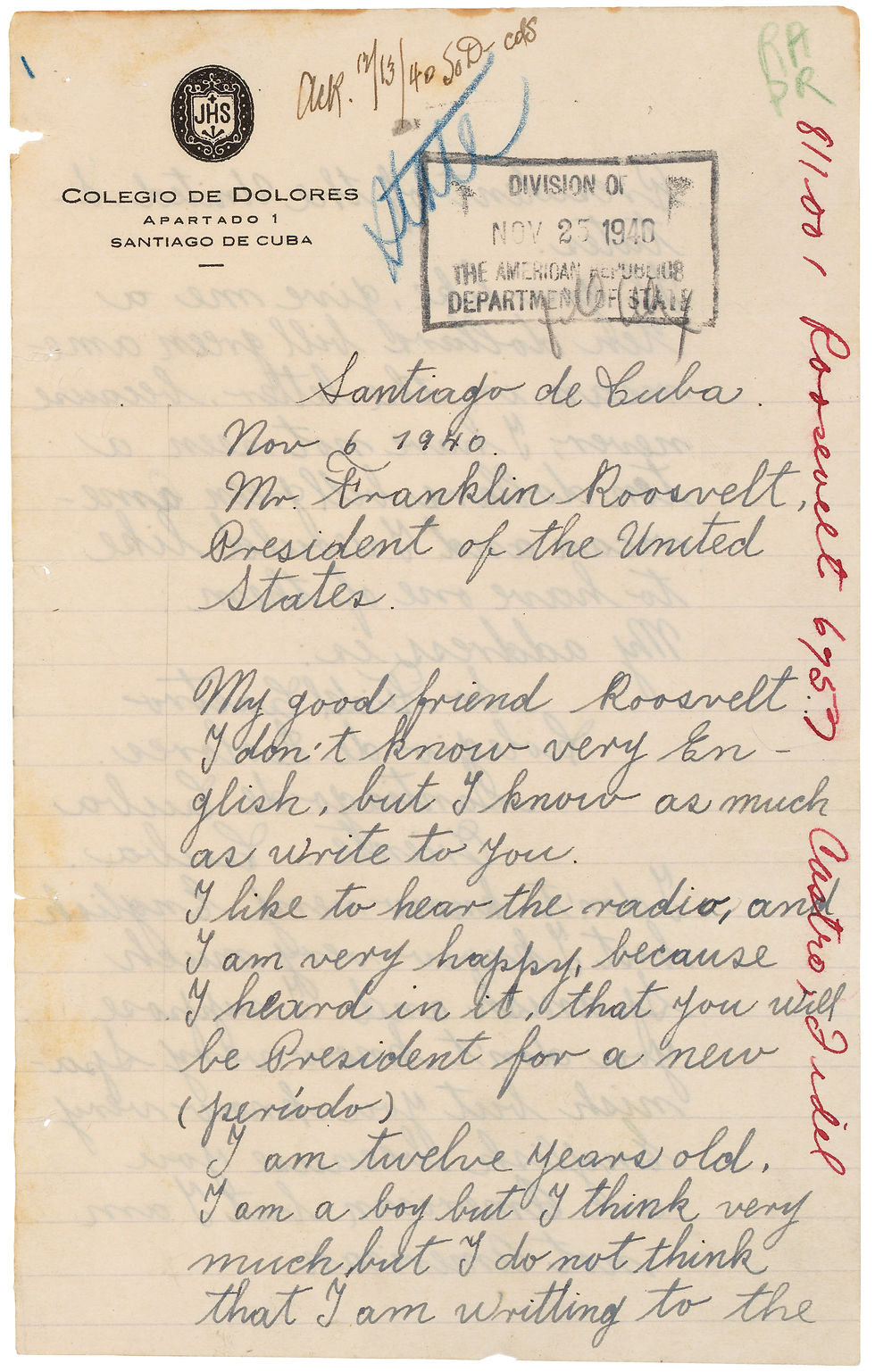
Rather than presenting a grand vision for hemispheric relations, he got straight to the point: the request for ten dollars. Not for frivolous spending, mind you, no mention of chocolate, cinema tickets, or baseball gear. He simply wanted to see what a real American bill looked like. Roosevelt, or more accurately the machinery underneath him, did not comply.
A Farm Boy With Something to Prove
To understand why a Cuban schoolboy felt entitled to write to the President of the United States as a friend, it helps to know where he came from. Fidel was born on 13 August 1926 at Las Manacas, his father's sugar cane farm outside Birán in Oriente province, the same province where Santiago and Colegio Dolores sat. His father, Ángel Castro y Argiz, was a Spanish immigrant who'd made himself wealthy in sugar. His mother, Lina Ruz González, was a household servant twenty seven years younger than Ángel, who was still married to his first wife when Fidel was born. Because of that, young Fidel carried his mother's surname instead of his father's for years, a mark of illegitimacy in a status conscious society that his parents didn't formally correct until they married in 1943.
That backstory explains a detail that's easy to miss in the letter itself. Castro's postscript offering Roosevelt access to iron ore deposits wasn't some random flight of childhood fantasy. He named the deposits at Mayarí, Oriente, which sat practically in his own family's backyard. The Spanish-American Iron Company had been pulling ore out of that ground since the early 1900s, and a boy who grew up on a working farm nearby would have known exactly what was under the soil and roughly what it might be worth to somebody with real money.

Schoolyard Diplomacy and a Missed Investment
Despite the diplomatic snub over the ten dollars, Castro did receive a response, and he proudly pinned it to the school bulletin board as a trophy. According to historian Luis Aguilar, who attended Colegio Dolores at the time, the letter boosted Castro's standing among his peers. In a school where the sons of Cuba's wealthiest families often looked down on him and his brothers over their illegitimacy and rural roots, recognition from Washington was a social triumph, even a small one. You can picture the scene: an eager Fidel parading the letter around, his classmates skimming past Roosevelt's words in search of any mention of an enclosed ten dollar bill, finding none, and handing him a fresh round of jeers.
It wasn't the first time young Fidel had rattled a Catholic school's patience. He and his brothers had already been expelled from an earlier school, Colegio La Salle in Santiago, reportedly for rough behaviour, before landing at the stricter Colegio Dolores. A boy who'd already been thrown out of one institution writing to the President of the United States like an old friend tracks with everything else about him.

What Actually Came Back From Washington
The popular version of the story, including the version Castro told journalists decades later in 1975, is that the White House sent a thank you note. The paper trail tells a slightly less romantic version. Records held by the National Archives show the reply was routed through ordinary State Department channels and the American Embassy in Havana rather than dictated personally by Roosevelt, essentially a polite, pro forma acknowledgment of the kind any foreign well wisher's letter might get. Whether Castro ever knew the difference, or cared, is another matter. He kept the story of a presidential reply going for the rest of his life, and by the time he was telling it, he was in a position to make sure people listened.
Today the letter itself lives in the National Archives, catalogued among the Havana embassy's 1940 post files. It was significant enough to be pulled out of storage for the Archives' American Originals exhibition, which ran in the Rotunda in Washington DC from December 1996 to December 1997, displayed alongside other oddities and turning points of American history. A schoolboy's request for pocket money, kept for eight decades by the same government he'd spend most of his adult life denouncing.
The Ghost of Ten Dollars Past
Nineteen years later, when Castro traveled to Washington as Cuba's revolutionary leader, he was keenly aware of the precedent set by Latin American politicians who came to the U.S. cap in hand. He told his finance minister, Rufo López-Fresquet, “I don't want this trip to be like that of other Latin American leaders who always come to the U.S. to ask for money.” Could his early ten dollar disappointment have shaped that instinct? Probably not directly, but childhood slights have a way of lingering longer than anyone expects.
The irony, of course, is that Castro went on to become one of the most formidable critics of the United States, railing against its economic policies and its influence over the region for the rest of his life. It's tempting to wonder whether a crisp ten dollar bill tucked into that reply might have nudged history down a slightly different road. It almost certainly wouldn't have. But it's a nice thought for a Tuesday.
He never got his ten dollars. But he spent the next several decades making sure the United States never stopped paying attention to him, and in the strange accounting of history, that's worth a great deal more than ten bucks.
Sources
1. National Archives, catalog record for the Castro letter to FDR: catalog.archives.gov
2. National Archives, Pieces of History, “Fidel Castro's childhood plea to President Roosevelt”: prologue.blogs.archives.gov
3. National Archives, American Originals exhibit record: archives.gov
4. Time, “Inside a Young Fidel Castro's 1940 Letter to an American President”: time.com
5. CNN, “When Fidel Castro sent FDR fan mail”: cnn.com
6. History Today, “My Good Friend Roosevelt”: historytoday.com
7. Biography.com, Fidel Castro, on his early life and education: biography.com


