Bunny Yeager: The Woman Who Shot the World's Most Famous Pin-Up

In the early 1950s, pin-up photography was a man's game. The photographers were men, the editors were men, the readers were men. Then along came Bunny Yeager, a blonde, five-foot-nine model from Pittsburgh who'd taught herself to use a camera, sewed her own costumes, dragged her subjects onto Miami Beach, and ended up shooting some of the most iconic photographs of the twentieth century.
From Pennsylvania to Miami, via Lana Turner
Born Linnea Eleanor Yeager in 1929 in Wilkinsburg, Pennsylvania, she adopted the nickname Bunny from Lana Turner's character in the 1945 film Week-End at the Waldorf. When her family moved to Florida, she was seventeen and determined to reinvent herself. She completed high school in Miami, entered beauty pageants, and within a few years had become one of the most photographed models in the city, her face appearing in over 300 newspapers and magazines.

Photography entered the picture almost by accident. She enrolled in a night class in 1953 at a vocational school, initially just to save money making copies of her own modelling photos. Then photographer Roy Pinney found out she was taking the class. "I just wanted to be able to make copies of my modeling photos; I didn't really want to be a photographer," she said later. "But Roy said, 'No, no, that's a good story,' so he took my picture and put it on the cover of U.S. Camera magazine, with the caption 'The World's Prettiest Photographer.'" The label stuck. And it turned out to be good for business. A female photographer shooting pin-up girls in 1954 was a novelty few magazine editors could resist.
Her first real professional assignment, a shot of model Maria Stinger taken as a school project, sold to Eye magazine for the cover of its March 1954 issue. Within months she was a professional.
Bettie Page Calls Bunny Yeager
1954 was also the year the phone rang. "Bettie called me," Yeager recalled. "Everybody had my number back then. She told me she was a New York model. I took her sight unseen. I figured any New York model had to be something special. I didn't know she was doing bondage photos."
What Yeager did know, and what clinched the collaboration, was that Page didn't mind posing nude. Yeager had never photographed a model without clothes before. Page, for her part, apparently made an entrance. As Yeager later described it: "She came tiptoeing into the studio completely nude and ready for instructions. She walked up on her toes because her legs looked better that way, and also longer. She didn't want anyone to see her walking like normal people walk, with heel and toe on the floor."

The two got to work, and they didn't stop. Over the course of 1954 Yeager shot over 1,000 photographs of Page: on Miami Beach, at the Africa USA theme park in Boca Raton, at Yeager's own home. The shoots were inventive. Yeager designed and sewed the costumes herself, built the props, and insisted on shooting outdoors in natural light rather than in a studio. The famous cheetah series, in which Page poses with a pair of live cheetahs, was Yeager's concept. Page sewed the leopard-print swimsuit herself.
"Our relationship was excellent," Yeager said. "I was a director and she was a performer. She did everything I asked her to do. I liked that. I had the feeling Bettie really enjoyed working with me more than other photographers, because I was always coming up with strange new ideas."

Cold-Calling Hugh Hefner
Not knowing where to submit the Christmas shoot she'd done with Page, Yeager walked past a newsstand and spotted a new men's magazine. She called Playboy's offices cold. "Nobody had heard of Hugh Hefner," she said, "but I figured because it was new they might pay attention to an amateur, and that's what happened. If I hadn't made that early connection when he was just starting out, maybe I wouldn't have got such a big push, but immediately I became employable."
Hefner bought the photograph immediately and ran it as the January 1955 centrefold: Bettie Page, kneeling in nothing but a Santa hat, hanging a silver ornament on a Christmas tree. Yeager became the first woman ever to shoot for the magazine. She went on to shoot six centrefolds for Playboy, appeared in it as a model five times herself, and discovered Lisa Winters, the first-ever Playmate of the Year.
Diane Arbus, one of the most celebrated photographers of the following generation, called Yeager "the world's greatest pin-up photographer." The New York Times later wrote that she was widely credited with helping turn the erotic pin-up, long a murky enterprise, into high photographic art. Hollywood glamour photographer Danny Rouzer, writing in 1956, said of her: "One of the finest pin-up photographers is Bunny Yeager, who is highly successful because she knows exactly what the procedure is for profitable pin-up work." He wrote that just four years after she'd picked up her first camera.
Working as a Woman in a Man's Industry
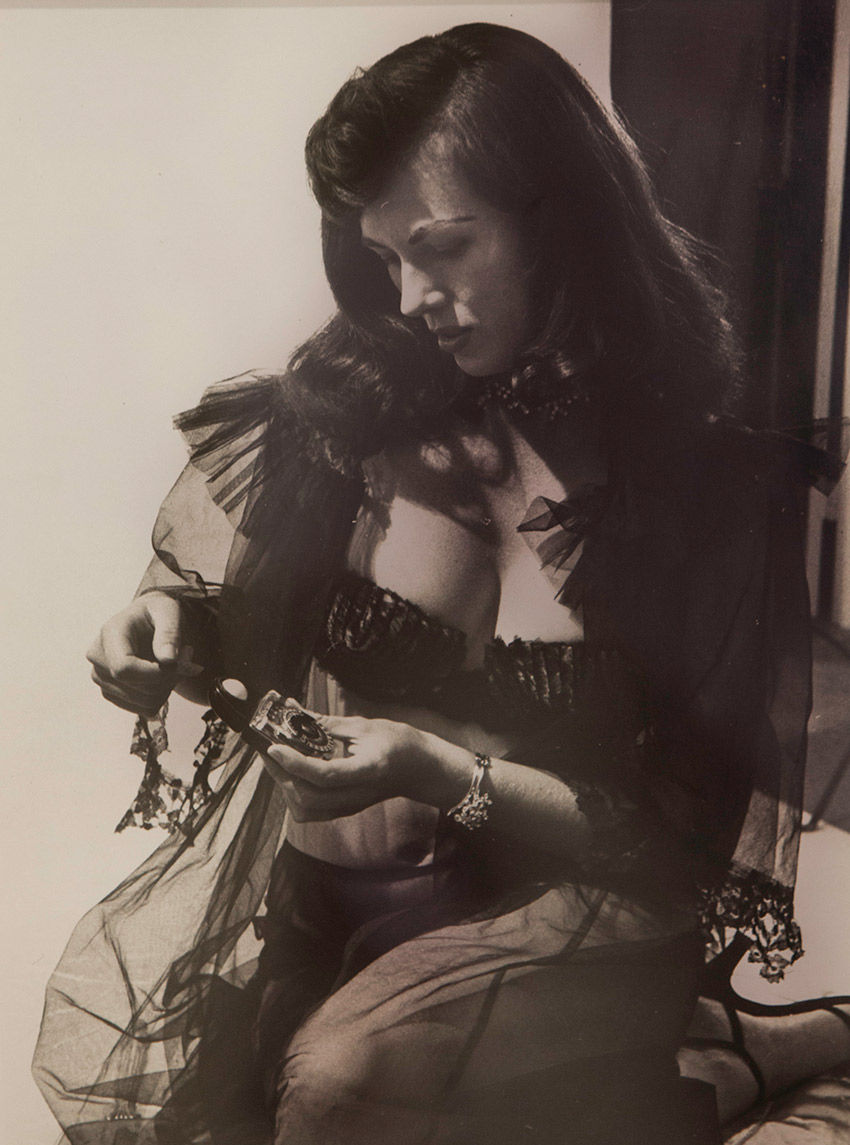
Being the only female pin-up photographer in America in the 1950s was a complicated position. The novelty worked in her favour, but the headline she was most famous for, the World's Prettiest Photographer, made clear that her looks were considered at least as notable as her ability. The Gavlak Gallery, which later exhibited her self-portraits, framed it precisely: the caption "points to the contradictory nature of what it meant then to be both model and photographer."
Yeager was clear-eyed about what her perspective gave her that her male counterparts lacked. "I want to show off how beautiful my subjects are," she told the New York Times. "I'm not doing it to titillate anybody's interests." Documentary filmmaker Dennis Scholl, who directed the 2023 film Naked Ambition about her career, was more direct: "She wasn't Hugh Hefner's favourite female photographer. She was Hugh Hefner's favourite photographer for Playboy, entirely."
She was also competitive about what it took to stand out. "For me to get my pictures in, and not some other photographers', I'd have to do something outstanding and very different," she said. "I couldn't submit pin-up girls in studios. The magazines weren't used to receiving pictures of girls on location, on Miami Beach, and the tropics. They snapped up those pictures like they couldn't get enough of them."
She was careful too about her own image within the industry. "I was never a pin-up model," she insisted. "I did not pose for men individually like Bettie Page did." She designed and wore her own two-piece swimsuits, which led to another claim she enjoyed making: "All the other models were wearing one-piece Jantzen and Catalina suits. I made my own and am beginning to think I invented the bikini, after the French did it."

The Fall and the Comeback
The 1970s ended the golden run. As Hustler and Penthouse pushed the visual language of men's magazines into explicit territory, Yeager's girl-next-door aesthetic looked dated. She stopped shooting for them almost entirely. "In 1998 she stated, 'The kind of photographs they wanted was something I wasn't prepared to do.'" A rejection letter from Penthouse, preserved in her archive, read: "The Yeager photographic style does not parallel the contemporary mood and image of Penthouse magazine." She treated it as a compliment.
She made ends meet through graphic design and nightclub singing. Then the 1990s rockabilly revival brought her work back. A new generation found Bettie Page, and with her, the photographer behind the best images. In 2010, the Andy Warhol Museum mounted the first major retrospective of her self-portraits. Gallery shows followed across Europe and the Americas. She died in North Miami on May 25, 2014, aged 85, still shooting on film.
Her influence has been traced through Diane Arbus, Cindy Sherman, and Dita Von Teese, all of whom have acknowledged her work. The tradition of women photographing themselves goes back further than Yeager, but she gave it a very particular flavour: sunlit, playful, and made entirely on her own terms.
"Make the most of what you have," she said, "and enjoy being female. Enjoy being you." In Eisenhower's America, that was a more radical statement than it sounds.
Sources
1. Wikipedia: Bunny Yeager - https://en.wikipedia.org/wiki/Bunny_Yeager
2. HuffPost Miami: Bunny Yeager Talks Old-School Miami Glamour - https://www.huffpost.com/entry/bunny-yeager-photography_b_2007159
3. Boca Raton Magazine: The Notorious Bunny Yeager - https://bocamag.com/the-notorious-bunny-yeager/
4. HuffPost: Pinup Provocateur Bunny Yeager - https://www.huffpost.com/entry/pinup-provocateur-bunny-yeager-didnt-give-a-crap-about-the-male-gaze_n_55ba90eee4b0d4f33a0222fe
5. Intelligent Collector: Peek Inside Bunny Yeager's Vintage Archive - https://intelligentcollector.com/peek-inside-bunny-yeagers-vintage-archive/
6. Interview Magazine: How Bunny Yeager Pioneered a New Erotica - https://www.interviewmagazine.com/art/how-bunny-yeager-pioneered-a-new-erotica
7. KQED: Naked Ambition Documentary Review - https://www.kqed.org/arts/13958101/naked-ambition-documentary-review-bunny-yeager-bettie-page-photography
8. Gavlak Gallery: Bunny Yeager - How I Photograph Myself - https://www.gavlakgallery.com/exhibitions/bunny-yeager-how-i-photograph-myself/selected-works
9. Rockabilly Lifestyle: Bunny Yeager Pinup Photographer - https://www.rockabillylifestyle.com/bunny-yeager-pinup-photographer/