

Annie Londonderry: First Woman to Cycle Around the World

On 25 June 1894, around 500 people gathered outside the Massachusetts State House in Boston to watch a young mother climb onto a heavy women's bicycle and wobble off down Beacon Street. She was supposedly riding around the world for a bet. She'd only learned to ride a few days earlier. She had three kids under six at home, a pearl-handled revolver in her bag and a brand new surname she'd sold to a spring water company for $100.
Her name was Annie Londonderry. Except it wasn't, and plenty of what she told people over the next 15 months wasn't true either. That's exactly what makes her story so good.
Quick Answers
• Who was Annie Londonderry? Annie Cohen Kopchovsky, a Latvian-born Jewish mother of three from Boston.
• Was she really the first woman to cycle around the world? She's usually credited as the first, but she covered a lot of the distance by steamship and some of it by train.
• Why was she called Londonderry? A New Hampshire spring water company paid her $100 to carry its advert on her bike and use its name.
• Was the $10,000 bet real? Probably not. The two men behind it were never named, and her own biographer thinks she invented it.
• What happened to her afterwards? She wrote for the New York World as "Nellie Bly, Jr.", later ran businesses in New York and died in 1947.

Who Was Annie Cohen Kopchovsky?
Annie Cohen was born in Latvia, then part of the Russian Empire, in 1870. Her family emigrated to the US in 1875 and settled in a cramped tenement on Spring Street in Boston's West End, a neighbourhood crammed with immigrant families.
Life got hard fast. In January 1887 her father died, and her mother followed two months later. Annie was 17. Her older sister had already married and moved to Maine, so Annie and her brother Bennett were left to raise their younger siblings, Jacob and Rosa.
In 1888 she married Simon "Max" Kopchovsky, a peddler and devout Orthodox Jew, and within four years they had three children: Bertha, Libbie and Simon. Max spent his spare time at the synagogue studying the Torah. Annie brought in money selling advertising space for several Boston daily papers. She had a gift for talking people into things and a nose for a good story. Both would come in very handy.
The Bicycle Craze and the "New Woman"
To understand why anyone cared, you need to know what bikes meant in the 1890s. The safety bicycle, with two same-sized wheels and a chain drive, had replaced the wobbly penny-farthing, and America went bike mad. For women, it was a genuinely big deal. A bicycle was cheap, independent transport that didn't need a husband, a father or a horse.
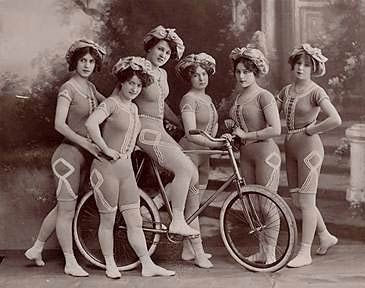
It changed what women wore too. You can't pedal far in heavy skirts and a tight corset, so bolder riders switched to bloomers, which scandalised plenty of people. In 1896 the suffragist Susan B. Anthony said bicycling had "done more to emancipate women than anything else in the world."
The papers had a name for this new breed of educated, independent woman who wanted more than marriage and babies: the "New Woman". Annie was about to become one of the most famous examples of all.
The $10,000 Bet That Probably Never Happened
The story went that two wealthy Boston men had wagered $20,000 against $10,000 that no woman could get around the globe by bicycle in 15 months. She'd also have to earn $5,000 along the way on top of her expenses.
It's a great story, but there are problems with it. Nobody ever named the two men, and the idea looks suspiciously borrowed. In February 1894 a former Harvard student calling himself Paul Jones set off on a supposed round-the-world ride for a $5,000 bet. Two weeks later, that bet was exposed as a fake.
Peter Zheutlin, Annie's great-grandnephew and biographer, reckons she almost certainly made hers up to sensationalise the trip. If anyone was quietly pulling strings, the likeliest candidate is Colonel Albert Pope, whose company made Columbia bicycles. His top salesman in Boston personally delivered the bike she set off on. A man had already cycled around the world in the 1880s, so a woman doing it was the obvious next headline. Bets have sparked plenty of daft adventures, like Thomas Fitzpatrick's drunken flights onto New York streets, but this one may never have existed at all.
The Most Unlikely Candidate Imaginable
If you were picking a woman to cycle around the world, Annie would've been near the bottom of the list. She was 5ft 3in and weighed about 100 pounds. She'd never ridden a bike until a few days before she left. She was married with three children aged five, three and two. And her surname marked her out as Jewish at a time when anti-Semitism was widespread in America.
She wasn't setting off to make a political point either. Zheutlin's view is that the bike was simply her way out of a life she found stifling. Whatever her reasons, she left Max to look after the kids and was gone for 15 months.

How She Became "Annie Londonderry"
At the send-off, a rep from the Londonderry Lithia Spring Water Company of Nashua, New Hampshire, handed her $100. In return she hung the company's placard on her bike and agreed to call herself Annie Londonderry for the whole trip.
It was the first of many deals. Along the way she rented space on her bike and her clothes to everything from tyre makers to perfume brands, hanging ribbons and signs off herself like a rolling billboard. She sold signed photos, souvenir pins and autographs, gave cycling demonstrations and turned up as a paid attraction in shops. Long before influencers, Annie had worked out how to make money just by being looked at.
A Skirt, a Corset and a 42-Pound Bike
She set off wearing a long skirt, a corset and a high collar, carrying a change of clothes and that pearl-handled revolver. Her 42-pound women's Columbia was heavy, clunky and hopeless for long-distance touring.
She headed out via Providence, New York, Albany, Buffalo and Cleveland, following routes published by the League of American Wheelmen. Their tour books listed distances, road conditions, places to eat and hotels that gave cyclists discounts, and there were usually other riders on the same roads for company.
By the time she reached Chicago on 24 September, she'd lost 20 pounds and most of her enthusiasm. Winter was coming and there was no way she'd make it over the mountains to San Francisco before the snow. She came very close to giving up.
The Chicago Makeover
Then the Sterling Cycle Works stepped in. They gave her a men's Sterling roadster weighing around 21 pounds, half the weight of the Columbia. It had a single gear and, slightly terrifyingly, no brake.
A men's frame and a long skirt don't mix, so she switched to bloomers and later a full men's riding suit. Women in trousers rattled people back then, as the Pit Brow Lasses of Lancashire's coal minesfound out, and the new look only got her more attention. With a lighter bike and a fresh sponsor, she decided to carry on, just in the opposite direction. She rode back to New York to catch a ship to Europe, with less than a year left on the clock.

Chaos in France
On 24 November 1894 she sailed on the French liner La Touraine, landing at Le Havre on 3 December. It went wrong almost immediately. Customs officials seized her bike, her money was taken and the French papers ran nasty pieces mocking her appearance.
She sorted it all out and made it from Paris to Marseille in about two weeks, using a mix of cycling and trains. Bad weather slowed her down and she hurt her foot on the road, finishing the ride with it bandaged and propped up on her handlebars. Somewhere along the way an American diplomat in Paris gave her a Stars and Stripes, which she wrapped around her bike frame. By the time she left Marseille she was a proper celebrity, and crowds turned out on the quay to wave her off.
Through Asia by Steamship
From Marseille she boarded the steamship Sydney, heading east with eight months left. Stops included Alexandria, Colombo, Singapore, Saigon, Hong Kong, Shanghai and Nagasaki. The bet didn't set any minimum distance by bike, so at each port she'd go out for a day's riding, soak up enough local colour for her lectures and get back on the boat.
She later claimed trips to Korea and Vladivostok, and even said she'd witnessed the Sino-Japanese War, which was raging at the time. None of that has ever been confirmed.
Tigers, Bandits and a Japanese Prison
Annie's paid lectures were packed with outrageous tales. She'd hunted Bengal tigers in India with German royalty. She'd been shot and thrown in a Japanese prison. She'd fought off bandits. In France she'd variously been an orphan, a wealthy heiress, a Harvard medical student, the inventor of a new shorthand system and a senator's niece. She tended not to mention the husband and three kids.
She even staged photos to back up her stories, including a dramatic hold-up scene shot near San Francisco, and turned them into glass lantern slides for her talks. Amazingly, those fragile slides survived and were found intact more than a century later.
The small stuff got the same treatment. When a runaway horse and cart nearly flattened her and another cyclist in California, she claimed she'd been knocked out and spent two days in a Stockton hospital coughing up blood. In reality she gave a lecture at the town's Mozart Hall the very next evening.

Back Across America
She sailed from Yokohama on 9 March 1895 and reached San Francisco on 23 March. From there she rode south through Stockton, San Jose and Santa Barbara to Los Angeles, then east across the desert to Yuma, Phoenix, Tucson and El Paso.
The Southern Pacific railway made the desert crossing possible. Cyclists could ride the hard-packed service roads beside the tracks and stop at crew shelters for a meal and a wash. Some suspect she hopped on the odd train too, though she insisted she'd turned down lifts from passing crews.
From El Paso she turned north, leaving Albuquerque on 20 July and reaching Denver on 12 August. She took the train across most of Nebraska because the roads had turned to mud. Then, near Gladbrook in Iowa, she crashed into a herd of pigs and broke her wrist, which stayed in a cast for the rest of the trip.
On 12 September 1895 she rolled into Chicago alongside two cyclists she'd met in Clinton, Iowa, claiming the $10,000 prize with 14 days to spare. She was back in Boston on 24 September.

So Did She Actually Cycle Around the World?
Sort of. Critics at the time grumbled that she'd travelled with a bicycle more than on one, and they had a point. Huge stretches were covered by ship, and some by train.
But she still rode thousands of miles over terrible roads on a single-gear bike, and she held her own in impromptu local races along the way. Zheutlin argues she may genuinely have been the first woman to cross America by bike, train hops and all. It'd be another eight years before the first Tour de France sent riders out on roads just as brutal.
Nellie Bly, Jr. and the New York World
On 20 October 1895 the New York World ran her account of the trip, billing it as the most extraordinary journey ever undertaken by a woman. It appeared under the byline "Nellie Bly, Jr.", borrowing the name of the paper's famous reporter who'd raced around the world in 72 days a few years earlier.
Annie moved the family to the Bronx, and the World took her on to write as its resident New Woman. One piece opened with her describing herself as a journalist and a new woman, if that meant believing she could do anything a man could do.
What Happened to Annie After the Ride?
The journalism didn't last. She fell pregnant soon after reuniting with Max and had another child in 1897. For a while she lived apart from the family in northern California, before returning to the Bronx, where she and Max ran a clothing business.
Her talent for reinvention hadn't gone anywhere. In the 1920s the business burned down, and she used the insurance money to start a new company in Manhattan, Grace Strap & Novelty, with a man named Feldman she'd met at a Horn & Hardart restaurant.
She died of a stroke on 11 November 1947, in her late seventies. By then, hardly anyone remembered she'd ever been famous.
How Annie Londonderry Was Rediscovered
For a century she was barely a footnote. Then Zheutlin, digging into his family history, pieced her story back together and published Around the World on Two Wheels: Annie Londonderry's Extraordinary Ride in 2007. He followed it with a novel about her, Spin, in 2021.
She's had a proper revival since. Canadian artist Evalyn Parry wrote a song about her for her bike-themed show SPIN. A 2013 documentary, The New Woman, won Best Documentary at the DC Independent Film Festival. And the musical Ride opened at London's Charing Cross Theatre in 2022, moved on to Southwark Playhouse in 2023 and made its American debut at the Old Globe in San Diego in 2024. Women were shut out of big cycling events for decades after her ride, as the wild history of the Tour de France shows.
She was a brilliant self-promoter and a wildly unreliable narrator. But at a time when most women couldn't vote and were expected to stay home, she turned a bike and a probably made-up bet into worldwide fame. Not bad for someone who'd only just learned to ride.
You Might Also Like
Sources
6. Atlas Obscura: Annie Londonderry Barely Knew How to Ride a Bike When She Set Off Around the World


