

The Pit Brow Lasses: The Women Who Fought Parliament to Keep Their Jobs
Updated: Aug 10

In 1887, twenty three women traveled from the coalfields of Lancashire and Cumberland to London and petitioned the Home Secretary directly. They weren't asking for better pay or shorter hours. They were asking Parliament to stop trying to take their jobs away from them, jobs that involved hauling coal tubs and sorting rock in trousers, jobs that respectable Victorian society had decided were degrading them. The women disagreed, and for a few tense months in 1887, it genuinely wasn't clear who was going to win.

A Disaster That Rewrote the Rules
Women and children had worked underground in British coal mines for generations before anyone in Westminster paid much attention to it. That changed after the Huskar Pit disaster of July 4, 1838, when a violent thunderstorm at the Silkstone colliery in South Yorkshire knocked out the boiler fires powering the mine's lifting engine. About 40 children were still underground when it happened, so they tried to climb out through a steep drift instead, a fifteen meter passage cut through a fault in the coal seam. A door partway up gave way under the pressure of the storm water, and the flood swept the children off their feet and into a dead end tunnel where 26 of them drowned.
The youngest was Sarah Newton, who was eight. The oldest, Hannah Taylor, was seventeen. Fourteen children survived only because they found a pocket of trapped air to breathe until they were pulled out. The inquest, held at the local pub, returned a verdict of accidental death, and the children were buried three days later. It was the ages of the dead as much as the number that made the disaster impossible to ignore. Anthony Ashley-Cooper, the reformer later known as Lord Shaftesbury, used cases like Huskar to push through the 1842 Children's Employment Commission report, which sent investigators including Samuel Scriven down mine after mine to document what child and female labor underground actually looked like. Parliament responded with the Mines and Collieries Act of 1842, banning all women and girls, along with boys under ten, from working below ground anywhere in Britain.
Banned Underground, Not Banned From Work
The 1842 Act didn't put women out of work. It just moved them to the surface. Across the coalfields of Lancashire, Cumberland, Wales, Cornwall, Devon, County Durham and the Midlands, women went to work above ground screening coal, sorting out stone and rubbish, and hauling loaded tubs to the weighing station. Depending on where you were, they were called pit brow lasses, tip girls or pit bank women, and nowhere employed more of them than the Wigan coalfield, which had the single largest concentration of female surface workers in the country. By 1886 there were 4,131 women working colliery surfaces in Britain according to official mining inspectorate figures, about 4.5 percent of the entire surface workforce, and some historians have put the true nationwide total for surface coal work as high as 11,000 once every regional trade is counted. In some pit villages the numbers were startling. The Pemberton district near Wigan counted 164 pit brow workers in 1886, and 138 of them were single women or widows supporting themselves.

The Job, and the Trousers That Scandalized Victorian Britain
The work itself was heavy and unglamorous. Women stood at moving belts breaking up large lumps of coal with hammers, picked stone and slate out of the passing coal by hand, and pushed loaded tubs weighing hundreds of pounds along tramways, often on ten hour shifts. North of Haydock up through Wigan, many of the women wore trousers under their skirts, sometimes rolling the skirts up entirely while they worked, since long fabric caught in moving machinery could get someone killed.
Victorian commentators were less concerned with the safety logic and more scandalized by the sight of women in trousers at all, treating it as evidence of what one campaigner called "unsexing," language that turns up again and again in the parliamentary debates over these women's jobs. The Manchester Guardian went further, sniffing that trousers were "the article of clothing which women ought only to wear in a figure of speech," and some pit owners actually restricted visitors from the areas where women worked, ostensibly to protect the visitors' own eyes and moral sensibilities rather than the women's safety. It's the same reflex that showed up whenever nineteenth and early twentieth century women stepped into physical roles men considered theirs, whether that was hauling coal tubs or, decades later, outshooting the men on a college rifle team.

Twice the Work for Half the Pay
For all the outrage about their trousers, nobody in Parliament seemed especially bothered by what the pit brow lasses were actually paid. In 1886, women doing surface work earned between one shilling and one shilling sixpence a day. Men doing the identical job on the same pit brow earned two shillings sixpence, more than double. By 1887, after years of the same complaints, the maximum a woman could expect had crept up to two shillings a day, still nowhere close to parity. Campaigners for the women pointed out the obvious irony at the time: reformers were demanding these jobs be taken away from women on the grounds of protecting their dignity, while the same women were being paid roughly half of what a man got for doing the identical shift.
The Campaign to Ban Them Outright
Trying to legislate pit brow women out of work wasn't a new idea by the 1880s, it had first come up in Parliament back in 1872, but it turned serious in 1883 when a Cheshire coal contractor named Ellis Lever began actively campaigning for a total ban on female surface labor. Liberal MPs tried to slip an exclusion clause into mining legislation in 1886. Conservatives tried again in 1887. The exclusion campaign didn't split neatly along class lines either. Some Lancashire trade unionists, including the Wigan miner William Pickard, backed the ban, worried that cheap female labor was undercutting men's wages, while others, like William Kay of the St Helens Miners Association, argued publicly in the women's defense. Even reform minded feminists like Josephine Butler warned that banning the work outright, rather than fixing the pay and conditions, would just push these women into worse options.
What made the real difference in 1887 was that the women organized their own defense too. The Vicar of Pemberton, Harry Mitchell, and Margaret Park, the Mayoress of Wigan, helped lead a public campaign on the women's behalf, drawing crowds of 200 or more to meetings in pit villages like Bryn. On May 17, 1887, twenty three pit brow women, twenty from Lancashire and three from Cumberland, traveled to London and personally petitioned the Home Secretary to leave their jobs alone. On June 23, a parliamentary test vote went the women's way and blocked the exclusion clause. When the Coal Mines Regulation Act finally passed that September, women over twelve were still allowed to work the pit brow. The only concession the reformers won was a rule banning women from moving coal wagons themselves.
Muscular Maids and the Man Who Documented Them
Much of what's known today about the pit brow lasses' lives comes from Arthur Munby, a barrister and diarist who spent roughly thirty years photographing and interviewing working women in physically demanding jobs, pit brow lasses among them. Munby, somewhat patronizingly by modern standards, referred to them as muscular maids, but his research undercut the reformers' entire argument. He found that former pit women in their sixties were often in noticeably better health than women who'd spent their lives in domestic service, and he noted that mothers in mining villages actively encouraged their daughters to apply for pit brow jobs rather than steer them away from the work. Munby's photographs of the women, in their trousers, aprons and headscarves, also fed a strange secondary industry.
Studio photographers sold pictures of pit brow lasses to commercial travelers as curiosities, sometimes blown up to life size and hand colored, and the women themselves were often paid a shilling to sit for them. Some of the cards were even double sided, showing the same woman in her work clothes on one side and dressed up in her Sunday best on the other, as if her respectability needed proving twice over. It fed a middle class audience fascinated and faintly titillated by working women who looked nothing like the domestic ideal, not unlike the way the press covered working class women who ended up in Edwardian police mugshots a generation later, treating poverty and hard labor as a curiosity to be looked at rather than a life to be understood.
Jean Millard's Pit Brow
The best surviving firsthand account of the work comes from Jean Millard, born in 1934 in the Wigan township of Ince, who worked the pit brow at Moss Pit from 1949 to 1955 alongside her sister Lillian. Their father William had put in more than fifty years at the same pit, was wounded at the Somme in 1916, and later lost a finger to a conveyor belt accident on the very brow his daughters would go on to work. Jean started at 7am and finished at 2:30pm, five days a week, using spades, picks and even sledgehammers to break up and screen the coal, dressed in turbans, aprons, thick stockings and clogs. She earned one pound, five shillings and eight pence a week after union dues, and handed every bit of it straight to her mother. She remembered the belts stopping only once in her six years there, for a two minute silence on February 6, 1952, the day King George VI died. When mechanical screens finally replaced the pit brow lasses at Moss Pit in 1955, Jean wasn't impressed by the upgrade. It wasn't as good as the girls, she said afterward, and there was more dirt than coal going into the wagons. Looking back on the work itself, her verdict was simple: I really enjoyed it.
Two World Wars and a Slow Fade
Far from dying out, the pit brow workforce actually grew in the decades after the 1887 fight. There were 4,206 women working colliery surfaces in 1890, 4,808 by 1900, and 6,168 by 1909, and when the First World War pulled men out of the pits and into uniform, coal companies leaned on women even harder to keep production moving. The Wigan Coal Company put women back on jobs picking waste off conveyor belts and hauling tubs that had briefly been men's work, and thousands more did the same across Lancashire and Cumberland. Women stayed on through the Second World War too, still confined to the surface by the same 1842 rule, but just as essential to keeping British coal flowing while men were away fighting.
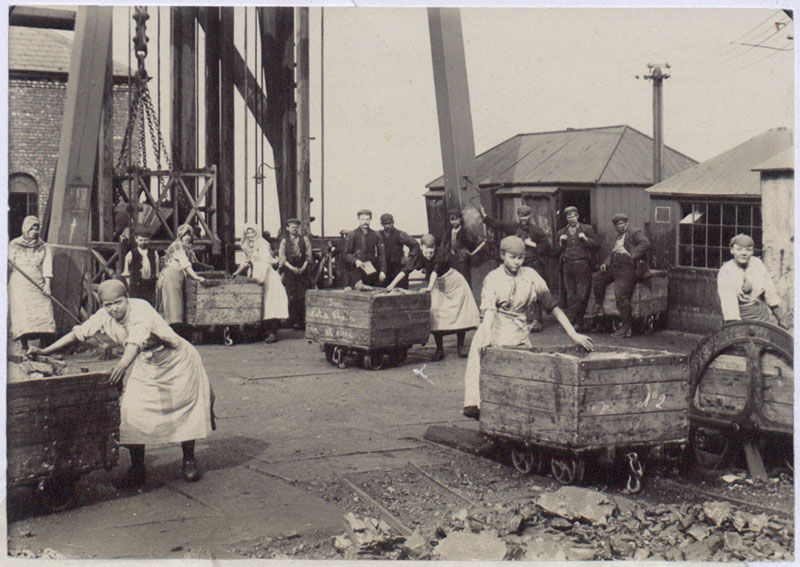
The Last Pit Brow Lass
What finally ended the job wasn't Parliament, it was the shovel being replaced by the machine. Nationalization of the coal industry in 1946 brought a wave of mechanization, and gravity washing plants and automated screens started doing in minutes what had taken women entire shifts to do by hand. The numbers collapsed almost overnight by historical standards. From several thousand pit brow women nationally in the early 1940s, the workforce had shrunk to just 956 by 1953, two thirds of them still in Lancashire. The job disappeared region by region after that: the last pit brow lasses in Lancashire left the industry in 1966, Scotland's Fife coalfield followed in 1967, and Cumberland held out until 1972, exactly 130 years after the law that was supposed to have pushed women out of coal mining for good. What actually happened instead was that a workforce Victorian society tried repeatedly to legislate out of existence just kept showing up for the next shift, in trousers, for over a century, until the machines made the job obsolete rather than the lawmakers.


