


1913: When Hitler, Trotsky, Tito, Freud and Stalin All Lived In The Same Place.
Updated: Aug 4
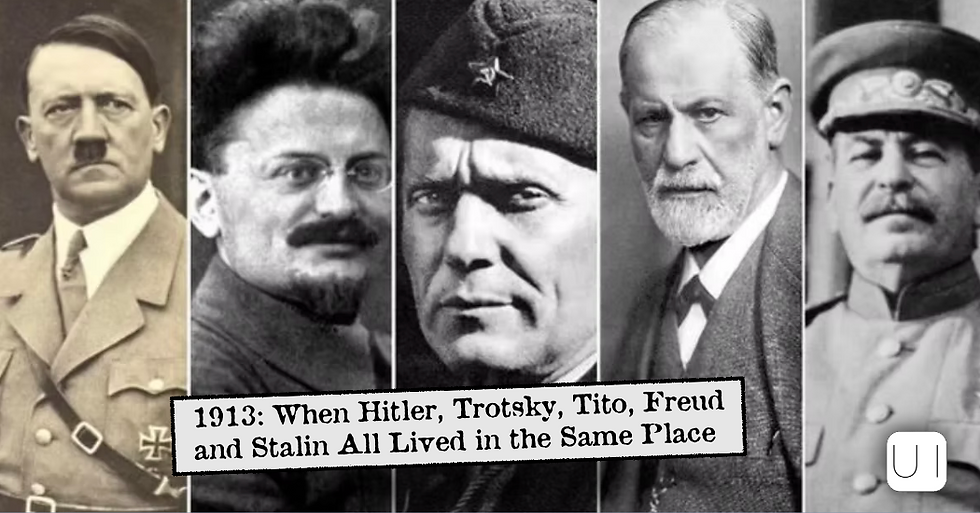
In January 1913, all of the following people were living within a 2.36-mile radius of each other in Vienna: a failed art student from Austria who slept in a men's hostel and painted postcards for tourists; a Russian revolutionary editing a newspaper from a coffee house table; a Georgian Bolshevik travelling on a forged Greek passport; the founder of psychoanalysis; and a young metalworker from Croatia who'd just moved to a factory town down the road. None of them had met.
None of them knew what the others were about to become. Twelve months later, Franz Ferdinand, also in Vienna that year, would be shot dead in Sarajevo and drag the entire continent into a war. The five men in question were Adolf Hitler, Leon Trotsky, Joseph Stalin, Sigmund Freud, and Josip Broz Tito. This is one of history's more extraordinary coincidences, and it's entirely true.

The City Itself
Vienna in 1913 was the capital of the Austro-Hungarian Empire, a city of roughly two million people and one of the great intellectual centres of Europe. It was also a city of wild inequality and political tension, where high culture rubbed up against extreme poverty and the café on one street might be hosting a psychoanalytic debate while the one two doors down was full of pan-German nationalists reading anti-Semitic leaflets. Nearly 1,500 Viennese took their own lives that year. It attracted radicals, exiles, and dreamers in enormous numbers, partly because the Austro-Hungarian state was bureaucratically loose enough that people could move in and out without much scrutiny. The Austro-Hungarian capital had become, almost by accident, one of the best places in Europe to disappear into a crowd of other interesting people.
Adolf Hitler, Meldemannstrasse 27
Hitler was 24 years old in 1913 and had been living in Vienna since 1908, initially hoping to study at the Vienna Academy of Fine Arts. The Academy rejected him twice. The rejection letters still exist. An examiner's note on his application observed that his portfolio showed "too few heads," meaning not enough portrait work. He was good at architecture but couldn't draw people convincingly enough for the Academy's standards.
By 1913 he was living at the Mannerheim, a men's hostel at Meldemannstrasse 27 near the Danube. It was a step up from the genuine homeless shelters he'd used earlier, with small private cubicles rather than open dormitories, a reading room, and cooking facilities. He spent his days painting watercolours of Vienna's streets and landmarks and selling them to tourists and shopkeepers for a few krone each, just enough to get by. He was reading voraciously, mostly anti-Semitic pamphlets and pan-Germanic literature, and haranguing fellow residents. Frederic Morton, in his 1989 book Thunder at Twilight, imagines him at this point "ranting about the treachery of the Jews" to his bored dormitory neighbours. In May 1913, he left Vienna for Munich, having finally received a small inheritance from his father's estate. He never lived in Vienna again.

Leon Trotsky, Rodlergasse 25
Trotsky had been living in Vienna since October 1907, having fled Russia after the failed 1905 revolution. He lived with his wife and two sons at Rodlergasse 25, in the northwestern part of the city, and spent most of his days at Café Central on Herrengasse, where he edited Pravda from a table covered in newspapers, cigarette ash, and correspondence. Café Central was the kind of place where you could nurse a coffee for four hours and nobody would ask you to leave. It was also where both Trotsky and Hitler came to read the papers, though there's no confirmed record of them ever acknowledging each other's existence.
Trotsky was, by this point, a significant figure in Russian revolutionary circles, though hardly a household name outside them. He was 33, intellectually prolific, and deeply contemptuous of the city's official culture while being entirely dependent on its cafés for his working life. He left Vienna in August 1914 when the war broke out, expelled as a Russian national.
Joseph Stalin, Schönbrunner Schlossstrasse 30
Stalin's visit to Vienna was short and purposeful. He arrived in January 1913 from Krakow on a forged passport in the name of Stavros Papadopoulos, a name he'd used before. He'd come at Lenin's specific request to research and write a paper on how the Bolsheviks should approach the question of national minorities in a future socialist state. The Austro-Hungarian Empire, with its dozens of nationalities, was the perfect place to study the problem up close.
He stayed with a Russian emigrant couple, Alexander and Yelena Trojanovsky, at Schönbrunner Schlossstrasse 30, just across from the grounds of Schönbrunn Palace. He worked on his essay with the help of Nikolay Bukharin, who was also in Vienna at the time. The resulting paper, "Marxism and the National Question," was published under the name K. Stalin, one of the first times he used that pseudonym in print. Lenin was reportedly delighted with it. Stalin left Vienna after about a month.
His one confirmed encounter with another of the five figures was with Trotsky. Trotsky later described the meeting in precise and unflattering terms:
"He was short... thin... his greyish-brown skin covered in pockmarks... I saw nothing in his eyes that resembled friendliness."
Trotsky was dismissive of Stalin from the start. Stalin noted the dismissal and filed it away. Their rivalry would eventually cost Trotsky his life, an ice axe to the skull in Mexico City in 1940, ordered by Stalin's secret police, run by Lavrentiy Beria.

Sigmund Freud, Berggasse 19
Freud was the only one of the five who was already genuinely famous in 1913. He'd lived in Vienna since childhood and had been working from his apartment and consulting rooms at Berggasse 19 since 1891. By 1913 his ideas about the unconscious, repression, and the interpretation of dreams had made him one of the most discussed and controversial figures in European intellectual life. His favourite café was the Landtmann, just off the Ringstrasse, which still operates today and still has a Freud connection on its menu.
In 1913 he published Totem and Taboo, which tried to apply psychoanalytic thinking to the origins of religion and moral prohibitions. He was also in the middle of a bitter falling-out with Carl Jung, who'd been his closest collaborator and designated heir. The correspondence between them that year was, by the end, barely civil. Freud lived and worked at Berggasse 19 until 1938, when the Nazis annexed Austria and he was forced to flee to London. He died there the following year.
Josip Broz Tito: Close, But Not Quite Vienna
Here's where the story requires a small correction that most versions of it skip over. Tito wasn't actually in Vienna in 1913. He was in Wiener Neustadt, a factory town about 40 kilometres south of the capital, working at the Daimler automobile plant. That's close enough to be included in the broader story, and he did visit Vienna periodically, but he wasn't living within the 2.36-mile radius of the others. He was 20 years old, recently arrived from Croatia, looking for work and getting his first real exposure to trade union politics and socialist ideas. He was drafted into the Austro-Hungarian army in 1913 and spent WWI as a soldier before being captured by the Russians in 1915.

The Cafés They Shared
The most tantalising question in the whole story is whether any of these men ever sat at the same table, or at least in the same room. The answer, frustratingly, is: possibly, but not provably. Both Hitler and Trotsky were confirmed regulars at Café Central. Freud preferred the Landtmann. Stalin was only in the city for a month and left few records of his leisure habits. They were all operating within the same dense few square miles of central Vienna, using the same cafés, buying papers from the same kiosks, and riding the same trams. The city was that compressed.
Nobody who saw any of them in a café in January 1913 would have looked twice. A grumpy young art student. A Russian intellectual with a pile of newspapers. A Georgian man with a thick moustache who spoke limited German. An elderly professor in a good suit. None of them looked like the 20th century.

What Came After
Within five years of 1913, WWI had destroyed the empire all of them had been living inside. The men in the cafés had been scattered across the century. Hitler went to Munich, then to the Western Front, then to Landsberg Prison, then to the Reichstag. Trotsky went to revolution, then to power, then to exile, then to that ice axe in Mexico. Stalin went from the Trojanovsky apartment to the Gulag system and the death of perhaps 20 million people. His legacy lives on in strange ways, including in his granddaughter Chrese Evans, a tattooed Buddhist antique dealer in Portland, Oregon, who couldn't be more different from the man in the forged-passport photograph arriving at Vienna's North Terminal in January 1913. Freud fled the Nazis in 1938 and died in London in 1939, the city still occupied by the ideology of the man who'd been selling postcards from Meldemannstrasse when Freud was finishing Totem and Taboo. Tito became Marshal of Yugoslavia and ran his country's unique brand of independent socialism for 35 years.
Archduke Franz Ferdinand, heir to the empire they were all living inside, was assassinated in Sarajevo on 28 June 1914. The shot that killed him triggered the war that broke the world open for all five of them. He'd been in Vienna in 1913 too, at the Belvedere Palace, a thirty-minute walk from Café Central.
Sources:
1. Florian Illies, 1913: The Year Before the Storm. Sceptre, 2012.
2. Brigitte Hamann, Hitler's Vienna: A Dictator's Apprenticeship. Oxford University Press, 1999.
3. Frederic Morton, Thunder at Twilight: Vienna 1913/1914. Scribner, 1989.
4. BBC Radio 4: Today programme, April 2013 (Vienna 1913 feature).
5. BBC Radio 4 piece by Andy Walker (17 April 2013)


