

He Drove 14 Miles, Killed His Mother-in-Law, and Remembered Nothing: The Extraordinary Sleepwalking Case of Kenneth Parks
Updated: Aug 3
In 1987, a young Canadian father walked into a police station covered in blood and told officers he thought he'd just killed two people. He had. But what followed became one of the most debated legal cases in criminal history, because he was almost certainly asleep when he did it.

A Night That Changed Criminal Law
Kenneth James Parks was 23 years old, six feet five inches tall, and known by his in-laws as a "gentle giant." He had a five-month-old daughter, a wife named Karen, and a life that, at least from the outside, looked ordinary enough.
Beneath the surface, though, things had been unravelling for months. Parks had developed a serious gambling addiction after a lucky early win at Woodbine Racetrack hooked him completely. By early 1987 he'd racked up debts exceeding $60,000. Desperate to cover his losses, he stole from the family savings, then forged his wife's signature on financial documents, then embezzled around $30,000 from his employer, Revere Electric. In March 1987 the theft was discovered and he was fired. Criminal charges followed.
The stress was catastrophic. Parks reportedly experienced chest pains severe enough that he feared a heart attack. Insomnia plagued him. On May 20, 1987, he attended his first meeting of Gamblers Anonymous. Encouraged by the group, he made a plan: he'd visit his grandmother the following Saturday, then go to his in-laws on the Sunday to come clean about everything.
That Sunday was May 24, 1987.

Saturday Night, Sleeping on the Couch
The night before the planned confession, Parks fell asleep on his sofa watching Saturday Night Live. It was around 1:30 in the morning. His wife Karen had gone to bed.
Sometime in the small hours, according to what later testimony and expert analysis would reconstruct, Parks got up from the couch. He put on his coat. He got into his car. And he drove roughly 14 miles from his home in Pickering, Ontario, to the Scarborough home of his in-laws, Dennis and Barbara Woods.
He had a key. They'd given it to him because they trusted him completely. Barbara had referred to him warmly as her "gentle giant." The couple had never had a serious disagreement with their son-in-law.
Parks let himself in, went to the bedroom, and attacked Barbara Woods with a tire iron he'd brought from the car. She was 42 years old. The injuries were fatal. He then turned on Dennis Woods and attempted to strangle him. Dennis survived, though he was seriously injured.
Parks got back into his car and drove. Not home. To the nearest police station.
When he arrived, officers immediately noticed the blood. They also noticed something else: Parks seemed completely confused about where he was and how he'd got there. He was apparently unaware that he'd severely lacerated both of his hands during the attack, severing tendons. He'd driven to the police station with these injuries and seemingly felt nothing.
"I think I have killed some people," he told officers. "My hands."

No Memory, No Motive, No Mental Illness
The investigation that followed quickly produced a puzzle that wouldn't resolve neatly.
Parks had no history of violence. He had no apparent motive to kill the two people who were arguably his most supportive family members. Even with his shameful financial secrets about to come out, there was nothing to suggest he'd benefit from their deaths. He'd been planning to confess everything to them the next morning.
Police initially suspected he'd decided to silence the in-laws before they could react to the confession. But that theory had problems. If Parks had planned a murder, why drive to the police station straight afterwards? Why make no attempt to clean up or flee? Why appear so genuinely confused?
Medical testing ordered during the investigation added another layer of complexity. Parks underwent EEG readings and sleep studies. The results showed highly abnormal sleep patterns, including unusually deep non-REM sleep and irregular cycling between sleep phases. Crucially, these readings were, as experts later testified, impossible to fake. There was also a strong family history to consider: multiple members of Parks's family had documented histories of parasomnias, including sleepwalking and sleep talking. Parks himself had reportedly walked in his sleep on at least two previous occasions.
The defence that took shape around this evidence was one almost no one in the legal world had encountered before, at least not in a Canadian murder trial.
The Defence Nobody Believed at First
Parks's attorney, Marlise Edworth, built the case around a concept called non-insane automatism. The argument was straightforward, even if it was extraordinary: Parks had been asleep during the entire episode. Not groggy, not half-awake, not in some diminished state. Fully asleep, in the clinical sense, with no conscious mind directing his actions.
Automatism in law refers to behaviour performed without conscious control. It's split into two categories. Insane automatism applies where the unconscious behaviour stems from a mental illness or disease of the mind, and typically results in a verdict of not guilty by reason of insanity, followed by detention in a psychiatric facility, potentially indefinitely. Non-insane automatism applies where the behaviour stems from something external or transient, not from any underlying mental disorder. The result, if accepted, is a complete acquittal.
For Parks's defence to succeed, the jury had to accept that his sleepwalking was of the non-insane variety: triggered by extreme stress and exhaustion, not by any psychiatric illness.
Edworth assembled an exceptional expert panel. The team included psychiatrists, a psychologist, a neurologist, and a sleep disorder specialist. All of them reached the same conclusion independently: at the time of the attack, Kenneth Parks had been asleep. Dr. R. Billings, one of the psychiatrists, explained that the sleeping mind operates independently from the conscious mind and that Parks's actions were consistent with an incomplete arousal process during which the body acts without any directing will.
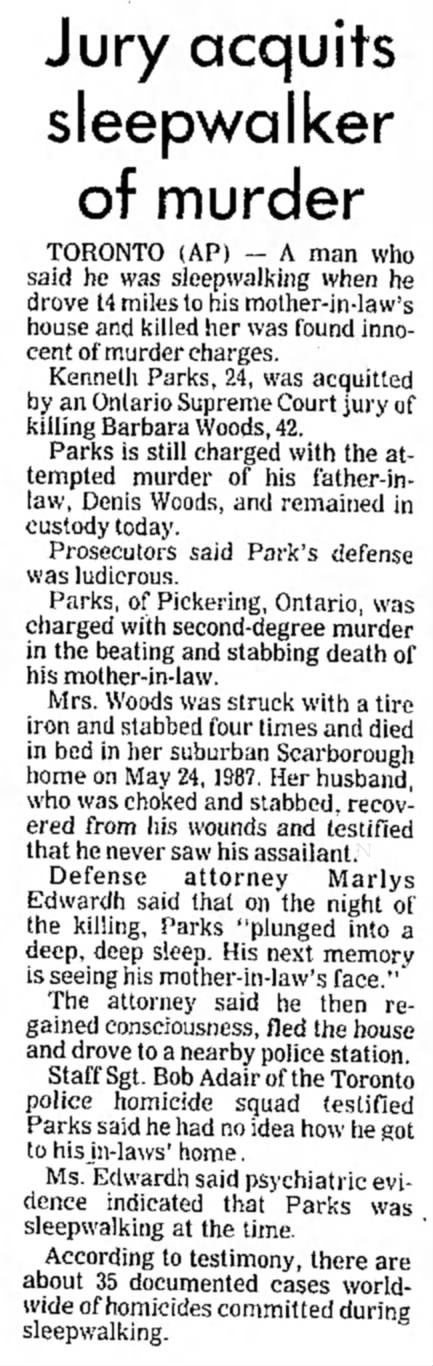
Five neurological experts in total testified for the defence. All five agreed. The prosecution called this ludicrous. Their case rested on a simpler argument: driving a car, navigating to a specific address, using a key, and carrying out a sustained attack required conscious awareness. The acts were too complex, too purposeful, to have been committed in sleep.
What the Science Actually Says
Here's where the Parks case becomes genuinely fascinating rather than simply strange. The prosecution's instinct that complex behaviour requires consciousness was, and still is, widely shared by the public. It feels intuitively right. But sleep science tells a more unsettling story.
Somnambulism, or sleepwalking, is classified as a non-REM parasomnia. It typically occurs during slow-wave sleep, the deepest stage, when the brain is least responsive to the outside world. What makes it particularly strange is that it can co-exist with quite sophisticated motor activity. Sleepwalkers have been documented cooking full meals, playing musical instruments, holding conversations, and yes, driving vehicles, without any conscious awareness.
The reason this is possible relates to how different brain regions manage sleep differently. During a sleepwalking episode, some areas responsible for motor control remain partially active while those governing higher cognition, memory formation, and conscious decision-making are effectively offline. The person isn't pretending to be asleep. The part of the brain that would register the experience and form memories of it is genuinely switched off.
In Parks's case, his abnormal EEG readings indicated he spent an unusual amount of time in slow-wave sleep and transitioned between stages in atypical ways. This, experts argued, made him particularly susceptible to complex parasomnic episodes. His obliviousness to the severe pain of severed hand tendons during the drive to the police station was cited as powerful supporting evidence. It's extremely difficult to fake indifference to that kind of injury.
The Trial: May 1988
Parks went to trial in May 1988, roughly a year after the attack. The central question for the jury was simple: was he conscious when he committed the killing?
The defence evidence was compelling and consistent. The prosecution struggled to counter it effectively. They couldn't produce a credible alternative explanation for the EEG data, couldn't explain the severed tendons and apparent absence of pain response, and couldn't shake the expert testimony.
The jury acquitted Parks on the murder charge. He still faced the attempted murder charge relating to Dennis Woods, but that too was ultimately resolved in his favour.
The verdict made front pages around the world. The reaction was roughly split between those who found it plausible given the scientific evidence, and those who found it deeply troubling that a man could kill someone and walk free without even serving time.
The Supreme Court: 1992
The Crown appealed, and the case ultimately reached the Supreme Court of Canada, which heard it in January 1992 and issued its ruling in August of that year.
The court's judgment in R v Parks, [1992] 2 S.C.R. 871, became a landmark. The central legal question was whether sleepwalking should be classified as non-insane automatism, meaning a complete acquittal was appropriate, or as a "disease of the mind" under section 16 of the Criminal Code, which would result in a finding of not criminally responsible on account of mental disorder and the possibility of indefinite psychiatric detention.
Chief Justice Antonio Lamer held that the trial judge had correctly analysed the evidence and had been right not to characterise sleepwalking as a mental disorder. The expert testimony, he found, established genuine reasonable doubt as to whether Parks had acted voluntarily.
Justice La Forest, writing for a majority that included Claire L'Heureux-Dubé and Charles Gonthier, went further and examined the broader public policy dimensions. He noted that the mental disorder defence exists to protect public safety and that its applicability must hinge on the likelihood of recurrence.
For the "disease of the mind" classification to apply, the condition must represent a continuing danger to others and must stem from an internal cause rooted in the accused's psychological or emotional pathology. Sleepwalking, in Parks's case, met neither criterion. There was no underlying mental illness. The episode had been triggered by extraordinary external stress and sleep deprivation. There was no evidence of a propensity for ongoing violent risk.
The Supreme Court upheld the acquittal by a majority of seven to two.
The dissent, written by Chief Justice Lamer didn't dispute the factual findings but raised concerns about the legal framework and whether the case had been properly put to the jury.
The ruling drew an important legal line that still stands today. It was distinguished in the later case of R v Stone [1999], where the Supreme Court rejected non-insane automatism for dissociative states triggered by psychological blows, holding that those internal causes were closer to mental disorder. Parks set the boundary: isolated physiological sleep events that arise from transient external triggers, not from any ongoing internal pathology, can constitute non-insane automatism. That boundary hasn't shifted.
The Precedent and Its Limits
The Parks ruling has echoed through legal systems well beyond Canada. It's cited in UK parasomnia cases, referenced in Australian courts, and taught in law schools worldwide as the defining example of non-insane automatism in a homicide context.
But it hasn't opened the floodgates its critics feared. La Forest's judgment anticipated that concern directly, pointing out how vanishingly rare genuine homicidal somnambulism is. At the time of the Parks trial, defence experts noted that medical literature contained only around 30 documented cases of murder committed during sleepwalking across recorded history. By 2005 that number had risen to around 68, spread across centuries and continents. It remains one of the rarest events in forensic medicine.
And not every sleepwalking defence has succeeded. Scott Falater in Arizona, who stabbed his wife 44 times and drowned her in their swimming pool in 1997, was convicted of first-degree murder in 1999.
The jury didn't buy his sleepwalking claim, partly because a neighbour had witnessed him moving the body in deliberate stages, motioning for his dog to lie down, and retrieving work gloves from the garage. Stephen Reitz in California was convicted in 2004, despite sleep clinic tests confirming a propensity to sleepwalk, because the court found other factors more persuasive.

In UK law, Jules Lowe was acquitted in Manchester in 2005 after beating his 83-year-old father to death following a drinking session, on the basis of automatism, though that verdict rested heavily on the insane automatism route, resulting in indefinite detention rather than a clean acquittal. In Dorset the same year, Michael Catling's attempted automatism defence over the stabbing of his partner collapsed under expert scrutiny, and he pleaded guilty to murder.
The lesson the legal community has drawn from Parks and its progeny isn't that sleepwalking is a get-out clause. It's that each case requires rigorous forensic sleep medicine assessment and that genuine somnambulism carries specific neurological signatures that trained experts can evaluate and, crucially, that are very difficult to manufacture.
Life After the Verdict
Kenneth Parks was never imprisoned. Following the acquittal he was placed on medication to manage his sleep disorder and, according to all available accounts, never experienced another episode of violent somnambulism.
He and Karen divorced in 1991. He went on to remarry and have more children.
In 2006, in a moment that generated headlines for its sheer surreality, Parks ran for election to the Durham District School Board. His candidacy was reported by CityNews Toronto, which noted that the man once acquitted of a sleepwalking murder was seeking public office. He was unsuccessful.
Dennis Woods, the father-in-law who survived the attack, faced an almost incomprehensible situation after the acquittal: processing the violent death of his wife at the hands of a man the legal system had concluded bore no criminal responsibility for what he'd done. How the Woods family navigated that in the years following has never been widely reported.
The Question That Won't Go Away
The Parks case sits at the intersection of law, neuroscience, and moral philosophy in a way that no tidy resolution can address.
Criminal law in most common law countries rests on two foundations: the act itself (actus reus) and the guilty mind (mens rea). Without both, there's no crime. If Parks was genuinely unconscious, then there was no guilty mind. The act happened, but the criminal wasn't there to commit it. The body was present. The person, in the legal and philosophical sense, wasn't.
Critics argue this is too neat, that it places an unfair burden on victims and lets genuine killers construct elaborate defences using medical complexity most jurors aren't equipped to evaluate. Supporters point out that convicting someone for an act they genuinely didn't choose to commit would be a greater injustice still.
The science hasn't stood still since 1987. Sleep medicine has developed far more sophisticated tools for assessing parasomnia, including overnight polysomnography, genetic screening for parasomnia predisposition, and detailed neuroimaging. Any sleepwalking defence mounted today would face a far more rigorous forensic investigation than Parks did. That's largely because of him.
What the Parks case ultimately shows isn't that sleep can transform peaceful people into killers, that would be a grotesque and statistically absurd conclusion. What it shows is that the human brain is stranger and more complex than our everyday experience of it suggests. And that criminal law, built on assumptions of conscious agency, sometimes encounters the hard edges of its own foundations.
In the gap between those foundations and the messy reality of human neuroscience, Kenneth Parks walked free. The law decided he had to. Whether justice was done depends on questions the law alone can't answer.
Sources
R v Parks, [1992] 2 S.C.R. 871, Supreme Court of Canada: https://decisions.scc-csc.ca/scc-csc/scc-csc/en/item/907/index.do
Wikipedia: R v Parks: https://en.wikipedia.org/wiki/R_v_Parks
Sleep Forensic Associates, Case Studies: Sleepwalking: https://sleepforensicmedicine.org/case-studies/sleep-walking/
UPI Archives, "Sleepwalker Acquitted in Mother-in-Law's Slaying," May 27, 1988: https://www.upi.com/Archives/1988/05/27/Sleepwalker-acquitted-in-mother-in-laws-slaying/1299580708800/
Ramsland, Katherine, "Automatism: The Sleepwalker's Defense": https://ms-hurley.weebly.com/uploads/5/9/1/4/59141159/automatism.pdf
Mental Floss, "A Bump in the Night: When Sleepwalkers Turn Violent": https://www.mentalfloss.com/article/27072/bump-night-when-sleepwalkers-turn-violent
History Collection, "11 Sleepwalking Killers from History": https://historycollection.com
CityNews Toronto, "Man Acquitted of Sleepwalking Murder Running for School Trustee in Durham," October 27, 2006: https://toronto.citynews.ca/2006/10/27/man-acquitted-of-sleepwalking-murder-running-for-school-trustee-in-durham/
Grokipedia, R v Parks legal analysis: https://grokipedia.com/page/R_v_Parks
NIH / PMC: "While You Were Sleepwalking: Science and Neurobiology of Sleep Disorders": https://www.ncbi.nlm.nih.gov/pmc/articles/PMC4506454/
R v Stone, [1999] 2 S.C.R. 290, Supreme Court of Canada


