


The Scottsboro Boys: The Case That Exposed American Injustice
Updated: Oct 6

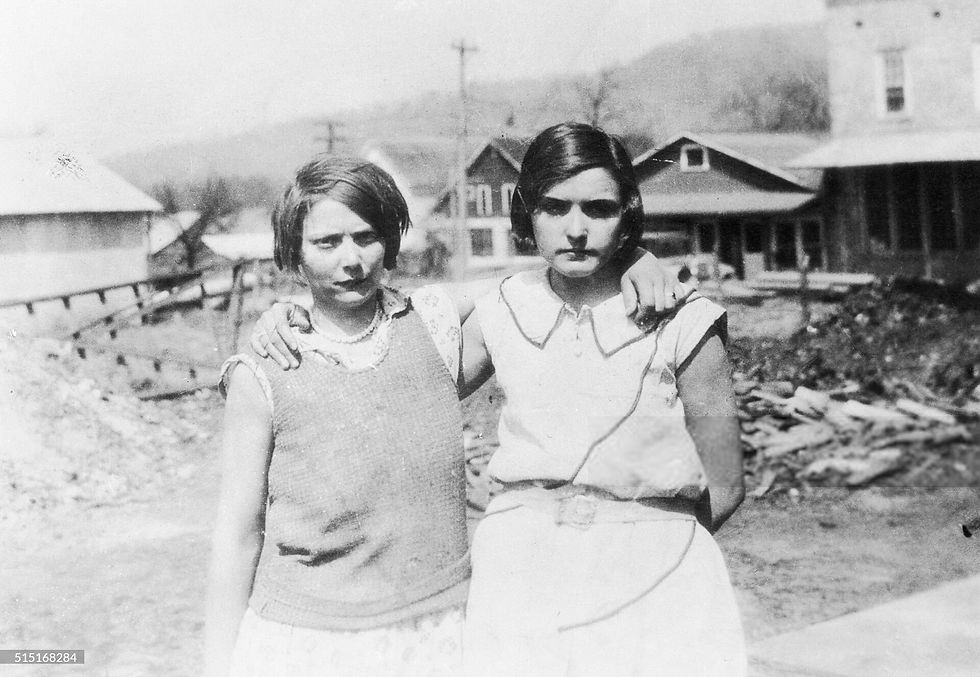
On 25 March 1931, a white teenager walking across the top of a freight car in northern Alabama stepped on the hand of a Black teenager named Haywood Patterson, who was hanging on to the side of the same train. A fight broke out. By the time it ended, a posse of armed men had stopped the train at a small station called Paint Rock, pulled nine young Black men off it, tied them together with plow line, and driven them to a jail in a town called Scottsboro. Two young white women who'd also been riding the train told the posse they'd just been gang raped.
Nothing about that accusation was true. It still took eighty two years, four trips to the United States Supreme Court, six years of imprisonment for some of the men involved, and the deaths of most of the people at the centre of it before the state of Alabama admitted as much. The Scottsboro Boys became one of the defining injustices of the twentieth century American legal system, and one of the clearest illustrations of exactly how that system could be turned into a weapon.
Quick Answers
Who were the Scottsboro Boys? Nine Black teenagers, aged 12 to 19, falsely accused of raping two white women aboard a freight train in Alabama in March 1931: Haywood Patterson, Clarence Norris, Andy Wright, Roy Wright, Ozie Powell, Charlie Weems, Willie Roberson, Olen Montgomery and Eugene Williams.
Were the Scottsboro Boys guilty? No. Medical evidence contradicted the accusation from the start, and one of the two accusers, Ruby Bates, later recanted entirely and testified for the defence. Alabama posthumously pardoned or exonerated all nine between 1976 and 2013.
What did the Scottsboro case change in American law? Two landmark Supreme Court rulings came out of it. Powell v. Alabama (1932) established a right to competent legal counsel in capital cases, and Norris v. Alabama (1935) ruled that excluding Black citizens from jury rolls was unconstitutional.
A Fight Over a Foot
Riding freight trains for free was an ordinary way to get around during the Depression, and the Chattanooga to Memphis run on 25 March 1931 was carrying two dozen or so people doing exactly that, roughly split between Black and white, most of them teenagers looking for work. Somewhere after the train crossed into Alabama, a white youth walking along the top of a tank car stepped on Patterson's hand. Stones started flying between a group of white teenagers and a larger group of Black teenagers, and by the time it was over the white group had been forced off the moving train, all except one, Orville Gilley, who Patterson himself pulled back aboard after the train had already picked up dangerous speed.

The white teenagers who'd been forced off reported to a stationmaster that they'd been attacked by a gang of Black youths. Word was wired ahead. When the train slowed at Paint Rock, a posse of armed white men was waiting, and they rounded up every Black rider they could find, nine in total, most of whom had never met each other before that day. Two white women were also found on the train, Victoria Price and Ruby Bates, both mill workers from Huntsville returning from an unsuccessful job hunt in Chattanooga. Bates told a member of the posse they'd been raped. In the jail that same day, Price pointed to six of the nine and named them as her attackers. When one of the accused, Clarence Norris, called the girls liars, a guard struck him with a bayonet.
Nine Strangers, One Story
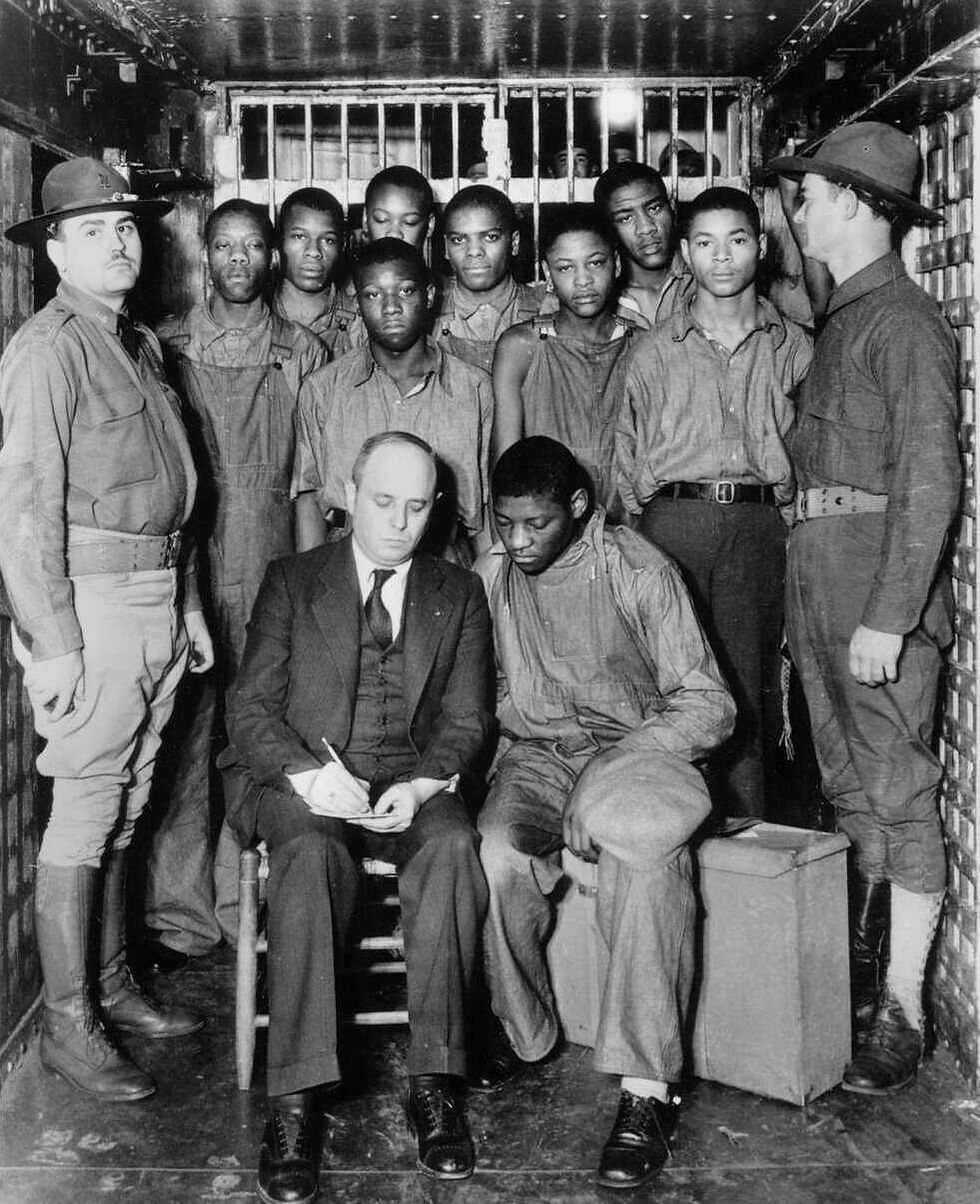
The nine ranged from twelve to nineteen years old. Roy Wright, the youngest, had never left home before and was travelling with his older brother Andy. Willie Roberson was suffering from a serious untreated venereal infection so severe he could barely walk without a cane. Olen Montgomery was nearly blind in one eye. None of that mattered once the accusation was made. A crowd of several hundred gathered outside the Scottsboro jail that night hoping for a lynching, and was only stopped when Alabama's governor sent in the National Guard to protect the nine boys inside.
Twelve days later, trials began in the courtroom of Judge Alfred E. Hawkins. Haywood Patterson later described the scene as one big smiling white face. Local papers had already convicted the defendants before a word of testimony was heard, one headline ran across the full width of the page naming them nine black fiends. Representing all nine boys were two court-appointed lawyers, an unpaid, unprepared Chattanooga real estate attorney who arrived to the first day of trial visibly drunk, and a forgetful seventy year old local lawyer who hadn't tried a case in decades. Between them they offered no real cross-examination of the accusers, no cross-examination at all of the examining doctors, and no closing argument.
Four rushed trials later, eight of the nine had been convicted and sentenced to death. Only Roy Wright, twelve years old, escaped that fate, and only because eleven of the twelve jurors had actually wanted to sentence a child to the electric chair too, over the prosecution's own request for life imprisonment, forcing a mistrial rather than accept anything less.
The Communists and the NAACP
The NAACP, the obvious organisation to take up the case, hesitated. Rape was a politically dangerous charge to be associated with in the Jim Crow South, and the organisation was wary of the damage it might suffer if any of the nine turned out to be genuinely guilty. Into that gap stepped the Communist Party's legal wing, the International Labor Defense, which saw the case as exactly the kind of cause that could win it credibility among both Black southerners and northern liberals. By the time the NAACP came around to the case's obvious public relations value and tried to recruit the famous defence attorney Clarence Darrow to fight the ILD for the right to represent the nine, it was already too late. The Scottsboro Boys, as the press had already nicknamed them, were drowning, and the Communists were the only ones who'd thrown them a rope.
That alliance shaped everything that followed, for better and worse. It brought money, national attention and genuinely committed lawyers to a case that would otherwise have vanished into Alabama's prison system with barely a headline. It also gave prosecutors and local newspapers an easy, race-baiting angle to work with for years: not a case about nine innocent boys, but a case about outside agitators and Communist money coming to tell Alabama how to run itself.

A Right to Actual Counsel
The convictions were appealed. In January 1932 the Alabama Supreme Court upheld all but one of them, tossing out only the conviction of thirteen year old Eugene Williams on the technical basis that he should never have been tried as an adult in the first place. The case then went to the United States Supreme Court, where the justices ruled 7 to 2 that the boys' Fourteenth Amendment right to due process had been violated by the sheer inadequacy of their original legal representation. Powell v. Alabama, decided in November 1932, established for the first time that criminal defendants facing the death penalty have a constitutional right to competent counsel. It remains one of the case's two lasting legal legacies, and it meant everyone would have to go through this again.
Samuel Leibowitz Comes to Alabama
For the retrials, the ILD made a shrewd move, hiring Samuel Leibowitz, a New York criminal defence attorney with a genuinely staggering record: seventy seven acquittals and one hung jury across seventy eight murder trials. Leibowitz had no Communist sympathies at all and would spend four years on the Scottsboro defence entirely without pay, a fight he later said he simply believed in. Alabama's newly elected attorney general, Thomas Knight Jr, whose own father had written the state supreme court's decision upholding the original convictions, led the prosecution personally.

The second trial of Haywood Patterson opened in March 1933 in Decatur, in front of Judge James Horton. Leibowitz's cross-examination of Victoria Price was merciless, four hours picking apart a story riddled with contradictions: a boarding house that turned out not to exist, a description of injuries that didn't match her calm, unbruised appearance less than two hours after the alleged attack, and medical testimony that the semen found in her body was non-motile, well past the window in which living sperm should still have been present. When a posse member testified he'd found a knife on one of the defendants, Leibowitz's cross-examination produced an accidental confession from the witness himself, that the boy had said he'd taken it off Victoria Price, not the other way around. Prosecutor Knight was so delighted he clapped his hands and had to leave the courtroom to hide his reaction, prompting a defence motion for a mistrial that Judge Horton refused. The prosecution's only supposed eyewitness, a farmer named Ory Dobbins, insisted under cross-examination that he'd watched the assault from a distance and could tell it was a woman being grabbed because she was wearing a dress. Everyone in the courtroom knew both women had been wearing overalls that day.
Ruby Bates Walks Back In
The defence's final witness arrived like something out of a courtroom drama. Ruby Bates had vanished in the months before the trial, and Leibowitz had already told the court he was resting his case when he asked for a short recess. National Guardsmen then opened the courtroom's back doors, and Bates walked in to gasps from the crowd. Under oath, she said there had been no rape, that none of the nine had touched or even spoken to her, and that Victoria Price had told her beforehand to "frame up a story" to avoid being charged herself under the Mann Act for crossing state lines with men who weren't her husband. Knight tore into her on cross-examination, confronting her with gifts of new clothes from Communist Party supporters and her own earlier sworn testimony saying the opposite.
It didn't matter. The jury took five minutes to convict Patterson again and sentence him to death, apparently without giving Bates's testimony any real weight at all. In his closing argument, one of the prosecutors, Solicitor Wade Wright, asked the jury outright whether justice in the case was going to be bought and sold with Jew money from New York, a line aimed squarely at Leibowitz, who was Jewish. Judge Horton refused to declare a mistrial over it. Leibowitz, shaken, later said of the jury that convicted his client that their faces alone explained the verdict, describing them afterwards in language that reflected just how brutalised he felt by what he'd witnessed. Ruby Bates, meanwhile, left Alabama for good, later touring with ILD-organised rallies, begging forgiveness and singing alongside the crowds that had adopted the Scottsboro cause.
The Judge Who Did the Right Thing
What nobody in that courtroom knew was that Judge Horton had a second, private reason to doubt the prosecution's case. A doctor originally listed as a prosecution witness had been quietly excused from testifying at Knight's request, on the grounds his evidence would be redundant. That same doctor later pulled Horton aside and told him, away from the jury, that he was convinced the girls were lying and had told them so to their faces. Horton urged him to testify publicly. The doctor refused, certain it would end a career he'd only just started.
Horton kept the secret and ruled anyway. Warned by a well-connected political ally that overturning the jury's verdict would end his career, he set aside Patterson's conviction and death sentence in June 1933 regardless, citing a motto his own mother had taught him: let justice be done, though the heavens may fall. He lost his next election. The retrials were moved out of his courtroom entirely and handed to Judge William Callahan, a judge with a stated goal of debunking the whole case and getting it off the nation's front pages as fast as possible, who told juries outright that they should presume no white woman in Alabama would ever consent to sex with a Black man. Guilty verdicts and fresh death sentences followed quickly for both Patterson and Norris.
Forged Jury Rolls
The case reached the Supreme Court a second time in February 1935. Leibowitz argued that Alabama had systematically excluded Black citizens from jury service, and told the justices the names supposedly added to local jury rolls to disguise that exclusion had actually been forged after Patterson's trial had already begun. Chief Justice Charles Evans Hughes asked if he could prove it. Leibowitz produced the actual rolls and a magnifying glass, and passed them down the bench from justice to justice, each one's expression souring as they looked. Six weeks later, in Norris v. Alabama, the Court ruled unanimously that Alabama's jury selection system was unconstitutional, delivering the case's second lasting legal legacy and forcing southern states to begin actually seating Black jurors.

A Knife in the Backseat
Progress in the courtroom didn't translate into safety anywhere else. While being transported back to prison after testifying, Ozie Powell managed to pull a small knife from his pocket while handcuffed and slashed a deputy's throat. The deputy, who was driving, slammed on the brakes, got out and shot Powell in the head. Powell survived, but the injury left him with permanent brain damage. Clarence Norris said afterwards that Powell was simply never the same man again.
The Compromise That Almost Was
By late 1936, both sides were exhausted. Attorney General Knight met Leibowitz secretly in New York and offered a deal: drop the charges against three of the nine, and cap sentences for the rest at ten years for rape or assault. Leibowitz agreed with, in his own words, a heavy heart, knowing he was accepting further prison time for boys he believed entirely innocent because any actual trial in Alabama was almost certain to end in conviction regardless of the evidence. Before the deal could be finalised, Knight died suddenly in May 1937. A week later, his successor announced the next round of trials would go ahead as planned.

Those trials, held in July 1937 as Judge Callahan rushed through cases in stifling summer heat to beat his own self-imposed three-day limit per defendant, produced a death sentence for Norris, ninety nine years for Andy Wright, and seventy five years for Charlie Weems. Then, unexpectedly, the state dropped the rape charges against Ozie Powell entirely in exchange for a guilty plea on the lesser charge of assaulting the deputy who'd shot him. Moments later came the biggest news of the whole eight year saga: all charges were dropped against the remaining four, Willie Roberson, Olen Montgomery, Eugene Williams and Roy Wright. Leibowitz personally drove all four to the Tennessee state line.
What Became of Them
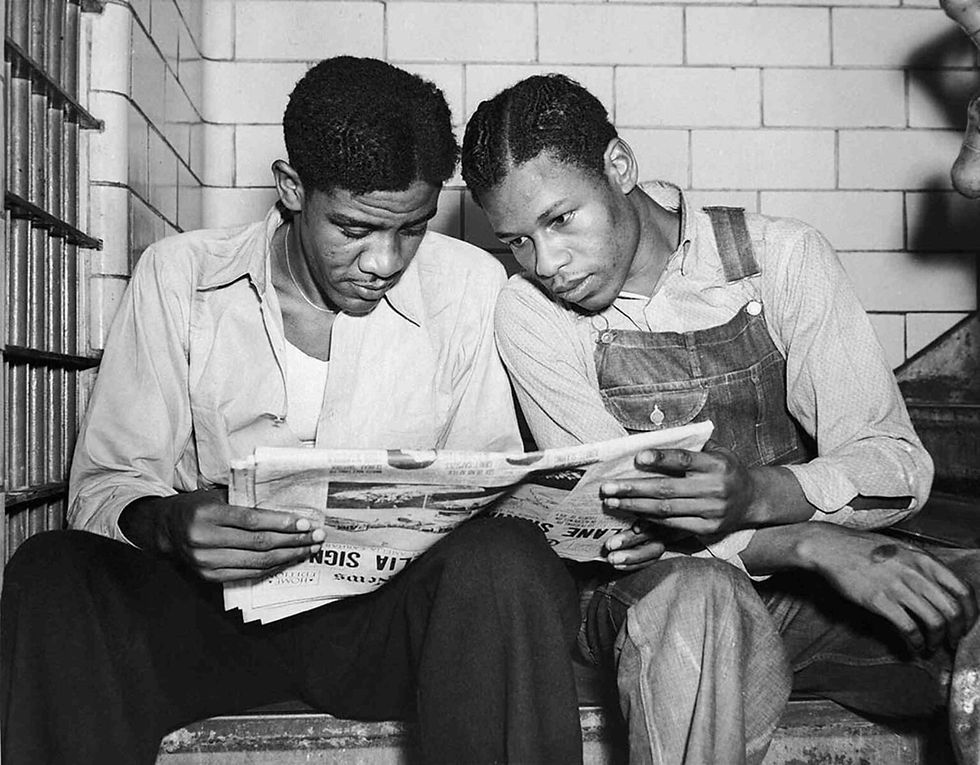
Freedom for the four released in 1937 didn't undo six years in Alabama's prison system, and none of them found it easy afterwards. Leibowitz personally took all four back to New York with him. Willie Roberson, whose asthma had been badly aggravated by six years in cramped, poorly ventilated cells, eventually settled in Brooklyn, where the condition killed him with an attack years later. Olen Montgomery tried to build a career at music school but never found steady footing, drifting between jobs for the rest of his life. Eugene Williams went to St Louis, where he still had family. Roy Wright, the youngest of the nine and by most accounts the one who adjusted best, finished his education, served in the army and got married, seemingly the genuine success story of the group. In 1959, twenty two years after his release, convinced his wife had been unfaithful, he stabbed her to death in a fit of rage, then killed himself the same day. Whatever the false accusation had done to him as a twelve year old boy never really let go.
For the five still held, resentment festered too, each convinced their continued imprisonment was somehow the price of the others' release. Conditions inside were brutal. Atmore Prison was infested with venomous snakes and run by guards with a reputation for cruelty. At Kilby Prison, one of Patterson's own assigned jobs was carrying the bodies of executed inmates out of the death chamber next to his cell.
In 1938, outgoing Governor Bibb Graves considered pardoning the remaining five before leaving office, and arranged individual interviews with each of them first. The meetings went badly. Patterson was found carrying a knife on his way in. Ozie Powell, brain damaged from the shooting two years earlier, refused to answer any of the governor's questions at all. According to Graves, Norris threatened to kill Patterson, with whom he'd been feuding bitterly, the moment he was free. None of the five would admit to a rape Graves still personally believed had happened. He left office without signing a single pardon.
They got out anyway, eventually, through parole rather than pardon. Charlie Weems was paroled in 1943, Ozie Powell and Clarence Norris in 1946. Haywood Patterson escaped from a work detail in 1948 and made it to Michigan, where the state's governor refused Alabama's request to send him back. Andy Wright, paroled once already and returned for a parole violation, wasn't finally free of Alabama until June 1950, nineteen years after he'd first been arrested as a nineteen year old on a freight train.
The Accusers, After
Ruby Bates spent the rest of her life associated with the cause she'd once helped create, then largely faded from public view. Victoria Price never recanted anything, and resurfaced decades later when a 1976 television dramatisation of the case aired on the assumption, based on a factual error in an earlier book, that both women were already dead. Price was very much alive and sued for defamation. Her case was ultimately dismissed on appeal, but the fact she was still around to bring it at all was itself a reminder of how recent this supposedly settled history actually was.

The Last Pardon
Between them, the nine Scottsboro Boys spent a combined total of roughly 130 years in Alabama's jails and prisons for a crime that never happened. Clarence Norris outlived every other member of the group. In 1976, Alabama governor George Wallace, the same man who'd once stood in a schoolhouse door to block integration, granted Norris a full pardon, the first official acknowledgment from the state that at least one of the nine had been innocent all along. Norris published his own memoir three years later. He died in 1989, the last surviving Scottsboro Boy, fifty eight years after the accusation that had defined his entire adult life.
Righting the Record
For decades after Norris's death, that single 1976 pardon was as close as Alabama had come to a full accounting. It took a woman named Sheila Washington to finish the job. As a teenager in the 1970s, she found a paperback book about the Scottsboro Boys hidden under her parents' bed, one her stepfather told her was too traumatic for a young girl to read. She read it anyway, and the story never left her. A year later, her own brother died at Kilby Prison, the same institution that had once held the men she'd just been reading about.
Washington spent seventeen years trying to build a museum to the case in the town of Scottsboro itself, facing real resistance from residents who felt the story was old news best left alone. She finally opened the Scottsboro Boys Museum and Cultural Center in a former church in 2010, and kept pushing for something more than a museum: full legal exoneration, not just a pardon, for the men who'd never received one. In 2013, largely because of her efforts, the Alabama legislature posthumously exonerated Haywood Patterson, Charlie Weems and Andy Wright, the last three of the nine never formally cleared. Governor Robert Bentley signed it into law at a ceremony inside Washington's own museum, eighty two years after nine strangers were pulled off a train for a crime that never happened. Washington died of a heart attack in January 2021, having spent most of her adult life making sure the story couldn't be quietly forgotten a second time.
Why Scottsboro Still Matters
Beyond the two Supreme Court precedents it produced, Scottsboro became a cultural reference point that outlasted every person actually involved in it. Huddie Leadbelly Ledbetter, who'd have known Alabama's prison system as well as anyone alive, recorded a song called The Scottsboro Boys on 26 December 1938 in New York, at the same Alan Lomax session that produced his Bourgeois Blues. It's a warning song rather than a retelling, aimed at any Black traveller thinking about passing through Alabama, and it sat alongside a small handful of other topical compositions in his catalogue about the news events of the day, including songs referencing Hitler and Franklin Roosevelt. Harper Lee has said the trial's atmosphere fed directly into To Kill a Mockingbird, written a generation later but clearly shaped by the same Deep South mythology about Black men, white women and manufactured guilt. And the case sits directly alongside the other great miscarriages of justice from the Jim Crow era, moments when an accusation alone, regardless of evidence, was treated as close enough to a verdict.
You Might Also Like
For another false accusation that turned deadly in the Jim Crow South, read Emmett Till: The 14-Yr-Old Boy Who Was Abducted, Tortured and Lynched in Mississippi in 1955.
For another case where a mob decided guilt before any trial could, see A Dark Chapter in American History: The Lynching of J. Thomas Shipp and Abraham S. Smith.


