The Remarkable and Tragic Story of Mary Ann Bevan: A Mother’s Sacrifice
Updated: Jul 31
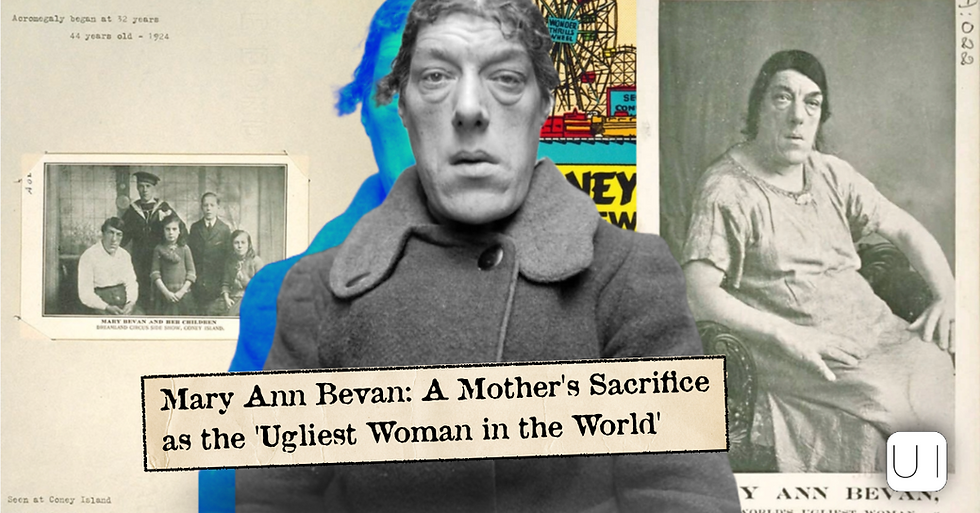
In the early 20th century, Mary Ann Bevan became known to the world under the cruel moniker "The Ugliest Woman in the World." To many, her appearance was a spectacle, a source of mockery and gawking. But behind the sideshow posters and public ridicule was a story of profound sacrifice, resilience and love, one that would eventually catch the attention of the one man in the world most qualified to understand exactly what had happened to her body.
A Life of Promise
Born Mary Ann Webster in Plaistow, East London, on 20 December 1874, Mary Ann grew up in a large working-class family, one of eight children. Despite limited means, she carved out a promising future for herself, qualifying as a nurse in her early twenties, a respectable and essential profession at the time. By every account, she was an attractive young woman before anything about her began to change. In 1902, she married Thomas Bevan, a farmer from Kent, and together they had four children, two sons and two daughters. For a while, it looked like a steady, fulfilling life.
The Onset of Acromegaly
That changed not long after the wedding. When Mary Ann was around 32, she began to notice unsettling changes in her body. Her hands and feet started to swell, her facial structure altered, and her once-delicate features grew coarse. She was developing acromegaly, a rare condition caused by an overproduction of growth hormone by the pituitary gland, and one that medical science of the time barely understood. Left untreated, it caused her bones and soft tissues to grow abnormally: her brow and jaw jutted forward, her nose expanded, and her hands and feet swelled to the point that she eventually needed a size 11 shoe.

Thomas stood by Mary Ann through more than a decade of this visible transformation. Her disfigurement wasn't a second tragedy that struck alongside her husband's death, it was something the two of them lived with together for years first. The second blow came separately, in 1914, when Thomas died suddenly and left her a widow with four children and no income.
A Bold Decision
With her nursing career no longer viable, Mary Ann eventually answered a newspaper advertisement placed by a British agent for Barnum and Bailey's circus in 1920. It read, in full: "Wanted: Ugliest woman. Nothing repulsive, maimed or disfigured. Good pay guaranteed, and long engagement for successful applicant. Send recent photograph." It's a genuinely strange piece of writing to have decided the direction of someone's entire life, and Mary Ann answered it out of necessity rather than choice. The agent who reviewed her photograph described her face, in what reads almost like a backhanded compliment, as unusual but not genuinely unpleasant to look at. She got the job, and it wasn't long before American showman Samuel W. Gumpertz offered her a spot at Coney Island's Dreamland Sideshow in New York, performing under a title she'd never chosen for herself. It was a grim prospect, standing before crowds who came specifically to gawk at her appearance, but she accepted, driven entirely by the need to support her children.
Life as a Sideshow Performer
Billed as "The Ugliest Woman in the World," Mary Ann became a staple attraction, drawing large crowds eager to see her unusual appearance. Posters advertised her height, weight and the specifics of her enlarged hands and feet, encouraging spectators to gawk and jeer. She supplemented her sideshow wages by selling postcards of her own image at fairgrounds, earning roughly $12 per card, and later toured with Ringling Brothers, performing, as one contemporary account put it, between the Fat Lady and the Armless Wonder. Despite the humiliation built into the job itself, she remained visibly proud of her role as a mother, frequently showing visitors photographs of her children and reminding onlookers more than once that the whole point of the exercise was for them, not for her.

A Doctor Who Understood Exactly What Had Happened to Her
That mix of dignity and desperation eventually reached the attention of Dr. Harvey Cushing, and the connection was less of a coincidence than it might first appear. Cushing wasn't just a respected physician. He's widely considered the father of modern neurosurgery, and it was his own research that first proved acromegaly was caused by pituitary gland overactivity, the exact mechanism behind Mary Ann's condition. He'd spent decades studying and operating on the very gland responsible for what the public was paying to gawk at. So when Time magazine ran a piece mocking her appearance in 1927, Cushing was uniquely positioned to respond, and he did, writing a pointed letter of protest that described the woman she'd been before the disease took hold, once vigorous and good-looking, now reduced by a national magazine to a punchline. "Being a physician," he wrote, "I do not like to feel that Time can be frivolous over the tragedies of disease." It's one of the only recorded instances of someone with real scientific standing publicly defending Mary Ann's dignity during her own lifetime, made more pointed by the fact that it came from literally the world's foremost expert on the disease that had reshaped her face.
Financial Success
Whatever the cost to her dignity, Mary Ann's decision to enter the sideshow world paid off in the most literal sense. Over the years, she earned an estimated $50,000, a considerable fortune equivalent to roughly $1 million today. That income ensured her children were fed, educated and cared for, and it gave her a degree of financial stability that her nursing income alone could never have provided after Thomas's death.
The Final Years
Mary Ann kept performing until her health genuinely gave out. The effects of acromegaly, combined with the physical toll of years on the sideshow circuit, brought increasing pain and partial blindness, itself a known complication of the condition caused by pressure the pituitary tumor put on her optic nerves. She worked until she truly couldn't continue, driven to the end by the same commitment that had put her on that circuit in the first place. Mary Ann Bevan died on 26 December 1933, six days after her 59th birthday, and was buried in South London's Ladywell and Brockley Cemetery, fulfilling her wish to be laid to rest near her home.

A Legacy That Outlasted the Cruelty
Even that wasn't the end of the exploitation. In 2006, Hallmark Cards printed her photograph on a UK birthday card intended as a joke about ugliness, more than seven decades after her death. The card sparked real public backlash after a Dutch endocrinologist who'd researched her condition recognized her photograph and spoke out publicly, arguing it was deeply inappropriate to turn a woman who'd suffered from a genuine, disfiguring disease into a novelty punchline all over again.
Mary Ann Bevan's story is a complex and poignant one. She endured public ridicule and a cruel title, but she also demonstrated extraordinary determination, going so far as to make a living out of the very thing the world used to humiliate her, purely so her children would never feel the financial desperation that drove her into the sideshow in the first place. She was far more than the label assigned to her: a mother, a provider, and a woman who, in the end, found one genuine, expert defender in a world that mostly just wanted to stare. Her story sits alongside other sideshow performers whose real character got lost behind the cruel banner they performed under, women like Grace McDaniels, billed as the Mule-Faced Woman, who built a similarly quiet, determined life around providing for her own child.