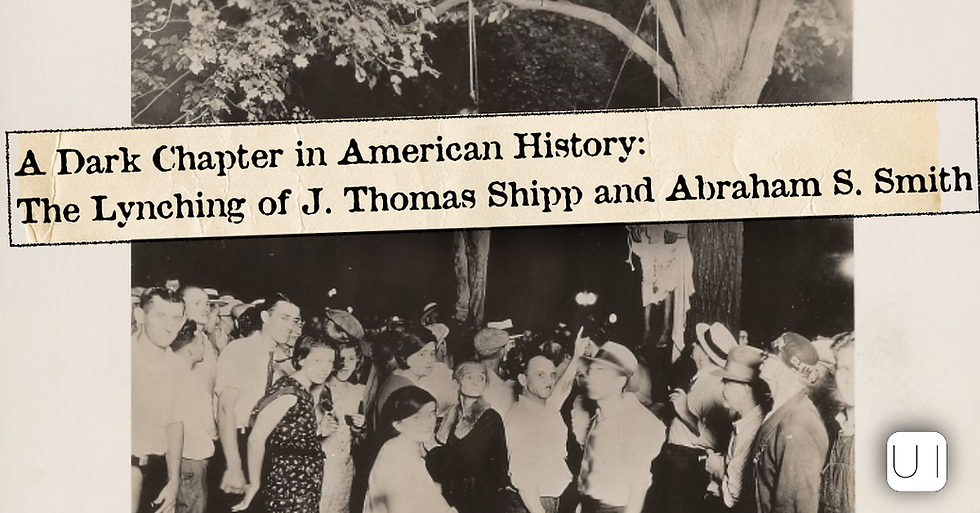
The Lynching of Thomas Thurmond and John Holmes: San Jose's Darkest Night
On a Sunday night in November 1933, thousands of people crammed into a city park in San Jose, California, to watch two men being hanged from trees. Radio stations had been trailing it all afternoon. The governor had refused to send troops. And when it was all over, people hacked bits off the trees to take home as keepsakes.
The two men were Thomas Harold Thurmond and John Maurice "Jack" Holmes, who'd confessed to kidnapping and murdering Brooke Hart, the 22-year-old heir to one of the city's best-known shops. Here's how a botched ransom plot turned into one of the most shameful nights in Californian history, and how the state's governor ended up with the nickname "Governor Lynch".
Quick Answers
Who were Thurmond and Holmes? Two San Jose men who confessed to the November 1933 kidnapping and murder of department store heir Brooke Hart.
When and where were they lynched? Late on 26 November 1933, in St. James Park, right across the road from the Santa Clara County Jail.
How many people watched? Estimates run from about 3,000 to more than 15,000, including women and children.
Was anyone punished? No. A few men were arrested, but nobody was ever convicted.
Who Was Brooke Hart?
Brooke Leopold Hart was born on 11 June 1911, the eldest son of Alexander Hart, whose family ran L. Hart & Son, a large department store on the corner of Market and Santa Clara streets in downtown San Jose. Brooke had just graduated from Santa Clara University and his dad was getting him ready to take over the business one day.
He was young, popular and comfortably off. He also drove a brand new Studebaker President roadster his parents had given him as a graduation present. To a couple of local men with big ideas and very little sense, he looked like a payday.
The Kidnapping on 9 November 1933
Just before 6pm on Thursday 9 November, Brooke collected the Studebaker from the car park behind the family store. He never made it home.
At about 9:45 that night the phone rang at the Hart house. Brooke's 18-year-old sister Aleese answered, and a man told her that her brother was being held for $40,000 in cash and would be killed if the family went to the police. Alex Hart called them anyway. As Crime Library's detailed reconstruction of the case explains, federal agents from what would become the FBI wired up recording equipment on the family phone and put a man inside the house. Brooke's car turned up abandoned in the hills that same night.
What the Harts didn't know was that Brooke was already dead. Time magazine reported a fortnight later that his kidnappers had driven him to the San Mateo Bridge, smashed his skull with a brick from behind, tied him up with baling wire, pinched his wallet and dumped him over the railing into San Francisco Bay. Accounts of the killing differ in the details. Some say he was pistol-whipped, and later versions claim the tide was out, so he was shot as he struggled in the shallow water. Either way, every ransom call that followed came from men who knew there was nobody left to ransom.
Ransom Notes and a Phone Box Arrest
For the next week the kidnappers kept up the act with letters and phone calls. One long note ordered Alex Hart to take the $40,000 and drive alone towards Los Angeles in the Studebaker. Brooke's wallet was later found on a tanker ship in the bay, which only made the family's dread worse.
The plot fell apart because Thurmond couldn't stop phoning. During another call to the Hart house, an agent listened in while the operator traced the line. Alex Hart stalled, telling the caller he couldn't drive and would need to find someone to take the car. That bought enough time for the call to be traced to a pay phone at a garage on South Market Street, a short walk from City Hall.
When officers yanked open the booth, the caller found himself face to face with Sheriff William Emig. The frightened man gave his name as Harold Thurmond. Within hours he'd named his partner, Jack Holmes, a 29-year-old who'd been born in Los Angeles and had never been arrested for anything in his life.
Both men confessed, but each blamed the other for the worst of it. The FBI's own case summary records that they admitted robbing Hart, wrapping him in wire, weighting him down and throwing him off the San Mateo Bridge.
How a City Turned Into a Mob
Kidnapping for ransom was the crime that terrified America in the early 1930s. The Lindbergh baby had been snatched and killed only the year before, and the idea of a local lad being taken off the street and murdered for cash sent San Jose into a rage that built for more than two weeks.
Then came two bits of news that poured petrol on it. Local papers reported that Thurmond and Holmes had been seeing psychiatrists and might plead not guilty by reason of insanity. And Holmes's father had handed San Francisco lawyer Vincent Hallinan a staggering $10,000 to defend his son. To plenty of locals, it looked like the pair might wriggle out of the noose through the courts.
Sheriff Emig could see where this was heading. He asked Governor James Rolph to send in the National Guard to protect his prisoners. Rolph refused, and he told reporters so days before anything happened.
On the morning of 26 November, Brooke Hart's body was finally recovered from the bay near the San Mateo Bridge. Word spread across northern California within hours, and local radio stations broadcast the plan for a lynching in St. James Park that very night.
The Night of 26 November 1933
By 6pm hundreds of men had gathered outside the county jail. The crowd swelled through the evening as people came out of cinemas and passing drivers parked along First Street to see what all the cheering was about. Deputies fired tear gas, but it barely slowed anyone down. One officer later told the Associated Press, "The mob seemed to be insane."
The rioters used lengths of iron pipe as battering rams to smash through the jail's doors, beat the guards and hauled Thurmond and Holmes out. Photos from the following morning show police officers inspecting 30-foot pipes the mob left behind.
The two men were dragged across the road into St. James Park and beaten until they were barely conscious. As the Without Sanctuary archive of lynching photography records, Holmes had every stitch of clothing torn off him, while Thurmond's trousers were pulled down to his ankles. Thurmond was hanged from a tree around 100 yards from the jail, and Holmes was strung up a few minutes later. Torches lit the scene and some accounts say the crowd tried to set fire to the bodies.
Nobody agrees on how many people were there. Contemporary newspapers guessed anything from 3,000 to 10,000, and one estimate held by San José State University's special collections puts it at over 15,000. Whatever the true figure, it included women and children, and reporters, photographers and newsreel cameramen recorded the whole thing.
Souvenirs, Postcards and a Confiscated Front Page
The next morning St. James Park was a wreck, and curiosity seekers were still wandering about looking for mementos. Police had to keep back souvenir hunters after a twig from the so-called gallows tree, which had already had its bark and lower branches hacked away.
Street hawkers sold postcards of the dead men, while others flogged chunks of tree limb. The city eventually cut the trees down altogether. Somebody even printed an accordion fold-out booklet called "Official Photographs of Lynching of San Jose Kidnapers", a copy of which survives at History San José.
The local press had its own problems. One morning paper ran a front-page photo of Holmes's naked body, and the city's leaders were so offended by it that they ordered the entire edition confiscated. Meanwhile the bodies of Thurmond and Holmes lay in the county morgue right next to Brooke Hart's, until the Hart family had their son moved to a funeral home later that morning.
The Governor Who Cheered It On
If San Jose's reaction was grim, Sacramento's was worse. The day after the lynching, Governor Rolph publicly approved of it, telling the press "If anyone is arrested for this good job, I'll pardon them all." He went further, saying he'd happily parole every convicted kidnapper in San Quentin and Folsom prisons to the people of San Jose. He even defended the mob in a radio and newsreel address.
The backlash was huge. President Franklin Roosevelt and former President Herbert Hoover both condemned him, and the Southern Commission on Inter-Racial Relations accused him of being in effect an accessory before the fact for refusing to call out troops. Within weeks there were calls for his impeachment.
Not everyone was appalled, though. Telegrams of praise flooded into San Jose and the governor's office. The editors of the Harvard Crimson backed Rolph, and at Stanford one professor asked his students to stand and applaud the lynching. A Philadelphia socialite even wired the governor her congratulations.
Then came the darker consequence. Just days after San Jose, a mob in St. Joseph, Missouri, lynched a young Black man named Lloyd Warner, and Time noted that many Americans held Rolph directly responsible for encouraging it. Rolph never faced any real consequences himself. He died in office on 2 June 1934.
Nobody Was Ever Convicted
Thousands of people saw exactly who did what in St. James Park, and plenty of it was photographed. It made no difference.
A 17-year-old called Anthony Cataldi bragged that he'd led the mob, but he was never held to account. Seven men were eventually arrested on various charges linked to the killings, yet the Santa Clara County grand jury never indicted the mob. The San Jose News refused to print pictures of the lynching but backed it in an editorial anyway. In the end, not a single person was convicted of anything.
How the San Jose Lynching Lived On
Royce Brier's coverage for the San Francisco Chronicle, written on deadline as the mob battered the jail, won him the 1934 Pulitzer Prize for reporting. The story also caught the eye of Hollywood. In 1936 MGM released Fury, Fritz Lang's first American film, starring Spencer Tracy as an innocent man who barely survives a lynch mob. Turner Classic Movies calls it one of Lang's finest American pictures, it picked up an Oscar nomination for Best Story, and NAACP secretary Walter White wrote to congratulate Lang after seeing it.
There's an uncomfortable side to all this attention. Thurmond and Holmes were white, and the case got national coverage partly because it happened to white men in a big city. Most lynching victims in America were Black, and their deaths were often barely reported at all. From the lynching of Will Brown in Omaha to the murders of Thomas Shipp and Abram Smith in Marion, Indiana, crowds behaved in much the same way and nobody was punished either. The same pattern would play out again decades later with the abduction and murder of Emmett Till.
Today a San Jose History Walk marker in St. James Park mentions the killings, calling them California's last lynching. That's not strictly true, as a mob in Yreka lynched a man named Clyde Johnson in 1935. But the park's still there, opposite where the old jail stood, and most people strolling through it have no idea what happened under those trees.
Suggested Reading
Want to dig deeper into the Brooke Hart case and the history of lynching in the American West? These are worth a look.
Swift Justice: Murder and Vengeance in a California Town by Harry Farrell. The go-to book on the Hart kidnapping and the St. James Park lynching, written by a veteran San Jose newspaperman.
Without Sanctuary: Lynching Photography in America by James Allen. A hard but important collection of the postcards and photos that lynch mobs made and sold, including images from San Jose.
Lynching in the West: 1850-1935 by Ken Gonzales-Day. Looks at hundreds of California lynchings that history mostly forgot, with a lot of Mexican and Native American victims.
As an Amazon Associate, Utterly Interesting earns from qualifying purchases.
You Might Also Like
Sources
Vigilantes in California lynch two suspected murderers, History.com
The Kidnapping and Murder of Brooke Hart, Crime Library
'Lynching Is A Sincere Demand', Crime Library
Crime: Death After Dark, Time
Brooke L. Hart kidnapping case summary, FBI (archived)
Brooke Hart Kidnapping Newspaper Collection, San José State University Special Collections, via Online Archive of California
The Knickerbocker Press, 28 November 1933, Rare Newspapers
Lynching photographs, San Jose 1933, Without Sanctuary
The lynching of John (Jack) Holmes, Without Sanctuary
"Official Photographs of Lynching of San Jose Kidnapers", History San José, via Calisphere
Jail After Lynch Mob Breaks In, San Jose, California, November 27, 1933, Bridgeman Images
Governor Rolph on the San Jose lynching, The Star (Christchurch), 28 November 1933, via Papers Past
U.S.A. Lynch Law: Opinion Divided, Hokitika Guardian, 30 November 1933, via Papers Past
Mr James Rolph, Governor of California, Timaru Herald, 12 December 1933, via Papers Past
Lesson Learned, Time, 11 December 1933, via Maryland State Archives
James Rolph, Jr., Museum of the City of San Francisco
New photo exhibit examines California's history of lynching and frontier justice, LAist
St. James Park lynching marker, James Madison University Lynching Markers project
Fury (1936), Turner Classic Movies
Fury (1936), AFI Catalog