The Day In 1857 That The Dead Rabbits And Bowery Boys Rioted In Lower Manhattan
Updated: Oct 6

On the evening of 4 July 1857, while most of New York was celebrating Independence Day with fireworks and street parties, a gang of Irish immigrants from the Five Points neighbourhood marched into the Bowery, smashed their way into a rival clubhouse, wrecked the bar, ripped up the dance floor, drank everything in the place, and started a two-day street war that left at least eight people dead and more than 100 injured. The New York Times headline the following morning read: "RIOTING AND BLOODSHED; THE FIGHT AT COW BAY. Metropolitans Driven from the 6th Ward. Chimneys Hurled Down Upon the Populace."
Five Points and the Bowery
To understand the riot, you need to understand the geography. Five Points was a slum neighbourhood in Lower Manhattan, built on the site of a former pond that had been filled in badly, leaving the ground permanently damp and the buildings permanently tilting. By the 1840s it was one of the most densely populated and reputedly dangerous neighbourhoods in the world, home mainly to newly arrived Irish Catholic immigrants who'd fled the famine. It was the kind of place Charles Dickens visited on a tour of America in 1842 and described in his American Notes with barely concealed horror.

A mile north, the Bowery was a different world. Broad, commercially active, lined with theatres, saloons, and oyster bars, it was the territory of the Bowery Boys, a nativist gang of native-born Protestant Americans who viewed the Irish flood into their city with deep hostility. They were affiliated with the Know Nothing Party, a political movement that wanted to restrict immigration and keep Catholics out of public office. Their antipathy toward Five Points was ideological as much as territorial.
Between these two neighbourhoods, there had been more than 200 gang battles in the ten years leading up to 1857. The riot wasn't an aberration. It was the logical extreme of an ongoing war.
The Dead Rabbits: Who Were They?
The Dead Rabbits were an Irish American gang that had split off from another Five Points outfit called the Roach Guards after a dispute at a gang meeting, during which someone flung a dead rabbit across the room. The dissidents took this as an omen, named themselves accordingly, and adopted a dead rabbit on a pike as their battle symbol. Herbert Asbury, whose 1928 book Gangs of New York popularised all of this, was later criticised by historians for embellishing freely, but the basic story of the name has held up. The term "dead rabbit" was also a combination of period slang ("dead" meaning "very") and mangled Gaelic ("raibead" meaning "a tough guy"), which meant the name worked on multiple levels for its members.
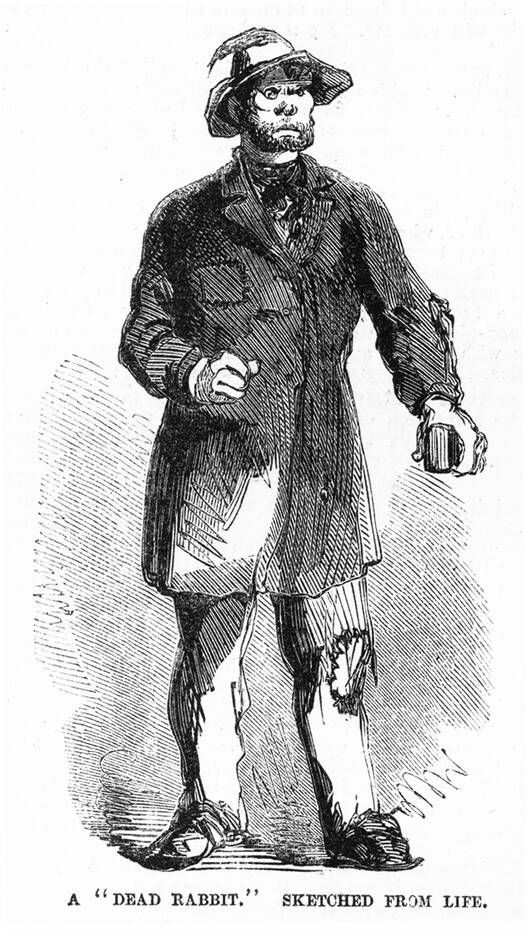
By the 1850s, the press was using "Dead Rabbits" as a catch-all term for all Five Points gangs, which annoyed the actual Dead Rabbits enough that they issued a public denial after the July riot, stating through a newspaper intermediary that they "did not participate in the riot with the Bowery Boys, and that the fight on Mulberry Street was between the Roach Guards of Mulberry Street and the Atlantic Guards of the Bowery. The Dead Rabbits are sensitive on points of Honor, we are assured, and wouldn't allow a thief to live on their beat, much less be a member of their club." Whether this was true or a face-saving exercise remains debated.
The Police Problem
The riot happened at a particularly convenient moment for anyone wanting to cause mayhem without police interference. In June 1857, just weeks before the riots, New York City had experienced something historians call the Police Riot: a physical confrontation between two rival police forces. The state government had created a new Metropolitan Police force in April 1857, funded and controlled by Albany rather than City Hall, as part of a Republican attempt to break Democratic control over the city. The Democratic mayor refused to recognise the new force and kept his own Municipal Police running alongside it. The two departments weren't cooperating. They were barely speaking.
When the Dead Rabbits marched into the Bowery on the evening of 4 July, the Metropolitan and Municipal police each claimed the other was responsible for handling the situation. Neither did much. The gangs noticed.
The Riot
The Five Points gangs, including the Dead Rabbits, Plug Uglies, and Roach Guards, invaded the Bowery clubhouse of the Bowery Boys and Atlantic Guards and systematically destroyed it. They wrecked the bar, stripped the dance floor, and drank the place dry. When the Bowery Boys rallied and confronted them on the street, the fighting spread outward through Bayard, Mulberry, Elizabeth, and Baxter Streets. By the following morning, both sides had returned in larger numbers.
What followed was, by any measure, a pitched battle. The New York Times estimated 800 to 1,000 gang members were involved. Weapons included iron bars, paving stones, axes, clubs wrapped in rabbit skins (the Dead Rabbits' signature), and brickbats torn from buildings. Residents of the surrounding tenements joined in by hurling chimney pots and roof slates from above. A lone Metropolitan patrolman who tried to wade into the fighting at Bayard Street was knocked down, stripped of his uniform, beaten with his own nightstick, and escaped wearing only his underwear.

When a small police squad arrived at Centre Street, the gangs temporarily united and turned on the police instead, forcing them to retreat. The officers tried again, fighting through the mob and managing to arrest two men they believed were ring leaders. The gangs responded by storming the buildings lining Bayard Street, forcing residents out, climbing to the rooftops, and showering the police with stones until they fled again.
"Brickbats, stones and clubs were flying thickly around, and from the windows in all directions, and the men ran wildly about brandishing firearms. Wounded men lay on the sidewalks and were trampled upon."
That account comes from the contemporary press. It wasn't until the afternoon of 5 July that order was restored, when the New York State Militia arrived with three regiments under Major-General Charles W. Sandford. By then, the officially confirmed death toll stood at eight, though contemporaries believed the true number was higher, since gang members had a well-established practice of carrying off their wounded and dead before the police could count them.
What It Was Really About
The riot was gang violence, but it wasn't only gang violence. It was a physical expression of one of the central tensions in mid-19th century American life: what to do with the more than 1.5 million Irish immigrants who had arrived in the US between 1845 and 1855, fleeing famine, and who had clustered in cities like New York in numbers that alarmed the Protestant establishment. The Bowery Boys weren't just street thugs. They were the street-level arm of the Know Nothing movement, which at its peak in 1854 had elected mayors in Boston, Philadelphia, and Washington, and won 52 seats in Congress. Their hostility to the Irish wasn't incidental to their identity. It was the point.
The Dead Rabbits, for their part, were fighting to hold territory in a city that was actively hostile to their presence. The connections between the Five Points gangs and Tammany Hall, the Democratic political machine that depended on Irish immigrant votes, gave them a degree of political protection that the Bowery Boys' Know Nothing affiliations were designed to break. It was Marm Mandelbaum who would later demonstrate how thoroughly women had integrated into this criminal ecosystem, running a fencing operation out of the same Five Points milieu that produced the Dead Rabbits, with Tammany protection and enough political cover to operate openly for decades.
The Aftermath and Legacy
No significant prosecutions resulted from the riot. The police situation was eventually resolved when the courts ruled in favour of the Metropolitan force and the Municipal Police was disbanded in August 1857, just weeks after the riot. The Know Nothing Party effectively collapsed after the 1856 presidential election, removing one of the Bowery Boys' main political patrons. By 1866, newspapers had stopped mentioning the Dead Rabbits as an active organisation, and "dead rabbit" had become generic slang for a rioter.
The 1857 riot remained the largest gang violence event in New York until the Draft Riots of 1863, when conscription anger turned into three days of violence that left over 100 people dead and became the deadliest civil insurrection in American history.
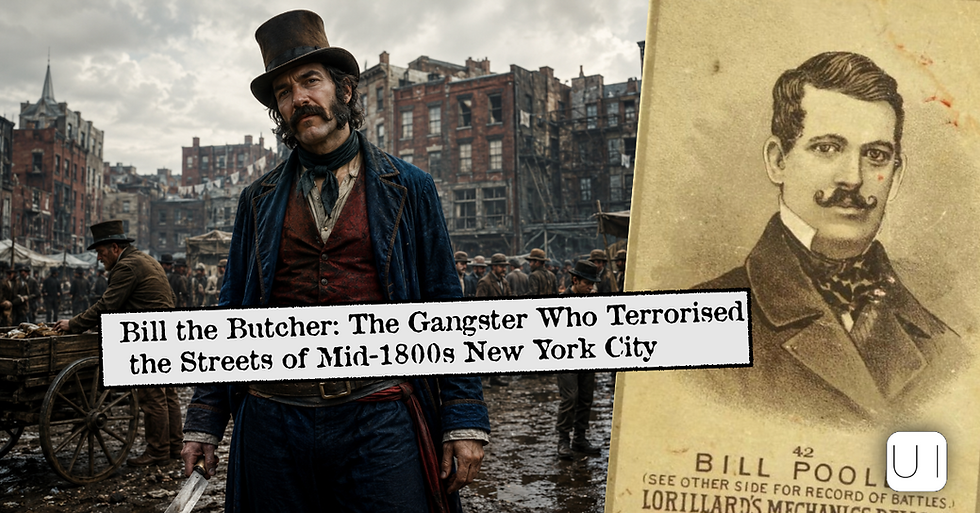
The whole era was popularised and heavily fictionalised by Martin Scorsese's 2002 film Gangs of New York, inspired by Asbury's book, in which Daniel Day-Lewis plays a version of Bill the Butcher. The film compresses years of history into a single narrative arc and takes significant liberties with the facts, but it captures the essential character of the period: a city where gang membership and political affiliation were so intertwined that you couldn't really separate them, and where the streets of Lower Manhattan were contested territory that was settled, not by courts or politicians, but by whoever turned up with the most paving stones.
Sources:
1. Wikipedia: Dead Rabbits riot. https://en.wikipedia.org/wiki/Dead_Rabbits_riot
2. New York Times archive: "Rioting and Bloodshed; The Fight at Cow Bay," July 6, 1857. https://query.nytimes.com/mem/archive-free/pdf?res=9C07E1DE163CEE34BC4E53DFB166838C649FDE
3. Ephemeral New York: The bloody, two-day "Great Gang Fight" of 1857. https://ephemeralnewyork.wordpress.com/2011/01/10/the-bloody-two-day-great-gang-fight-of-1857/
4. Tyler Anbinder, Five Points: The 19th-Century New York Neighbourhood That Invented Tap Dance, Stole Elections and Became the World's Most Notorious Slum. Free Press, 2001.
5. Herbert Asbury, The Gangs of New York: An Informal History of the Underworld. 1928.
6. Bowery Boys History: William Poole aka Bill the Butcher. https://www.boweryboyshistory.com/2021/07/william-poole-aka-bill-the-butcher-was-born-200-years-ago.html