The Bowery Boys: New York's Nativist Gang Who Hated the Irish
Updated: Oct 6

There's a version of the Bowery Boys that gets handed down as entertaining New York folklore: tough guys in stovepipe hats and red shirts, brawling in the streets, part of the colour of a rougher, more chaotic city. The reality was less picturesque. The Bowery Boys were a nativist gang whose reason for existing was, in large part, hatred of Irish Catholic immigrants. Their political affiliations made them the street-level arm of a movement that at its peak controlled Congress and several American cities. They were violent, organised, and deeply ideological, which made them more dangerous than most street gangs of the period.
Who Were the Bowery Boys?
The Bowery Boys took their name from the Bowery, a broad avenue running through Lower Manhattan that by the 1840s had become a centre of theatres, saloons, oyster bars, and working-class entertainment. Unlike Five Points, a mile to the southwest, the Bowery was not a slum. It was a rough but commercially active street with a distinct identity: loud, populist, and proudly American-born.

The gang emerged from the volunteer fire companies that operated in the area. Before New York had a professional fire service, fires were fought by competing volunteer brigades that were as much social clubs and political organisations as emergency services. The Howard Fire Engine Company Number 34, based near the Bowery, was one of the breeding grounds for what became the Bowery Boys. Members wore distinctive uniforms of red shirts, trousers tucked into boots, and tall stovepipe hats. The look became so associated with the gang that it was recognisable across the city.
Their membership was predominantly native-born Protestant Americans, many of Anglo-Irish Protestant descent, which partly explains the paradox Herbert Asbury noted in his 1928 book: that the Bowery Boys were an anti-Irish gang despite having significant Irish Protestant membership. The distinction between Irish Protestants and Irish Catholics was fundamental to their ideology. They weren't anti-Irish in a simple ethnic sense. They were anti-Catholic, anti-immigrant, and convinced that the wave of Catholic Irish arriving from the famine were going to overwhelm American institutions and hand political power to the Pope.
Writer James Dabney McCabe observed of the Bowery B'hoy in 1872:
“You might see him ‘strutting along like a king’ with his breeches stuck in his boots, his coat on his arm, his flaming red shirt tied at the collar with a cravat such as could be seen nowhere else...None so ready as he for a fight, none so quick to resent the intrusion of a respectable man into his haunts.”
The Know Nothing Connection
The Bowery Boys' political affiliation was with the American Party, more commonly known as the Know Nothing Party, a nativist political movement that peaked in the mid-1850s. The Know Nothings wanted to restrict immigration, extend the period required for naturalisation from five to twenty-one years, and exclude Catholics from public office. Their name came from a deliberate policy of secrecy: members were instructed to say "I know nothing" if asked about the organisation's activities.
At the movement's peak in 1854 and 1855, the Know Nothings were a genuine political force. They elected the mayors of Boston, Philadelphia, and Washington. They won 52 seats in Congress in the 1854 midterms. They controlled the Massachusetts state legislature. In New York, they were closely allied with the Bowery Boys, who served as enforcers on election days, intimidating opposition voters and guarding polling stations. The gang and the party needed each other: the Know Nothings needed muscle, and the Bowery Boys needed political cover.
Bill the Butcher
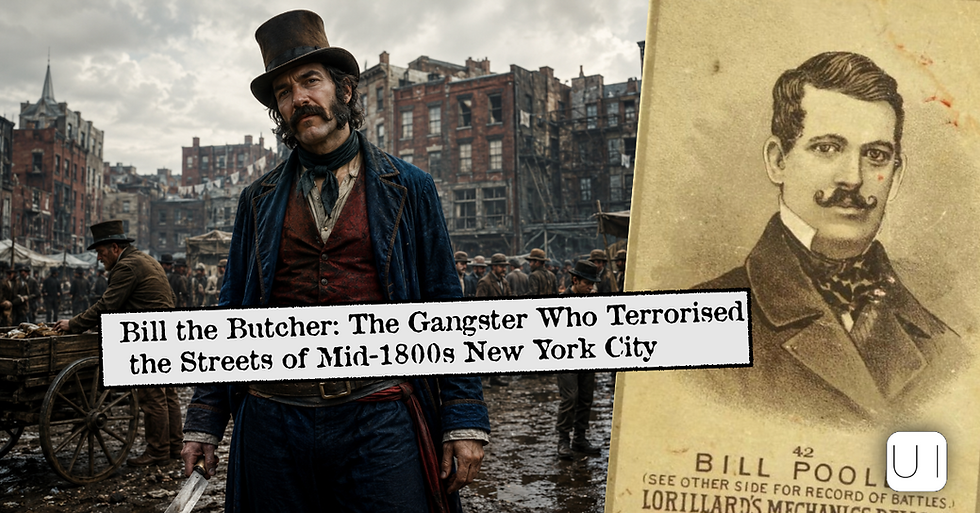
The most notorious figure associated with the Bowery Boys was William Poole, better known as Bill the Butcher. A six-foot, 200-pound former butcher and bare-knuckle boxer who had grown up near Washington Market, Poole fused the gang's street violence with its political ambitions more completely than anyone else. He was an early organiser of the Know Nothing movement in New York, using the gang's muscle to deliver votes and terrorise political opponents. His full story is covered in our dedicated Bill the Butcher article, but the short version is that he was shot in a saloon brawl in February 1855, lingered for nearly two weeks, and died reportedly saying "Goodbye boys, I die a true American." His funeral drew thousands of mourners and his coffin was draped in an American flag. He became a martyr for the nativist cause, which tells you something about the times.

Fighting the Dead Rabbits
The Bowery Boys fought more than 200 battles with Five Points gangs, principally the Dead Rabbits, over roughly a decade from the mid-1840s to the late 1850s. These weren't random brawls. They were territorial and political confrontations fought over control of streets, polling stations, and the right to exist unmolested in the city. The largest single confrontation was the Dead Rabbits riot of July 4, 1857, when the Dead Rabbits led a coalition of Five Points gangs into the Bowery, wrecked the Bowery Boys' clubhouse, and started two days of street warfare that required three militia regiments to stop.
The 1857 riot happened partly because both the Metropolitan and Municipal police forces were in the middle of their own political dispute and neither was willing to intervene. It was the largest gang violence event in New York history until the 1863 Draft Riots.
Decline and Legacy
The Know Nothing Party effectively collapsed after the 1856 presidential election, when its presidential candidate Millard Fillmore finished third. Without a functioning political patron, the Bowery Boys lost their most important source of protection and purpose. The Draft Riots of 1863, driven largely by the same working-class nativist anger the Bowery Boys had channelled, were chaotic and leaderless in a way that the more organised gang violence of the 1850s had not been. By the late 1860s, the Bowery Boys as a coherent organisation had dissolved.
The Bowery itself changed too. The theatre district migrated uptown, the saloons became less glamorous, and the neighbourhood gradually became associated with poverty and skid row rather than working-class swagger. By the early 20th century, the Bowery was a byword for homelessness and alcoholism, a long way from the red-shirted toughs who had once fought Irish immigrants in the streets.
The gang's cultural legacy is complicated. They've been romanticised in film and fiction, most notably as the antagonists in Scorsese's Gangs of New York, but their ideology was straightforwardly nativist and their violence was organised and political. The Know Nothing movement they served didn't disappear, it simply transformed. Similar arguments about immigration, Catholicism, and national identity resurfaced in the 1890s, the 1920s, and periodically ever since. The Bowery Boys were a local gang, but the ideas they were fighting for were not local at all. For another example of organised gang culture from the same era, the Apache gangs of Paris offer a fascinating European parallel: street gangs who became notorious for organised violence and developed their own mythology that outlasted the gangs themselves.
Sources:
1. Wikipedia: Bowery Boys. https://en.wikipedia.org/wiki/Bowery_Boys_(gang)
2. Wikipedia: Know Nothing. https://en.wikipedia.org/wiki/Know_Nothing
3. New York Almanack: Bill the Butcher, a Nativist Know Nothing Movement Martyr. https://www.newyorkalmanack.com/2023/11/bill-the-butcher-poole-nativist/
4. Tyler Anbinder, Five Points. Free Press, 2001.
5. Herbert Asbury, The Gangs of New York. 1928.