The Dead Rabbits: The Irish Gang That Ruled New York's Five Points
Updated: Oct 6

The name alone has done most of the work for the Dead Rabbits' reputation. It sounds invented, the kind of thing a Hollywood screenwriter comes up with at 2am. But the Dead Rabbits were real, they operated in Lower Manhattan for roughly three decades, and the name came from exactly the kind of chaotic, drunken moment you'd expect from a 19th-century street gang meeting.
Where They Came From
Five Points was a slum neighbourhood in Lower Manhattan built on the site of a former pond, the Collect Pond, that had been drained and filled in during the 1810s. The fill was poor and the ground remained permanently damp, which meant buildings sank, tilted, and rotted faster than usual. By the 1830s, Five Points was one of the most densely packed and reputedly dangerous neighbourhoods in the Western world, home mainly to Irish Catholic immigrants who had arrived destitute and had nowhere else to go.
Charles Dickens visited in 1842, escorted by two policemen, and described what he saw in American Notes: "From every corner, as you glance about you in these dark retreats, some figure crawls half-awakened, as if the judgment hour were near at hand, and every obscure grave were giving up its dead." It was that kind of place.
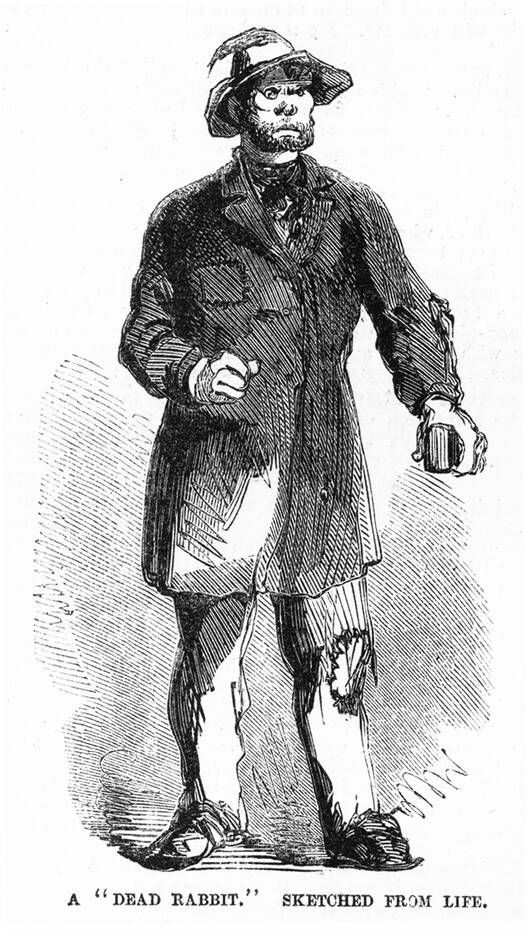
The Dead Rabbits emerged as a splinter group from the Roach Guards, one of Five Points' established Irish gangs, sometime in the 1840s. The split was characteristically dramatic. During a heated gang meeting, someone threw a dead rabbit into the centre of the room. A faction took this as an omen and walked out. They called themselves the Dead Rabbits and adopted a rabbit carcass on a pike as their battle standard. Historians have pointed out that "dead rabbit" also worked as slang on two levels: "dead" was period slang for "very," and "raibead" was a Gaelic term meaning roughly "tough guy," so the name translated loosely as "very tough men," which was exactly the impression they wanted to make.
How They Were Organised
The Dead Rabbits weren't a criminal organisation in the modern sense. They didn't run extortion rackets or control drug supply chains. They were a street gang in the original meaning: a group of men from the same neighbourhood who organised for mutual protection, political muscle, and territorial control. Their main functions were fighting rival gangs, particularly the Bowery Boys, turning out votes for Tammany Hall candidates on election days, and protecting their patch of Five Points from encroachment.
Tammany Hall, the Democratic political machine that dominated New York City politics for much of the 19th century, had a symbiotic relationship with Five Points gangs. Tammany needed votes from newly arrived Irish immigrants. The gangs needed political protection and the occasional blind eye from the police. On election days, gang members served as "shoulder-hitters," intimidating opposition voters and guarding polling stations. In return, gang members who were arrested could expect Tammany-connected lawyers and judges to intervene on their behalf. It was a corrupt system that worked efficiently for everyone involved, except the people on the wrong end of it.
Their chief rivals were the Bowery Boys, a nativist gang of native-born Protestant Americans who were affiliated with the Know Nothing Party and specifically hostile to Irish Catholic immigration. The two groups fought more than 200 battles over roughly a decade, which works out to a gang fight every 18 days on average.
Weapons and Tactics
The Dead Rabbits weren't known for firearms, though they had them. Their typical arsenal was whatever came to hand: paving stones, iron bars, clubs wrapped in rabbit skins (both a weapon and an identifier in a crowd), brickbats, and knives. In large-scale confrontations they also used axes and, in the 1857 riot, chimney pots hurled from rooftops.
Their tactics in street fights were straightforward: numbers and aggression. They operated as a coalition with other Five Points gangs, including the Roach Guards and the Plug Uglies, when the situation called for it, forming temporary alliances against the Bowery gangs despite the fact that the Dead Rabbits and Roach Guards also fought each other regularly. The ability to switch between fighting each other and fighting a common enemy was a feature of Five Points gang politics rather than a bug.
The 1857 Riot
The Dead Rabbits' most famous moment came on the evening of 4 July 1857, when they led a coalition of Five Points gangs into the Bowery, raided a Bowery Boys clubhouse, wrecked it entirely, and started a two-day street war that left at least eight people dead. The full story of that riot is covered in our dedicated Dead Rabbits and Bowery Boys riot article, but the short version is that the New York police were in the middle of their own institutional crisis and did almost nothing to stop it, and three militia regiments eventually had to restore order.

After the riot, the Dead Rabbits issued a public statement through a newspaper intermediary denying they had been involved, claiming the fighting was between the Roach Guards and the Atlantic Guards. Historians generally treat this with scepticism, but it says something about the Dead Rabbits' self-image that they felt the need to clarify they weren't thieves, even while being a gang.
The 1863 Draft Riots
The Dead Rabbits and their Five Points associates are believed to have participated in the New York Draft Riots of July 1863, the deadliest civil insurrection in American history, triggered by opposition to the Civil War conscription law that allowed wealthy men to buy their way out of service for $300. The riots lasted three days, left over 100 people dead, and were largely driven by Irish working-class men who resented being drafted into a war they saw as being fought on behalf of Black Americans, while Black New Yorkers were blamed by some for driving down wages.
The Draft Riots effectively ended the era of Five Points gang dominance. The neighbourhood itself was gradually demolished from the 1880s onwards, with the construction of Columbus Park and later the extension of Foley Square. By 1866, New York newspapers were already referring to the Dead Rabbits in the past tense.
The Gangs of New York Connection
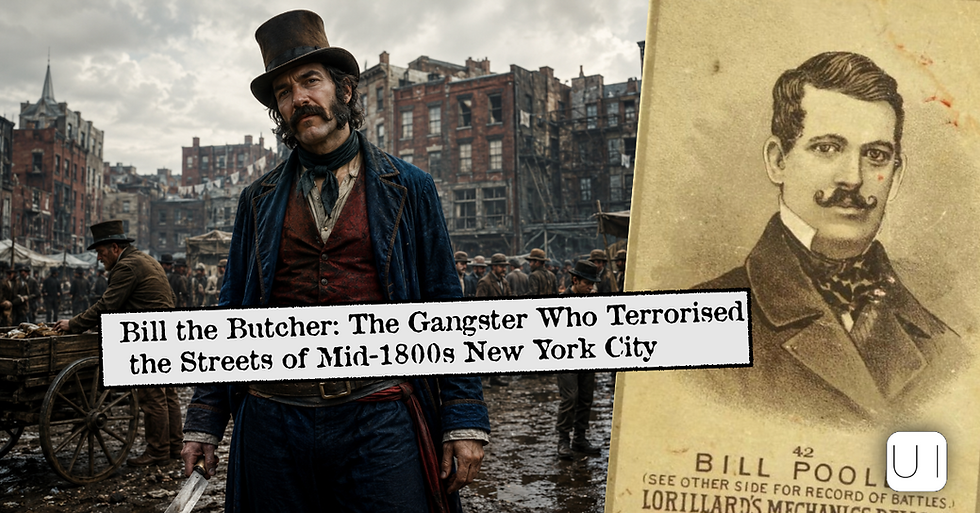
Herbert Asbury's 1928 book Gangs of New York: An Informal History of the Underworld was the main vehicle through which the Dead Rabbits entered popular consciousness. Historians have since criticised Asbury for embellishing freely and treating yellow journalism as reliable source material, but the book was vivid, entertaining, and sold well. Martin Scorsese's 2002 film, loosely based on it, brought the Dead Rabbits to a new generation, though the film compresses decades of history and takes significant liberties with the characters and events. The real Dead Rabbits were gone long before the 1862 setting of the film's climax. Bill the Butcher himself had been dead since 1855.
Sources:
1. Wikipedia: Dead Rabbits. https://en.wikipedia.org/wiki/Dead_Rabbits
2. Tyler Anbinder, Five Points. Free Press, 2001.
3. Herbert Asbury, The Gangs of New York. 1928.
4. Bowery Boys History podcast: Five Points and the Gang Era.
5. New York Daily, July 6, 1857: "Rioting And Bloodshed; The Fight At Cow Bay."