

The Cat’s Meat Man: London’s Forgotten Street Trader
Updated: Sep 18
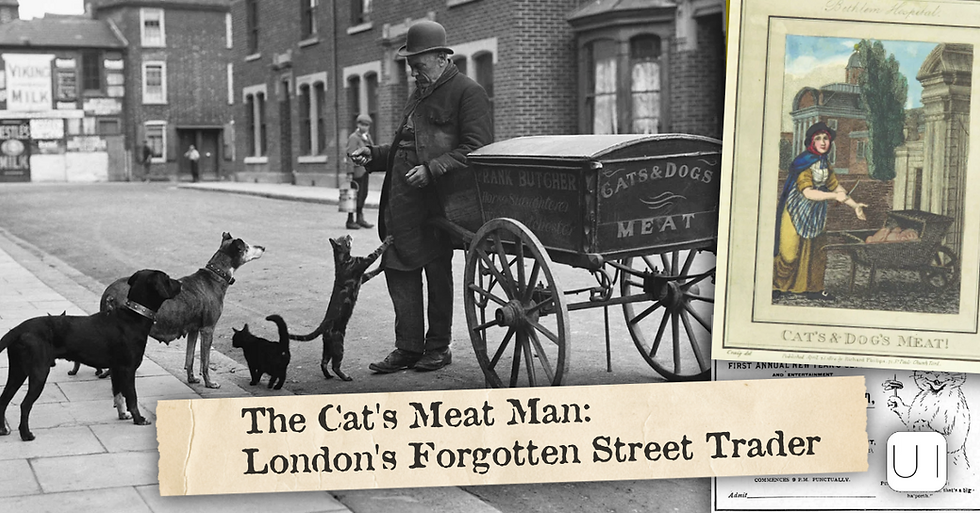
If you'd walked down a London street on almost any evening in the mid 1800s, you'd have heard him before you saw him: a rising cry of "cats' meat" cutting through the traffic noise, with every cat and dog on the block perking up at once. The cat's meat man was one of Victorian London's most familiar street traders, walking miles of set routes every day with a barrow or basket of skewered horseflesh and selling pet food a halfpenny's worth at a time to a city that was, by several accounts, absolutely full of cats. The trade disappeared within a few generations, and it left behind a far richer paper trail than you'd expect, running from a killer's own landlady to a cat illustrator who once threw the trade its own formal dinner.
Quick answers
• Who was the cat's meat man? A Victorian street trader who sold skewered horsemeat as pet food door to door, calling out a rising cry of "cats' meat" while walking a set daily route.
• How many cat's meat traders were there? Henry Mayhew counted around 1,000 of them working London in the mid 1800s, though the widely repeated claim that they fed 300,000 cats seems to trace to a separate, later source.
• What happened to the trade? It died out by the early 20th century as an industrial consolidation of the knackers' yards that supplied it met growing competition from commercial dog biscuits and later canned pet food.
• Is there a real true crime connection? Yes. Jack the Ripper's second victim, Annie Chapman, was found in the yard of a house where a cats'-meat seller named Harriet Hardiman ran her trade from the ground floor front room.

The cry every London street knew
Nobody agrees on exactly how the cat's meat man's cry sounded once someone tried to write it down, but some version of "cats' meat" turns up again and again in Victorian accounts of London's street cries. What's better documented is who was doing the calling. The social investigator Henry Mayhew counted somewhere around 1,000 cats'-meat traders working London's streets in his mid-1800s survey of the city's poor. The now-standard claim that those traders were feeding some 300,000 cats almost certainly doesn't come from Mayhew at all. It appears instead to trace to a separate 1868 article in the children's magazine Chatterbox, where a writer named W. Baird arrived at 300,000 simply by assuming there was roughly one cat to every inhabited house in London. Somewhere across more than a century and a half of retelling, Mayhew's trader count and Baird's cat population guess got welded into a single statistic and credited to one man and one book, when they're really two separate estimates from two different decades.
What a halfpenny actually bought
The meat itself came from London's knackers' yards, where old, sick or injured horses no longer fit for work were slaughtered rather than sold on. By the time the writer W.J. Gordon documented the trade in his 1893 book The Horse World of London, it had become a properly industrial operation. The dominant firm, Harrison Barber and Company, was killing around 26,000 horses a year, roughly 500 a week, and turning them into about 70 tons of meat weekly across seven depots, with a refrigerated store at Wandsworth big enough to hold 250 carcasses at once. A single pound of horseflesh was cut into around six ha'porths, or halfpenny portions, for retail, which is about as precise as the historical record gets on exactly what your halfpenny bought. Even the horses had a documented price arc of their own: a London omnibus horse cost around £35 when bought at five years old, worked roughly five more years hauling passengers through the city, and then sold on to the knackers for about 30 shillings once it was worn out.
The knacker who called himself Horse Slaughterer to the Queen
One knacker built an entire public profile out of the trade. John Atcheler ran what was reportedly London's largest horse-slaughtering operation, working out of Belle Isle in Islington, and hung a sign on his office reading "Horse Slaughterer To Her Majesty," earning himself a local reputation as "Knacker to the Queen" before his death in 1867. It's a fairly bold piece of Victorian self-promotion. No surviving royal document actually confirms he held any such warrant, and it appears to have been entirely his own sign that made the claim rather than any formal appointment.
The rules London wrote for the men who fed its cats
The knackers' yards supplying the whole trade weren't left to police themselves. Parliament's Towns Improvement Clauses Act of 1847 specifically brought slaughterhouses and knackers' yards under license, forcing existing operators to register within three months, requiring daily cleaning, letting inspectors seize meat they judged unfit and fining unlicensed yards up to £5 with further daily penalties for as long as they kept operating illegally. It's worth being clear about what this regulation wasn't. Despite the RSPCA having been founded back in 1824, there's no documented evidence the charity specifically targeted the cats'-meat trade or campaigned over the quality of the meat it sold. The pressure that did exist on the trade came from ordinary municipal public health law rather than any animal welfare campaign aimed at this specific corner of London's economy.

Thirty miles a day and a turf system nobody wrote down
Whatever regulations governed the supply chain, the men and women actually walking the streets had a hard working life. Cats'-meat sellers were reported to cover 30 to 40 miles a day along set routes, timing their rounds so the meat reached customers before it spoiled and working the mews and back streets behind grander residential squares, where household staff kept cats to manage the mice around stables and kitchens and made for reliable daily custom. Established traders didn't just wander wherever they liked, either. They worked defined daily routes, generally called "walks," that functioned almost like informally inherited property, built up over years of regular customers and effectively passed on, sold through classified adverts in the local paper with a cash premium attached, or defended against rivals trying to work the same streets. It gave a trade with almost no formal structure something that looked a lot like a guild system, without any guild ever actually existing on paper.
Not everyone came to the trade the same way, either. Some cats'-meat sellers were born into it and grew up learning a parent's route before taking it over themselves. Others arrived after failing at something else entirely, worn-out butchers or carriage painters whose health had been ruined by the fumes of their old trade, for whom walking the streets with a barrow was one of the few options left. The work came with its own specific hazards on top of the distance. A loaded barrow left unattended for even a minute could be ambushed by stray dogs, and a bad spill in the street meant watching a morning's stock get eaten on the spot by the very cats who were supposed to be paying customers.

The cat's meat seller who lived above a murder scene
The trade's most unexpected brush with history came on September 8, 1888, in the yard of 29 Hanbury Street in Spitalfields. That's where the body of Annie Chapman, Jack the Ripper's second canonical victim, was discovered early that morning. The building's ground floor front room was rented by Harriet Hardiman, a cats'-meat seller who ran her trade from the address, and she lived there with her sixteen-year-old son James, who ran the daily cart rounds himself. She was among the residents police interviewed during the investigation that followed. One genuine ambiguity is worth flagging here. Some period slang dictionaries record "cat's meat shop" as separate slang for a cheap eating house, and a few true crime researchers have questioned whether Hardiman's shop sold pet food or meals for people. The stronger, more recent research reads it as a literal cats'-meat trade, but the honest answer is that both readings have some support behind them.

The dinner party London threw for 250 cat's meat men
If Hardiman's story shows the trade's darker edges, the strangest and most delightful documented moment in cats'-meat history is a formal dinner. On January 10, 1901, the illustrator Louis Wain, already well known for his anthropomorphic cat drawings, organized a dinner in Holborn for 250 working cats'-meat men through the cat-fancier magazine Our Cats, with around 400 members of the public competing for whatever tickets were left over just to attend as spectators and hosts.
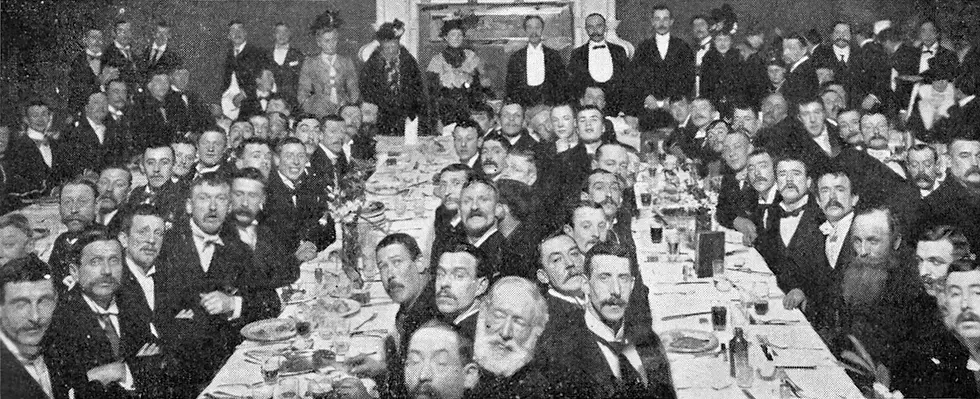
The Duchess of Bedford came in person, having once adopted a stray that a local cats'-meat man had rescued, and she didn't just watch from the side: she helped serve the vegetables and gave a short speech urging the men to report any cruelty to animals they came across on their rounds. The cat historian Frances A. Simpson and the pianist Natalia Janotha, who brought along both her own cat and her violin, were also there, and Princess Alexandra sent her own letter of regret at being unable to attend, less than a fortnight before she became queen. By one account of the evening, when the food came out the guests greeted it with the same street cry they used on their actual rounds, shouted back across the room instead of down a street.

Dickens, a poet and the trade in print
Charles Dickens wrote about the horse-slaughter trade behind the cats'-meat business himself, in an 1868 essay for his own magazine All the Year Round called "A Pair of Horse-Pictures." Dickens describes a midnight visit to a London abattoir, watching around three dozen worn-out horses slaughtered well outside legal hours, with the owner, a Mr. Potler, explaining the illegal timing by pointing at his customers rather than the law: "the London tabbies are so dainty that they don't like horse that's been killed too long over-night." The meat went out to around forty cats'-meat vendors by six the next morning, who spent roughly an hour threading it onto wooden skewers in portions from a ha'penny snack up to a three-penny feast before starting their rounds around eight. The Victorian antiquarian Charles Hindley's 1880 collection Cries of Old London preserved an actual period street-cry verse about the trade too, opening with the line "Hark! how the Pussies make a rout," a small, genuine fragment of exactly the kind of everyday urban noise that rarely survives into the historical record at all.

Feeding cats versus eating them
The cats'-meat trade only makes sense against a British squeamishness about eating cats that other countries didn't necessarily share, and one moment made that contrast vivid. During the Siege of Paris in the winter of 1870 to 1871, starving Parisians ate cats along with horses, dogs and rats, and reports of cat ragout on restaurant menus horrified British commentators, who treated it as one more piece of evidence of French depravity alongside all the horse and frog eating they already found distasteful. Two years later, a tabby entered at an 1873 Birmingham cat show reportedly came with its own tragic backstory, that its mother had been eaten during the siege. The judges were apparently unmoved: the cat didn't win a prize.

Why the cat's meat man disappeared
The cats'-meat man's disappearance wasn't a single event so much as two separate forces closing in from different directions. On the supply side, Gordon's 1893 numbers already show an industry consolidating hard around big firms like Harrison Barber, complete with refrigerated storage and multiple depots, steadily squeezing out the smaller, more informal character the trade had in Mayhew's day decades earlier. On the retail side, commercial pet food started eating into the market from around 1860 onward, when the American-born James Spratt patented a wheat and vegetable dog biscuit in London after reportedly watching stray dogs eat discarded ship's biscuits on the docks, building it into a real company, Spratt's Patent Limited, by 1885. It's worth being precise here: Spratt's early, well-documented product was a dog biscuit rather than a cat food, so crediting him with killing off the cats'-meat trade specifically needs a caveat, since his direct impact on cat owners came later and isn't as clearly dated in the surviving record. Between industrial consolidation upstream and branded competition downstream, the door to door cats'-meat man had largely vanished by the early 20th century.

A trade historians are rediscovering
The trade has had a real resurgence of scholarly attention lately. Historian Kathryn Hughes built her 2024 book Catland: Louis Wain and the Great Cat Mania partly around this world, and a 2025 essay she wrote drawing on that research proved popular enough online to generate its own extended discussion thread. The London Museum holds real period photographs of cats'-meat men in its permanent collection, including one taken around 1901 to 1902 that shows a trader in an East End street decorated for Edward VII's coronation, and museum staff have written about the subject on the museum's own blog. It's a trade that vanished from London's streets generations ago, but between true crime crossover, cat history and Victorian social investigation, it keeps finding new reasons to get written about.
Further reading on the site
London's cats'-meat men fit into a much bigger world of Victorian street life and its stranger corners. Our piece on Jack the Ripper and His Victims goes further into who the women he killed actually were, including Annie Chapman, whose story crosses paths with this one. For other Victorian street traders working the same city at almost the same time, there's Street Life in Victorian London, built around the 1870s photographs of John Thomson and Adolphe Smith. And for anyone curious how differently ordinary Victorians actually talked, The Slang Dictionary covers John Camden Hotten's 1865 collection of London street language.

Sources
2. The Horse World of London, Ch. 1: The Omnibus Horse — W.J. Gordon (1893), via victorianlondon.org
8. Catland: Louis Wain and the Great Cat Mania — Kathryn Hughes, Johns Hopkins University Press (2024)


