

Ted Kaczynski and the Harvard Experiments: Did a 1950s Study Create the Unabomber?

Sometime around 1960, a teenage maths prodigy sat down in a small room at Harvard, with electrodes stuck to his body and a bright light in his face. Behind a one-way mirror, a camera was rolling. Across the table sat a confident young law student who'd been given a detailed plan for one job: tearing apart everything the teenager believed in.
The teenager's code name in the study was Lawful. His real name was Theodore Kaczynski, and between 1978 and 1995 he'd kill three people and injure 23 more with homemade bombs as the Unabomber.
For decades, people have asked whether what happened in that room helped make him. The question's back in the headlines this week, with Netflix's new film Unabomber, starring Jacob Tremblay as the young Kaczynski and Russell Crowe as the Harvard psychologist Henry Murray. So here's what we actually know about the experiments America ran on its students in the 1950s and 60s, what was done to Kaczynski and whether it had anything to do with what he became.
Quick Answers
● Was Ted Kaczynski part of a psychology experiment? Yes. From 1959 to 1962 he was one of 22 Harvard undergraduates in a study run by psychologist Henry Murray that included deliberately abusive interrogations.
● Was the Harvard experiment part of MKUltra? There's no documentary evidence it was. Murray had wartime intelligence links, but no CIA funding for the study has ever been proven.
● Did the experiment cause Kaczynski's crimes? Nobody can say for sure. Some experts think it harmed him, but psychiatrists who examined him pointed to many other factors, and his violent turn came years later.
● What was Kaczynski's code name? Lawful.
● Is the Netflix Unabomber film accurate? It's a dramatisation. It leans hard on the Harvard experiment as the key to his story, which goes further than the evidence does.
America's Campus Experiments of the 1950s and 60s
To understand what happened to Kaczynski, it helps to know how normal experimenting on students was at the time. The Cold War had governments desperate to understand brainwashing, interrogation and mind control, and universities were full of willing, cheap and very trusting young test subjects.

The most notorious programme was the CIA's MKUltra, which began in the early 1950s. When the US government later had to explain it in court, its own Supreme Court brief admitted the agency had funded 149 subprojects involving at least 80 institutions and 185 private researchers, many of them at universities. Some of those projects gave drugs to people who had no idea what they were taking. Much of the paperwork was destroyed in 1973, and what survived only came to light in a 1977 Senate hearing.
Not every campus experiment was secret government work, though. At Harvard itself, the psychologists Timothy Leary and Richard Alpert were giving psilocybin to volunteers from 1960 onwards. After complaints in 1962, they promised not to use undergraduates. Alpert broke that promise, and on 27 May 1963 Harvard sacked him, according to the Harvard Crimson's report at the time, for giving the drug to an undergraduate. Leary had his salary suspended for going absent without leave.
A few miles away, on Good Friday 1962, a Harvard graduate student called Walter Pahnke gave psilocybin to ten divinity students during a service at Boston University's Marsh Chapel to see if it triggered religious experiences. It did. It also sent one student into such a state of panic that Pahnke had to sedate him, a detail he left out of his thesis. Researcher Rick Doblin tracked down the participants in the late 1980s and called the omission good politics but bad science.
The appetite for this kind of thing went right to the top of society. Even Hollywood stars were signing up, as we covered in our piece on Cary Grant's experiments with LSD. And it was an era when research ethics were loose to the point of being nonexistent, the same era that allowed the Tuskegee syphilis experiment to carry on for decades.

Ted Kaczynski: A Boy Genius at Harvard
Kaczynski was born in Chicago in 1942 and was obviously brilliant from the start. He skipped two grades at school, which put him among much older children and left him isolated and bullied. According to journalist Alston Chase, who investigated his Harvard years in depth for The Atlantic, he arrived at Harvard in September 1958 aged just 16.
Harvard put him in 8 Prescott Street, a house set aside for particularly bright young freshmen, where students got more individual attention. For a shy, socially awkward teenager from a working-class family, it wasn't a comfortable fit. In his second year, he was recruited into a psychology study.
Who Was Henry Murray?
Henry A. Murray was one of the most famous psychologists in America. He'd run the Harvard Psychological Clinic and co-created the Thematic Apperception Test, a personality test that's still used today. He also had a long-running interest in what he called dyadic interactions, the dynamics between two people.
He also had a war record that's fuelled conspiracy theories ever since. During the Second World War, Murray worked for the Office of Strategic Services, the forerunner of the CIA, where he helped design tests to see whether potential agents could withstand hostile, stressful interrogation. According to the Alliance for Human Research Protection, that wartime work gave him the template for what he'd later do at Harvard.

What Actually Happened in the Experiment
The study ran from autumn 1959 to spring 1962 and involved 22 undergraduates, each given a code name. Kaczynski was Lawful.
First, each student wrote an essay setting out their personal philosophy of life, their deepest beliefs and ambitions. Then they were taken into a room, wired up to electrodes to track their heart rate and breathing, and sat opposite a law student who'd been briefed to attack them. The session was watched through a one-way mirror and filmed. Afterwards, the students had to sit and watch the footage of themselves being humiliated.
Murray himself later described the attacks as "vehement, sweeping, and personally abusive". The volunteers didn't know in advance what was coming.
It's worth adding some balance here, because the popular version of this story can make it sound like three years of non-stop torture. It wasn't. Chase notes that one participant, Richard Adams, recalled that the vast majority of the study time was relaxed stuff: personality tests, interviews, written life stories and even friendly dinners. The confrontation was a small part of the whole. But it was the part people remembered, and AHRP notes that several participants were still haunted by it decades later.
Was It MKUltra?
This is where the story tends to run away from the evidence. Plenty of websites, and now a Netflix film, present Murray's study as a CIA mind control experiment. The truth is more complicated.
What's true is that MKUltra existed, that it funded research at universities, that Murray had worked for the CIA's predecessor and that his study looked a lot like an interrogation stress test. What hasn't been found is any document showing the CIA paid for or directed the Harvard study. Chase, who's the journalist most responsible for bringing the experiment to public attention, found no evidence that Murray gave his subjects LSD or any other drug.
Kaczynski researcher Alex Uziel has gone further, arguing in a detailed rebuttal of the MKUltra theory that the transcripts of Kaczynski's own sessions show a calm, composed young man who more than held his own in the argument. Some reporting on the new Netflix film, like this Tech Times piece, claims historians see the MKUltra link as highly probable. That's overstating it. It's a possibility, not a proven fact.
There's also the question of the records. In 2000, after Kaczynski's code name had become public, Harvard's Murray Research Center permanently sealed his file. Its director told the Harvard Crimson, "We cannot protect its confidentiality anymore." That's a legitimate privacy decision, but it's also exactly the sort of thing that keeps conspiracy theories alive.
What Kaczynski Himself Said About It
Kaczynski's own views on the experiment shifted over the years, which doesn't help anyone trying to settle the argument.
In an autobiography he wrote in 1979, a year after his first bomb, he was bitter about it. He said he'd been deceived and subjected to severe psychological harassment, and called it "one of the two episodes in my life that I am really ashamed of". He described Murray in very unflattering terms for having manipulated him.
Later, from prison, he played it down and dismissed the whole thing as trivial. By then he was also fiercely resisting any attempt to explain his crimes through psychology, so he had his own reasons for downplaying it.
What's striking is how much he came to hate psychologists in general. The court-ordered psychiatric report by Dr Sally Johnson, written in 1998, records recurring nightmares he had in graduate school in which psychologists tried to convince him he was sick or control his mind, and in which he'd attack them and feel a rush of relief. Whether Murray's experiment planted that fear or simply fed something that was already there is impossible to know.
The Real Turning Point Came in 1966
If you're looking for the moment Kaczynski decided to kill, most of the evidence points not to Harvard but to Michigan, four years after the study ended.
According to the Johnson report, in 1966, while he was a graduate student in Ann Arbor, Kaczynski went through several weeks of intense fantasies about being a woman and made an appointment with a psychiatrist to discuss a sex change. In the waiting room, he lost his nerve and talked about something else. He left feeling disgusted and humiliated, and furious with the psychiatrist. It was then, he wrote, that he first seriously thought about murder: "I really felt I could kill someone."
It's hard to ignore the pattern. The one time he approached a mental health professional for help, the result was humiliation and rage, just as it had been in Murray's lab. But Johnson's report doesn't blame one event. She pointed to his social isolation after skipping grades, what he saw as psychological abuse by his parents, his failure with women and his obsessive adoption of anti-technology ideas from books like Jacques Ellul's The Technological Society. She also offered a provisional diagnosis of paranoid schizophrenia, which Kaczynski furiously rejected.
From Berkeley to the Cabin to the Bombs
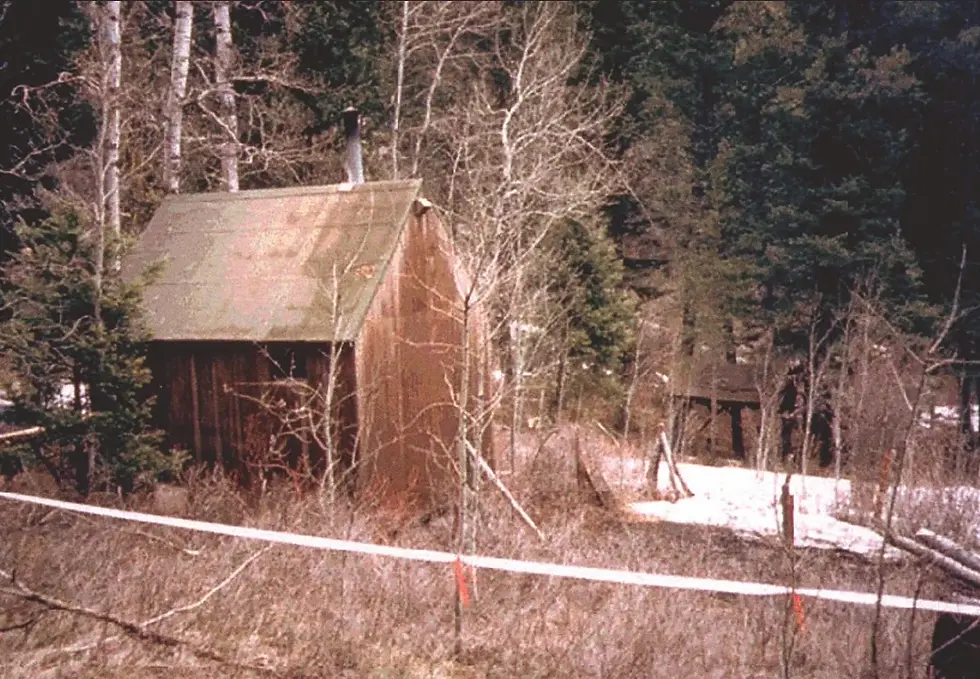
Kaczynski went on to become one of the brightest young mathematicians in America and an assistant professor at Berkeley at 25, then quit suddenly in 1969. By 1971 he was living in a tiny cabin without electricity or running water near Lincoln, Montana.
His first bomb went off in 1978 at the University of Illinois at Chicago. According to the FBI's history of the case, he carried out 16 bombings over 17 years, aimed mostly at universities, airlines and people he associated with technology. Three people died. In 1995 the Washington Post published his 35,000-word manifesto, Industrial Society and Its Future, and his brother David recognised the writing. We've told the full story of how Ted Kaczynski was caught in a separate article.
He was arrested at his cabin on 3 April 1996 and pleaded guilty in January 1998 to avoid the death penalty, and to avoid a mental illness defence he considered humiliating. He got eight life sentences with no possibility of parole.
So Did the Harvard Experiment Create the Unabomber?
Here's the honest answer: it probably played some part, but it didn't create him.
The case for it mattering is real. Kaczynski was still a teenager, younger and more isolated than most of his classmates, and he was put through a deliberately humiliating interrogation, on camera, without really knowing what he'd signed up for. Dr Ann Wolbert Burgess, one of the pioneers of the FBI's behavioural science work, has argued it very likely harmed him. Speaking to Fox News, she said he was very vulnerable because of his age, adding: "I think it did affect him." His later hatred of psychologists and fear of mind control certainly fit.
The case against it being the cause is just as strong. The other 21 students went through the same study and none of them became killers. Kaczynski's problems at school and at home started long before Harvard. The moment he first wrote about wanting to kill came years later and was tied to a completely different humiliation. And his manifesto is about technology and industrial society, not psychologists or Harvard.
The most reasonable reading is that Murray's experiment was one more weight on a young man who was already struggling, at exactly the wrong time. It was unethical by today's standards, and probably by the standards of plenty of people in 1959 too. But it's a piece of the story, not the explanation for it. Research like this is a reminder of how casually scientists of that era treated the people in their studies, something that also comes through in the story of David Reimer and the gender identity experiment.
Kaczynski's Death and the Netflix Film
Kaczynski was moved from the supermax prison in Florence, Colorado, to the federal medical centre in Butner, North Carolina, in December 2021. He died there on 10 June 2023, aged 81. CNN reported that officials believed he'd taken his own life.
Netflix's Unabomber, released on 25 September 2026 and directed by Janus Metz, puts the Harvard experiment front and centre, with Crowe's Murray presented as a cold, manipulative figure. The reviews have been mixed at best. RogerEbert.com's reviewer called it "a hackneyed blend of true-crime drama and banal biopic tropes" and questioned its idea that Murray's work turned an awkward kid into a violent recluse.
That's the danger with this story. The Harvard experiment is a real scandal worth knowing about. But turning it into a neat origin story lets everyone off the hook a little too easily, including the man who actually built the bombs.


